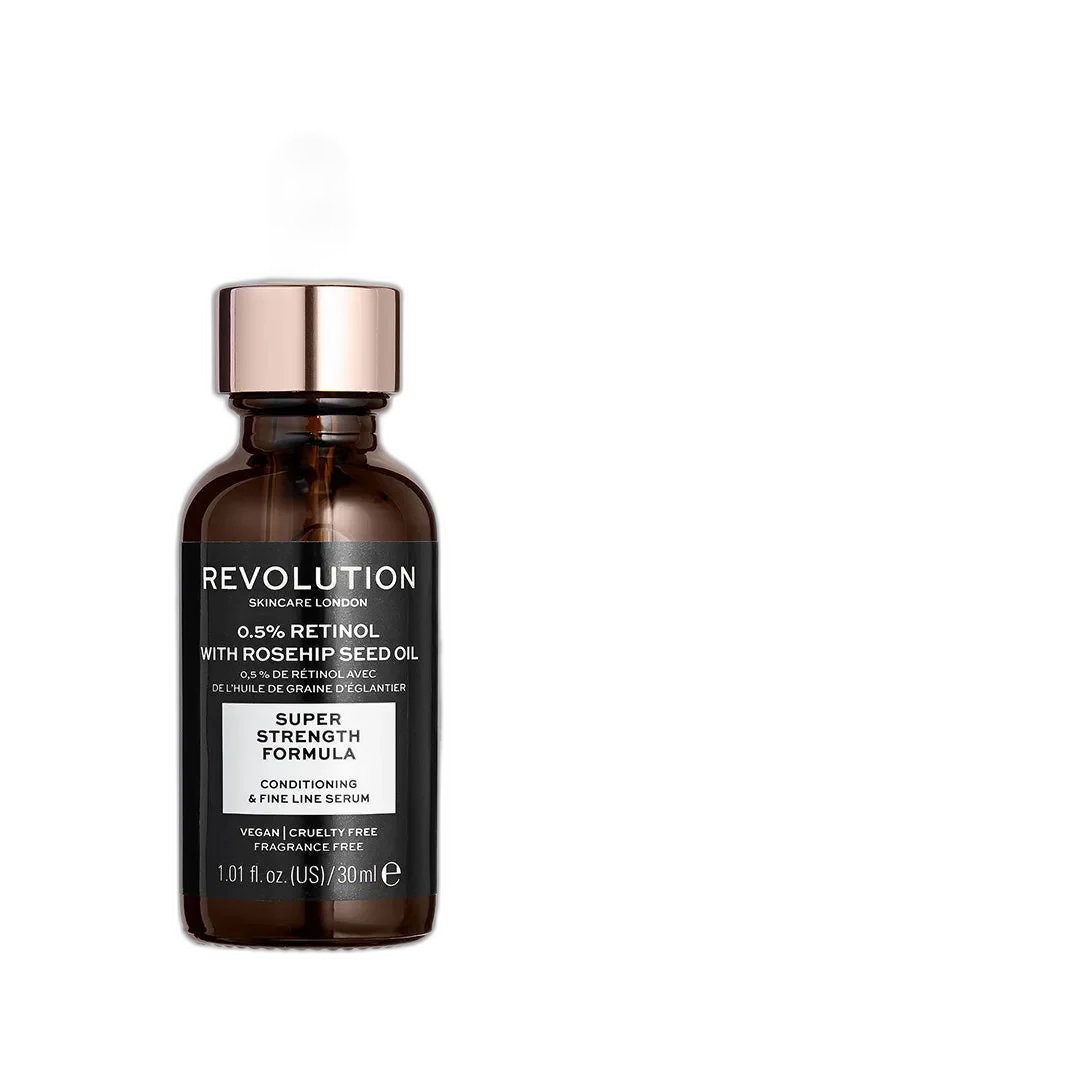
0.5% Retinol Super Serum
Budget Retinol Starter
 Verified reviewer
Pros & cons.
- +Legitimate 0.5% retinol at an exceptionally low price
- +Oil-based anhydrous formulation provides some retinol stability
- +Rosehip and grapeseed oils add emollient and supportive value
- +Fragrance-free, vegan, and cruelty-free
- +Comfortable, non-stinging application for dry skin
- +Good entry point for budget-conscious beginners with dry skin
- +Widely available through drugstore channels
- −Coconut and almond oils are comedogenic for acne-prone skin
- −Not safe for fungal-acne prone users
- −Oil-heavy finish is too much for oily skin types
- −Dropper packaging exposes retinol to air over time
- −Sweet almond allergen for nut-sensitive users
The full review.
Revolution Skincare built its business on one observation: many skincare actives are cheap raw materials that brands mark up 5-10x for Sephora shelves. The parent company, Revolution Beauty, is a UK mass-market cosmetics group. They started with makeup palettes and entered skincare in the late 2010s using a simple thesis: ingredient-forward formulations at Boots and Superdrug prices. Their 0.5% Retinol Super Serum was an early release and stays in the lineup because it sells well. At around $12 for 30ml, it costs roughly a third of a comparable premium retinol serum, despite having the same active concentration on paper.
The formulation choice is interesting. Instead of common water-based or squalane-based retinol carriers, Revolution uses a pure oil blend: caprylic/capric triglyceride leads, followed by coconut oil, grapeseed oil, rosehip seed oil, sweet almond oil, and a neutral vegetable oil. The retinol sits in this oil matrix with BHT and BHA antioxidant stabilizers. This is a deliberate formulation for a budget product—the anhydrous oil-only base protects the retinol from the water-driven oxidation that affects many cheap retinol serums. The oil mix balances emollient comfort with enough lightness to avoid feeling heavy. Rosehip seed oil acts as a supporting actor, adding natural pro-vitamin A carotenoids and fatty acids alongside the retinol.
The skin experience reveals the formulation’s personality. The serum is an amber-gold oil that feels warm on application, absorbs in 2-3 minutes to a glowy finish, and does not sting or tingle like some retinol formulations. For dry skin, this is a lovely product—the oil blend provides overnight moisture, the retinol works its 0.5% concentration over several weeks, and the experience feels more like pampering than treatment. First-time retinol users with dry skin often tolerate this better than a water-based 0.5% because the oil buffer softens the adjustment period. Texture smoothing appears around week three, fine lines respond at two months, and by four to six months, the cumulative effect shows in photos.
The oil blend is the formulation’s biggest problem and defining choice. Coconut oil is comedogenic for acne-prone skin and feeds malassezia (the fungus behind fungal acne). Sweet almond oil is mildly comedogenic for sensitive users. If your skin is oily, acne-prone, or fungal-acne-prone, this serum likely causes breakouts caused by the carrier base rather than the retinol. This is a serious limitation; many people buying affordable retinol serums are younger and manage active acne alongside early aging, and this is not the product for them. That demographic needs a water-based or squalane-based retinol, making The Ordinary’s retinol line the obvious budget alternative.
Other drawbacks exist. The packaging is a small glass dropper bottle; this helps retinol stability but exposes the contents to air during use. While the oil-only base helps, finish the bottle within 4-6 months of opening to ensure full retinol potency. The ‘Super Serum’ branding stretches the truth for a standard 0.5% retinol in an oil base; the formula is solid, but the technology is not “super.” The fragrance-free claim is accurate, but the natural oils have a faint earthy scent some users dislike.
The value math is strong. At $12 for a nightly 0.5% retinol, you pay roughly $4-6 per month depending on dosage. Compared to $50-100 premium retinols, the savings are substantial. For dry skin users who do not need an anhydrous silicone base or a green-tea polyphenol complex, this delivers the core retinol benefit at a fraction of the cost. For the right user—dry, non-reactive, non-acne-prone, and budget-conscious—this is one of the better cheap retinols. For the wrong user, it is an expensive mistake regardless of the price.
Formula
### PM routineIngredient analysis.
Full INCI list
Caprylic/Capric Triglyceride, Cocos Nucifera (Coconut) Oil, Vitis Vinifera (Grape) Seed Oil, Rosa Canina Fruit Oil, Prunus Amygdalus Dulcis (Sweet Almond) Oil, Olus (Vegetable) Oil, Retinol, Polysorbate 20, BHT, BHA.
Skin match.
The science.
The Science
The core active is 0.5% retinol. Clinical literature shows this concentration improves fine wrinkle appearance, tone, and texture over 12-24 weeks of consistent use. In the skin, a two-step enzymatic process converts retinol to retinoic acid. This binds nuclear retinoic acid receptors and drives cellular changes that reverse photoaging. At 0.5%, the evidence for mild-to-moderate anti-aging benefit is solid across many brands and formulations. The delivery system makes this formulation unique. Oil-based anhydrous formats protect retinol from water-driven oxidation, a primary degradation pathway for retinol in cosmetic products. BHT and BHA act as antioxidant stabilizers to extend shelf life; these industrial-grade antioxidants protect oxidation-sensitive actives in oil bases. The supporting oils serve different roles. Grapeseed oil has linoleic acid and acts as a lightweight carrier. Rosehip seed oil contains natural pro-vitamin A carotenoids and small amounts of trans-retinoic acid, but its retinoid-like activity is weaker than marketed and is not a meaningful add-on. Coconut oil provides heavy occlusive-emollient support but carries a known comedogenic risk for acne-prone skin. This formulation prioritizes cost and dry-skin compatibility over broad use, and each component has adequate evidence. This serum lacks the targeted anti-inflammatory or antioxidant support (green tea polyphenols, niacinamide, etc.) that premium retinol formulations use to reduce retinoid dermatitis; it is a straightforward retinol in oil, not a multi-active formulation.
Dermatologist Perspective
Dermatologists view 0.5% retinol as a reasonable intermediate concentration for patients moving from beginner-level products (0.1-0.25%) to more active routines. Board-certified dermatologists note that the carrier base determines who tolerates a retinol serum. They generally recommend oil-based formulations like this one for dry, non-acne-prone patients, while they direct water- or gel-based alternatives toward oily or acne-prone individuals. Clinical practice views the affordability of budget retinol serums positively. Retinol efficacy depends on consistent long-term use, so a cheaper product used nightly for years often produces better outcomes than a premium product used sporadically. Dermatologists typically recommend starting at 2-3 nights per week and building to nightly use, always paired with daily broad-spectrum sunscreen.
Where it fits in your routine.
Massage 3-4 drops into clean, dry skin on the face and neck at night. Wait 15 minutes for absorption before applying a moisturizer. Use 2-3 nights per week for the first two weeks to check tolerance, then increase to 4-5 nights or nightly use. Do not use glycolic acid, vitamin C, salicylic acid, benzoyl peroxide, or other retinoids on the same night. Use broad-spectrum SPF 30 or higher every morning. Finish the bottle within 4-6 months of opening to maintain retinol potency.
At about $12 for 30ml, this ranks in the top tier of budget retinol serums by price-to-concentration. One bottle lasts 2-3 months with nightly use, costing roughly $4-6 per month — less than The Ordinary's 0.5% retinol. For dry, non-acne-prone skin seeking a simple, affordable retinol routine without premium brand marketing markups, the value math works. For acne-prone or oily skin, the savings disappear because the formulation is a structural mismatch; the breakouts from the oil base cost more in aggravation than a more expensive, better-matched alternative.
Dry-skin users on a budget want a true 0.5% retinol without premium prices. It fits normal skin seeking an oil-based starter retinol that works as a facial oil. Experienced retinol users comfortable with oil carriers can also use it to keep their routine inexpensive.
Oily, acne-prone, or fungal-acne-prone skin should avoid this formulation; the coconut and almond oil content is a structural problem. Sensitive or rosacea-prone skin needs a gentler formulation. Anyone pregnant, breastfeeding, or on prescription tretinoin should skip retinol during that period.
Product details.
fall winter Certifications Cruelty-FreeVeganFragrance-Free Background
The backstory.
Revolution Skincare launched in 2018-2019 as the skincare extension of Revolution Beauty's mass-market makeup business, with a pricing strategy explicitly designed to undercut The Ordinary. This 0.5% retinol was one of the brand's first active-focused serums and has been a steady seller in UK drugstores ever since.
About Revolution Skincare
Established Brand (5–20 years)Revolution Skincare is the skincare division of Revolution Beauty, a UK-based mass-market beauty group founded in 2014. The brand makes affordable, simple active-focused formulations and sells through Boots, Superdrug, and Ulta since the late 2010s.
Common myths.
Because it's cheap, the retinol must be ineffective.
Raw retinol costs little, so a 0.5% formulation works without expensive supporting ingredients. A cheap retinol serum matches a premium one at delivering the active; differences usually lie in stability, irritation profile, and supporting actives, not the core retinol itself.
Rosehip oil works like retinol because it contains vitamin A.
Rosehip seed oil has small amounts of carotenoids (pro-vitamin A) but lacks free retinoic acid. It shows very mild retinoid-like activity and does not substitute for actual retinol. In this formula, Rosehip seed oil is a supporting ingredient, not the active.
FAQ.
Will this break me out?
If you have acne-prone or fungal-acne-prone skin, this may cause issues. The formulation uses high amounts of coconut oil and sweet almond oil. Both are comedogenic for susceptible skin and can feed malassezia. Dry or normal skin without acne history works fine.
Is this good for beginners?
This is a reasonable budget entry point for dry skin beginners, but 0.5% is a high starter concentration. If you have never used retinol, start with a 0.2-0.25% formula and build to 0.5% after one or two months of tolerance.
Can I use this with vitamin C?
Yes, but not simultaneously. Use vitamin C in the morning and this retinol at night. Layering them in one application increases irritation risk and degrades both actives.
How long does the retinol stay active in the bottle?
The oil-only anhydrous base helps stability, and BHT/BHA antioxidants extend shelf life, but dropper packaging exposes the serum to air during use. Finish the bottle within 4-6 months of first opening to keep potency.
Is it safe during pregnancy?
No. Retinol is contraindicated during pregnancy and breastfeeding. Use bakuchiol or a gentle peptide serum instead.
Community
What the community says.
"Extremely affordable entry-level retinol"
"Oil base is moisturizing and gentle"
"No fragrance"
"Visible smoothing within a few weeks"
"Coconut oil clogs acne-prone skin"
"Greasy finish not everyone likes"
"Retinol percentage feels modest for the 'Super' naming"
"Retinol stability questionable over time"
People also looked at.