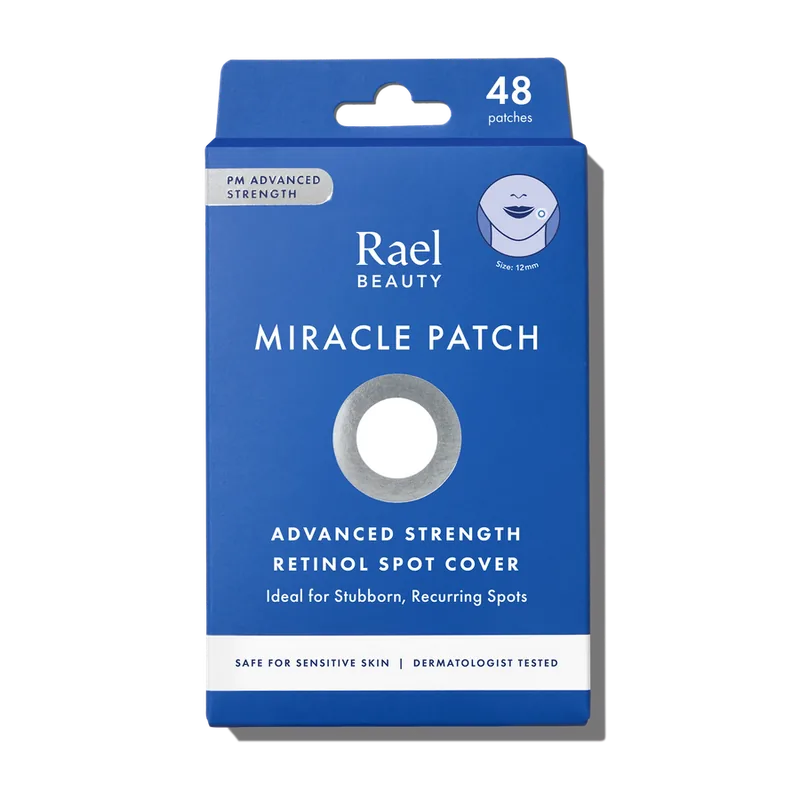
Miracle Patch Advanced Strength Retinol Spot Cover
Retinyl Palmitate Hydrocolloid
 Verified reviewer
Pros & cons.
- +Combines hydrocolloid's behavioral benefit (no picking, sealed environment) with active delivery — retinol patch is a category innovation
- +Retinyl palmitate is a gentler retinoid ester than retinol or retinal — appropriate for targeted spot use without all-over irritation
- +Niacinamide and Ceramide NP in the same patch deliver complementary anti-inflammatory and barrier-support functions
- +Tapered edges and thicker center hold up to 8 hours under sleep without lifting
- +Clinical claim of 40% redness reduction in 6 hours (31-participant study by Rael) — modest but specific and verifiable
- +Works on whiteheads that have surfaced AND has cumulative anti-PIH benefit for marks left after they heal
- −Retinyl palmitate is the weakest retinoid form (least bioconversion to retinoic acid) — concentration not disclosed but likely modest
- −$14.99 / 48 patches = 31¢ each, slight premium over the plain Miracle Patch Invisible (29¢) for the active inclusion
- −6-hour minimum wear time means designed for overnight use, not daytime quick fixes
- −Patch is slightly thicker and less invisible than the Invisible variant — daytime use isn't the design intent
- −Like all hydrocolloid patches, ineffective on unbroken cystic lesions where there's nothing to absorb
The full review.
The Rael Miracle Patch Advanced Strength Retinol Spot Cover is one of the U.S. hydrocolloid market’s category-pushing SKUs — a patch that delivers a retinoid (retinyl palmitate) alongside niacinamide and Ceramide NP through the hydrocolloid matrix itself, over a 6–8 hour wear window. There aren’t many direct competitors. Most retinol products are leave-on serums and most pimple patches are passive hydrocolloid; bringing the two together in a single SKU is a thoughtful but rare design.
The retinoid choice — retinyl palmitate — is conservative on purpose. Retinoids work by binding retinoic acid receptors in keratinocytes, but only retinoic acid (tretinoin) does that directly. Every other retinoid form needs enzymatic conversion in skin to reach the active endpoint. Retinyl palmitate is the gentlest of the OTC options and the form furthest from active retinoic acid — roughly 1/100th the potency of tretinoin. That’s a feature, not a bug, for a patch sitting on broken acne skin for hours. A more aggressive retinoid (retinol, retinaldehyde) at the same concentration would cause peeling and prolonged redness; retinyl palmitate at patch concentration delivers gentle slow conversion without inflammation.
The other two actives in the patch handle adjacent jobs. Niacinamide — the same vitamin B3 derivative that’s in Rael’s Miracle Clear Serum at 2% — reduces inflammation around the active lesion and starts the work of fading the post-inflammatory hyperpigmentation that will otherwise persist for weeks after the spot heals. Ceramide NP restores barrier function at the lesion site, specifically offsetting the barrier-weakening effect that retinoids cause. The synergy is genuinely useful: each component compensates for the other’s side effects, producing less net irritation than any of them alone at higher concentrations.
The patch’s physical design is engineered for overnight wear. The center is thicker than the edges, creating a domed contour that sits over the lesion without lateral pressure. The edges are tapered for adhesion through movement and side-sleeping. The 48-patch sleeve is similar to the plain Miracle Patch lineup, with the same matte finish (though slightly less invisible — the active layer adds visible thickness).
Rael’s own 31-participant clinical study reports a 40% reduction in redness at 6 hours of wear. The sample size is modest but the trial is reasonable and the direction is consistent with the published literature on hydrocolloid wound healing and retinoid anti-inflammatory effects. The more interesting outcome — reduced post-inflammatory hyperpigmentation after the spot resolves — is harder to capture in a 6-hour study but is the more important long-term benefit. Users with deeper skin tones particularly tend to report fewer lasting marks from spots they patched with this SKU than from spots they patched with plain hydrocolloid.
At $14.99 for 48 patches (31¢ each), the premium over the plain Miracle Patch Invisible Spot Cover (29¢) is minor for the active inclusion. There’s no real direct competitor — Hero Cosmetics’ Mighty Patch line includes “Surface” and “Original” but no retinoid variant; Peace Out has a retinol serum and a separate dot product but not combined. For its specific niche, the Rael Retinol Spot Cover is functionally without rival.
Not ideal for
Pregnant and breastfeeding individuals — all topical retinoids are categorically avoided regardless of how local the application. Active rosacea — retinoids worsen vasodilation and flushing. Users who already run an all-over leave-on retinoid serum (tretinoin, adapalene, retinol) shouldn’t double-up on the same spot the night they wear the patch; the combined exposure pushes most skin into peeling territory.
Ingredient analysis.
Full INCI list
Hydrocolloid (Polyisobutene, Polyisoprene, Cellulose Gum), Retinyl Palmitate, Niacinamide, Ceramide NP, Tocopherol.
Skin match.
The science.
Retinyl palmitate in a hydrocolloid patch
Retinoids work by binding to retinoic acid receptors (RARs) in keratinocytes, which normalize keratinization, reduce sebum production, and accelerate cellular turnover. Only one form — retinoic acid (tretinoin) — binds the receptors directly. Every other retinoid (retinol, retinaldehyde, retinyl palmitate, retinyl esters) must be enzymatically converted in skin before it can bind. Each conversion step loses roughly 50% of the molecule.
This conversion chain is why retinyl palmitate is roughly 1/100th the potency of tretinoin. It's the gentlest retinoid form sold over-the-counter and the form Rael chose specifically because the patch sits directly on broken acne skin for 6–8 hours. A leave-on serum with 0.5% retinol on the same broken skin would cause peeling and inflammation; retinyl palmitate at patch concentration doesn't.
The synergy with niacinamide and Ceramide NP in the same patch matters. Retinoids upregulate epidermal turnover, which thins the stratum corneum transiently and weakens the barrier. Ceramides delivered to the same site offset that barrier weakening. Niacinamide reduces the inflammatory response that retinoids can trigger. The three together produce less net irritation than any single component on its own would at higher concentrations.
Rael's own clinical study (31 participants) reported a 40% reduction in redness at 6 hours. Sample size is small but the direction is consistent with the well-established literature on hydrocolloid healing and the more limited literature on topical retinyl palmitate. The cumulative benefit — less post-inflammatory hyperpigmentation as the spot heals — is harder to measure from a single-application study but is the more important real-world outcome.
References
- Retinoids in dermatology — Journal of the American Academy of Dermatology (2018)
- Niacinamide topical applications — International Journal of Dermatology (1995)
- Hydrocolloid wound healing — International Wound Journal (2012)
Where it fits in your routine.
Cleanse and fully dry the area. Apply the patch directly over the surfaced or healing acne spot for 6–8 hours (best worn overnight). The thicker center sits over the lesion; the tapered edge holds the seal. Peel slowly in the morning, follow with your AM routine, and apply broad-spectrum SPF — retinoids increase photosensitivity for the following 24 hours.
$14.99 for 48 patches = ~31¢ each, a 2¢ premium over the plain Invisible Spot Cover (29¢) for the retinyl palmitate + niacinamide + ceramide additions. Fair value for the category — there's no real direct competitor combining hydrocolloid with a retinoid at this format and price.
Anyone who picks at spots and wants to also fade the resulting marks; users running a multi-product acne routine who want a targeted retinoid step that doesn't interfere with the all-over routine; sensitive skin that can't tolerate leave-on retinoid serums.
Pregnant individuals (all retinoids categorically); anyone with active rosacea; users with cystic or fungal acne where patches don't work generally.
Product details.
Hydrocolloid film with infused active layer
Fragrance free
Resealable foil sleeve, 48 patches with tapered edges and thicker center
All Year (but use vigilant SPF the morning after)
The backstory.
Rael's category-pushing patch — one of the first major U.S. hydrocolloid SKUs to infuse a retinoid into the adhesive matrix itself. Launched in 2023 as part of the Miracle Patch expansion that took the line from a single SKU (Invisible Spot Cover) to a five-variant family (Invisible, Microcrystal, Microcrystal Dark Spot, Overnight, XL, Advanced Strength Retinol).
About Rael
K-beauty / acne-careRael was founded in 2017 by three Korean-American women — Yanghee Paik, Aness An, Binna Won — initially around organic-cotton period care, expanding into skincare with the Miracle Patch in 2019. The patch family has expanded aggressively since 2022 with progressively more active inclusion (microneedles, retinoids, vitamin C). South Korea manufacturing.
Common myths.
A retinol patch is as effective as prescription tretinoin.
Not even close. Tretinoin is retinoic acid — the bioactive endpoint of the retinoid conversion chain. Retinyl palmitate is two enzymatic steps and ~99% potency loss removed from tretinoin. The patch is a useful niche product for targeted spot use, not a replacement for systemic retinoid therapy.
Retinoid patches build cumulative tolerance like all-over retinoids.
A patch is local, brief, and intermittent — the systemic exposure is too low to drive the normalization of keratinization that all-over retinoid use achieves. Use this for what it is: a soothing-and-fading spot treatment, not the cornerstone of anti-aging.
FAQ.
Is retinyl palmitate "real" retinol?
It's a retinoid, but the weakest practical form. The skin converts retinyl palmitate to retinol then to retinaldehyde then to retinoic acid (the bioactive form). Each step loses about half the potency, so retinyl palmitate is roughly 1/100th the strength of prescription tretinoin. For targeted overnight spot use it's appropriate. For all-over anti-aging you'd want retinol or retinaldehyde at a meaningful concentration.
Can I use this if I'm already using a retinoid serum?
Yes, but skip the retinoid serum on the area where you're using the patch the night you wear it. Doubling the retinoid exposure on broken skin can cause peeling and prolonged redness. Use this on a spot, regular retinoid on the rest of the face.
How is it different from the Miracle Patch Microcrystal cover?
Microcrystal uses dissolving microneedles to deliver salicylic acid + niacinamide + tea tree through unbroken skin — good for under-the-skin pimples that haven't surfaced. This Retinol cover is plain hydrocolloid with retinyl palmitate infused into the patch — works on surfaced whiteheads with the addition of slow retinoid contact. Use Microcrystal for closed comedones and this Retinol patch for surfaced spots that you want to also leave fewer marks.
Why does the patch turn white?
Same reason as the plain hydrocolloid patches — the cellulose gum is absorbing exudate from the lesion. The retinoid and ceramide are delivered separately within the matrix and don't affect the visible whitening.
Is it safe in pregnancy?
No — all topical retinoids, including retinyl palmitate, are categorically avoided in pregnancy by most OBs and dermatologists. There's debate about how much retinyl palmitate actually crosses into systemic circulation from a leave-on patch on broken acne skin, but the precautionary standard is to skip any retinoid during pregnancy.
Can I wear it under makeup?
Technically yes, but the patch is slightly thicker and less matte than the Invisible variant. It will be visible under foundation. This SKU is designed for overnight wear; for daytime makeup-friendly patches use the Invisible Spot Cover instead.
What the community says.
"Noticeably less pigment left behind after the pimple heals"
"The 40% redness claim is real in my experience"
"Stays on through a full night without lifting"
"Niacinamide + ceramide additions mean I don't get the retinoid-irritation peel"
"One of the few patches that does more than just hydrocolloid"
"Thicker than the Invisible variant; not great for daytime"
"Retinyl palmitate is the weakest retinoid form; want a stronger version"
"Pricier than the plain Miracle Patch"
"Adhesion can fail on oily skin in summer"
Featured in.
People also looked at.