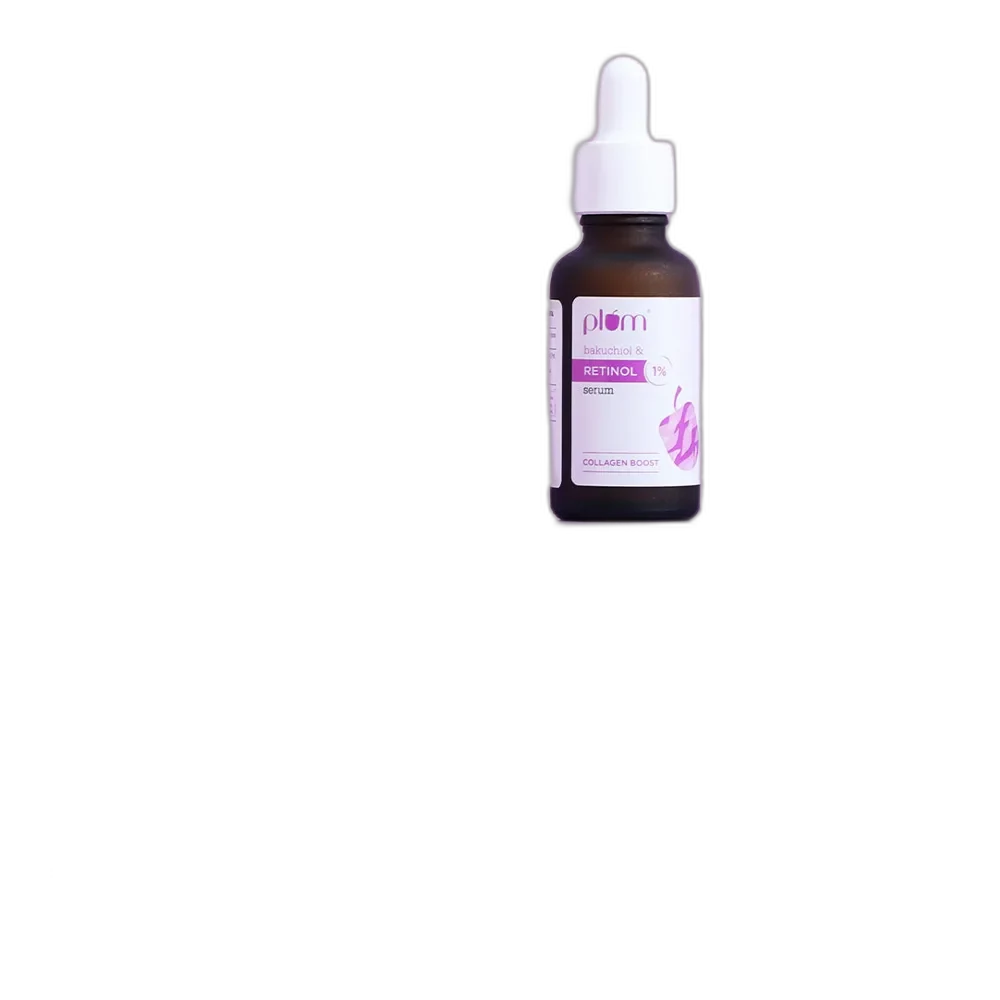
1% Retinol Anti-Aging Face Serum
Budget High-Strength Retinol
 Verified reviewer
Pros & cons.
- +Full 1% retinol dose at an unusually accessible price point
- +Bakuchiol and niacinamide included as genuine buffering support
- +Dimethyl isosorbide supports stable retinol distribution in the carrier
- +Clean, simple formula with no fragrance or essential oils
- +Vegan and cruelty-free certification appropriate to the brand positioning
- +Squalane base gives a comfortable, non-greasy application feel
- −1% dose is too strong for retinol beginners and sensitive skin
- −20ml size is small relative to most Western retinol serums
- −Dropper packaging exposes retinol to air and accelerates oxidation
- −Limited independent clinical data specific to this formulation
- −Contains BHT, which some ingredient-conscious users prefer to avoid
The full review.
A specific gap exists in the retinol market. Beginner serums at 0.1-0.3% are common and priced for new anti-aging routines. Prestige 1% retinol products from brands like SkinCeuticals or Drunk Elephant cost between $80 and $120. Few products offer 1% retinol at drugstore-adjacent prices because higher concentrations usually carry R&D and marketing premiums. Plum’s answer is this serum, which puts 1% retinol in a 20ml amber dropper bottle for roughly $22, assuming the user knows what they are doing.
That caveat is the most important part of this formula. 1% retinol is not a casual product. It sits at the top end of what is reasonable for at-home use without prescription oversight. For users who haven’t spent months or years building retinoid tolerance, it will almost certainly cause a rough adjustment period. Plum’s packaging does not hide this, but the low price often puts it in beginner carts. The results are predictable: flaking, redness, and the product returning to the drawer.
For the intended audience—experienced retinol users moving up from 0.5% without paying prestige prices—the formula is reasonable. The base uses a simple squalane-and-triglyceride carrier with dimethyl isosorbide as a penetration enhancer. This last ingredient matters; DMI is a well-established solubilizer for retinol that helps it distribute evenly through the vehicle and supports consistent delivery onto the stratum corneum. This detail suggests the formulator prioritized stability, not just raw percentage.
Bakuchiol is the second important detail. It appears in a small but real dose alongside the retinol. While bakuchiol marketing sometimes overclaims, evidence shows it can reduce some markers of retinol irritation while providing modest retinol-like signaling. At a 1% retinol concentration, you want every tolerability hedge possible, and bakuchiol is a sensible choice. Niacinamide is the third buffering piece, supporting barrier function during acclimation, while panthenol handles some redness-soothing.
The formula’s omissions also matter. There is no encapsulation, no time-release system, and no fancy delivery technology. This is straightforward retinol in an oil carrier. For some, this is a feature, as encapsulated systems can sometimes underdeliver on active concentration. For others, it is a reason to choose a more engineered competitor. Either way, the transparency is clear: the label matches the bottle.
The sensory experience is unremarkable in a good way. The serum feels light with the slight slip of squalane, absorbs without grease, and does not tingle dramatically on first application. Tingling, if it occurs, arrives over the next few days as the skin registers the active and adjusts. The scent is faint and natural with no added fragrance, which fits a product that stresses the barrier.
Limitations: the 20ml size is small for nightly use; you will get about two to three months per bottle. The dropper packaging is not ideal for retinol. Opening it exposes the formula to air, and retinol is sensitive to oxygen and light. The amber glass helps with light but does not stop oxidation. A pump or airless system would improve this.
The other limitation is positioning. At this price, users may mistakenly treat it as a casual addition, which is the wrong way to use 1% retinol. If you buy this because “it’s only $22 and retinol is good,” you will have a bad experience. If you have used 0.5% consistently for six months and want to step up without Drunk Elephant prices, it is a legitimate option.
The buffering ingredients do not make this gentle; they make it slightly more tolerable than an unbuffered 1% would be. That is a real distinction. This formula will not transform irritation-prone skin into retinol-tolerant skin. But for people who have already done that work, this is a competent, affordable way to continue.
Ingredient analysis.
Full INCI list · pH 5.8
Aqua, Propanediol, Caprylic/Capric Triglyceride, Glycerin, Cetearyl Olivate, Sorbitan Olivate, Squalane, Cetearyl Alcohol, Niacinamide, Dimethyl Isosorbide, Retinol, BHT, Tocopherol, Bakuchiol, Sodium Hyaluronate, Allantoin, Panthenol, Xanthan Gum, Phenoxyethanol, Ethylhexylglycerin, Disodium EDTA
Skin match.
The science.
The Science
Retinol's efficacy at improving photoaging, fine lines, and hyperpigmentation is one of the best-documented findings in cosmetic dermatology, with peer-reviewed evidence dating back to studies by Albert Kligman and others in the 1980s. The mechanism involves conversion to retinoic acid in the skin, which binds to retinoid receptors and modulates gene expression related to collagen synthesis, cell turnover, and melanogenesis. Concentrations between 0.3% and 1% have demonstrated clinical improvements in fine lines and pigmentation in multiple randomized controlled trials, with efficacy generally plateauing at higher concentrations while irritation continues to scale.
The specific choice of 1% in this serum reflects a decision to push toward the upper end of the typical efficacy curve. Studies suggest the gap between 0.5% and 1% in terms of outcome is often smaller than the gap in tolerability, which is why many formulators and dermatologists consider 0.5% the pragmatic sweet spot for most users. That said, for users who tolerate lower concentrations without irritation and aren't seeing continued improvement, stepping up to 1% is a reasonable next move and does show incremental benefits in some trials.
Bakuchiol is the more recent addition to this class of formulations. A frequently-cited randomized controlled trial published in the British Journal of Dermatology in 2019 compared bakuchiol and retinol head-to-head and found comparable improvements in wrinkles and hyperpigmentation over 12 weeks, with bakuchiol producing fewer side effects. That study is often interpreted as 'bakuchiol is as good as retinol,' which overstates the finding — the trial was small and the results have not been replicated consistently — but it does establish bakuchiol as a plausible retinol-adjacent active. When included alongside actual retinol, its value is mainly in its buffering role and its secondary signaling contribution.
Niacinamide's inclusion is supported by strong evidence for its barrier-supporting effects, including reduced transepidermal water loss and improved ceramide synthesis. In a retinol serum, niacinamide serves to partially offset the barrier disruption retinol can cause, and its combination with retinol is well-tolerated and commonly used in clinical dermatology products.
Dermatologist Perspective
Dermatologists generally consider 1% retinol a concentration for experienced users rather than a starting point, and many board-certified dermatologists recommend that patients who want stronger anti-aging effects than a 0.5% retinol can provide transition to prescription tretinoin rather than chasing higher OTC retinol concentrations. That said, for patients who prefer an OTC option and who have demonstrated tolerance at lower retinol doses, a 1% formulation with supportive buffering ingredients like bakuchiol and niacinamide is considered a reasonable option. Dermatologists consistently emphasize that any retinoid use must be paired with daily broad-spectrum sunscreen, and that patients with rosacea, eczema, or compromised barriers should avoid high-strength retinol entirely or use it under professional guidance.
Where it fits in your routine.
Apply 2-3 drops to clean, dry skin at night, after cleansing but before moisturizer. Use it two nights per week for the first 2-3 weeks, then increase frequency as your skin tolerates it. Always use a ceramide-based moisturizer to support the barrier. Use sunscreen every morning. Retinol increases UV sensitivity; without SPF, the active causes more photoaging than it prevents. Do not layer this with AHA/BHA exfoliants, vitamin C, or benzoyl peroxide on the same night.
At about $22 for 20ml, this serum offers real value for its concentration. Western prestige brands charge $60-120 for 1% retinols in similar sizes. This value only works for users who tolerate 1% retinol, a smaller group than the price suggests. Beginners who quit after two weeks of irritation waste their money. For experienced users moving up from 0.5%, the per-ounce math works well. Plum has less brand heritage than Western derm-developed brands, which slightly weakens the case for this price — but the cost of experimentation remains low.
Retinol users who tolerate 0.5% well and want more strength without prestige prices. People seeking a bakuchiol-buffered 1% formulation at an accessible price point.
Retinol beginners — use 0.3% first. Sensitive, rosacea-prone, or compromised-barrier skin. Pregnant or breastfeeding users. Anyone unwilling to use daily sunscreen.
Product details.
Lightweight oil-in-water serum with slight slip from squalane
Faint natural oil smell, no added fragrance
Amber glass bottle with dropper — provides UV protection, but the dropper exposes the formula to air
The first two weeks show if your barrier handles a 1% dose. Expect dryness, flaking around the nose and mouth, and mild tingling on application. Purging-like breakouts occur for 2-4 weeks.
Approximately 2-3 months with nightly facial use
6 months
fall winter
The backstory.
Plum launched in 2013 as India's early entry into the vegan, cruelty-free D2C beauty space, and built much of its reputation on accessible pricing for formulations that would otherwise require importing Western brands. The 1% retinol serum arrived as the strength-forward flagship in their anti-aging line, responding to Indian consumer interest in higher-percentage actives that had become mainstream elsewhere.
About Plum
Emerging Brand (2–5 years)Plum (Plum Goodness) launched in Mumbai in 2013. It is one of India's top direct-to-consumer clean beauty brands and uses vegan and cruelty-free positioning. Its formulations follow mainstream clean-beauty conventions. While the brand has good reviews in the Indian market, this retinol serum lacks independent clinical validation.
Common myths.
Higher retinol percentages always work better.
Research shows most users see diminishing returns above 0.5-1%, and irritation scales faster than efficacy. For many, a well-tolerated 0.3% retinoid used consistently works better than a 1% dose they cannot maintain.
Bakuchiol cancels out retinol's irritation entirely.
Bakuchiol buffers irritation but does not neutralize it. It reduces some irritation markers, but at 1% retinol you still need to go slow and wear sunscreen rigorously.
FAQ.
Is 1% retinol safe for daily use?
Use only if you are an experienced retinol user with well-adapted skin. Most dermatologists recommend starting at 0.25-0.5% for 2-3 nights per week. Build tolerance over months before using 1%.
Can I use this if I've never used retinol before?
This is not an ideal starting point. 1% is a high dose; beginners often get dryness, flaking, and redness. Use 0.1-0.3% retinol first and increase only after several months of consistent tolerance.
What does bakuchiol add to this formula?
Bakuchiol is a plant-derived compound that has retinol-like signaling effects and anti-inflammatory properties. This serum uses it as a buffering agent to soften the irritation from the 1% retinol dose.
Can I use it with vitamin C?
Don't use them together. Apply vitamin C in the morning and this serum at night. Layering them on the same evening increases irritation without adding benefit.
Is it safe during pregnancy?
No. Avoid Retinoids at this concentration during pregnancy and breastfeeding.
How long does one bottle last?
At 20ml with nightly use, expect roughly 2-3 months. The 20ml size is small compared to many Western retinol serums in 30ml bottles.
Will it help with acne scars?
Retinol gradually improves post-inflammatory hyperpigmentation and supports cell turnover to smooth mild textural acne scarring, but results take months and indented scars generally require in-office treatments.
What the community says.
"affordable for a 1% retinol"
"bakuchiol buffering"
"clean formulation"
"too strong for beginners"
"small 20ml size"
"dropper packaging can be messy"
People also looked at.