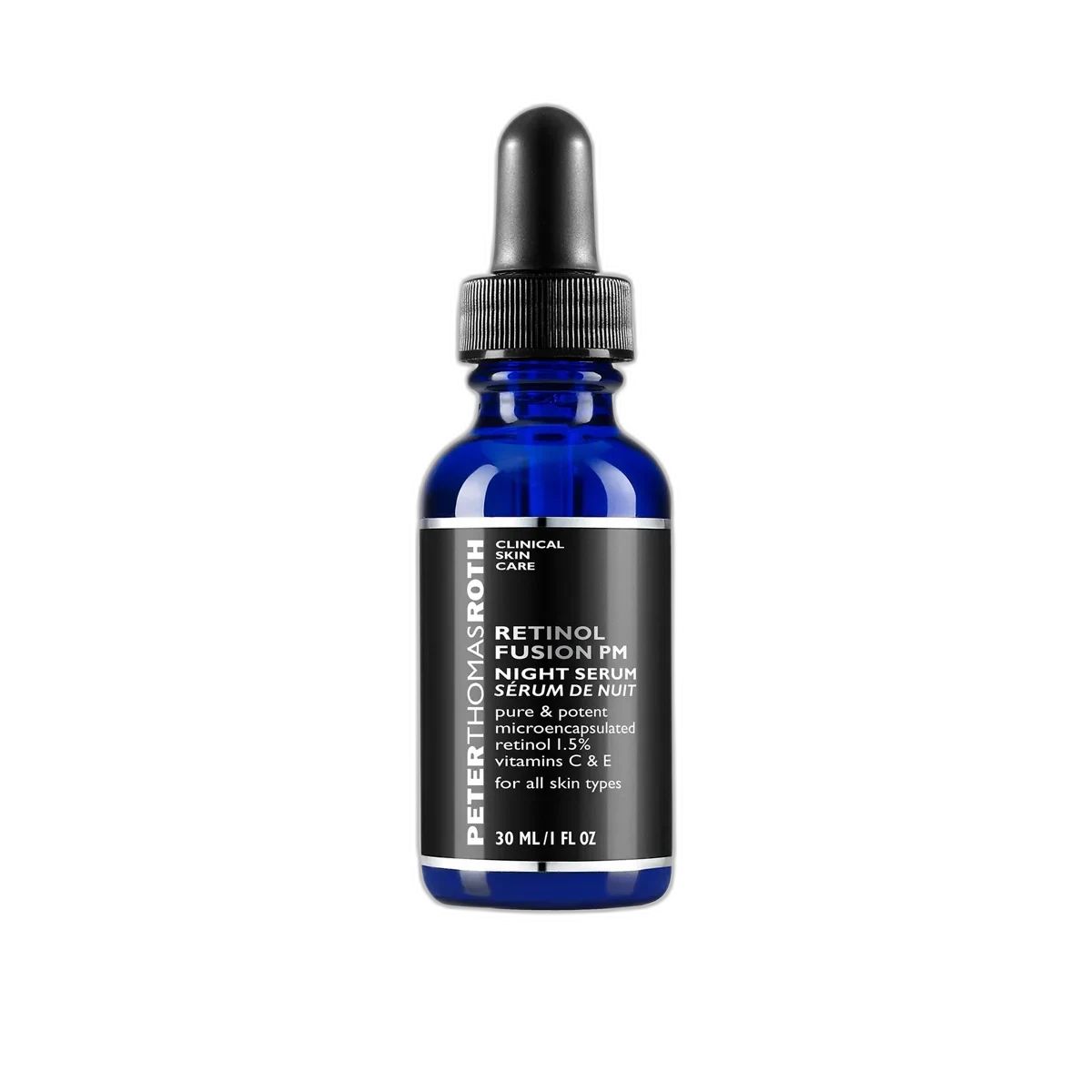
Retinol Fusion PM Night Serum
High-Potency Retinol Workhorse
 Verified reviewer
Pros & cons.
- +1.5% microencapsulated retinol — one of the most potent OTC retinol products with time-released delivery
- +Remarkably minimalist 12-ingredient formula with no unnecessary filler ingredients
- +Squalane base provides effective moisture support without heaviness or occlusion
- +Bisabolol soothing agent genuinely reduces irritation during the retinol adjustment period
- +15+ years of market presence with long-term users reporting sustained skin quality improvements
- +Fragrance-free and paraben-free with no essential oils or botanical allergens
- −Very thin, runny consistency makes the dropper dispensing messy and imprecise
- −Premium price of $65 per ounce with no volume discount on larger sizes
- −Takes approximately 5 minutes to absorb which extends the evening routine
- −Contains alcohol as the last ingredient which strict ingredient-avoiders may reject
- −1.5% retinol is genuinely potent and will irritate those with sensitive or compromised skin barriers
- −Not suitable during pregnancy or breastfeeding
The full review.
In 2010, most prestige retinol products used 0.5% concentrations. They sat in complex formulas where retinol acted as a minor ingredient among botanical extracts and peptides. Peter Thomas Roth used a different strategy with Retinol Fusion PM Night Serum: 1.5% retinol and twelve ingredients.
Fifteen years later, this remains one of the simplest prestige skincare formulations. The ingredient list functions like a chemistry exam: cyclopentasiloxane acts as the vehicle, squalane provides moisture, retinol is the active, vitamins C and E offer antioxidant support, bisabolol soothes, lecithin handles microencapsulation, potassium phosphate buffers the pH, and a few functional ingredients stabilize the mix. Every ingredient has a specific job. There is no botanical window dressing, no trendy extracts, and no marketing ingredients.
This minimalism is the product’s greatest strength and its main differentiator. While serum ingredient lists often exceed fifty entries, Retinol Fusion PM provides retinol, an effective delivery method, and the necessary support for skin tolerance. The formula trusts that equation and the consumer who understands it.
Microencapsulation is the critical engineering element. Applying 1.5% retinol directly to the skin in a conventional vehicle causes redness, peeling, tightness, and the “retinol uglies” that lead users to quit within two weeks. By encapsulating the retinol in lecithin microspheres, the formula delivers the active gradually overnight. The retinol releases in a sustained pattern rather than hitting the skin all at once, mimicking how prescription retinoids deliver active ingredients.
Consequently, many users tolerate 1.5% retinol with a mild adjustment period. Some report no peeling or irritation when starting every other night. Others see mild flaking in the first week that resolves quickly. The adjustment is less dramatic than the concentration suggests, proving the delivery system works.
The application requires adjustment. Cyclopentasiloxane as the first ingredient makes the serum thin and watery with a silicone-slip feel. Two to three drops from the glass dropper spread fast across the face. The serum takes about five minutes to absorb and feels slightly slick during that time. Once dry, it leaves a velvety, satin finish that works under a nighttime moisturizer.
The dropper packaging frustrates users. Because the serum is thin, the dropper dispenses erratically, sometimes dripping or dispensing too much. For a product at sixty-five dollars per ounce, a more precise mechanism is needed. The glass bottle protects the retinol from light degradation.
Squalane as the second ingredient is a smart moisturizing partner. Plant-derived squalane mimics skin sebum and integrates into the lipid barrier without the heaviness of oils or thick emollients. For retinol users needing moisture to buffer drying effects without blocking active penetration, squalane provides the right balance.
Bisabolol, a chamomile-derived soothing agent, provides anti-inflammatory support for this retinol concentration. Instead of using aloe vera or centella, PTR chose an ingredient with documented anti-irritant properties that works with the silicone-squalane vehicle. This decision prioritizes function over marketing.
The alcohol at the end of the ingredient list is worth noting. At the twelfth and final position, its concentration is likely below one percent, acting as a formulation aid rather than a primary skin contact ingredient. This is a non-issue for most, but it exists for those who strictly avoid all alcohol in skincare.
Retinol Fusion PM Night Serum delivers what fifteen years of consumer data and retinol science predict. Skin texture improvement and increased radiance typically appear within two to four weeks. Fine line softening and pore refinement follow at six to eight weeks. Consistent use for twelve or more weeks is needed for significant wrinkle reduction and collagen-rebuilding benefits. Long-term users report sustained skin quality improvements they credit to this serum.
The price needs context. At sixty-five dollars for one ounce, this is a premium product. However, the 1.5% retinol concentration and microencapsulated delivery system require significant formulation investment. A tube of prescription-strength tretinoin (which retinol converts to in the skin at a lower rate) costs thirty to eighty dollars with insurance, so the price fits the category. PTR offers four sizes from 0.4 oz to 3.35 oz, but none offer a per-ounce discount; the jumbo size costs more per ounce than the standard size, which is unusual.
Peter Thomas Roth Retinol Fusion PM does not try to be everything to everyone. It is a retinol delivery vehicle built with pharmaceutical precision for consumers who want more retinol. The twelve-ingredient formula lets the retinol do the heavy lifting and provides the necessary support structure. In an industry of complexity, this focused simplicity has maintained relevance for fifteen years.
Formula
Ingredient analysis.
Full INCI list
Cyclopentasiloxane, Squalane, Water/Aqua/Eau, Retinol, Tocopheryl Acetate, Ascorbyl Palmitate, Bisabolol, Lecithin, Potassium Phosphate, Pentylene Glycol, Polysorbate 20, Alcohol
Skin match.
The science.
The Science
Retinol is the most studied topical anti-aging ingredient in dermatology. It works by converting to retinoic acid through a two-step enzymatic process (retinol → retinaldehyde → retinoic acid) and binding to retinoid receptors in keratinocytes. This receptor activation stimulates collagen synthesis, melanin regulation, and cell turnover.
A 2007 Kafi et al. study in the Archives of Dermatology showed that topical retinol at 0.4% applied three times weekly for 24 weeks improved fine wrinkles and was well-tolerated in elderly subjects. The 1.5% concentration in this product is nearly four times higher, using the microencapsulation delivery system.
The microencapsulation technology uses lecithin to form liposomal vesicles around the retinol molecules. A 2013 review by Zhai and Maibach in Skin Pharmacology and Physiology documented that encapsulated retinol delivery systems reduce initial irritation by 30-50% compared to free retinol at equivalent concentrations, while maintaining similar long-term efficacy. The lecithin microspheres slowly degrade over hours, releasing retinol gradually to avoid the concentration spike that causes acute irritation.
Squalane acts as the moisturizing vehicle and enhances the penetration of lipophilic actives. A 2012 study in the International Journal of Pharmaceutics found that squalane-based vehicles improved the dermal delivery of lipophilic compounds compared to mineral oil or silicone-only vehicles, making it an ideal partner for retinol delivery.
Ascorbyl palmitate, the oil-soluble vitamin C derivative, provides complementary anti-aging benefits through a separate mechanism. While retinol stimulates collagen gene expression, vitamin C supports the post-translational hydroxylation of collagen — a different step in collagen biosynthesis. A 2003 study by Pinnell et al. in Dermatologic Surgery confirmed that combining vitamin C with vitamin E enhanced antioxidant protection synergistically.
References
- Improvement of naturally aged skin with vitamin A (retinol) — Archives of Dermatology (2007)
- Encapsulated retinol delivery systems: reduced irritation with maintained efficacy — Skin Pharmacology and Physiology (2013)
- Topical vitamin C and vitamin E synergistic antioxidant protection — Dermatologic Surgery (2003)
Dermatologist Perspective
Dermatologists view retinol as a cornerstone of evidence-based anti-aging skincare. The 1.5% concentration in this serum is at the upper end of OTC retinol potency. Dermatologists note that while prescription tretinoin is more potent drop-for-drop, high-concentration OTC retinol with an effective delivery system achieves meaningful clinical results for fine lines, texture, and hyperpigmentation. Board-certified dermatologists appreciate the minimalist formulation because it reduces the risk of sensitization reactions and ingredient interactions. The microencapsulated delivery aligns with pharmaceutical drug delivery principles that dermatologists understand well. For patients not ready for prescription retinoids, or those maintaining results between prescription treatments, this serum is a clinically serious OTC option.
Where it fits in your routine.
Apply 2-3 drops to a clean, dry face and neck at night. Use fingertips to spread it evenly, avoiding the eye area and corners of the mouth. Wait about 5 minutes for full absorption before you apply moisturizer. Use every-other-night for the first 2-4 weeks to build tolerance, then use nightly. Always apply a broad-spectrum SPF 30+ the next morning. Stop use if persistent irritation, excessive peeling, or burning occurs. Do not use during pregnancy or breastfeeding.
At $65 for 1.0 oz, this premium retinol serum has reasonable pricing for its category. The 1.5% microencapsulated retinol concentration and pharmaceutical-grade delivery system justify the cost over commodity retinol products. For comparison, prescription tretinoin costs $30-80 per tube depending on insurance, and many prestige retinol serums at 0.3-0.5% concentration cost $50-100. The lack of volume discounts across the four available sizes (0.4 oz at $35, 1.0 oz at $65, 2.0 oz at $130, 3.35 oz at $218) is a negative — loyal customers buying larger sizes get no reward.
Normal to combination skin types seeking a potent, no-nonsense retinol serum for anti-aging, texture improvement, and hyperpigmentation. It works for consumers who prefer minimalist formulations, have used retinol before and want higher concentrations, or want an OTC alternative to prescription retinoids. Best for users aged 30+ with established anti-aging concerns.
People with sensitive, dry, or eczema-prone skin must use 1.5% retinol with caution or start with a lower-concentration product. Pregnant or breastfeeding individuals must avoid this product. This concentration is too aggressive for those with a compromised skin barrier, active rosacea, or current use of other strong actives (prescription retinoids, high-strength acids).
Product details.
Fragrance-free with no added scent or essential oils. It is unscented and has no noticeable aroma during application.
Glass bottle with dropper applicator. The thin consistency makes the dropper design messy; the serum drips or runs. Four sizes exist: travel (0.4 oz), standard (1.0 oz), super size (2.0 oz), and jumbo (3.35 oz), but none provide a per-ounce discount. Finish satinvelvetynon-greasy
The serum feels lighter and more liquid than most retinol products on first use. The silicone base provides a silky slip during application. Most users feel no immediate tingling or burning. Mild peeling and slight sensitivity are normal during the first 1-2 weeks as skin adjusts to 1.5% retinol. Using it every other night minimizes the adjustment period.
2-3 months with nightly use on face and neck, using 2-3 drops per application
12 months
All Year
The backstory.
Launched around 2010, Retinol Fusion PM was one of the first prestige OTC retinol serums to push beyond the 0.5-1% concentrations that were standard at the time. Peter Thomas Roth bet on microencapsulation technology — borrowed from pharmaceutical drug delivery — to solve the irritation problem that had kept OTC retinol concentrations conservative. Fifteen years later, it remains one of the strongest OTC retinol products on the market and has developed a loyal following of users who have used it continuously for a decade or more.
About Peter Thomas Roth
Established Brand (5–20 years)Peter Thomas Roth launched in 1993 in New York City. It is the largest privately-owned clinical skincare brand in the U.S. The Retinol Fusion PM Night Serum is one of the brand's oldest products, on market since approximately 2010, and sells through Sephora, Ulta, Nordstrom, and dermatologist offices.
Common myths.
Build up to 1.5% retinol using lower concentrations over several months.
Increasing retinol concentration gradually works, but the microencapsulated delivery system in this formula makes 1.5% retinol tolerable from the start. The time-released mechanism lowers the initial irritation spike common with high-concentration retinol. Most users can start every other night and build to nightly use without using a lower concentration product first.
Retinol and vitamin C cannot be used together
This formula contains both retinol and ascorbyl palmitate (a vitamin C derivative). This shows they are compatible in one product. Past concerns focused on pH incompatibility between L-ascorbic acid (low pH) and retinol (higher pH), but oil-soluble vitamin C derivatives like ascorbyl palmitate work across a wider pH range and stay stable with retinol.
FAQ.
Is PTR Retinol Fusion PM too strong for beginners?
The 1.5% concentration is potent, but the microencapsulated delivery system makes it tolerable for retinol beginners. Use it every-other-night for the first 2-4 weeks, then move to nightly use as your skin adjusts. Mild peeling and sensitivity during the first two weeks is normal. If irritation lasts longer, a lower-concentration retinol may work better.
Can you use PTR Retinol Fusion PM with other actives?
Yes, but timing matters. Do not use AHA/BHA exfoliants or benzoyl peroxide on the same nights as this retinol serum to avoid irritation. Vitamin C serums work well in the morning (retinol at night). Niacinamide is compatible and works in the same routine. Always follow with a moisturizer and use SPF 30+ during the day.
Why does the PTR Retinol serum feel so runny?
cyclopentasiloxane (a volatile silicone) is the first ingredient, creating a thin, liquid consistency. This lightweight vehicle partially evaporates on application, leaving the retinol and squalane behind. The consistency makes the dropper messy, but 2-3 drops ensure rapid, even distribution across the face.
Is PTR Retinol Fusion PM safe during pregnancy?
No — retinol and all retinoid derivatives are contraindicated during pregnancy and breastfeeding because they can cause teratogenic effects. This product contains 1.5% retinol and requires discontinuation before attempting conception. Consult your healthcare provider for pregnancy-safe alternatives.
How long does it take to see results from PTR Retinol Fusion PM?
Texture improvement and increased luminosity show within 2-4 weeks. Fine line reduction and pore refinement appear at 6-8 weeks. Full anti-aging benefits like wrinkle reduction and collagen rebuilding take 12+ weeks of consistent nightly use. The microencapsulated delivery works faster than non-encapsulated retinol products.
What the community says.
"Highly effective for fine lines and wrinkles without the severe irritation of other high-concentration retinols"
"Remarkably short 12-ingredient list appeals to those who prefer minimalist formulations"
"Smoother, brighter skin texture noticeable within days of starting use"
"Microencapsulated delivery system genuinely reduces the adjustment period for many users"
"Long-term users report sustained improvements in skin quality over years of consistent use"
"Very liquid and runny consistency makes the dropper messy and can waste product"
"Takes several minutes to absorb and dry down which extends the evening routine"
"Premium price of $65 per ounce with no volume discount on larger sizes"
"Oily feel from the silicone-squalane base may not suit oily skin types"
"Contains alcohol as the last ingredient which some users prefer to avoid"
People also looked at.