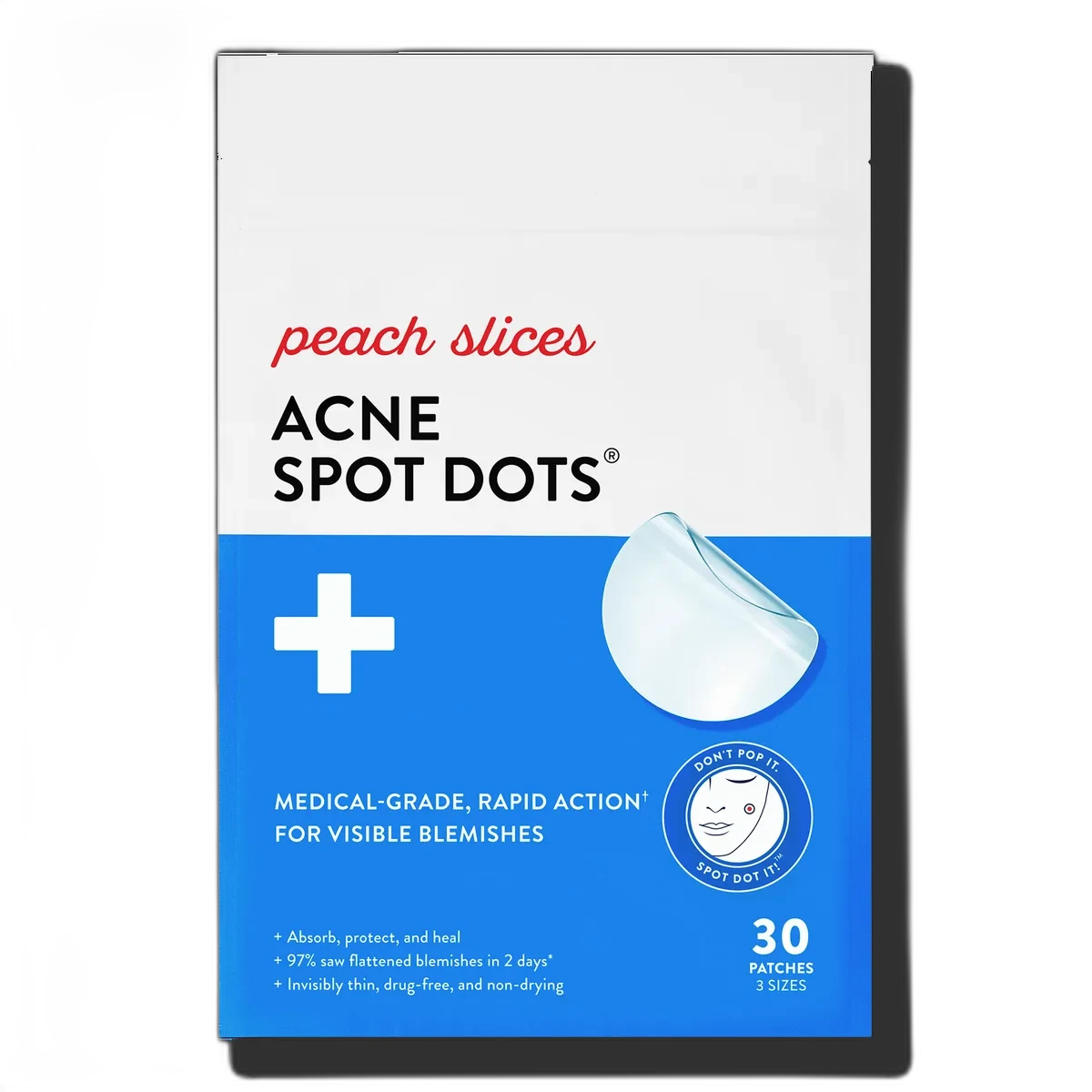
Acne Spot Dots
Drugstore Pimple Patch Favorite
 Verified reviewer
Pros & cons.
- +Visibly shrinks whiteheads overnight with no active ingredients
- +Physical barrier that prevents picking and further damage
- +Two patch sizes in one pack for versatile use
- +Excellent value at around 20 cents per patch
- +Fragrance-free and nearly universally tolerated
- +Safe during pregnancy and breastfeeding
- −Contains gelatin, so not vegan
- −Only effective on whiteheads and open lesions, not cysts
- −Adhesive can slip overnight on oily skin
- −Don't work on blackheads or closed comedones
The full review.
Here’s a medical-history curiosity worth knowing: the hydrocolloid material in every pimple patch you’ve ever used was originally developed in the 1960s for moist wound healing in hospital settings. Nurses used it on pressure ulcers, burns, and chronic wounds — anywhere tissue needed to heal in a protected, moist environment while fluid was actively draining. It sat in that clinical niche for decades before Korean beauty brands noticed a useful coincidence: an active whitehead is, functionally, a small open wound producing fluid. Apply hydrocolloid, and the same physics that works on a diabetic foot ulcer works on the pimple on your chin.
Peach Slices was among the first brands to bring this idea to mainstream American drugstores in 2018, riding the K-beauty wave that was sweeping Target and Ulta at the time. The formula isn’t really a formula at all — it’s a sheet of medical-grade hydrocolloid die-cut into circles of two different sizes, pressed onto paper backing, and sealed in a pouch. There’s no salicylic acid, no tea tree oil, no niacinamide, no added anything. The brand made the correct observation that for overnight wear on an active lesion, plain hydrocolloid works as well as any medicated version and is less likely to cause irritation. This is the kind of minimalism that only works when the underlying material is already doing most of the job.
How to Use
Using them is straightforward to the point of being dull. Wait until a pimple has whiteheaded — meaning there’s visible fluid at the surface — or has been freshly extracted. Cleanse the area thoroughly and dry the skin completely; any leftover serum, oil, or moisturizer will prevent the patch from sticking. Peel a patch off the sheet with clean dry fingers and press it gently over the lesion for about ten seconds to secure the adhesive. Wear it for at least six hours, ideally overnight. When you peel it off in the morning, the center will be white and opaque — that’s the hydrocolloid saturated with fluid it pulled out of the lesion. Under the patch, the pimple will be visibly flatter, smaller, and less inflamed, and the surface will have been protected from picking all night.
Common Praise
The practical genius is less about any one application and more about behavioral modification. Most people who struggle with their skin know the sequence: see a new pimple, touch it, pick at it, make it worse, spread bacteria, delay healing, end up with post-inflammatory hyperpigmentation that takes weeks to fade. A pimple patch interrupts that cycle at the picking stage. Once the patch is on, your fingers can’t reach the lesion. That alone is worth the price of the box.
Packaging
The two-size pack is more useful than it sounds. Smaller patches work for early-stage whiteheads and the classic chin zit; larger patches cover more distributed inflamed areas, post-extraction spots, or those occasional pimples that come up along the jawline with a red halo. Having both sizes in a single envelope means you don’t have to buy two products, which is a small practical edge over single-size competitors like the original Mighty Patch.
Not ideal for
There are real limits to what these patches can do, and it’s worth being explicit about them. They don’t work on blackheads — there’s no fluid to absorb, just solidified sebum. They don’t work on closed comedones, the flesh-colored bumps under the skin surface. They don’t work on deep cystic acne, where the inflammation is buried and there’s no open surface. And they don’t work on dry, crusted lesions that have already stopped producing fluid. The target is specifically the whitehead phase, the freshly-extracted opening, or the actively weeping pustule. For that target, they’re among the most reliable interventions in skincare. For anything else, you need a different tool.
Conflicts With
One more caveat worth flagging: the Peach Slices formulation includes gelatin, which makes the patches non-vegan. If vegan purchasing is important to you, Hero Cosmetics Mighty Patch uses a gelatin-free hydrocolloid base and performs essentially the same. The rest of the ingredient list is identical in both — standard medical hydrocolloid polymers. Beyond the gelatin issue, there’s almost nothing to complain about. At under $6 for 30 patches, wearing one overnight costs about 20 cents, which for the visible reduction in the size of a breakout the next morning is an extraordinarily good trade. Keep a pack in your drawer. Deploy them on whiteheads. Stop picking. Your skin will thank you.
Ingredient analysis.
Full INCI list
Hydrocolloid (styrene isoprene styrene block copolymer, polyisobutylene, mineral oil, sodium carboxymethylcellulose, pectin, gelatin)
Skin match.
The science.
The Science
Hydrocolloid dressings have been used in medical wound care since the 1960s, with extensive literature supporting their role in moist wound healing for pressure ulcers, diabetic ulcers, and post-surgical incisions. A 2006 review in the Journal of Wound Care established that hydrocolloid dressings provide a moist environment that promotes epithelial migration and reduces healing time compared to dry dressings, while absorbing exudate via the formation of a gel-like matrix when in contact with wound fluid. The application to acne lesions is mechanistically identical. A 2006 study published in Dermatologic Surgery (Chao et al.) specifically evaluated hydrocolloid patches on acne vulgaris and found that they produced statistically significant reductions in lesion size, erythema, and inflammation compared to untreated controls, without the irritation associated with topical retinoids or benzoyl peroxide. The researchers also noted that the occlusive barrier prevented patients from manipulating the lesions, which itself contributed to faster resolution. What's especially interesting about the Peach Slices version is that it relies entirely on this mechanism — there are no added actives to muddle the clinical picture. That's the correct engineering choice, because medicated hydrocolloid patches (those containing salicylic acid or tea tree oil) have not shown improved efficacy in comparative studies, but they have shown increased rates of contact dermatitis.
References
- A pilot study on the efficacy of acne dressings for the treatment of acne — Dermatologic Surgery (2006)
Dermatologist Perspective
Dermatologists widely recommend hydrocolloid pimple patches as a low-risk, high-utility addition to almost any acne routine. Board-certified dermatologists note that the patches are particularly useful for preventing patient manipulation of active lesions — picking and squeezing are major drivers of post-inflammatory hyperpigmentation and scarring — and that the occlusive moist environment supports faster resolution of whiteheading pimples. Dermatological guidance commonly emphasizes that pimple patches are best deployed as an acute intervention on individual lesions rather than a preventive measure, and that patients should not expect them to address deeper cystic acne, blackheads, or closed comedones. They are also commonly recommended during pregnancy when most active acne treatments (retinoids, salicylic acid) are contraindicated.
Guidance
Where it fits in your routine.
Cleanse the area with a gentle cleanser once a pimple has a whitehead or is freshly extracted. Pat the skin dry; moisture prevents adhesion. Use clean, dry fingers to peel a patch from the backing, center it over the lesion, and press for ten seconds. Wear for at least 6 hours, or 8-12 hours overnight. Remove and discard gently. Do not apply serums, oils, or moisturizer to the area underneath before applying the patch. You can wear the patch under makeup during the day.
At approximately $6 for 30 patches in two sizes, each use costs about 20 cents — roughly the price of a piece of gum. Peach Slices is fractionally cheaper per patch than Mighty Patch, which costs around $7 for 36 patches in a single size, and Peach Slices offers two sizes. Both outperform prestige brand patches that charge $20 or more for similar or smaller quantities. Hydrocolloid pimple patches are a rare skincare category where paying more adds almost nothing, because the underlying material is commoditized medical-grade hydrocolloid. Peach Slices provides the material at a fair price in a useful two-size pack, which is all the category requires.
Use this for occasional whiteheads, surface-level inflammatory acne, or post-extraction wound protection. It works well for pregnant users and sensitive skin types that cannot tolerate active acne treatments.
Skip these if your main acne concerns are blackheads, closed comedones, or deep cystic lesions — hydrocolloid patches do not work on those. Also skip if you need a vegan option, as this formulation contains gelatin.
Product details.
Flexible translucent hydrocolloid circles in two diameters
Unscented
Sealed paper envelope with small and large perforated patch sheets
Peel a patch off the backing using clean, dry fingers and press it onto a cleansed, dry pimple. The patch turns opaque white within a few hours as it absorbs fluid; this visual indicator shows it works. Remove after 6-12 hours to see a flatter, less inflamed lesion underneath.
Roughly 15-30 days of pimple treatment depending on how often breakouts occur
24 months
All Year
The backstory.
Hydrocolloid dressings were originally developed for medical wound care in the 1960s and used in hospital settings for decades before Korean beauty brands adapted them for pimple management in the early 2000s. Peach Slices launched their version in 2018 as one of the first patches to achieve wide US drugstore distribution, helping to mainstream the pimple-patch category in American beauty retail.
About Peach Slices
Emerging Brand (2–5 years)Alicia Yoon founded Peach & Lily, then launched Peach Slices in 2018 as its mass-market line. Hydrocolloid pimple patches are a standard dermatology category, originally made for wound care. The Peach Slices version uses the same pharmaceutical-grade hydrocolloid material found in FDA-cleared wound dressings.
Common myths.
Pimple patches work on any kind of breakout.
Hydrocolloid patches absorb fluid from open or whiteheading lesions. They have almost no effect on closed comedones (flesh-colored bumps), deep cystic acne, or blackheads because these lack fluid for the material to absorb.
Patches with salicylic acid or tea tree work better.
Studies on hydrocolloid patches show plain material works as well as medicated versions. Added actives increase irritation risk. For overnight use on a whitehead, plain hydrocolloid is the gold standard.
FAQ.
How long do I leave them on?
Leave on for at least 6 hours for visible effect, ideally 8-12 hours overnight. Remove the patch when the center turns white and opaque; this shows the hydrocolloid is saturated with fluid from the lesion.
Do they work on cystic acne?
Hydrocolloid patches absorb surface fluid. They work only on whiteheads or freshly popped pimples with accessible fluid. Closed cysts lack a surface opening for the patch to reach.
How do they compare to Mighty Patch?
Both use medical-grade hydrocolloid material and perform similarly. Peach Slices offers two sizes per pack (small and large), while Mighty Patch has one size. Peach Slices is often cheaper per patch at drugstores. There is minimal real-world difference in performance.
Can I wear them during the day?
The patches are translucent and low-profile, but visible up close. Many users wear them under makeup — apply concealer lightly over the edges to blend.
Are they reusable?
No. A patch is finished once it absorbs fluid and turns opaque. Use a fresh patch if the lesion still produces fluid after 12 hours.
Are they safe during pregnancy?
Yes. Hydrocolloid has no active ingredients. It is a passive absorbent material and is safe during pregnancy and breastfeeding. It works well for breakouts when most active acne treatments are off-limits.
Are they vegan?
No. This formulation uses gelatin, an animal-derived ingredient. For a vegan option, Hero Cosmetics Mighty Patch is an alternative that uses a gelatin-free hydrocolloid base.
What the community says.
"Visible overnight shrinking"
"Two sizes in one pack"
"Barrier against picking"
"Genuinely affordable"
"Patches turn white when saturated (which is the intended indicator)"
"Don't work on closed bumps"
"Adhesive can slip overnight"
Featured in.
People also looked at.