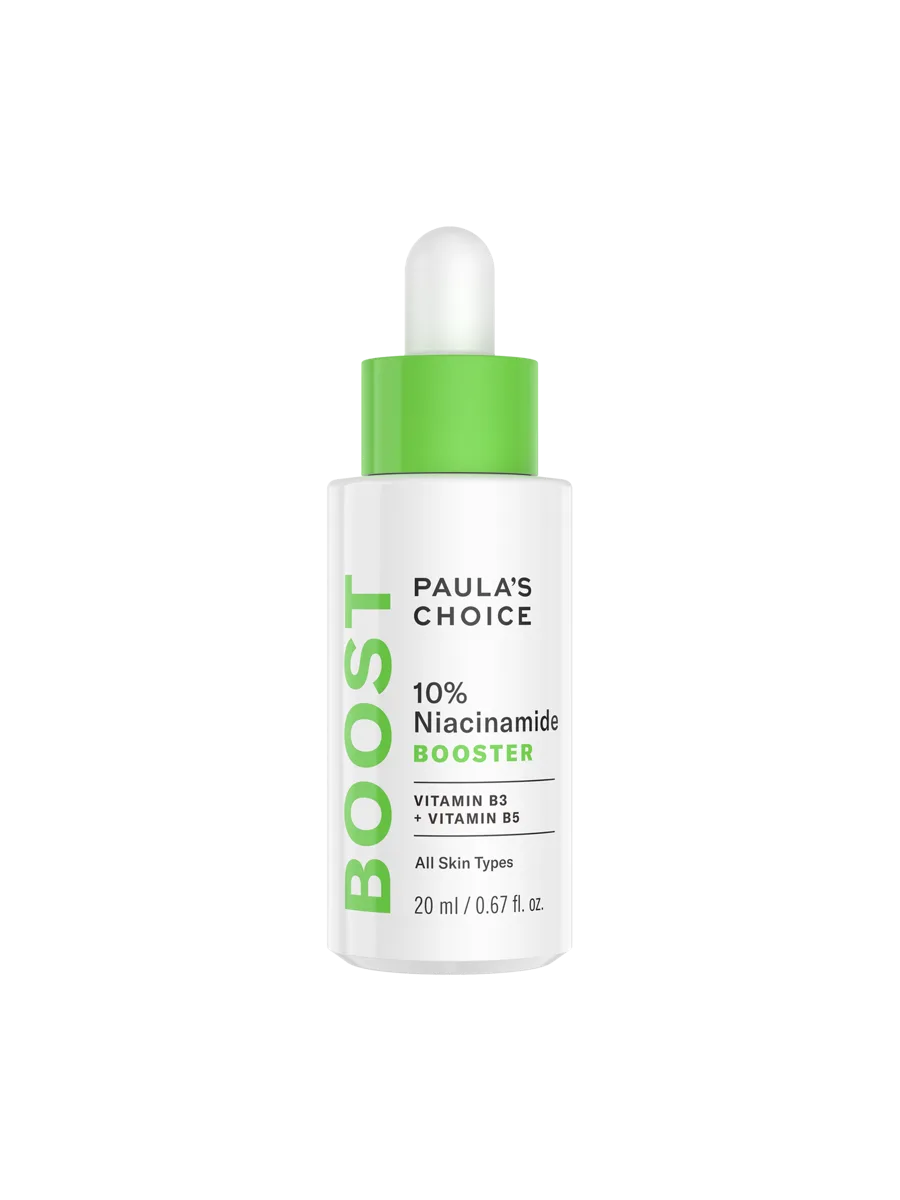
10% Niacinamide Booster
Pore Refinement Powerhouse
 Verified reviewer
Pros & cons.
- +Synergistic niacinamide-acetyl glucosamine pairing backed by published research for enhanced brightening
- +Three independent brightening pathways target hyperpigmentation from multiple angles simultaneously
- +Universally gentle formula — fragrance-free, alcohol-free, silicone-free with zero common irritants
- +Pregnancy-safe and suitable for nearly all skin types including sensitive skin
- +Watery texture absorbs instantly and layers perfectly under any product without pilling
- +Booster format adds clinical-strength niacinamide to your existing routine without replacing products
- +Rich supporting cast includes CoQ10, hyaluronic acid, panthenol, and green tea catechins
- −At $49 for 0.67 oz, the price-per-ounce is steep compared to other niacinamide serums
- −Small bottle empties quickly with recommended twice-daily use
- −Glass dropper packaging isn't ideal for travel or shower use
- −Some users experience temporary flushing from the high niacinamide concentration
- −Results for hyperpigmentation require 8-12 weeks of patience
The full review.
There are roughly nine thousand niacinamide serums on the market right now. Most of them dump the ingredient into a basic hydrating base, slap a percentage on the label, and call it formulation. Paula’s Choice took a different approach with this booster, and the difference shows up in the ingredient list before it shows up on your face.
The key insight here isn’t the 10% niacinamide — plenty of products match that concentration. It’s what sits right behind it on the INCI list: acetyl glucosamine. This amino sugar has published research showing that when combined with niacinamide, the pair reduces hyperpigmentation more effectively than either ingredient used alone. It’s the kind of evidence-based ingredient pairing that separates a thoughtfully formulated product from a marketing exercise with a high percentage on the label.
But Paula’s Choice didn’t stop there. This formula layers three independent brightening pathways: niacinamide inhibiting melanosome transfer, ascorbyl glucoside (a stable vitamin C derivative) inhibiting tyrosinase, and licorice root extract providing glabridin for additional pigment reduction. If you’re dealing with uneven skin tone, dark spots, or post-inflammatory hyperpigmentation, this triple-approach is more likely to produce visible results than any single-pathway product, because hyperpigmentation is frustratingly multifactorial and attacking it from one angle often isn’t enough.
The booster format remains one of Paula’s Choice’s best ideas. Rather than buying a full moisturizer or serum with niacinamide already built in — where you’re locked into whatever texture, additional ingredients, and price point the brand chose — you get a concentrated fluid that adds niacinamide to whatever products you already love. Two to three drops mixed into your morning moisturizer. A few drops applied directly before your evening retinol. The flexibility is genuine and practical.
Texture-wise, this is about as close to water as a skincare product can get while still having some viscosity. It absorbs in seconds, leaves zero residue, doesn’t pill under other products, and adds no discernible weight or greasiness to your routine. If you’ve ever struggled with serums that leave a sticky film or refuse to play nice under sunscreen, this will feel like a revelation.
The supporting ingredients read like a greatest hits of gentle, evidence-backed actives. Sodium hyaluronate for hydration. Allantoin and panthenol for soothing. Beta-glucan for barrier support. Epigallocatechin gallate (green tea catechin) and ubiquinone (CoQ10) for antioxidant protection. Carnosine and genistein as additional antioxidants. This is not a one-note product — it’s a concentrated multi-active treatment that happens to lead with niacinamide.
The fragrance-free, alcohol-free, silicone-free formula makes this one of the most universally tolerable active treatments on the market. Niacinamide is inherently gentle — it doesn’t thin the skin, doesn’t increase sun sensitivity, doesn’t require a tolerance-building period, and is pregnancy-safe. The worst most people experience is mild temporary flushing, a harmless vasodilation response that typically subsides with continued use.
Now for the reality check. This booster costs $49 for 0.67 ounces. That’s a premium price for a product that, at its core, is a water-based niacinamide serum. The supporting ingredients are excellent, the formulation is smart, and the results are real — but the value equation gets complicated when products like The Ordinary offer 10% niacinamide at a fraction of the price. What you’re paying for here is the acetyl glucosamine partnership, the three-pathway brightening approach, the cleaner base formula, and the Paula’s Choice quality control. Whether that’s worth the markup is a personal calculation.
The glass bottle with dropper is appropriate for the product — it protects from light, allows precise dispensing, and feels premium in hand. It’s not the most travel-friendly packaging, and the bottle does empty faster than you’d like at twice-daily use, but these are minor inconveniences.
Results follow niacinamide’s typical timeline. A subtle improvement in skin’s overall luminosity appears within the first few days — not dramatic, but noticeable if you’re paying attention. Pore appearance and oil control improvements typically become visible at the two to four week mark. The real payoff — meaningful reduction in hyperpigmentation and post-inflammatory marks — takes eight to twelve weeks of consistent use. Patience is required, but niacinamide rewards consistency more reliably than almost any other active in skincare.
Paula Begoun has long argued that skincare should be boring — no fragrance, no gimmicks, just ingredients that work at concentrations that matter. This booster is the embodiment of that philosophy. It’s not exciting to look at, not thrilling to apply, and not the kind of product you’d post about on social media. It just works, quietly and consistently, which might be the highest compliment a skincare product can earn.
Formula
Texture
Texture-wise, this is about as close to water as a skincare product can get while still having some viscosity. It absorbs in seconds, leaves zero residue, doesn’t pill under other products, and adds no discernible weight or greasiness to your routine. If you’ve ever struggled with serums that leave a sticky film or refuse to play nice under sunscreen, this will feel like a revelation.
Scent
The fragrance-free, alcohol-free, silicone-free formula makes this one of the most universally tolerable active treatments on the market. Niacinamide is inherently gentle — it doesn’t thin the skin, doesn’t increase sun sensitivity, doesn’t require a tolerance-building period, and is pregnancy-safe. The worst most people experience is mild temporary flushing, a harmless vasodilation response that typically subsides with continued use.
Packaging
The glass bottle with dropper is appropriate for the product — it protects from light, allows precise dispensing, and feels premium in hand. It’s not the most travel-friendly packaging, and the bottle does empty faster than you’d like at twice-daily use, but these are minor inconveniences.
Common Praise
Results follow niacinamide’s typical timeline. A subtle improvement in skin’s overall luminosity appears within the first few days — not dramatic, but noticeable if you’re paying attention. Pore appearance and oil control improvements typically become visible at the two to four week mark. The real payoff — meaningful reduction in hyperpigmentation and post-inflammatory marks — takes eight to twelve weeks of consistent use. Patience is required, but niacinamide rewards consistency more reliably than almost any other active in skincare.
Best for
If you’re dealing with uneven skin tone, dark spots, or post-inflammatory hyperpigmentation, this triple-approach is more likely to produce visible results than any single-pathway product, because hyperpigmentation is frustratingly multifactorial and attacking it from one angle often isn’t enough.
Works for
Two to three drops mixed into your morning moisturizer. A few drops applied directly before your evening retinol. The flexibility is genuine and practical.
Ingredient analysis.
Full INCI list
Aqua, Niacinamide, Acetyl Glucosamine, Ascorbyl Glucoside, Butylene Glycol, Phospholipids, Sodium Hyaluronate, Allantoin, Boerhavia Diffusa Root Extract, Glycerin, Dipotassium Glycyrrhizate, Glycyrrhiza Glabra Root Extract, Ubiquinone, Epigallocatechin Gallate, Beta-Glucan, Panthenol, Carnosine, Genistein, Citric Acid, Sodium Citrate, Sodium Hydroxide, Xanthan Gum, Disodium EDTA, Ethylhexylglycerin, Phenoxyethanol
Skin match.
The science.
The Science
Niacinamide at 2-10% concentrations has extensive research for skin benefits. A 2009 study in the British Journal of Dermatology by Kimball et al. forms the basis for this formulation. That study shows that combining niacinamide and N-acetyl glucosamine reduces hyperpigmentation and improves skin tone evenness more than niacinamide or acetyl glucosamine alone. This synergy is why acetyl glucosamine is the third ingredient in this formula.
Niacinamide has broad mechanisms. It inhibits melanosome transfer from melanocytes to keratinocytes, which reduces visible pigmentation without affecting melanin production. It stimulates ceramide and fatty acid synthesis in the stratum corneum to strengthen barrier function. It increases cellular NADPH levels to support energy metabolism and repair. Clinical studies also show niacinamide regulates sebum, reducing oil without the drying effects of traditional mattifying agents.
The Bissett et al. study in Dermatologic Surgery (2005) tested 5% topical niacinamide and found significant improvements in fine lines, hyperpigmentation, texture, and skin sallowness. At 10%, this booster provides double that studied concentration. Clinical benefits do not always scale linearly with concentration; higher concentrations primarily offer faster visible results rather than much greater efficacy.
Ascorbyl glucoside provides a second depigmenting pathway by inhibiting tyrosinase—a different mechanism than niacinamide's melanosome transfer inhibition. Licorice root extract's glabridin adds a third pathway. This multi-mechanism approach works well for stubborn hyperpigmentation that often resists single-ingredient treatments.
References
- The effects of niacinamide on facial skin appearance: A double-blind, randomized, vehicle-controlled trial — British Journal of Dermatology (2009)
- Niacinamide: A B vitamin that improves aging facial skin appearance — Dermatologic Surgery (2005)
- Mechanistic Basis and Clinical Evidence for the Applications of Nicotinamide (Niacinamide) to Control Skin Aging and Pigmentation — Antioxidants (MDPI) (2021)
Dermatologist Perspective
Dermatologists often recommend niacinamide as a versatile, well-tolerated over-the-counter active. Board-certified dermatologists note that 10% niacinamide is a high studied concentration but remains safe for almost all skin types, including during pregnancy and breastfeeding. Dermatologists value how niacinamide complements retinoids; using this booster with a retinol product is a common suggestion for patients treating both aging and hyperpigmentation. Because it does not cause photosensitivity, it works for morning use, and its barrier-strengthening properties help patients on aggressive acne or anti-aging regimens.
Where it fits in your routine.
Mix 2-3 drops into a serum or moisturizer, or apply directly to clean skin before moisturizer. Use it morning and evening. Apply in the morning before sunscreen. Apply in the evening before retinol or heavier treatments. Do not mix directly with L-ascorbic acid vitamin C serums. If using both, apply niacinamide in the morning and vitamin C in the evening, or wait a few minutes between applications.
At $49 for 0.67 fl oz, this niacinamide serum costs a premium. The concentrated booster format uses 2-3 drops per use, so one bottle lasts 2-3 months — about $16-25 per month. Does the acetyl glucosamine pairing, triple brightening pathways, and clean supporting formula justify the price over niacinamide products that cost a quarter as much? The multi-pathway approach offers an advantage for targeting stubborn hyperpigmentation or post-inflammatory marks. For basic oil control and pore refinement, a simpler niacinamide product works well at a lower cost.
Use this if you have enlarged pores, uneven skin tone, oiliness, or post-inflammatory hyperpigmentation and want a clinical-strength niacinamide treatment with brightening ingredients. It works well for retinol users seeking a complementary active that adds no irritation to their routine.
Cheaper niacinamide products offer similar, if not identical, pore-refining benefits for budget-conscious consumers. Users seeking only basic niacinamide benefits without targeting stubborn hyperpigmentation may not need the multi-pathway formulation that justifies this product's premium price.
Product details.
Thin, watery liquid with slight viscosity — absorbs almost instantly and leaves no residue or tackiness
No added fragrance — virtually undetectable scent
A frosted glass bottle with dropper dispenser protects the formula from light and allows precise drop-by-drop application.
Absorbs immediately without stinging, burning, or an adjustment period for most users. A small percentage may see mild temporary flushing — a harmless reaction to high-concentration niacinamide that subsides with continued use. Results build gradually instead of delivering an immediate visible effect.
2-3 months with twice-daily use of 2-3 drops
12 months
All Year
The backstory.
Paula's Choice developed this booster as part of their mix-and-match philosophy — giving consumers clinical-strength concentrations of proven actives in formats designed to customize their existing routines rather than replace them. The 10% concentration was chosen to deliver results faster than the 2-5% found in most moisturizers, while the booster format lets users control exactly how much niacinamide their skin gets.
About Paula's Choice
Established Brand (5–20 years)Paula Begoun, a cosmetics industry critic, founded Paula's Choice in 1995. She built the brand on ingredient transparency and evidence-based formulation. Skincare enthusiasts and dermatologists trust the brand's research-driven approach. Independent sources have reviewed Paula's Choice throughout its nearly three-decade history.
Common myths.
You can't use niacinamide and vitamin C together.
This formula contains both — ascorbyl glucoside (vitamin C) and niacinamide coexist in this product. Previous concerns about niacinamide and vitamin C interaction stem from a study using extreme conditions (high heat, low pH) that do not occur on human skin. The only real interaction is potential temporary flushing when combining niacinamide with L-ascorbic acid; this is cosmetic and harmless.
10% niacinamide is too strong and will irritate skin.
Niacinamide is a highly tolerable active ingredient. A small percentage of users experience mild flushing at higher concentrations, but this is a harmless vasodilation response, not irritation. The soothing ingredients in this formula (allantoin, licorice, panthenol) minimize sensitivity.
FAQ.
Can I use Paula's Choice 10% Niacinamide Booster with retinol?
Niacinamide and retinol pair well. The niacinamide in this booster calms retinol-induced irritation, while retinol increases anti-aging and pore-refining effects. Apply the niacinamide booster first, let it absorb, then apply your retinol product. Use both in an evening routine.
Is 10% niacinamide too strong for sensitive skin?
Most people with sensitive skin tolerate this formula well. niacinamide is gentle, and this product has no fragrance, alcohol, or common irritants. allantoin, panthenol, and licorice extract also soothe. Use once daily, then move to twice daily if your skin responds well. Mild temporary flushing is harmless and usually stops with continued use.
How long does the Paula's Choice 10% Niacinamide Booster last?
Apply 2-3 drops twice daily. The 0.67 oz bottle lasts 2-3 months. This makes the monthly cost roughly $16-25. Use it once daily or mix it into products to stretch use to 3-4 months.
What's the difference between this and The Ordinary Niacinamide 10% + Zinc 1%?
Both contain 10% niacinamide, but the supporting formulas differ. This Paula's Choice booster pairs niacinamide with acetyl glucosamine, vitamin C, licorice extract, and CoQ10 to brighten via multiple pathways. The Ordinary's formula uses zinc PCA to control oil. Paula's Choice has a thinner texture that absorbs easily and does not pill like The Ordinary.
Can I use this booster morning and evening?
Yes — this formula works twice daily. Niacinamide provides antioxidant protection in the morning and supports repair at night. The lightweight texture layers well under sunscreen in the morning and under retinol or heavier treatments at night.
Will this help with acne scars?
10% niacinamide, acetyl glucosamine, vitamin C derivative, and licorice extract target post-inflammatory hyperpigmentation — the dark marks left after acne heals. This formula does not fix textured or pitted scars, which need professional treatments. For flat discoloration from past breakouts, this multi-pathway brightening approach fades marks over 8-12 weeks.
Community
What the community says.
"Visible pore minimizing effect within weeks"
"Controls oil production without drying"
"Fragrance-free and gentle enough for sensitive skin"
"Lightweight texture mixes easily into other products"
"Noticeable improvement in skin tone evenness"
"Expensive for a small 0.67 oz bottle"
"Some users experience mild flushing at 10% concentration"
"Bottle empties quickly with twice-daily use"
"Glass dropper packaging could be more travel-friendly"
People also looked at.