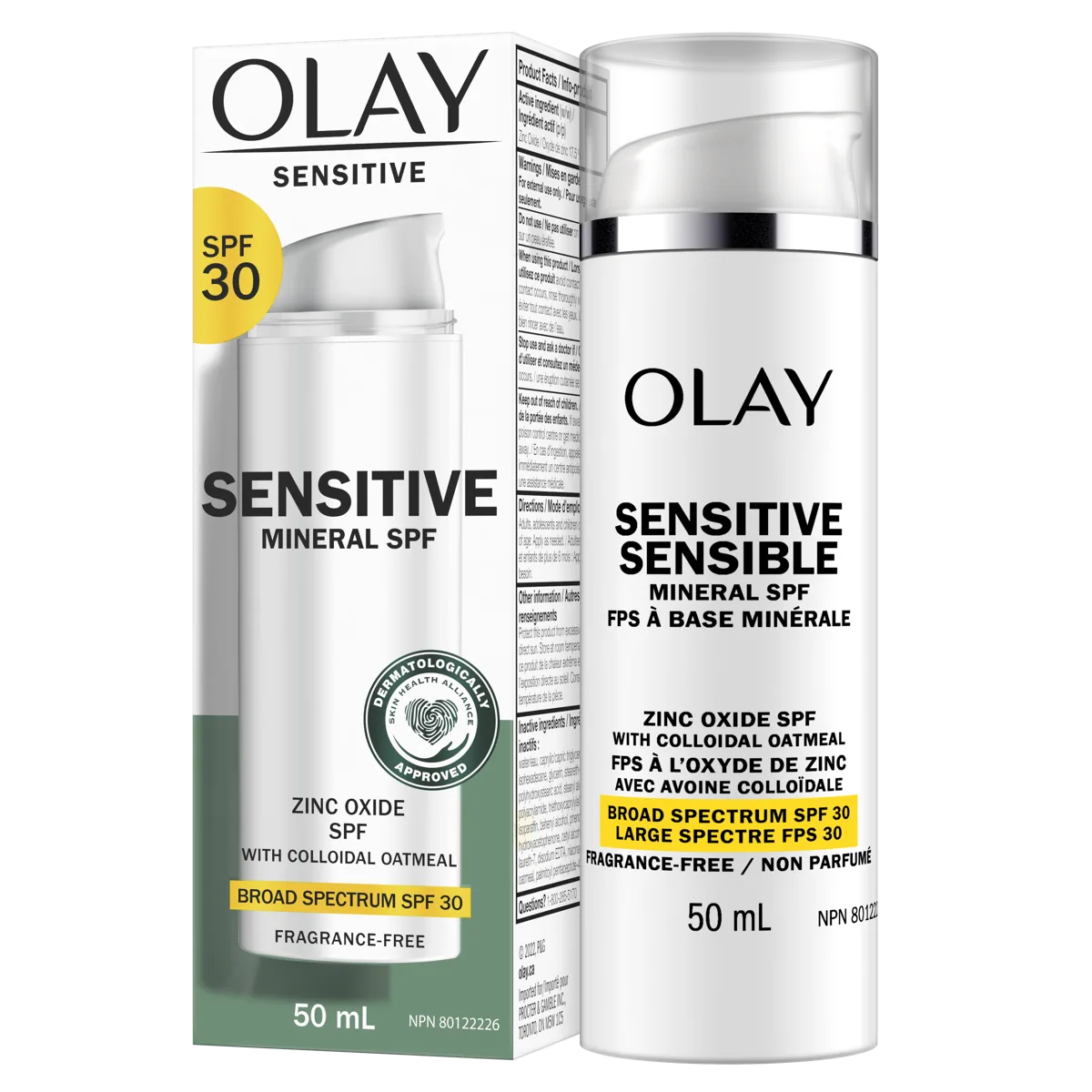
Sensitive Mineral Sunscreen SPF 30
Sensitive Skin Shield
 Verified reviewer
Pros & cons.
- +17.5% zinc oxide provides robust broad-spectrum protection without chemical UV filters
- +Colloidal oatmeal and niacinamide actively soothe and strengthen sensitive skin
- +Blends to a nearly invisible finish despite high zinc concentration
- +Fragrance-free, alcohol-free formula minimizes irritation risk for reactive skin
- +Includes Matrixyl peptide for collagen support — unusual in a sunscreen at this price
- +Comfortable satin finish that works well as a makeup base
- +Pleasant reapplication experience without pilling or heaviness
- −Small 1.7 oz bottle runs through quickly with daily use at this price point
- −Oily skin types may notice mid-day shine after several hours of wear
- −Limited review history as a 2023 launch makes long-term assessment difficult
- −No larger size available for better per-ounce value
- −Very deep skin tones may still notice a faint sheen from the zinc oxide
The full review.
There’s a quiet revolution happening in the drugstore sunscreen aisle, and Olay’s Sensitive Mineral Sunscreen is one of its more interesting foot soldiers. While most brands treat mineral sunscreen as a necessary evil — slapping zinc oxide into a base and calling it a day — Olay did something unusual here. They raided their own skincare ingredient cabinet and built a sunscreen that moonlights as a treatment product.
The formula centers on 17.5% zinc oxide, which is a generous concentration for SPF 30. Most mineral sunscreens in this range hover around 12-15%, so Olay is clearly prioritizing protection over cosmetic elegance. And yet, the elegance is here too. The polyhydroxystearic acid coating on the zinc particles does genuine work — this blends with about thirty seconds of effort into something approaching invisible on light-to-medium skin tones. It’s not the vanishing act of a chemical sunscreen, but it’s remarkably close for a formula this zinc-heavy.
What makes this more than just another mineral SPF is the supporting cast. Colloidal oatmeal isn’t here for decoration — it’s an FDA-recognized skin protectant with well-documented anti-inflammatory properties, rich in avenanthramides that actively calm reactive skin. Paired with niacinamide, which Olay has been researching for decades, you get a sunscreen that’s actively working to strengthen your barrier while it shields you from UV damage. Then there’s the Palmitoyl Pentapeptide-4, also known as Matrixyl — a collagen-supporting peptide that’s a genuinely smart inclusion in a daily sunscreen. The logic is sound: protect collagen from UV breakdown while gently encouraging new production.
The texture deserves specific praise. This applies like a lightweight moisturizer — no thick, draggy paste, no chalky residue. It sets to a satin finish that sits comfortably under makeup without pilling, which is more than many dedicated primer-sunscreen hybrids can claim. The lack of fragrance is a relief, not a compromise — the faint, neutral scent fades within seconds of application.
Performance during wear is solid if not spectacular. The satin finish holds up well for the first few hours, though oilier skin types may notice some shine creeping in by midday. For dry and normal skin, it wears comfortably and doesn’t emphasize texture or dry patches the way some mineral formulas can. Reapplication is pleasant — it layers over itself without balling up or feeling heavy, which is a practical advantage for a product you’re supposed to reapply every two hours.
The limitations are real but context-dependent. At roughly $25 for 1.7 ounces, this is expensive by drugstore standards — especially for a single-size offering with no larger, better-value option. The small bottle means you’ll go through it quickly if you’re applying the recommended amount daily, and the math starts to feel steep for what’s positioned as an accessible brand. Additionally, the review base is still thin. This is a relatively new addition to Olay’s lineup, launched in 2023, and it hasn’t accumulated the thousands of user reviews that would give full confidence in long-term performance across diverse skin types and climates.
The SPF 30 rating is perfectly adequate for daily incidental exposure — walks to the car, lunch breaks, office windows. For extended outdoor activity, you might want something higher, but for the intended use case, 30 is the sweet spot where protection is excellent and the formula can remain elegant.
Olay has built something genuinely thoughtful here. The ingredient list reads like it was designed by someone who understands that sensitive-skin consumers don’t just need protection from the sun — they need protection from the sunscreen itself. The colloidal oatmeal soothes, the niacinamide strengthens, the peptide supports, and the zinc oxide does its job without drama. It’s a sunscreen that respects your skin, and that’s worth something, even if the price-per-ounce gives you pause.
Formula
Ingredient analysis.
Full INCI list
Active Ingredient: Zinc Oxide 17.5%. Inactive Ingredients: Water, Caprylic/Capric Triglyceride, Isohexadecane, Glycerin, Steareth-21, Polyhydroxystearic Acid, Colloidal Oatmeal, Niacinamide, Palmitoyl Pentapeptide-4, Hydroxyacetophenone, C13-14 Isoparaffin, Steareth-2, Laureth-7, Stearyl Alcohol, Behenyl Alcohol, Cetyl Alcohol, Disodium EDTA, Polyacrylamide, Triethoxycaprylylsilane, Phenoxyethanol
Skin match.
The science.
The Science
Zinc oxide at 17.5% forms the backbone of this formula. It is one of only two UV filters the FDA and the scientific community recognize for true broad-spectrum protection across UVB, UVA II, and UVA I wavelengths. Chemical filters absorb UV radiation through molecular excitation, but zinc oxide reflects and scatters photons. This makes zinc oxide inherently photostable; it does not degrade from sun exposure like avobenzone.
The supporting ingredients have evidence. A 2012 review in the Journal of Drugs in Dermatology shows that colloidal oatmeal has FDA skin-protectant status. Its beta-glucan and avenanthramide content provide anti-inflammatory, antioxidant, and barrier-reinforcing properties. This is valuable in a sunscreen because UV exposure triggers skin inflammation; an active anti-inflammatory alongside the UV filter creates a more complete defense.
Niacinamide is one of the most studied cosmetic actives of the last two decades. A 2005 study in the British Journal of Dermatology shows that topical 2% niacinamide reduces transepidermal water loss by stimulating ceramide and free fatty acid synthesis in the stratum corneum. In this sunscreen, niacinamide reinforces the skin's barrier function while zinc oxide filters UV—a complementary mechanism that supports daily use.
Palmitoyl Pentapeptide-4, or Matrixyl, stimulates collagen. Work in the International Journal of Cosmetic Science (2005) shows it stimulates collagen I, III, and IV synthesis in fibroblast cultures. At the trace levels in this sunscreen, the effect is incremental, but adding a collagen-support peptide to a product that prevents UV-driven collagen damage is scientifically coherent.
References
- Colloidal Oatmeal: History, Chemistry and Clinical Properties — Journal of Drugs in Dermatology (2012)
- The effect of niacinamide on reducing cutaneous pigmentation and suppression of melanosome transfer — British Journal of Dermatology (2005)
Dermatologist Perspective
Dermatologists often recommend mineral sunscreens for sensitive, rosacea-prone, or post-procedure skin because zinc oxide and titanium dioxide sit on the skin's surface instead of being absorbed. The 17.5% zinc oxide concentration in this formula is within the effective range for daily protection. Including colloidal oatmeal aligns with dermatological practice, as it is one of the few over-the-counter ingredients with FDA-recognized skin protectant status. Board-certified dermatologists note that the best sunscreen is the one patients use consistently. The elegant texture of this formula addresses a major compliance barrier for mineral sunscreens: the thick, white, uncomfortable feel that causes many patients to skip application.
Where it fits in your routine.
Apply liberally to face and neck as your last morning skincare step, at least 15 minutes before sun exposure. Use a nickel-sized amount for the face. Reapply every two hours during prolonged sun exposure, or immediately after swimming, sweating, or towel-drying. Apply over serums and moisturizers. Wait about 60 seconds to set before applying makeup.
At about $25 for 1.7 ounces, this costs more than most drugstore options. Basic mineral sunscreens of this size cost $12-15, so the niacinamide, oatmeal, and peptide additions add cost. The value improves if you view this as a sunscreen-plus-treatment hybrid instead of a standard SPF product. The lack of a larger size is a missed opportunity — a 3 oz version at $30-35 would lower the per-ounce price and make daily use cheaper.
People with sensitive, easily irritated, or rosacea-prone skin want mineral sun protection without a white, heavy, or drying feel. This works well for those who want their sunscreen to act as skincare.
Oily skin types needing matte, oil-controlling sunscreen, and budget-conscious users seeking a large-format daily sunscreen with a lower per-ounce cost.
Product details.
This lightweight cream blends to a sheer, almost invisible finish. It feels more like a moisturizer than a traditional mineral sunscreen.
No fragrance — neutral, faintly product-like scent that dissipates quickly.
White squeeze tube with a flip-top cap. It is simple, hygienic, and controls dispensing well. The 1.7 oz size is travel-friendly.
Applies smoothly without the thick, chalky drag of many mineral sunscreens. Blends in within about 30 seconds with minimal to no white cast on most skin tones. Immediately feels comfortable — no tightness, stinging, or heaviness.
2-3 months with daily face application
12 months
All Year
The backstory.
Olay developed this as part of their sensitive skin expansion, recognizing that many mineral sunscreens either leave a white cast or skimp on the zinc concentration for cosmetic elegance. This formula aims to deliver serious mineral protection without the traditional tradeoffs, leveraging Olay's proprietary niacinamide research.
About Olay
Legacy Brand (20+ years)Olay has been a mass-market skincare staple since 1952, starting as Oil of Olay. The brand invests in dermatological research and publishes peer-reviewed studies on its formulations, specifically niacinamide and peptide technology.
Common myths.
Mineral sunscreens always leave a white cast
This formula uses polyhydroxystearic acid to coat the zinc oxide particles. This helps them disperse evenly and blend to a nearly invisible finish on most skin tones.
SPF 30 isn't enough protection
SPF 30 blocks about 97% of UVB rays. SPF 50 blocks about 98%. SPF 30 provides excellent protection for daily use with proper reapplication, and this broad-spectrum mineral formula covers the full UVA spectrum too.
FAQ.
Is this sunscreen safe for rosacea-prone skin?
Yes — this formula is fragrance-free, alcohol-free, and contains colloidal oatmeal and niacinamide. Both ingredients have anti-inflammatory properties that calm rosacea-prone skin. Zinc oxide is non-irritating and sits on top of the skin instead of being absorbed.
Can I use this sunscreen under makeup?
Yes. The lightweight, non-greasy finish works well under makeup. Wait 60 seconds for it to set before applying primer or foundation to prevent pilling.
Is this sunscreen reef-safe?
This formula uses zinc oxide as its only UV filter. It contains no oxybenzone or octinoxate, the two chemicals most linked to reef-safety concerns. No regulatory body certifies sunscreens as reef-safe, but zinc oxide is the most environmentally gentle UV filter available.
How does this compare to Olay's other sunscreens?
Unlike Olay's Complete SPF 30 for Sensitive Skin, which uses chemical UV filters, this Mineral Sunscreen relies entirely on zinc oxide for protection. It's the better choice for those who want to avoid chemical sunscreen actives entirely, though it's pricier per ounce.
Community
What the community says.
"Lightweight and non-greasy"
"No white cast when rubbed in"
"Gentle on sensitive skin without burning or stinging"
"Blends well across skin tones"
"Can feel slightly greasy after a few hours"
"Small bottle for the price"
"Limited availability at some retailers"
Featured in.
People also looked at.