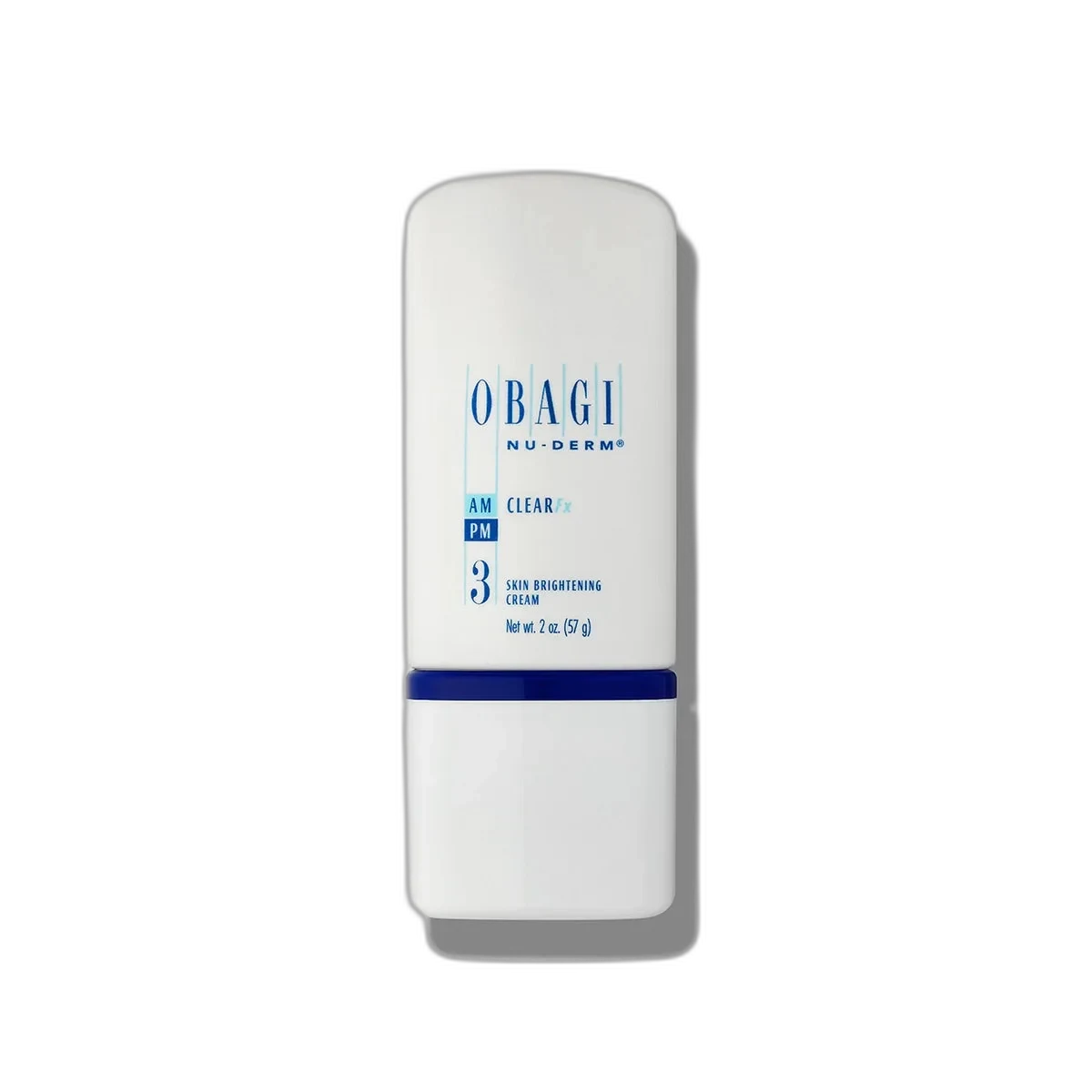
Nu-Derm Clear Fx
High-Dose Arbutin Brightener
 Verified reviewer
Pros & cons.
- +7% arbutin is one of the highest OTC concentrations available for serious brightening
- +Multi-pathway approach combining arbutin vitamin C and lactic acid targets pigmentation
- +Gentler than hydroquinone with lower risk of ochronosis and rebound pigmentation
- +Fragrance-free lightweight formula absorbs easily under moisturizer and sunscreen
- +Backed by the Nu-Derm system's decades of clinical dermatology experience
- +Effective for maintaining brightening gains between hydroquinone treatment cycles
- −Requires 3-6 months of daily use before meaningful brightening becomes visible
- −Contains SLS in a leave-on treatment cream which is unusual and potentially irritating
- −Three parabens included which will deter paraben-sensitive consumers
- −At $125 for 2 oz the price is steep for a relatively simple formulation
- −Dark spots may temporarily darken in weeks 2-8 before lightening begins
The full review.
About Obagi Nu-Derm Clear Fx
Obagi’s Nu-Derm system originally centered on hydroquinone before regulatory debates and consumer anxiety grew. The original Nu-Derm Clear used 4% hydroquinone—the gold standard for hyperpigmentation treatment—and it worked. When Obagi built the Fx line, they had to replicate hydroquinone’s brightening power without using hydroquinone. They chose 7% arbutin; this compromise works but requires patience and adjusted expectations.
Myth
Arbutin is hydroquinone’s polite cousin. It is a glycosylated form of hydroquinone that converts to hydroquinone in the skin at controlled, low levels. This provides tyrosinase inhibition without the concentration-dependent side effects that made prescription hydroquinone controversial. At 7%, this is one of the highest arbutin concentrations in an over-the-counter product. Most arbutin serums and creams use 1-2%; Obagi uses a much higher dosage.
Reality
The supporting ingredients are well-chosen. Ascorbic acid (vitamin C) provides a secondary brightening pathway by inhibiting melanin synthesis through a mechanism different from arbutin. Lactic acid adds gentle chemical exfoliation to promote cell turnover and reveal fresher skin beneath pigmentation, while also acting as a mild humectant at low concentrations. Tocopheryl acetate completes the antioxidant trio, protecting against UV-induced oxidative stress that triggers melanin production.
Texture
Clear Fx applies as a lightweight cream that blends easily and absorbs within one to two minutes. The formula is not marketed as fragrance-free, but the scent is minimal and functional. The texture is unremarkable: it does not pill, leaves no white cast, and sits comfortably under sunscreen and makeup. This invisible wearability is essential for a product used daily for months.
How to Use
Users must manage their expectations regarding the results timeline. Arbutin works slower than hydroquinone, which often shows visible lightening within two to four weeks. Many users report existing spots look slightly darker initially as arbutin draws pigment to the surface, a phenomenon lasting six to eight weeks. True lightening typically starts around the eight-to-twelve-week mark, and meaningful improvement in overall tone evenness may take four to six months of consistent daily use. This reflects arbutin’s gentler mechanism rather than a product flaw, but it requires a long-term commitment.
Common Complaints
The ingredient list has concerns. Sodium lauryl sulfate is present, which is unusual for a leave-on treatment cream and can irritate sensitive skin. The formula also contains three parabens (butylparaben, methylparaben, propylparaben); regulatory bodies consider these safe at cosmetic concentrations, but they will deter consumers seeking paraben-free products. Additionally, sodium metabisulfite, used as an antioxidant preservative, can trigger reactions in sulfite-sensitive individuals.
Price
The price is worth discussing. At $125 for 2 ounces, Clear Fx carries a premium reflecting the Obagi brand and physician-channel distribution. The 7% arbutin concentration justifies this somewhat, as comparable concentrations are hard to find, but the base formula is straightforward. The vitamin C appears after arbutin and surfactants, suggesting a modest concentration. This is not a sophisticated multi-pathway brightening formula; arbutin does the heavy lifting while the other ingredients play minor roles.
Best for
Clear Fx is a logical transition product for patients stopping hydroquinone by choice or on a dermatologist’s recommendation. It maintains tyrosinase inhibition through a gentler mechanism, helping preserve brightening gains without the risks of long-term hydroquinone use. It fills a clinical gap when used as a maintenance product between hydroquinone cycles.
Works for
Clear Fx works as a standalone brightening treatment for those who have never used hydroquinone, though the timeline and price require commitment. The arbutin concentration is high, the formula is stable, and the clinical pedigree is real. Whether the $125 price is justified depends on your value of the Obagi name and the 7% arbutin concentration, as the rest of the formula—containing SLS and parabens—is not premium.
Ingredient analysis.
Full INCI list
Water (Aqua), Arbutin, Cetyl Alcohol, Glycerin, Sodium Lauryl Sulfate, Stearyl Alcohol, Tocopheryl Acetate, Ascorbic Acid, Saponins, Sodium Metabisulfite, BHT, Lactic Acid, Disodium EDTA, Butylparaben, Methylparaben, Propylparaben.
Skin match.
The science.
The Science
Researchers have studied how arbutin inhibits tyrosinase. A 1995 study in the Journal of Biological Chemistry shows arbutin competitively inhibits tyrosinase activity. It binds to the enzyme's active site and stops L-DOPA from oxidizing into dopachrome, which is a critical step in melanin synthesis. This mechanism provides dose-dependent brightening without the cytotoxic effects seen with higher hydroquinone concentrations.
A 2017 clinical study in the Journal of Cosmetic Dermatology tested arbutin at 1-5% concentrations and found a significant reduction in melanin index after 12 weeks of daily use. The 7% concentration in this product is higher than that studied range, suggesting stronger inhibition, though published data for this specific concentration is limited.
Arbutin and L-ascorbic acid together inhibit melanogenesis via two pathways. Arbutin blocks tyrosinase directly, while vitamin C intercepts reactive oxygen species that trigger melanin production and inhibits melanin oxidation—the step that turns light pheomelanin into dark eumelanin. A 2006 study in Pigment Cell Research established that combining multiple melanogenesis inhibitors produces additive or synergistic effects.
Lactic acid, at the AHA concentrations found in treatment creams, accelerates keratinocyte turnover to shed melanin-laden surface cells. Research in Dermatologic Surgery (2001) documented lactic acid's dual role as an exfoliant and a melanin-dispersing agent, supporting its use in brightening formulations.
Dermatologist Perspective
Board-certified dermatologists often recommend Clear Fx for patients leaving hydroquinone or those seeking hydroquinone-free hyperpigmentation management. Dermatologists note the 7% arbutin concentration provides meaningful tyrosinase inhibition—higher than most OTC alternatives—making it a credible brightening tool. However, dermatologists state arbutin works on a longer timeline than hydroquinone; managing patient expectations for a 3-6 month commitment is essential. Doctors commonly prescribe the product as a maintenance treatment between hydroquinone cycles to prevent rebound hyperpigmentation.
Where it fits in your routine.
Apply a thin layer to clean, dry skin every evening. Focus on hyperpigmentation areas. Let it absorb fully before you apply moisturizer. Use it as part of the full Nu-Derm Fx system or as a standalone treatment. Always use broad-spectrum SPF 30+ during the day; the lactic acid increases photosensitivity and UV exposure counteracts brightening effects. Expect spots to look darker during the first 6-8 weeks; this is temporary.
Clear Fx costs $125 for 2 oz, making it a premium brightening treatment. The 7% arbutin concentration justifies part of this price, as comparable OTC concentrations are hard to find. However, the formula is simple (vitamin C, lactic acid, vitamin E), and the use of SLS and parabens lacks the sophistication expected at this price. For budget-conscious consumers, The Ordinary's Alpha Arbutin 2% costs under $10 and provides arbutin at a lower but effective concentration.
This treatment works for anyone with moderate-to-significant hyperpigmentation, sun damage, or post-inflammatory dark spots seeking a hydroquinone-free, clinical-grade formulation. It suits patients transitioning off hydroquinone who want to maintain brightening progress.
This product requires long-term commitment; do not expect rapid results. The SLS reacts with sensitive or dry skin. This formula uses three paraben preservatives. Shoppers on a budget can find effective arbutin products for less from brands like The Ordinary.
Product details.
This lightweight cream spreads easily and absorbs within one or two minutes. It has a non-greasy, non-tacky finish that sits well under other products.
Minimal, barely perceptible scent. No added fragrance.
Standard Obagi tube packaging in the Nu-Derm line's signature design. Tube protects the ascorbic acid from excessive air exposure.
Initial applications feel unremarkable. The cream applies smoothly without tingling or irritation for most users. The lactic acid may cause very mild tingling during the first few uses. There is no immediate visible brightening effect. Some users see existing dark spots look slightly darker during weeks 2-8 as pigment moves to the surface; this is expected and temporary.
3-4 months with daily evening use
12 months
All Year
The backstory.
When regulatory pressure and consumer preference shifted away from hydroquinone, Obagi faced a formulation challenge: how to maintain the efficacy of their flagship Nu-Derm Clear without the ingredient that made it work. The Fx (non-hydroquinone) line was their answer, replacing 4% hydroquinone with 7% arbutin — a structural relative that provides tyrosinase inhibition through a gentler, controlled-release mechanism. The transition preserved the system's clinical positioning while acknowledging the market's move toward hydroquinone-free options.
About Obagi
Legacy Brand (20+ years)Dr. Zein Obagi, a board-certified dermatologist and skin health restoration pioneer, founded Obagi Medical in 1988. The Nu-Derm system is a flagship product line that dermatologists have used for decades to treat hyperpigmentation and photo-aging.
Common myths.
Arbutin is just a weaker version of hydroquinone.
Arbutin is a glycosylated form of hydroquinone that converts to small amounts of hydroquinone in the skin. This controlled release inhibits tyrosinase with lower risk of side effects like ochronosis or rebound hyperpigmentation. At 7%, it is a legitimate brightening active, not a diluted alternative.
If dark spots darken initially, the product does not work.
Temporary darkening during weeks 2-8 is normal for arbutin. It draws existing melanin to the surface while it prevents new melanin formation below. This shows the product is active. Continue use through this phase to see brightening results.
FAQ.
How long does Obagi Nu-Derm Clear Fx take to work?
Clear Fx requires patience. Spots look darker during weeks 2-8 because arbutin draws pigment to the surface. Visible lightening starts at 8-12 weeks, and even skin tone takes 4-6 months of consistent daily use. This works slower than hydroquinone-based products but has fewer side effects.
Is Obagi Clear Fx the same as the original Nu-Derm Clear?
No. The original Nu-Derm Clear used 4% hydroquinone as its active ingredient. Clear Fx uses 7% arbutin instead—a structurally related but gentler ingredient. Both target hyperpigmentation via different levels of tyrosinase inhibition.
Can I use Obagi Clear Fx without the rest of the Nu-Derm system?
Yes, Clear Fx works as a standalone brightening treatment. Apply Clear Fx to clean skin in the evening, then use a moisturizer. Use a broad-spectrum SPF 30+ during the day. The lactic acid in Clear Fx increases sun sensitivity, and UV exposure counteracts the brightening effects.
Does Obagi Clear Fx contain hydroquinone?
No. Clear Fx is hydroquinone-free. It uses 7% arbutin instead—a naturally derived tyrosinase inhibitor that brightens skin without the side-effect profile of prescription-strength hydroquinone.
Is Obagi Clear Fx safe during pregnancy?
Clear Fx contains arbutin, vitamin C, lactic acid, and vitamin E, which are generally safe during pregnancy. But arbutin converts to trace amounts of hydroquinone in the skin. Some dermatologists advise caution with any hydroquinone-related ingredient during pregnancy. Consult your OB-GYN before use.
What the community says.
"Gradually and effectively lightens dark spots and sun damage"
"Less irritating than hydroquinone-based alternatives"
"Lightweight cream texture absorbs easily"
"Works well as part of the complete Nu-Derm Fx system"
"Dark spots may appear darker initially before lightening begins"
"Requires 3-6 months of consistent use for meaningful results"
"Expensive at $125 for a relatively simple formulation"
"Contains SLS and parabens in a leave-on product"
Featured in.
People also looked at.