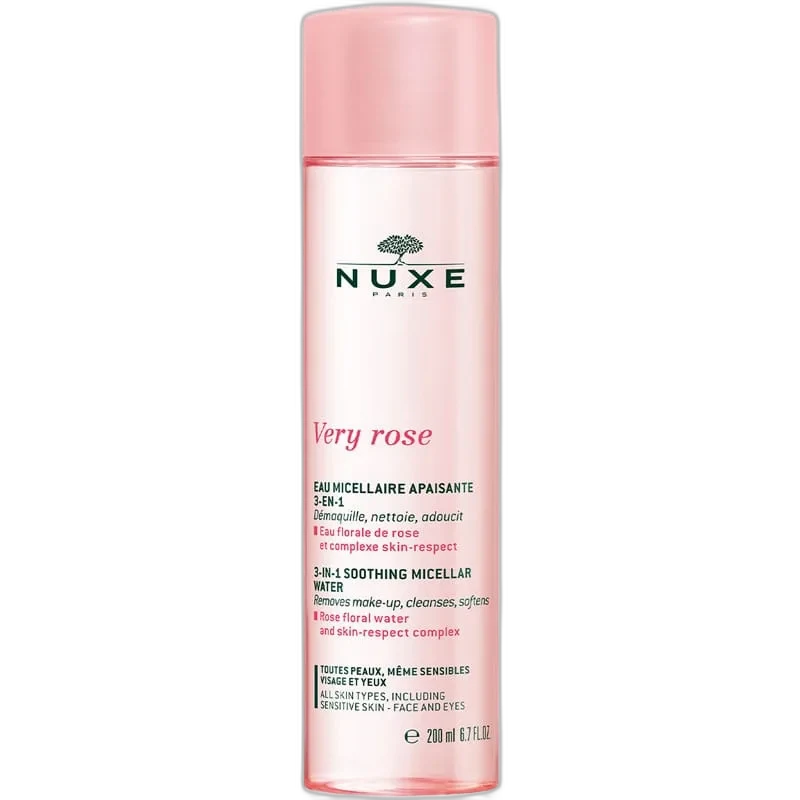
Very Rose Soothing Micellar Water
Sensitive Skin MVP
 Verified reviewer
Pros & cons.
- +Glycerin, hyaluronic acid and allantoin do genuine soothing work
- +Rose water adds polyphenolic support without heavy fragrance load
- +Comfortable on reactive skin that flushes with typical cleansers
- +Doesn't sting or blur vision around the eye area
- +Leaves a hydration layer instead of a dry, tight finish
- +Vegan formula unlike Nuxe's honey-based heritage lines
- +Legacy French pharmacy brand credibility behind the formula
- −Contains fragrance and allergens like linalool, geraniol and citronellol
- −Not effective on waterproof or long-wear makeup in a single pass
- −More expensive per milliliter than drugstore micellar waters
- −Flip-top plastic bottle isn't especially travel-friendly
- −Should still be followed by a rinse cleanser at night for full cleansing
The full review.
Micellar waters tend to have one job in a routine: get the makeup off, fast, and don’t cause a reaction. Nuxe’s Very Rose Soothing Micellar Water has a slightly different ambition, and once you’ve used it for a few weeks the difference becomes hard to ignore. Where most micellar waters are essentially diluted surfactant with water, Very Rose treats the cleanse as an opportunity to also soothe and hydrate. That’s what the glycerin, hyaluronic acid and allantoin in this particular formula are doing, and they are doing enough of the work to change how the product feels on reactive skin. The base of the formula does what every micellar water does — PEG-6 caprylic/capric glycerides and a couple of related mild surfactants form the oil-lifting micelles that pull off sebum, light makeup and sunscreen residue without foaming. What’s different is what comes next. Glycerin sits high on the ingredient list, hyaluronic acid is present at a meaningful dose for a leave-on rinseless product, and allantoin adds its usual soft calming action. The result, on skin that usually flushes the moment a cleanser touches it, is a genuinely uneventful cleansing step. No tightness, no flush, no drying tug at the corners of the mouth. The rose angle, which could easily have been a marketing fluff piece, earns its place for two reasons. First, the actual Rosa damascena flower water in the formula contributes a subtle, unsugared scent that makes the product feel like skincare rather than a utilitarian wipe substitute. Second, the polyphenolic contribution of rose water and rose petal extract — while it’s in the traditional-use column of evidence rather than the clinical-trial column — has a long track record of being well-tolerated on reactive skin. For a brand whose flagship line was always built around honey, shifting the soothing identity of a whole franchise to rose was a smart call, and the micellar water is where that decision pays off most clearly. The texture is what you’d expect: a thin, water-clear liquid with a very subtle silkiness when it’s sitting on a cotton pad. A single pad is enough for a morning refresh; at night, you’ll want two passes if you’re wearing full sunscreen, and you’ll want to follow with an actual rinse cleanser — this is not the product for walking away from a full day’s makeup in one step. Waterproof mascara and long-wear foundation are specifically not its wheelhouse, and trying to force it in that direction usually ends in over-scrubbing, which defeats the entire soothing promise. The honest criticisms are mostly about what the formula isn’t. It’s not fragrance-free — there’s declared parfum plus linalool, citronellol and geraniol in the ingredient list, which will rule it out for a small minority of fragrance-allergic users even though the overall fragrance load is modest. The packaging is also a plain flip-top plastic bottle, which is fine functionally but doesn’t travel particularly well and is a mild annoyance compared to pump-top micellars. The price lands at about eighteen dollars for 200 ml, which is genuinely more than drugstore micellar waters, and if your only metric is cost-per-milliliter you’ll find cheaper options. What you’re paying for is the humectant layer and the rose infrastructure, and whether that’s worth it depends on how much your skin actually benefits from the soothing step versus a basic micellar cleanser. Where Very Rose shines brightest is as a morning cleanse for anyone who doesn’t want to splash their face with water — reactive skin, rosacea-adjacent skin, skin recovering from retinoid use, skin that just doesn’t tolerate much. It’s also excellent as a quick first-cleanse step before a proper evening cleanser. Used that way, a 200 ml bottle realistically lasts six to eight weeks, and the per-use cost becomes quite reasonable. For what it is — a calm, thoughtful, hydrating micellar water with a clear pharmacy brand pedigree — Very Rose does its job well.
Texture
The texture is what you’d expect: a thin, water-clear liquid with a very subtle silkiness when it’s sitting on a cotton pad.
Scent
First, the actual Rosa damascena flower water in the formula contributes a subtle, unsugared scent that makes the product feel like skincare rather than a utilitarian wipe substitute.
Packaging
The packaging is also a plain flip-top plastic bottle, which is fine functionally but doesn’t travel particularly well and is a mild annoyance compared to pump-top micellars.
Best for
Where Very Rose shines brightest is as a morning cleanse for anyone who doesn’t want to splash their face with water — reactive skin, rosacea-adjacent skin, skin recovering from retinoid use, skin that just doesn’t tolerate much. It’s also excellent as a quick first-cleanse step before a proper evening cleanser.
Works for
It’s also excellent as a quick first-cleanse step before a proper evening cleanser.
Not ideal for
Waterproof mascara and long-wear foundation are specifically not its wheelhouse, and trying to force it in that direction usually ends in over-scrubbing, which defeats the entire soothing promise.
Common Complaints
The honest criticisms are mostly about what the formula isn’t. It’s not fragrance-free — there’s declared parfum plus linalool, citronellol and geraniol in the ingredient list, which will rule it out for a small minority of fragrance-allergic users even though the overall fragrance load is modest. The packaging is also a plain flip-top plastic bottle, which is fine functionally but doesn’t travel particularly well and is a mild annoyance compared to pump-top micellars. The price lands at about eighteen dollars for 200 ml, which is genuinely more than drugstore micellar waters, and if your only metric is cost-per-milliliter you’ll find cheaper options.
AM routine
A single pad is enough for a morning refresh;
PM routine
at night, you’ll want two passes if you’re wearing full sunscreen, and you’ll want to follow with an actual rinse cleanser — this is not the product for walking away from a full day’s makeup in one step.
Ingredient analysis.
Full INCI list · pH 5.5
Aqua, PEG-6 Caprylic/Capric Glycerides, Glycerin, Rosa Damascena Flower Water, Rosa Centifolia Flower Extract, PEG-60 Hydrogenated Castor Oil, Sodium Hyaluronate, Propanediol, Allantoin, Disodium Cocoamphodiacetate, Polysorbate 20, Parfum, Sodium Citrate, Citric Acid, Disodium EDTA, Potassium Sorbate, Sodium Benzoate, Phenoxyethanol, Benzyl Alcohol, Citronellol, Geraniol, Linalool
Skin match.
The science.
The Science
The cleaning action of this product rests on well-understood micellar chemistry: PEG-6 caprylic/capric glycerides and related surfactants form micellar structures in water where the hydrophobic tails face inward and the hydrophilic heads face outward. When those micelles encounter oil, makeup residue and sebum on the skin surface, the hydrophobic cores encapsulate the oil-soluble material and lift it onto a cotton pad, leaving the skin surface relatively free of surfactant residue. Research on micellar cleansing has consistently shown that these formulas are less disruptive to the skin barrier than traditional foaming cleansers, with smaller measured changes in transepidermal water loss after use. What differentiates the Very Rose formula is the concurrent humectant action. Glycerin, one of the most thoroughly studied humectants in cosmetic science, binds water at the stratum corneum and has been demonstrated to reduce transepidermal water loss even after rinse-off in multiple studies. Sodium hyaluronate performs a similar function at a different molecular scale, forming a thin hydrophilic film on the skin surface. Allantoin, which has a long history in both pharmaceutical and cosmetic formulations, has soothing and keratolytic properties that make it a standard inclusion in sensitive-skin products. The rose-derived ingredients themselves sit in the traditional-use column — there is a real body of research on rose polyphenols showing antioxidant and mild anti-inflammatory activity, but most of it is in vitro, and any topical benefit in a rinse-off or leave-on context at the concentrations used in cosmetic products is best described as a plausible contribution rather than a clinically proven effect.
Dermatologist Perspective
Dermatologists generally regard well-formulated micellar waters as a reasonable cleansing option for sensitive or reactive skin types, and the inclusion of humectants and soothing agents like those in this formula is commonly recommended for patients dealing with low-grade inflammation or barrier compromise. Board-certified dermatologists typically advise patients to treat micellar water as the first step in a double cleanse rather than the only cleansing step at night, particularly if sunscreen or makeup is involved. The fragrance content in this specific formula is the main clinical caveat — patients with known contact allergies to fragrance compounds, or those actively managing conditions like perioral dermatitis or seborrheic dermatitis, are usually steered toward truly fragrance-free alternatives from the same pharmacy shelf.
Where it fits in your routine.
Soak a cotton pad in the liquid and sweep it gently over the face and neck without scrubbing. For eye makeup, hold a saturated pad over closed eyelids for five to ten seconds before wiping; this lets the micelles work instead of your fingertips. Use it in the morning as a splash-free cleansing step, or at night as the first stage of a double cleanse. At night, always follow with a rinse-off cleanser if you wore sunscreen or makeup, then apply your normal toner or serum. One 200 ml bottle lasts most users six to eight weeks.
At about $18 for 200 ml, Very Rose costs more than most micellar waters—roughly double the per-milliliter price of basic drugstore options, but well below prestige brand pricing. Nuxe sells a 400 ml bottle of the same formula in some European markets; that larger size offers better per-milliliter value. The price reflects the humectant and soothing ingredient load instead of fancy packaging or marketing, a fair trade if your skin needs gentler cleansing. Cheaper options work for purely utilitarian makeup removal; for soothing-focused cleansing on reactive skin, the price-to-quality ratio is honest.
This works for sensitive, dry, or reactive skin types that feel tight or flushed after traditional cleansers. It acts as a morning cleanser and a hydration primer. It also suits travel or early-morning routines when you want to avoid splashing water on your face.
Skip this if you hate fragrance, need to remove heavy waterproof or long-wear makeup, or prioritize the lowest drugstore price. Users with active fragrance-contact dermatitis should use a fragrance-free micellar water instead.
Product details.
Thin, water-clear liquid with a slightly silky feel between fingers
Soft fresh rose, subtle and floral without being sweet
Clear plastic bottle with flip-top cap
The first use is unremarkable. The liquid is watery, the rose scent is subtle, and it does not sting the eye area. Reactive skin that usually flushes during cleansing stays calm, and the hydration layer prevents the usual micellar tightness.
6-8 weeks with daily use as a morning cleanse or makeup removal step
6 months
All Year
The backstory.
The Very Rose franchise launched in 2018 as Nuxe's dedicated sensitive-skin line, built around the brand's long relationship with rose ingredients and targeted at users who found the honey-and-oil heritage lines too rich. The micellar water quickly became the line's most repurchased product.
About Nuxe
Legacy Brand (20+ years)Nuxe has occupied French pharmacy skincare since 1989 and sells widely across Europe's pharmacy channels. The Very Rose franchise is its gentler, sensitive-skin line using rose water and rose petal extract.
FAQ.
Is this a good option for sensitive skin?
Generally yes. The glycerin, hyaluronic acid and allantoin combination is genuinely calming, and reactive skin that usually flushes during cleansing tends to stay comfortable. That said, the formula does contain fragrance and fragrance allergens, so users with known fragrance contact dermatitis should patch test first.
Does it remove waterproof makeup?
It is not effective. This light-to-medium micellar water cleanses and soothes daily. Use an oil cleanser first or switch to a more emulsifying biphase remover for waterproof mascara or long-wear foundation.
How does Very Rose compare to other French pharmacy micellar waters?
Most French pharmacy micellars have fewer humectants and a more clinical tone. Very Rose is more hydrating and has a stronger (though still gentle) rose scent. This makes Very Rose feel more like skincare than a utilitarian makeup remover.
Can I use it around my eyes?
Yes. The formula is safe for the eye area and comfortable for most contact lens wearers. It does not dissolve heavy eye makeup like a biphase remover, but it is gentle enough for light mascara and morning freshening.
Is Nuxe Very Rose Micellar Water vegan?
Yes. Unlike Nuxe's honey-based franchises, the Very Rose line uses only plant-derived ingredients and contains no bee or animal-sourced actives. Nuxe is not certified cruelty-free, however, so buyers seeking both may want to look elsewhere.
Community
What the community says.
"beautiful rose scent"
"genuinely soothing on reactive skin"
"removes light makeup easily"
"doesn't sting eyes"
"hydrating finish"
"fragrance not truly fragrance-free"
"doesn't remove heavy makeup in one pass"
"pricier than drugstore micellars"
"packaging not travel-friendly"
"not enough for waterproof mascara"
People also looked at.