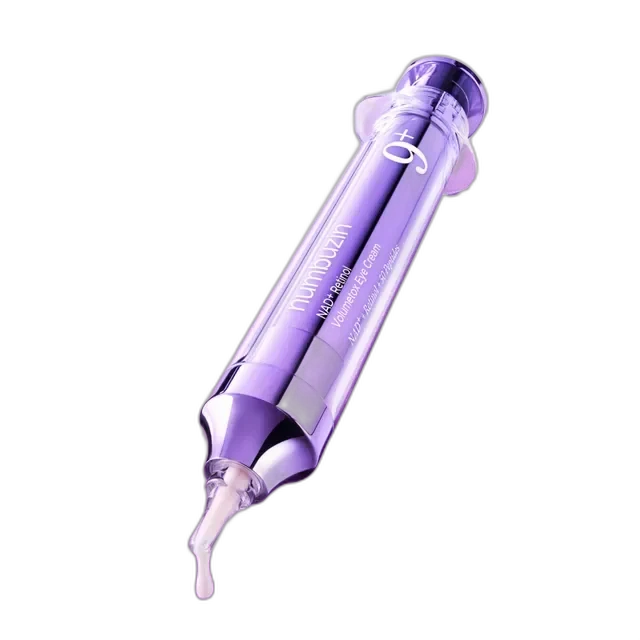
No. 9 NAD+ Retinol Volumetox Eye Cream
K-Beauty Eye Cream Powerhouse
 Verified reviewer
Pros & cons.
- +Extraordinarily complex formulation — retinol, NAD+, 30+ peptides, niacinamide, ceramides — at under $25
- +Gentle retinol concentration appropriate for the thin, sensitive periorbital skin
- +Dual NAD+ pathway: direct NAD+ plus niacinamide as a precursor for boosted cellular energy support
- +Rich, velvety texture that hydrates without migrating into the eyes during sleep
- +Fragrance-free and alcohol-free with no reported stinging or irritation
- +Over 840 reviews with consistently positive feedback on gentleness and brightening
- −10 mL tube is very small — lasts only 6-8 weeks even with minimal application
- −NAD+ topical efficacy is emerging science with limited independent validation
- −Individual peptide concentrations are likely very low given the 30+ peptides listed
- −Retinol concentration is undisclosed, making it hard to calibrate expectations
- −Contains silicones which some users prefer to avoid around the eye area
The full review.
The longevity community knows NAD+ well. Nicotinamide adenine dinucleotide—a coenzyme that powers cellular energy production and DNA repair—has led the supplement market for years, backed by researchers studying molecular aging. As we age, NAD+ levels drop; the theory suggests replenishing them could slow or reverse cellular aging. Oral supplements, IV infusions, and NAD+ precursors like NMN drive a billion-dollar industry. Numbuzin now asks: what if you apply NAD+ directly to the skin?
This is a bold claim, and the evidence for topical NAD+ delivery is still emerging. The molecule is large and does not penetrate the skin easily. Most studies supporting NAD+ as an anti-aging intervention focus on oral or intravenous use, not topical application. Numbuzin does not disclose the NAD+ concentration, and independent studies on topical NAD+ in skincare are sparse. If NAD+ were the only active in this formula, skepticism is warranted.
But NAD+ does not work alone—it is part of an ensemble that would be impressive at three times the price. Niacinamide is high in the ingredient list, and the science is clear: niacinamide is a direct precursor to NAD+ within the skin. The body converts niacinamide to NAD+ through the salvage pathway, a well-documented process. By including both the end product (NAD+) and its most efficient precursor (niacinamide), Numbuzin uses a dual-pathway approach—supplying NAD+ directly while boosting the skin’s own production. Whether topical NAD+ penetrates meaningfully or not, the niacinamide pathway is well-established.
Then there is the retinol. Positioned lower in the ingredient list, the concentration is likely gentle—suitable for the periorbital area where skin is up to ten times thinner than the rest of the face. Retinol’s ability to stimulate collagen production and accelerate cell turnover is one of the most validated claims in dermatology. Even at low concentrations, consistent nightly application improves fine lines around the eyes over 8-12 weeks.
The peptide complex makes the formula feel ambitious for its price. Over thirty peptides are included, such as Acetyl Tetrapeptide-5—marketed as EYESERYL, researched for under-eye puffiness via reduced fluid accumulation—and Copper Tripeptide-1, which has evidence for stimulating collagen, elastin, and glycosaminoglycan production. Multiple palmitoyl peptides target wrinkle depth and skin firmness through signal peptide mechanisms. Are all thirty peptides at an efficacious concentration? Almost certainly not. But even a few working at mild levels, alongside the retinol and niacinamide, creates a multi-pronged approach most eye creams in this price range do not attempt.
The vehicle is smart. Ceramide NP with cholesterol supports the fragile eye area barrier. Three forms of hyaluronic acid—regular, hydrolyzed, and sodium hyaluronate—provide multi-depth hydration. Macadamia and olive oils provide emolliency, and shea butter adds occlusive weight without heaviness. The texture is substantial enough to feel like a treatment, but not so heavy that it migrates into the eyes during sleep.
Users respond well. Over 840 reviews on Numbuzin’s own site show consistent praise for the gentle retinol that does not sting, the immediate brightening effect under the eyes, and the thick-but-not-greasy texture. The complaint about the 10 mL size is universal and valid—this is a very small tube, and even with tiny amounts for the eye area, it lasts about six to eight weeks. At $21, the monthly cost is reasonable, but the small tube is noticeable.
Numbuzin deserves credit for ambition, even if the NAD+ claim outpaces the evidence. The Numbuzin founders trained at Amorepacific—Korea’s largest beauty company—and their formulation reflects that: they layer multiple mechanisms at gentle concentrations instead of betting on one hero ingredient at a high dose. This philosophy reduces irritation risk while increasing the chance that several actives do meaningful work.
For the price, this eye cream offers more ingredient complexity than products costing three to five times as much. The retinol, niacinamide, ceramide, and peptide layers are all well-validated. The NAD+ is the speculative addition—potentially meaningful, but not yet proven for topical use. If you treat this as an excellent retinol-niacinamide-peptide eye cream with an intriguing NAD+ addition, rather than a NAD+ eye cream with supporting ingredients, you will set accurate expectations and likely see satisfying results.
Ingredient analysis.
Full INCI list
Water, Butylene Glycol, Glycerin, Propanediol, Macadamia Integrifolia Seed Oil, Niacinamide, Olea Europaea (Olive) Fruit Oil, Cetyl Ethylhexanoate, Methylpropanediol, Butyrospermum Parkii (Shea) Butter, Methyl Hydrogenated Rosinate, Polysorbate 60, Cyclopentasiloxane, 1,2-Hexanediol, Cetyl Alcohol, Stearic Acid, Glyceryl Stearate SE, Glyceryl Stearate, Dimethicone, PEG-100 Stearate, Cyclohexasiloxane, Hydrogenated Lecithin, Ammonium Acryloyldimethyltaurate/VP Copolymer, Sorbitan Stearate, Behenic Acid, Cocos Nucifera (Coconut) Oil, Hydroxyacetophenone, Polyacrylate-13, Vinyl Dimethicone, Behenyl Alcohol, Dimethicone/Vinyl Dimethicone Crosspolymer, Phytosteryl Isostearate, Polyisobutene, Ceramide NP, Nicotinamide Adenine Dinucleotide, Caprylic/Capric Triglyceride, Citric Acid, Retinol, Ethylhexylglycerin, Polyglyceryl-4 Oleate, Adenosine, Hydrolyzed Gardenia Florida Extract, Hydrolyzed Malt Extract, Hydrolyzed Viola Tricolor Extract, Theobroma Cacao (Cocoa) Seed Extract, Canola Sterols, Polysorbate 20, Disodium EDTA, Sorbitan Isostearate, Dextrin, Cholesterol, Polyglyceryl-10 Laurate, Ammonium Polyacryloyldimethyl Taurate, Hyaluronic Acid, Hydrolyzed Hyaluronic Acid, Sodium Hyaluronate, Phytosteryl/Behenyl/Octyldodecyl Lauroyl Glutamate, Aluminum/Magnesium Hydroxide Stearate, Pentaerythrityl Tetra-Di-T-Butyl Hydroxyhydrocinnamate, Potassium Cetyl Phosphate, Hydroxypropyl Cyclodextrin, Chitosan, Tris(Tetramethylhydroxypiperidinol) Citrate
Skin match.
The science.
The Science
The NAD+ angle in this formula is one of skincare's newer frontiers. NAD+ (nicotinamide adenine dinucleotide) drives mitochondrial energy production and activates sirtuins—enzymes that handle DNA repair, inflammation regulation, and cellular stress resistance. A 2014 Cell paper by Imai and Guarente showed that declining NAD+ levels mark aging in almost every tissue, including the skin. However, most NAD+ research studies oral supplementation or intravenous delivery; published evidence for topical NAD+ penetration and efficacy in human skin is limited.
Using niacinamide with NAD+ is biochemically sound. Niacinamide feeds the NAD+ salvage pathway via the enzyme NAMPT (nicotinamide phosphoribosyltransferase). Studies in the Journal of Investigative Dermatology confirm that topical niacinamide at 2-5% concentrations increases ceramide and free fatty acid synthesis in the stratum corneum and provides measurable brightening and barrier-strengthening effects.
The peptide complex includes Acetyl Tetrapeptide-5 (EYESERYL), which studies show has anti-edema properties around the eye. In vitro studies show it reduces protein glycation and decreases vascular permeability, which reduces under-eye puffiness and dark circles from fluid accumulation. Copper Tripeptide-1 (GHK-Cu) has more evidence; research in the Journal of Biomedicine and Biotechnology shows it stimulates collagen synthesis, attracts immune cells for tissue repair, and has antioxidant activity—though most studies use higher concentrations than this multi-peptide formula likely contains.
Dermatologist Perspective
Board-certified dermatologists note retinol remains a top validated topical anti-aging ingredient for the periorbital area, making its inclusion in a gentle, well-buffered eye cream clinically sound. Dermatologists usually advise starting with low-concentration retinol around the eyes and increasing gradually, a method this product's formulation supports. The NAD+ component interests dermatologists following longevity science, though most recommend focusing on proven ingredients—retinol, niacinamide, and peptides—when setting patient expectations. Clinicians appreciate the ceramide and hyaluronic acid support for maintaining barrier integrity in thin periorbital skin.
Where it fits in your routine.
Apply a rice-grain-sized amount to the under-eye area and orbital bone each evening, after serums and before moisturizer. Use your ring finger to pat the cream from the inner corner outward along the orbital bone, as it applies the least pressure. Do not apply directly to the eyelid or lash line. You can also use it in the morning; if you do, always apply SPF afterward. For best results, use it every night for 8-12 weeks before evaluating wrinkle and dark circle improvement.
At $21 for 10 mL, the cost is $2.10 per milliliter. This is higher than a facial moisturizer but competitive for a dedicated eye cream. The ingredient list is complex for this price: retinol, NAD+, 30+ peptides, niacinamide, ceramide NP, three forms of hyaluronic acid, shea butter, and multiple botanical extracts. Western clinical brands charge $50-100 for similar or smaller sizes with comparable ingredients. The small tube size is the main value concern; a 15-20 mL format at a slightly higher price would improve the value perception.
This multi-functional eye cream targets fine lines, dark circles, puffiness, and loss of firmness without luxury-brand prices. It suits K-beauty enthusiasts who like complex, multi-active formulations and users new to retinol around the eyes seeking a gentle entry point.
Avoid this if pregnant or breastfeeding due to the retinol content. The retinol level targets maintenance and prevention, so those seeking high-concentration retinol for advanced wrinkle correction may find this too gentle. If you prefer formulas with only extensively validated actives, the NAD+ component may not appeal.
Product details.
Fragrance-free with no noticeable scent. ***
A small 10 mL tube uses a narrow applicator tip for precise dispensing. The compact size travels easily but makes the per-use cost feel steep.
The cream feels thick and hydrates immediately on first use. The retinol concentration is gentle enough for the eye area and causes no tingling or irritation. The hyaluronic acid and emollient complex make the under-eye area look slightly brighter and more plumped after the first application. No adjustment period or peeling is expected. ***
6-8 weeks with twice-daily use on both eyes ***
12 months ***
All Year ***
The backstory.
Numbuzin's No. 9 series targets 'volume and wrinkle care' — the most advanced anti-aging category in their numbered system. This eye cream represents the brand's ambition to bring cutting-edge ingredients like NAD+ to K-beauty's accessible price tier. The formulation reflects the founders' Amorepacific training: layer multiple mechanisms at gentle concentrations rather than relying on a single hero ingredient at aggressive levels.
About Numbuzin
Emerging Brand (2–5 years)Benow, a South Korean beauty startup co-founded by Seoul National University alumni and former Amorepacific employees Lee Il-joo and Kim Dae-young, launched Numbuzin in 2019. The brand won top honors at the 2022 Olive Young Awards and operates in 16 countries. Its numbered product system uses simple, goal-based skincare routines.
Common myths.
Eye creams are just expensive moisturizers — your regular cream works fine around the eyes.
Periorbital skin is 10 times thinner than the rest of the face, has fewer oil glands, and ages earlier. This eye cream uses EYESERYL peptide for under-eye puffiness and retinol at a concentration calibrated for the thinner, more reactive eye-area skin — features a general moisturizer doesn't address.
Retinol is too harsh for the eye area.
Retinol concentration matters more than the ingredient itself. This formula uses retinol at a level below the high-actives in the ingredient list, which makes the concentration gentle enough for periorbital use. The ceramide and niacinamide in the formula buffer potential irritation.
FAQ.
Is the retinol in Numbuzin No. 9 eye cream strong enough to cause irritation?
No, for most users. The retinol uses a gentle concentration alongside ceramide NP, niacinamide, and shea butter to buffer irritation. Over 840 reviewers on the Numbuzin site report no significant irritation; many users note it is gentle and irritation-free around the sensitive eye area.
What does NAD+ do in a skincare product?
NAD+ (nicotinamide adenine dinucleotide) is a coenzyme that drives cellular energy production and DNA repair. Levels drop as you age, so topical application aims to support these skin processes. Oral NAD+ supplementation has substantial research, but topical delivery is newer. This emerging skincare ingredient shows promising but limited evidence for topical efficacy.
Can I use this eye cream in the morning?
Yes, if your skin tolerates retinol during the day. Use it in your morning eye-care step and apply SPF 30+ afterward, because retinol increases photosensitivity. Many users use it only at night to maximize the retinol's repair benefits during the skin's natural nighttime regeneration cycle.
Is Numbuzin No. 9 eye cream safe during pregnancy?
No. This product contains retinol. Most healthcare providers advise against using retinol during pregnancy and breastfeeding. If you are pregnant or planning pregnancy, use a retinol-free eye cream alternative.
How does this compare to more expensive retinol eye creams?
At $21 for 10 mL, this eye cream has an ingredient list — retinol, NAD+, 30+ peptides, niacinamide, ceramides, and three forms of hyaluronic acid — that matches or beats eye creams priced at $60-100. The trade-off is that retinol and peptide concentrations are likely lower than premium alternatives, and topical NAD+ efficacy has less clinical validation.
What the community says.
"Gentle retinol that doesn't irritate the eye area"
"Rich but not heavy texture"
"Visible improvement in under-eye brightness"
"Good value for the ingredient complexity"
"No stinging or burning on application"
"10 mL is a very small tube for the price"
"Retinol concentration not disclosed"
"NAD+ claims feel overhyped relative to the evidence"
"Slow to show dramatic wrinkle reduction"
People also looked at.