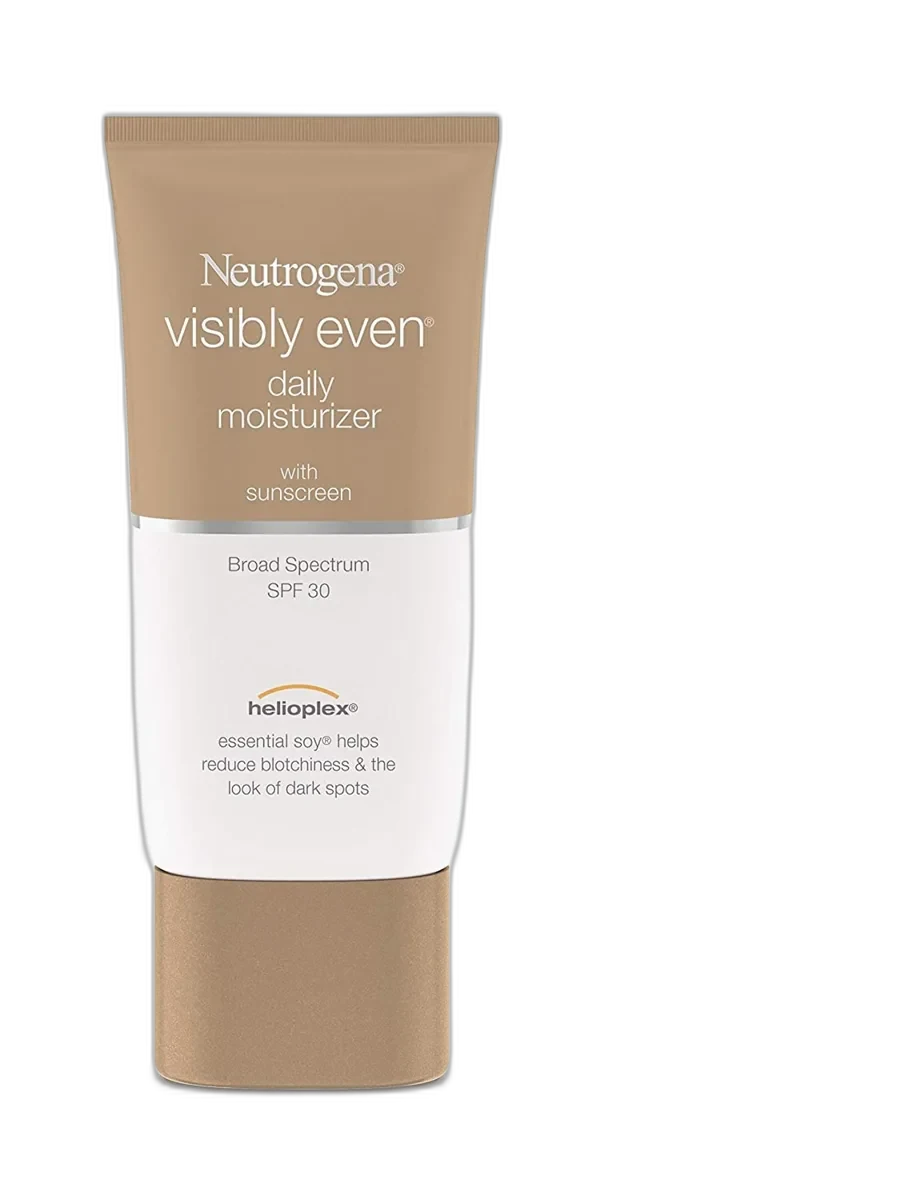
Visibly Even Daily Moisturizer SPF 30
Discontinued Cult Brightener
 Verified reviewer
Pros & cons.
- +Soy isoflavones provide genuine brightening through melanin pathway inhibition, not surface-level marketing
- +Helioplex-stabilized avobenzone delivers more reliable broad-spectrum UVA protection than unstabilized formulas
- +Lightweight non-greasy texture absorbs quickly and layers well under makeup
- +Optical blurring agents provide immediate luminosity while long-term brightening builds
- +Affordable drugstore price for a multitasking brightening SPF moisturizer
- +Fifteen years of real-world use confirms the formula works as intended for its target audience
- −Contains 3% oxybenzone, now widely avoided for health and environmental concerns
- −Three parabens in one formula feels excessive by current formulation standards
- −Fragrance and benzalkonium chloride add unnecessary irritation risk to a daily-use product
- −Discontinued by Neutrogena with no reformulated replacement
- −Not moisturizing enough for dry skin types, especially in cold or low-humidity climates
- −High cumulative sensitization risk from five chemical UV filters makes it unsuitable for reactive skin
The full review.
Before niacinamide became the ingredient every brand scrambled to put on their label, before tranexamic acid started showing up in serums at every price point, Neutrogena made a bet on soybeans. The Visibly Even line launched around 2007, built entirely around research showing that soy isoflavones could inhibit the transfer of melanin pigment from melanocytes to surrounding skin cells. It was a genuinely interesting scientific angle — not bleaching pigment like hydroquinone, but intercepting the delivery system. And they wrapped it in Helioplex, their proprietary avobenzone-stabilizing technology that was, at the time, one of the most reliable ways to get broad-spectrum UVA protection in an American drugstore product.
The Daily Moisturizer SPF 30 was the line’s anchor product, and for a while, it earned its shelf space. The formula does what it promises, albeit slowly and gently. The soy extract works through the PAR-2 pathway, blocking protease-activated receptor signaling that triggers melanosome uptake by keratinocytes. It’s not dramatic — you won’t see the overnight transformation that a prescription retinoid or hydroquinone delivers. But over four to eight weeks of consistent daily use, skin tone does appear more even, dark spots soften, and the general cast of dullness that accumulates from unprotected sun exposure starts to lift.
The texture earned its fans. A lightweight, dimethicone-smooth lotion that absorbs quickly and sits comfortably under makeup, it solved the daily problem of needing both moisturizer and sunscreen without the greasy, pilling compromise that plagued most two-in-one products of its era. The optical blurring agents — mica, boron nitride, and polymethyl methacrylate — add a subtle luminosity that gives skin an immediate polished quality before the soy has time to do its longer-term work. It was, in a word, pleasant.
But the formula carries baggage that modern skincare consumers won’t tolerate. Five chemical UV filters is a lot, and one of them is oxybenzone at 3% — an ingredient that has become persona non grata in the skincare world. A 2020 JAMA randomized clinical trial demonstrated that chemical UV filters including oxybenzone exceed the FDA’s systemic absorption threshold under maximal use conditions. Hawaii banned oxybenzone in reef-adjacent waters. Whether the health and environmental concerns are overblown or legitimate is still debated, but the court of consumer opinion has rendered its verdict, and oxybenzone lost.
Then there are three parabens — methyl, propyl, and ethyl — in a single formula. Fragrance. Benzalkonium chloride, a preservative that doubles as a skin irritant for reactive types. These were standard formulation choices in 2007. By 2020, they read like a checklist of ingredients that skincare-educated consumers actively avoid. The disconnect between the thoughtful soy brightening technology and the rest of the formula’s ingredient profile ultimately undermined the product’s credibility with the audience that would care most about a brightening moisturizer.
The SPF system deserves fair credit. Neutrogena’s Helioplex technology uses diethylhexyl 2,6-naphthalate to photostabilize the avobenzone, preventing the keto-enol tautomerization that makes unstabilized avobenzone lose its UVA protective capacity under sun exposure. This was legitimately innovative and gave the SPF 30 rating more real-world reliability than many competitors could claim. The five-filter approach — avobenzone, homosalate, octisalate, octocrylene, and oxybenzone — provides layered protection across both UVA and UVB spectrums.
The irritation profile, though, is significant. Five chemical filters, fragrance, and benzalkonium chloride create a cumulative sensitization risk that shows up clearly in user reviews. Multiple users report stinging and burning, particularly around the eye area. For a product marketed toward people with skin discoloration — a population that often includes those with post-inflammatory hyperpigmentation from reactive skin — this irritation potential is a meaningful contradiction.
Neutrogena eventually discontinued the entire Visibly Even line. The official product page carries a stark “DISCONTINUED” label, and standard retailers have cleared it from shelves. Remaining stock circulates on eBay and Amazon at inflated prices, a secondary market that speaks more to supply scarcity than to overwhelming demand. The product’s exit was quiet — no announcement, no reformulation, just a gradual disappearance as the formula’s ingredients fell out of step with where the market moved.
At its original price point of roughly sixteen dollars, the Visibly Even Daily Moisturizer offered reasonable value — genuine brightening technology, stabilized broad-spectrum protection, and a pleasant texture in one affordable tube. But value is relative to what else is available, and today’s drugstore shelves offer niacinamide SPF moisturizers, vitamin C day creams, and tranexamic acid treatments that achieve similar or better brightening without the oxybenzone, parabens, and fragrance overhead.
This product earns respect for its ambition. Neutrogena took legitimate science — soy isoflavone melanin pathway inhibition — and put it into an accessible, multi-benefit daily product a decade before the brightening category exploded. That the formula around that science has aged poorly doesn’t diminish what it represented. It was, for its moment, a smart product. That moment has passed.
Ingredient analysis.
Full INCI list
Active Ingredients: Avobenzone 3%, Homosalate 12%, Octisalate 5%, Octocrylene 1.7%, Oxybenzone 3%. Inactive Ingredients: Water, C12-15 Alkyl Benzoate, Dimethicone, Glycine Soja (Soybean) Seed Extract, Cetearyl Alcohol, Diethylhexyl 2,6-Naphthalate, Ethylene/Acrylic Acid Copolymer, Glycerin, Panthenol, Phenyl Trimethicone, Silica, Aluminum Starch Octenylsuccinate, Arachidyl Alcohol, Cetearyl Glucoside, Methylparaben, Steareth-2, Polyacrylate-13, Behenyl Alcohol, Titanium Dioxide, Steareth-21, Mica, Polymethyl Methacrylate, Disodium EDTA, Polyisobutene, Arachidyl Glucoside, Pentaerythrityl Tetra-Di-T-Butyl Hydroxyhydrocinnamate, Boron Nitride, Polysorbate 20, Propylparaben, Ethylparaben, Benzalkonium Chloride, Phenoxyethanol, Fragrance
Skin match.
The science.
The Science
The Visibly Even formula's brightening mechanism centers on soy isoflavones — primarily genistein and daidzein — extracted from Glycine soja seed. These isoflavones work through a specific and well-characterized pathway: they inhibit protease-activated receptor-2 (PAR-2) signaling, which is responsible for triggering the transfer of melanosomes from melanocytes to surrounding keratinocytes. A 2024 review published in Molecules documented that soy isoflavones demonstrate tyrosinase inhibition and melanosome transfer blocking in both in vitro and small clinical studies, though the evidence base remains smaller than for ingredients like niacinamide or vitamin C.
The Helioplex sun protection system is the formula's other notable technology. Standard avobenzone is notoriously photolabile — UV exposure triggers a keto-enol tautomerization that degrades its UVA protective capacity. Neutrogena addressed this by incorporating diethylhexyl 2,6-naphthalate as a photostabilizer, maintaining avobenzone's structural integrity under UV radiation. This approach was validated in the early 2000s and gave Neutrogena a legitimate competitive advantage in broad-spectrum protection before photostabilization became standard across the industry.
The oxybenzone component warrants discussion. A 2020 randomized clinical trial published in JAMA, conducted by FDA researchers, demonstrated that oxybenzone and other chemical UV filters exceeded the 0.5 ng/mL systemic absorption threshold under maximal application conditions. Oxybenzone showed the highest absorption levels among tested filters. The clinical significance of this absorption remains debated, but it prompted the FDA to request additional safety data and contributed to the ingredient's declining use in consumer sunscreens.
References
- Effect of Sunscreen Application on Plasma Concentration of Sunscreen Active Ingredients: A Randomized Clinical Trial — JAMA (2020)
Dermatologist Perspective
Dermatologists who recommended this product valued the combination of Helioplex-stabilized broad-spectrum protection with soy's gentle brightening action for patients who found hydroquinone too irritating. Board-certified dermatologists note that soy isoflavone brightening works through a different mechanism than most depigmenting agents — blocking pigment transfer rather than inhibiting pigment production — which makes it a gentler option for mild hyperpigmentation. However, the oxybenzone content and overall irritation burden of this formula led many dermatologists to transition patients to newer niacinamide-based alternatives once those became widely available at the drugstore level.
Where it fits in your routine.
Apply a nickel-sized amount to a clean face and neck. Use this as the last step of morning skincare, before makeup. Layer it over a vitamin C serum to increase brightening. Reapply every two hours during direct sun exposure. Normal and combination skin types can use this as a standalone moisturizer. Dry skin types can use a hydrating serum underneath.
At its original retail price of approximately sixteen dollars for 1.7 fl oz, this offered solid value — genuine soy brightening technology, Helioplex-stabilized SPF 30, and optical blurring agents in one lightweight tube. A tube lasted two to three months of daily use. However, the product is now discontinued, and secondary market prices of twenty to over one hundred dollars bear no relation to the formula's actual worth. Modern drugstore alternatives offer equivalent or superior brightening and sun protection without oxybenzone, parabens, or fragrance at comparable or lower prices.
This product works for normal and combination skin types with mild hyperpigmentation, dark spots, or dullness seeking one-step brightening and sun protection. It is best for users not sensitive to fragrance or chemical sunscreens.
People with sensitive or rosacea-prone skin, those avoiding oxybenzone or parabens, pregnant or nursing individuals, and those with melasma (soy's phytoestrogenic activity may worsen estrogen-mediated pigmentation) should avoid this. People preferring current-generation ingredient profiles should also skip it. Since this product is discontinued, most people should use modern alternatives instead.
Product details.
This lightweight, smooth lotion uses dimethicone for silicone-enhanced slip. It spreads easily without dragging and absorbs within one or two minutes. It is a fluid lotion rather than a thick or heavy cream.
Light synthetic fragrance exists on application but fades within minutes. It is not strong, but fragrance-sensitive users will detect it.
White plastic squeeze tube with twist-off cap, 1.7 fl oz. Standard Neutrogena drugstore packaging is functional and recognizable, not luxurious.
The mica and boron nitride optical blurring agents apply smoothly with a subtle luminous quality. Users sensitive to chemical sunscreens may feel mild tingling on first use. There is no purging period — brightening effects show gradually over the first two to four weeks.
2-3 months with daily morning face application
12 months
All Year
The backstory.
Launched as the anchor product of Neutrogena's Visibly Even line around 2007, this moisturizer was built entirely around soy isoflavone research for skin brightening. It was one of the earliest drugstore products to market soy as a serious skin-tone-evening active alongside genuine broad-spectrum protection. The line was eventually discontinued as its formula became dated — oxybenzone and parabens fell out of favor — and newer brightening ingredients like niacinamide and tranexamic acid took center stage.
About Neutrogena
Legacy Brand (20+ years)Neutrogena launched in 1930 and has decades of dermatologist recommendations. Now owned by Kenvue, it is among the most recommended drugstore skincare lines by US dermatologists. Its proprietary sun protection technologies, such as Helioplex, have published research.
Common myths.
Soy in skincare causes hormonal issues or systemic estrogenic effects
Topical soy isoflavones act locally on melanin pathways and do not reach systemic levels in meaningful amounts. However, people with estrogen-mediated melasma should be cautious, as phytoestrogenic activity may worsen that specific condition.
SPF in a moisturizer provides less protection than a standalone sunscreen
SPF testing is identical for every product vehicle. This product's SPF 30 provides the same measured protection as any standalone SPF 30 when applied at the standard 2mg per square centimeter — application amount, not product format, is the key variable.
FAQ.
Is Neutrogena Visibly Even Daily Moisturizer discontinued?
Neutrogena discontinued the Visibly Even Daily Moisturizer SPF 30. Target, Walgreens, and CVS no longer stock it. Secondary markets may sell remaining stock at higher prices, but these sellers do not guarantee freshness or authenticity.
Does Neutrogena Visibly Even really lighten dark spots?
Soy isoflavones in the formula inhibit melanosome transfer via the PAR-2 pathway. This reduces dark spot appearance over four to eight weeks of consistent use. It is a mild brightener and does not match prescription hydroquinone, high-concentration vitamin C, or tranexamic acid treatments.
Is Neutrogena Visibly Even safe for sensitive skin?
This product has high irritation potential. It contains five chemical UV filters, including oxybenzone, synthetic fragrance, benzalkonium chloride, and three parabens. Do not use it on sensitive, reactive, or rosacea-prone skin.
Does Neutrogena Visibly Even contain oxybenzone?
Yes, it contains 3% oxybenzone. This UV filter is increasingly avoided by consumers due to concerns about endocrine disruption, systemic absorption documented in FDA studies, and coral reef harm. This ingredient is one reason the product was likely discontinued in favor of updated formulations.
Can I use Neutrogena Visibly Even if I have melasma?
Use caution. Soy isoflavones reduce general hyperpigmentation, but soy is also a phytoestrogen. Because melasma is an estrogen-mediated condition, soy-based brighteners may worsen it. Consult a dermatologist before using soy-based products for melasma.
What is a good replacement for Neutrogena Visibly Even?
Modern alternatives with similar brightening-plus-SPF goals include niacinamide-based SPF moisturizers, products with tranexamic acid for dark spots, or vitamin C day creams with sunscreen — all use updated ingredient profiles without oxybenzone or parabens.
Is Neutrogena Visibly Even non-comedogenic?
Neutrogena markets it as non-comedogenic and hypoallergenic. But it contains cetearyl alcohol, which has a moderate comedogenicity rating, and polysorbate 20, which feeds Malassezia yeast. Results vary for acne-prone and fungal-acne-prone individuals.
What the community says.
"Noticeably evens out skin tone and softens dark spots over several weeks"
"Non-greasy lightweight texture absorbs quickly into skin"
"Works well as a makeup base with subtle luminosity"
"Reliable SPF 30 protection in one convenient step"
"Affordable drugstore price for a multitasking product"
"Burns or stings on sensitive and reactive skin types"
"Not moisturizing enough for dry skin in cold weather"
"Contains oxybenzone which many consumers now avoid"
"Has been discontinued and is increasingly difficult to find"
"Fragrance and parabens are dealbreakers for ingredient-conscious users"
People also looked at.