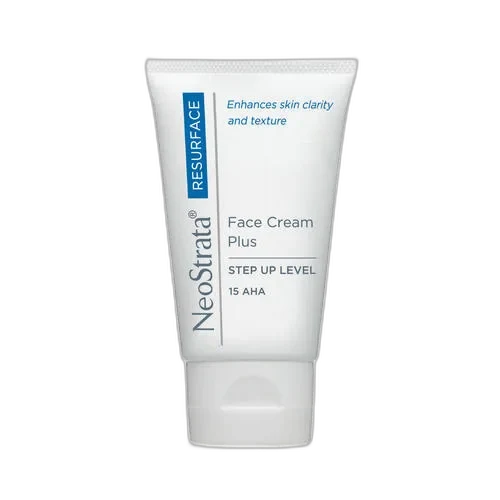
Face Cream Plus AHA 15
AHA Power Workhorse
 Verified reviewer
Pros & cons.
- +15% glycolic acid from the brand that invented and patented AHA technology delivers proven exfoliation results
- +Amphoteric formulation provides sustained, controlled exfoliation with less irritation than raw free-acid products
- +Cholesterol inclusion actively repairs barrier lipids depleted by the high-strength acid exfoliation
- +Simple, focused formula without unnecessary trendy ingredients — every component serves the glycolic acid delivery
- +Decades of real-world user validation with some users maintaining nightly use for 10-15+ years
- +Fragrance-free formulation reduces irritation risk on already-exfoliated skin
- +Fair pricing at $50 for 1.4 oz given the clinical-grade concentration and brand pedigree
- −Not suitable for AHA beginners — 15% glycolic acid requires prior tolerance building with lower concentrations
- −Contains methylparaben and propylparaben, which some consumers prefer to avoid
- −Increases photosensitivity significantly, requiring strict daily sunscreen use
- −Tingling sensation on application may be uncomfortable for those expecting a gentler moisturizer experience
- −Small 1.4 oz size limits longevity for those who also apply to neck and décolletage
The full review.
While markets chase new ingredients and influencer launches, NeoStrata Face Cream Plus sits in its tube, looking unremarkable, doing what it has done for over twenty years. It exfoliates. It moisturizes. It works. It lacks a TikTok moment, and it doesn’t need one.
The formula is simple. Glycolic acid at 15% leads the list, followed by meadowfoam seed oil, stearic acid, and several emollients and stabilizers. It has no peptides, no probiotics, no plant stem cells, and no trendy extracts. This is glycolic acid in a cream, made by the people who discovered what glycolic acid does for skin. This simplicity shows confidence in their ingredient knowledge.
Dr. Van Scott and Dr. Yu did more than study glycolic acid—they patented its topical application in 1973 and spent decades characterizing how it interacts with skin at various concentrations and pH levels. The 15% concentration in this cream hits a sweet spot they identified: high enough for clinical improvement in photoaging, but low enough (when partially neutralized) to avoid the severe irritation crude high-percentage glycolic formulations cause.
The amphoteric formulation is key. By partially neutralizing the glycolic acid with ammonium hydroxide and arginine, NeoStrata creates a delivery system where free acid and its salt coexist. The free acid provides immediate exfoliation at the skin surface, while the neutralized portion penetrates more slowly to act as a reservoir, extending the exfoliation effect. It is more sophisticated than the pH number suggests.
Cholesterol in the formula shows careful design. At 15% glycolic acid, you remove dead cells at an accelerated rate, which can thin the stratum corneum’s lipid barrier over time. Cholesterol is one of three essential barrier lipids (alongside ceramides and free fatty acids); including it helps replenish what the acid removes. Most glycolic acid products skip this, leaving barrier repair to whatever moisturizer you layer on top.
Meadowfoam seed oil provides the emollient base—it is high in long-chain fatty acids that sit at the skin surface to soften and protect. Dimethicone adds a silicone-smooth finish to help the cream spread evenly for uniform acid distribution and reduces water loss from the freshly exfoliated surface.
Using this cream is no-frills. Apply to clean, dry skin at night. Within seconds, you feel a distinct tingle ranging from mild to moderate depending on your tolerance and skin condition. The tingle is informative, not alarming—it confirms the acid is active and the pH is effective. It subsides within minutes, leaving skin feeling smooth and slightly tight. By morning, texture improves; skin looks clearer, brighter, and more refined.
The cumulative effect over weeks earns its cult following. By the third week, fine lines appear softer. By six weeks, skin texture has measurably improved. Users who use it nightly for years describe skin that looks significantly younger than their age suggests. This happens because consistent glycolic acid exfoliation at this concentration increases epidermal thickness and stimulates collagen production over time. Research supports this: published histological studies show long-term topical glycolic acid use increases dermal collagen content.
The formula contains methylparaben and propylparaben, which some consumers avoid. Preserving a cream at 15% glycolic acid concentration is difficult—the low pH limits which preservatives work, and parabens are reliable in these acidic conditions. Safety data on parabens at cosmetic concentrations remains favorable in regulatory reviews, but some users will pass on principle.
The limitation is the audience. This is not a beginner’s product. Someone new to AHAs starting with 15% glycolic acid will likely experience redness, peeling, and potential barrier damage. The cream assumes you have used lower concentrations—5%, 8%, 10%—and built tolerance. NeoStrata offers those stepping-stone products for this reason.
At $50 for 1.4 oz, the price is fair for a clinical-grade 15% glycolic acid cream from the brand that invented the technology. You pay for formulation expertise from four decades, not packaging or marketing. The tube lasts 2-3 months of nightly face application, costing under $20 per month for a product with anti-aging efficacy backed by decades of published research.
This cream won’t win beauty awards or generate Instagram buzz. It sits in medicine cabinets and delivers results year after year, recommended by dermatologists who value evidence over excitement. For experienced AHA users wanting serious glycolic acid exfoliation in a protective base, it remains one of the most reliable options—now and for the twenty-plus years it has been proving that point.
Ingredient analysis.
Full INCI list
Aqua (Water), Glycolic Acid, Limnanthes Alba (Meadowfoam) Seed Oil, Stearic Acid, Isopropyl Palmitate, Propylene Glycol, PEG-100 Stearate, Cetyl Alcohol, Glyceryl Stearate, Cholesterol, Isostearic Acid, Ammonium Hydroxide, Sorbitan Stearate, Arginine, Dimethicone, BHT, Hydroxyethylcellulose, Magnesium Aluminum Silicate, Disodium EDTA, Propylparaben, Methylparaben, Phenoxyethanol
Skin match.
The science.
The Science
Glycolic acid is the most studied alpha hydroxy acid. Peer-reviewed research spans four decades, much of it started or shaped by NeoStrata's founders. At 15% concentration, glycolic acid breaks ionic bonds between corneocytes in the stratum corneum. This accelerates desquamation and replaces photodamaged surface cells with fresher, more uniformly keratinized cells. A landmark study in the Journal of the American Academy of Dermatology shows that long-term topical glycolic acid use at 12-15% concentrations increases epidermal thickness, dermal collagen content, and acid mucopolysaccharide density—reversing several histological markers of photoaging.
NeoStrata innovation provides the amphoteric formulation in this cream. The formula partially neutralizes glycolic acid with ammonium hydroxide and arginine. This creates a mixture of free glycolic acid for immediate exfoliation at the stratum corneum surface and ammonium glycolate for slower penetration and a sustained exfoliation reservoir. This dual-delivery mechanism improves tolerability over fully free-acid formulations at equivalent concentrations.
Cholesterol addresses a known result of sustained AHA use: progressive depletion of stratum corneum barrier lipids. Research in the Journal of Investigative Dermatology shows the skin barrier relies on an approximately equimolar mixture of ceramides, cholesterol, and free fatty acids. By replenishing cholesterol topically during glycolic acid exfoliation, this formula supports barrier integrity—a strategy reflecting NeoStrata's decades of experience with long-term AHA use.
Dermatologist Perspective
Board-certified dermatologists often recommend 15% glycolic acid as a step-up treatment for patients who respond well to lower-concentration AHA products. Dermatologists value this cream's amphoteric formulation because it exfoliates effectively with a more predictable irritation profile than unmodified glycolic acid at the same percentage. In clinical practice, dermatologists commonly recommend this product for photoaging, dyspigmentation, and textural irregularities in Fitzpatrick skin types I-III. Dermatologists emphasize that strict photoprotection is mandatory during use. They typically advise patients to build up from every-other-night application to nightly use over a 2-3 week acclimation period.
Where it fits in your routine.
Apply a thin layer to a clean, dry face and neck every evening. Use it every other night for the first 1-2 weeks to test tolerance. A mild tingling sensation is normal and stops within minutes. Do not use this with other AHA, BHA, or retinoid products in the same routine. Apply broad-spectrum SPF 30 or higher every morning — glycolic acid increases photosensitivity for up to a week after each use. If skin peels or feels excessively dry, use it less often until skin adjusts. Avoid contact with eyes and broken skin.
At $50 for 1.4 oz, this cream costs a mid-range price for clinical-grade glycolic acid products. NeoStrata's formulation expertise provides the value, specifically the amphoteric delivery system and barrier-supportive ingredients like cholesterol. Cheaper alternatives lack these, as they only dissolve glycolic acid in a basic cream base. One tube lasts about 2-3 months with nightly facial application, making the monthly cost $17-25. This product offers solid value with decades of proven results and genuine AHA science pedigree. No alternate sizes are available.
Experienced AHA users want a serious, no-nonsense glycolic acid cream with decades of proven results. It suits normal to dry skin types showing signs of photoaging — fine lines, uneven texture, dullness, and sun damage — who already tolerate lower-concentration glycolic acid products. It works for those who value formulation science over trendy ingredients and want a reliable, long-term anti-aging workhorse.
AHA beginners without glycolic acid tolerance should start with 5-8% products. People with sensitive, rosacea-prone, or eczema-prone skin must avoid this concentration. A 15% glycolic acid product is unsafe if you do not use daily sunscreen. Those seeking paraben-free formulations must look elsewhere.
Product details.
Medium-weight emollient cream that spreads easily and absorbs without feeling greasy
Fragrance-free with no detectable scent
Tube in NeoStrata's Resurface line packaging with clinical branding
Expect a distinct tingling sensation on first application; the 15% glycolic acid causes this. The tingle is mild to moderate and lasts 2-5 minutes. This concentration may cause slight redness for first-time AHA users. Skin shows brightness and feels smoother after the first use. Mild flaking can occur during the first 1-2 weeks as skin adjusts to the exfoliation rate.
2-3 months with nightly face and neck application
12 months
fall winter
The backstory.
This is one of NeoStrata's original workhorse products, descended directly from the clinical formulations Dr. Van Scott used in his dermatology practice after discovering the cosmetic potential of glycolic acid. While the skincare industry has moved toward lighter, serum-based AHA formats, NeoStrata has kept this cream in production for decades because it works — and its loyal users, some of whom have used it nightly for 15+ years, won't let it go.
About NeoStrata
Legacy Brand (20+ years)Dermatologist Dr. Van Scott and dermatopharmacologist Dr. Ruey Yu founded NeoStrata in 1988. They invented alpha and polyhydroxy acid technology. NeoStrata has over 110 patents and nearly 250 published clinical studies and journal papers.
Common myths.
Higher AHA percentages are always better for anti-aging results.
At 15%, this cream is a high-strength product for experienced users. Increasing the concentration to 20% or more raises irritation risk without proportional efficacy gains. NeoStrata's amphoteric formulation at 15% often works better than crude higher-percentage products because the buffered delivery maintains consistent exfoliation without barrier damage.
Glycolic acid thins the skin over time.
The opposite is true: glycolic acid at these concentrations thickens the epidermis over time. It stimulates collagen production and accelerates cell turnover. Published research shows long-term AHA use increases epidermal thickness and dermal collagen density. The 'thinning' misconception comes from the temporary removal of dead surface cells.
FAQ.
Is 15% glycolic acid too strong for my skin?
This cream targets experienced AHA users with established tolerance. If 8-10% glycolic acid products work well, you can move to this 15% formula. NeoStrata's amphoteric (partially neutralized) formulation is more tolerable than a raw 15% free-acid product. Use it every other night, then move to nightly as your skin adjusts.
Can I use NeoStrata Face Cream Plus with retinol?
Do not use both in the same routine step. The 15% glycolic acid and retinol combination causes irritation and barrier compromise. Alternate nights instead — use glycolic acid cream one night and retinol the next — to get the benefits of both without overloading your skin.
Do I need sunscreen with this cream?
Daily broad-spectrum SPF 30 or higher is essential when using any glycolic acid product at this concentration. Glycolic acid increases photosensitivity because it removes the dead cell layer that provides UV protection. Even if you use this cream only at night, apply sunscreen every morning without exception.
How long does NeoStrata Face Cream Plus take to show results?
Most users see smoother, brighter skin after 2-3 weeks of nightly use. Fine line reduction and improved skin clarity show up after 4-8 weeks. Long-term users (months to years) report the biggest cumulative improvements in skin texture, tone evenness, and collagen density.
Why does this cream contain parabens?
NeoStrata uses methylparaben and propylparaben as preservatives in this formula. A 15% glycolic acid concentration requires effective preservation to maintain formula stability and prevent microbial contamination. Parabens are among the most well-studied and effective preservatives. The European Scientific Committee on Consumer Safety and multiple regulatory bodies have affirmed their safety at cosmetic concentrations.
What the community says.
"Dramatically smooths skin texture and reduces fine lines with consistent use"
"Users report visible results for over a decade of continuous use"
"Fragrance-free with a simple, effective formula"
"Absorbs well and can be used under makeup despite rich texture"
"Mild to moderate tingling on initial application, especially for new AHA users"
"Contains parabens which some consumers prefer to avoid"
"Requires strict daily sunscreen use due to photosensitivity"
"Too strong for beginners — requires prior AHA tolerance"