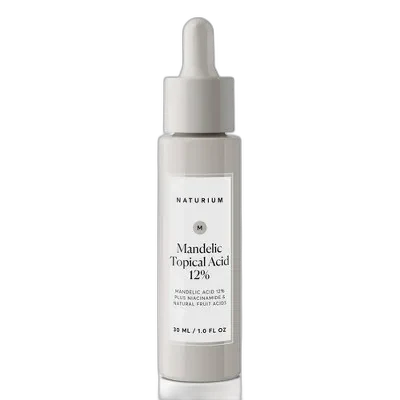
Mandelic Topical Acid 12%
Sensitive Skin's Gentle Exfoliant
 Verified reviewer
Pros & cons.
- +Full 12% mandelic acid at pH 3.5 — a genuinely effective OTC concentration
- +Significantly gentler than glycolic acid, making it accessible for sensitive and darker skin tones
- +4% niacinamide actively supports barrier function while the acid exfoliates
- +Lightweight, water-like texture absorbs instantly with no residue or pilling
- +Excellent $20 price point for a clinical-grade AHA exfoliant
- +Oil-free, silicone-free, fragrance-free formula suitable for acne-prone skin
- +Natural fruit AHA complex adds gentle multi-acid support
- −Small 1 oz bottle requires regular repurchasing with frequent use
- −Results are gradual — not for those seeking immediate dramatic exfoliation
- −Can still cause purging in acne-prone skin during first 2-4 weeks
- −Citrus fruit extracts may irritate extremely reactive skin types
- −Limited independent clinical data on this specific formulation
The full review.
Glycolic acid gets all the press. It is the AHA that launched a thousand serums, the one that beauty editors namecheck and dermatologists prescribe. But behind the scenes, there has always been another AHA that a specific subset of dermatologists has preferred — particularly for patients with darker skin tones, rosacea-adjacent sensitivity, or a history of post-inflammatory hyperpigmentation from overzealous exfoliation. That AHA is mandelic acid, and Naturium has made one of the most compelling cases for its mainstream adoption.
The chemistry is straightforward but important. Mandelic acid has a molecular weight of 152 daltons — roughly twice the size of glycolic acid at 76 daltons. In practical terms, this means mandelic acid penetrates the skin more slowly and more evenly. It does not dive down into the deeper layers as aggressively, which translates to less irritation, less redness, and crucially, less risk of triggering the very hyperpigmentation you are trying to treat. For anyone who has ever used a glycolic acid product and ended up with more dark spots than they started with, that distinction is not academic — it is the difference between a solution and a setback.
At 12%, this formula sits at a genuinely effective concentration. Many OTC mandelic acid products hide behind 5% or 8%, which are pleasant but often too gentle to produce meaningful change within a reasonable timeframe. Naturium commits to 12% at a pH of 3.5 — low enough for the acid to be in its free acid form, where it is actually active, rather than fully neutralized. This is a product that is formulated to work, not just to claim mandelic acid on the label.
The supporting cast is lean but intelligent. Four percent niacinamide provides dual benefit: it supports the skin barrier that the acid is actively dissolving the dead layers of, and it independently inhibits melanosome transfer to help with the very hyperpigmentation the mandelic acid is addressing from the exfoliation angle. Sodium hyaluronate adds a hydration safety net. A blend of natural fruit extracts — bilberry, sugar cane, orange, lemon, and sugar maple — contributes trace amounts of glycolic, lactic, citric, and malic acids, creating a gentle multi-acid symphony underneath the mandelic headline act.
The texture is essentially water. This is a thin, fast-absorbing liquid that you dispense with a dropper, spread across the face, and that disappears within seconds. There is no residue, no tackiness, no film. It layers beautifully under serums, moisturizers, and anything else you want to apply afterward. For an acid treatment, this ease of use matters — the less fuss a product requires, the more consistently you will actually use it.
On first application, expect a mild tingle. Not the sharp bite of a high-strength glycolic peel, but a gentle fizz that says the acid is active. It fades within a minute or two. Over the first couple of weeks, you may experience very mild flaking or a brief purging phase as accelerated cell turnover brings existing congestion to the surface. This is normal and resolves.
The results build gradually. After the first use, there is an immediate brightness — that fresh-faced glow that comes from dissolving the dull, dead cell layer on the surface. By week two or three, texture becomes noticeably smoother. Pores appear refined. By week six to eight, dark spots begin to fade with measurable evenness. This is not a product that delivers overnight transformation. It is a product that delivers real, cumulative change that you notice one morning when you catch your reflection and realize your skin looks different — clearer, more even, more alive.
The $20 price point is almost unfairly good. Mandelic acid has traditionally been positioned as a specialty ingredient, found in professional peels or premium serums priced at $40-60 and up. Naturium strips away the markup and delivers the active at a concentration and pH that respects what the research says works. The only real complaint is the 1 oz bottle size — at every-other-day use, you will get two to three months from it, which is reasonable, but nightly users will be reordering more frequently.
Naturium may be a young brand, but the science behind mandelic acid is not. Research dating back to the late 1990s has validated its efficacy for acne, hyperpigmentation, and photoaging, with particular emphasis on its safety profile for Fitzpatrick skin types IV-VI. What Naturium has done is package that science in a format that is affordable, accessible, and pleasant to use. The brand’s short track record means the formulation has not been tested by decades of reformulations and acquisitions, but the chemistry in the bottle is straightforward enough that there is little room for things to go wrong.
This is the exfoliant for people who have been burned — literally or figuratively — by glycolic acid. It is the exfoliant for people with melanin-rich skin who have learned the hard way that not all acids are created equal. And it is the exfoliant for anyone who wants steady, visible improvement without the drama of peeling, redness, or the anxiety of wondering whether tonight’s skincare routine will result in tomorrow’s inflammation. Mandelic acid deserves its moment, and this product makes a compelling argument for why.
Ingredient analysis.
Full INCI list · pH 3.5
Water, Mandelic Acid, Propanediol, Aminomethyl Propanol, Niacinamide, Polyacrylate Crosspolymer-11, Caprylyl Glycol, Vaccinium Myrtillus Fruit/Leaf Extract, Saccharum Officinarum (Sugar Cane) Extract, Sodium Hyaluronate, Citrus Aurantium Dulcis (Orange) Fruit Extract, Citrus Limon (Lemon) Fruit Extract, Acer Saccharum (Sugar Maple) Extract, Phenoxyethanol, Potassium Sorbate, Xanthan Gum, Hexylene Glycol, Phenylpropanol, Tocopherol
Skin match.
The science.
The Science
Mandelic acid is an alpha-hydroxy acid with a 152.15 daltons molecular weight—about twice that of glycolic acid (76.03 daltons). This larger size causes slower, more uniform penetration through the stratum corneum, which reduces irritation at similar exfoliating concentrations. A 2004 study by Jacobs et al. in the Journal of Cosmetic Dermatology shows mandelic acid treats acne and hyperpigmentation with fewer adverse effects than glycolic acid, especially in Fitzpatrick skin types IV-VI.
At pH 3.5, much of the 12% mandelic acid in this formula is in its free acid form (undissociated). This is the form that penetrates the skin to provide exfoliating activity. The pKa of mandelic acid is approximately 3.41, so at pH 3.5, roughly 45% of the acid is in its active free form—a balance between efficacy and tolerability.
The 4% niacinamide inclusion is a rational pairing. Mandelic acid exfoliates the surface to remove pigmented cells, while niacinamide inhibits melanosome transfer from melanocytes to keratinocytes via a separate mechanism documented by Hakozaki et al. (British Journal of Dermatology, 2002). This dual-pathway approach to hyperpigmentation works better than either ingredient alone.
The natural fruit extract blend (bilberry, sugar cane, citrus, and sugar maple) provides trace amounts of glycolic acid, lactic acid, citric acid, and malic acid. These concentrations are low, but multi-acid approaches provide broader exfoliation across different layers of the stratum corneum than single-acid formulations.
References
- A randomized, double-blind, half-face comparative study of mandelic acid for photoaging and acne treatment — Journal of Cosmetic Dermatology (2004)
- The effect of niacinamide on reducing cutaneous pigmentation and suppression of melanosome transfer — British Journal of Dermatology (2002)
Dermatologist Perspective
Board-certified dermatologists favor mandelic acid for patients with darker skin tones and those prone to post-inflammatory hyperpigmentation. Its slower penetration rate reduces acid-induced irritation that can trigger pigmentation. Dermatologists note the 12% concentration in this product is clinically meaningful and appropriate for unsupervised at-home use, especially with the pH buffered to 3.5. Many dermatologists recommend mandelic acid as a first-line AHA for patients who reacted poorly to glycolic acid, and the niacinamide inclusion follows evidence-based protocols for treating hyperpigmentation in sensitive or melanin-rich skin.
Where it fits in your routine.
Apply 3-5 drops to clean, dry skin in the evening after cleansing. Spread evenly across the face, avoiding the eye area and any open wounds. Allow to absorb for 1-2 minutes before applying a hydrating serum and moisturizer. Start with 2-3 times per week and gradually increase to every other night or nightly as tolerance builds. Do not use in the same routine as other direct acids or retinoids. Apply SPF 30+ every morning — AHAs increase sun sensitivity for up to a week after use. ### Value Assessment At $20 for 1 oz, this represents exceptional value in the AHA category. Professional mandelic acid peels can cost $75-150 per session, and competing OTC mandelic acid serums from boutique brands typically run $35-55 for similar or lower concentrations. Naturium delivers 12% at an optimal pH with 4% niacinamide and hyaluronic acid — a combination that would cost significantly more from clinical or luxury brands. The only value concern is the small bottle size, but at this price, even frequent repurchasing is manageable. ### Who Should Buy Perfect for anyone with sensitive skin, darker skin tones, or a history of irritation from glycolic acid who still wants effective chemical exfoliation. Ideal for treating hyperpigmentation, post-acne marks, dullness, and rough texture at a budget-friendly price point. ### Who Should Skip Skip this if you want dramatic, fast-acting exfoliation — a glycolic or salicylic acid will work faster (with more irritation). Also not appropriate for severely compromised skin barriers or active eczema flares — heal the barrier first, then introduce this gradually.
Product details.
Thin, water-like liquid with slight viscosity. It absorbs quickly and completely without residue or tackiness. It feels like a lightweight toner.
No added fragrance. A faint, barely perceptible acidic note dissipates immediately.
Frosted glass bottle with dropper dispenser. Clean Naturium branding with product information on a minimalist label.
The first application causes a mild tingling sensation for 1-2 minutes. This is normal for an AHA at pH 3.5 and shows the acid is active. The liquid absorbs almost instantly. Some users see an immediate brightening glow. Minor purging may occur in acne-prone areas during the first 1-2 weeks as the acid speeds up cell turnover. Use 2-3 times per week and increase frequency as tolerance builds.
2-3 months with every-other-day evening application to the full face
12 months
All Year
The backstory.
Mandelic acid has been something of an underdog in the AHA world — overshadowed by the marketing muscle behind glycolic acid despite being favored by dermatologists for darker skin tones and sensitive skin. Naturium's version brought mandelic acid into the mainstream affordable skincare conversation, making a clinical-grade concentration accessible at a drugstore price point.
About Naturium
Emerging Brand (2–5 years)Beauty journalist and influencer Susan Yara and brand accelerator The Center co-founded Naturium in 2020. e.l.f. Beauty acquired Naturium in 2023 for $355 million. Naturium formulations use well-studied ingredients at effective concentrations, but the brand's track record is short and independent clinical validation of its specific products is limited.
Common myths.
All AHAs irritate equally, so sensitive skin should avoid them entirely.
Mandelic acid has a larger molecular size, so it penetrates more slowly and uniformly than glycolic acid. This causes less irritation at comparable concentrations. This 12% mandelic acid formula at pH 3.5 is better tolerated than a 5-7% glycolic acid product. It works for sensitive and darker skin tones.
Mandelic acid works at 20%+ concentrations.
Clinical studies show improvements in hyperpigmentation, acne, and skin texture at 5-10% concentrations. This 12% concentration stays within the clinically effective range for daily or every-other-day use. Lower irritation potential improves long-term compliance.
FAQ.
Is Naturium Mandelic Acid better than glycolic acid for sensitive skin?
Yes, for most sensitive skin types. Mandelic acid has a larger molecular size, so it penetrates skin more slowly and evenly than glycolic acid, which causes less irritation. This 12% mandelic acid at pH 3.5 is generally better tolerated than a 5-7% glycolic acid product, but still provides exfoliation, brightening, and texture improvement.
Can I use Naturium Mandelic Acid with retinol?
Yes, but use them in different routines. Alternate mandelic acid one night and retinol the next to prevent over-exfoliation. After skin adjusts over several weeks, some experienced users layer them, but this increases irritation risk. The 4% niacinamide in this formula buffers sensitivity.
How often should I use Naturium Mandelic Topical Acid 12%?
Use 2-3 times per week in the evening for the first two weeks to let your skin acclimate. If your skin tolerates it, increase use to every other night or nightly. Watch for persistent redness, dryness, or peeling and reduce frequency if these occur. Always apply moisturizer after and use SPF 30+ the next morning.
Is Naturium Mandelic Acid safe for dark skin tones?
Yes — mandelic acid is a top recommended AHA for darker skin tones. Its slow, even penetration lowers the risk of post-inflammatory hyperpigmentation that stronger AHAs like glycolic acid trigger in melanin-rich skin. The 4% niacinamide also supports safe use by inhibiting excess melanin production.
Will Naturium Mandelic Acid cause purging?
It is possible. As an AHA, mandelic acid speeds cell turnover, which brings existing clogged pores to the surface during the first 2-4 weeks. This shows as small breakouts in your typical acne areas. If breakouts appear in unusual areas or last beyond 6 weeks, stop use; this is a reaction, not purging.
What the community says.
"Gentle enough for sensitive skin unlike glycolic acid"
"Visible brightening and glow after first use"
"Affordable alternative to expensive AHA treatments"
"Helps fade dark spots and post-acne marks"
"Lightweight liquid texture absorbs quickly"
"Can still cause irritation if overused or layered with other acids"
"Small 1 oz bottle for the frequency of use"
"Some users experienced initial purging in first weeks"
"Fruit extract blend may irritate very reactive skin"
People also looked at.