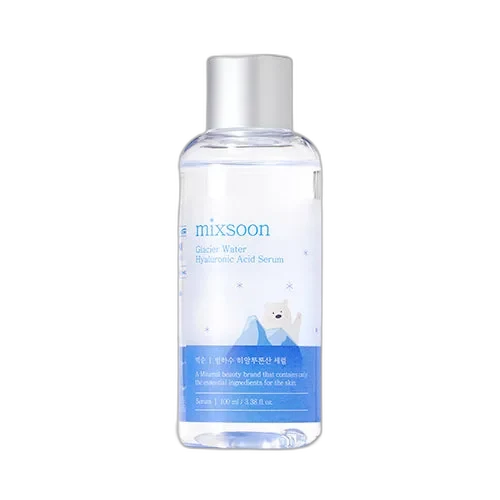
Glacier Water Hyaluronic Acid Serum
Budget Hydration Hero
 Verified reviewer
Pros & cons.
- +Triple hyaluronic acid complex provides multi-depth hydration that outlasts single-weight formulas
- +Outstanding value at $22 for 100 mL or $25 for 300 mL
- +Light gel texture absorbs quickly on damp skin without stickiness
- +Botanical extracts add soothing and antioxidant support alongside hydration
- +Layers seamlessly under all other products including retinoids and SPF
- +Available at Ulta Beauty for easy in-store access
- −Contains added fragrance — inconsistent with mixsoon's minimalist brand philosophy
- −Can feel tacky and non-absorbing if applied to dry skin instead of damp skin
- −Glacier water marketing overstates the functional benefit of the water source
- −Not fungal acne safe due to botanical extracts and polysaccharides
- −The 100 mL to 300 mL price jump ($22 to $25) makes the smaller size feel overpriced
The full review.
Here is an interesting contradiction: mixsoon built its reputation on radical minimalism. The Centella Asiatica Toner has four ingredients. The Galactomyces Ferment Essence has two. The brand name literally means ‘pure.’ So when the Glacier Water Hyaluronic Acid Serum arrives with 26 ingredients including added fragrance, it feels like meeting a monk at a nightclub. The philosophy has expanded.
Whether this expansion works depends on what you came to mixsoon for. If you valued the brand exclusively for its ingredient minimalism, this product represents a departure. If you valued it for effective Korean skincare at honest prices, the Glacier Water Serum delivers exactly that, with the kind of multi-ingredient formulation that most K-beauty brands build their hydrating serums around.
The core of the formula is a triple hyaluronic acid complex: standard hyaluronic acid, hydrolyzed hyaluronic acid (smaller molecular fragments that penetrate deeper), and sodium hyaluronate (the sodium salt form that is the most commonly studied in topical research). Three weights means three depths of hydration — surface plumping, mid-epidermal moisture binding, and deeper-layer hydration support. It’s the same multi-weight approach used by brands from Hada Labo to Drunk Elephant, and it works.
Supporting the HA complex are glycerin and propanediol (humectants), glyceryl glucoside (a sugar-based moisturizer that enhances the skin’s own aquaporin water channels), and a collection of botanical extracts — aloe vera, laminaria japonica (kelp), yam root, matsutake mushroom, and several others. These add soothing, antioxidant, and barrier-supporting properties around the hydration core. It’s not a simple formula, but every ingredient has a role.
The texture is a light gel that sits right in the sweet spot between watery essences and thicker serums. It has enough body to feel like it’s doing something, without the heaviness or stickiness that plague many HA serums. Applied to damp skin — and this is critical — it absorbs within about thirty seconds and leaves a dewy, plumped finish. Applied to dry skin, it can feel tacky and sits on the surface without absorbing properly. The damp-skin application isn’t optional; it’s essential.
The glacier water marketing deserves a frank assessment. Korean skincare has a long tradition of highlighting pristine water sources — Jeju Island volcanic water, deep-sea water, glacier water — as premium formulation bases. The reality is that water serves primarily as a vehicle for the active ingredients. The minerals in glacier water are present at trace levels that are unlikely to produce measurable skin benefits beyond what purified water provides. The hyaluronic acid, glycerin, and botanical extracts are what actually hydrate your skin. The glacier water is the story, not the science.
The fragrance inclusion is the product’s most notable compromise. Listed at the end of the INCI list (suggesting a relatively low concentration), it adds a light, clean scent that dissipates quickly. It’s not offensive and most users won’t think twice about it. But for a brand that prides itself on purity and whose other hero products are fragrance-free, it’s an inconsistency. For users who specifically sought out mixsoon because of its minimal, fragrance-free positioning, this will feel like a betrayal. For everyone else, it’s a minor footnote.
Performance is where the serum earns its place. The hydration is immediate and substantial. Skin that felt tight and dehydrated after cleansing feels soft and plump within minutes of application. Dry patches that normally require a heavy cream to manage become less noticeable. Over a week or two of consistent use, the baseline hydration level rises measurably — skin stays comfortable longer between applications, makeup sits better, and there’s a healthy dewiness that wasn’t there before.
The triple HA approach adds genuine depth to the hydration. Single-weight HA serums tend to provide surface-level plumping that can feel impressive initially but doesn’t last. The multi-weight approach here creates a layered effect — surface hydration, mid-layer moisture, and deeper moisture support — that extends the duration and completeness of the hydrating effect.
Value is the strongest selling point. At $22 for 100 mL, the per-unit cost is already competitive with budget HA serums. The 300 mL bottle at $25 is borderline absurd in its value — that’s roughly 6 months of product for the price of a single lunch. For a hydrating serum that you’ll use twice daily, the economics are extremely friendly.
The serum plays well with others. Under vitamin C, niacinamide, retinoids, and SPF, it layers without pilling or interference. As a hydration prep step before retinol, it helps buffer irritation. Mixed with a drop of facial oil, it creates an impromptu moisture cocktail. It’s the kind of versatile, everyday product that doesn’t demand attention but quietly makes everything else in your routine work better.
Ingredient analysis.
Full INCI list
Water, Dipropylene Glycol, 1,2-Hexanediol, Glycerin, Propanediol, Hyaluronic Acid, Hydrolyzed Hyaluronic Acid, Sodium Hyaluronate, Glyceryl Glucoside, Hydrolyzed Vegetable Protein, Maltodextrin, Dioscorea Japonica Root Extract, Aloe Barbadensis Leaf Extract, Laminaria Japonica Extract, Ulmus Davidiana Root Extract, Viola Mandshurica Flower Extract, Water, Butylene Glycol, Glycereth-25 PCA Isostearate, Erythritol, Tricholoma Matsutake Extract, Hydrolyzed Cicer Seed Extract, Rhododendron Chrysanthum Leaf Extract, Ethylhexylglycerin, Disodium EDTA, Fragrance
Skin match.
The science.
The Science
Multi-weight hyaluronic acid formulations use the molecular-size-dependent properties of HA to reach different skin depths. Standard hyaluronic acid (high molecular weight, typically >1000 kDa) forms a moisture-binding film on the skin surface, which plumps skin immediately and reduces transepidermal water loss. Hydrolyzed hyaluronic acid (low molecular weight, typically <50 kDa) enters the stratum corneum more effectively because of its smaller size, hydrating deeper epidermal layers.
A study in the Journal of Clinical and Aesthetic Dermatology shows that topical formulations with multiple molecular weights of hyaluronic acid hydrate better than single-weight formulations. This results in measurable improvements in skin moisture content, elasticity, and wrinkle depth reduction.
Sodium hyaluronate, the sodium salt of hyaluronic acid, is the most studied form in topical research. Its smaller molecular size compared to free HA improves percutaneous absorption. Research in Skin Research and Technology confirmed that sodium hyaluronate increases stratum corneum hydration in a dose-dependent manner.
Glyceryl glucoside, another ingredient in this formula, upregulates aquaporin-3 (AQP3) expression in keratinocytes. AQP3 channels are the primary water transport proteins in the epidermis. Increasing their expression improves how the skin moves and retains water — a different mechanism from external humectants like HA and glycerin.
References
- Efficacy of a New Topical Nano-hyaluronic Acid in Humans — Journal of Clinical and Aesthetic Dermatology (2012)
Dermatologist Perspective
Dermatologists recommend hyaluronic acid as a foundational hydrating ingredient for all skin types. Board-certified dermatologists note that multi-weight HA formulations, like the triple complex in this serum, hydrate more comprehensively than single-molecular-weight products. Dermatological guidance emphasizes the damp-skin application method — HA is a humectant that needs available water to work optimally. Dermatologists may note the added fragrance as a minor concern for highly reactive skin, though the concentration is low. This serum is a common recommendation for hydration prep before retinoid therapy.
Guidance
Where it fits in your routine.
Apply 2-3 pumps to freshly cleansed, damp skin morning and evening. Pat it onto the face and neck; do not rub. Damp skin is essential because HA needs water to bind. Follow immediately with serums and moisturizer. You can also apply it to damp skin between cleansing and toner if using an active toner. For extra hydration, apply multiple layers, letting each absorb before adding the next.
The value is exceptional. At $22 for 100 mL, the per-unit cost competes with drugstore HA serums. The 300 mL bottle at $25 offers high per-unit value — roughly 5-6 months of product at a price that makes the smaller bottle look overpriced. For a triple-HA formula with botanical extracts at Ulta, this is one of the best hydration values in K-beauty. The only caveat is the added fragrance, which mixsoon's more minimal products avoid.
Anyone seeking an affordable, effective hydrating serum for daily use. It works well for dehydrated skin, dry climates, and as a moisture layer before retinoids or other drying actives. The 300 mL size suits those who use hydrating products quickly or apply it generously to face, neck, and body.
Choose mixsoon's Centella Asiatica Toner if you require strict fragrance-free formulas. Users with active fungal acne may avoid the botanical extracts. The 26-ingredient list is complex if you want the simplest HA serum.
Product details.
Light, clean fragrance. The scent is mild and fades fast, but the INCI list shows added fragrance.
Plastic pump bottle. Comes in 100 mL and 300 mL sizes. Packaging is simple and clean. ***
The first application provides a plumping sensation. Skin feels more hydrated and looks dewier within minutes. The gel texture is cooling. Apply to damp skin for best results; it feels slightly tacky on dry skin. ***
2-3 months with twice-daily use (100 mL size) ***
12 months ***
All Year ***
The backstory.
mixsoon expanded beyond their centella and bean essences with this hyaluronic acid serum, targeting the massive demand for affordable hydrating serums in the K-beauty market. The 'glacier water' branding leverages the Korean skincare trend of using pristine water sources as a formulation base, though the functional benefit comes primarily from the triple HA complex.
About mixsoon
Emerging Brand (2–5 years)Jooup Hwang founded mixsoon in 2020. A Korean cosmetics veteran with over 10 years of experience, Hwang builds mixsoon around minimalist, natural-ingredient formulations sourced from South Korea.
Common myths.
Glacier water hydrates better than regular water.
Marketing claims often highlight glacier water's minerals, but the three forms of hyaluronic acid and glycerin are the primary hydrating agents in this formula. The water acts as a vehicle for the actives.
Hyaluronic acid serums can dry out skin in low humidity.
In very low humidity, HA can pull water from deeper skin layers instead of the atmosphere. This formula uses glycerin and multiple humectants to stop this. Applying an occlusive moisturizer after seals in hydration regardless of ambient humidity.
FAQ.
How does mixsoon Glacier Water Serum compare to Hada Labo?
Both are affordable hyaluronic acid serums popular in Asian beauty. The mixsoon version is thicker and adds botanical extracts to the triple HA complex. Hada Labo's Gokujyun uses a more minimalist formula. Both provide comparable hydration — choose based on texture preference or if you want the extra botanical ingredients.
Is mixsoon Glacier Water Serum fragrance-free?
No — mixsoon usually uses a minimalist approach, but this serum has added fragrance (listed at the end of the INCI list). The scent is mild and fades fast, but people with fragrance sensitivities should note this. For a fragrance-free mixsoon option, use the Centella Asiatica Toner instead.
Should I apply this serum to wet or dry skin?
Apply to damp skin. Hyaluronic acid draws water from its environment; applying to damp skin gives the HA immediate moisture to bind. On dry skin, the serum feels tacky and absorbs less effectively. Pat your face after cleansing so it stays slightly moist, then apply.
Can I use this with retinol?
Yes — this serum provides an excellent hydration layer before retinol. The triple hyaluronic acid complex buffers retinol's drying effects. Apply this serum to damp skin, let it absorb, then apply your retinol product and finish with moisturizer.
Which size should I buy — 100 mL or 300 mL?
The 300 mL ($25) has better per-unit value than the 100 mL ($22). The 100 mL is a reasonable starting point for first-time users, but the jumbo size is the smarter purchase if you have already used and enjoyed it.
What the community says.
"Deeply hydrating without stickiness"
"Skin feels plump and bouncy after use"
"Excellent value for the 300 mL size"
"Light gel texture absorbs easily"
"Contains fragrance despite brand's minimalist positioning"
"Can feel tacky if applied without toner underneath"
"Some find the 100 mL bottle depletes quickly"
Featured in.
People also looked at.