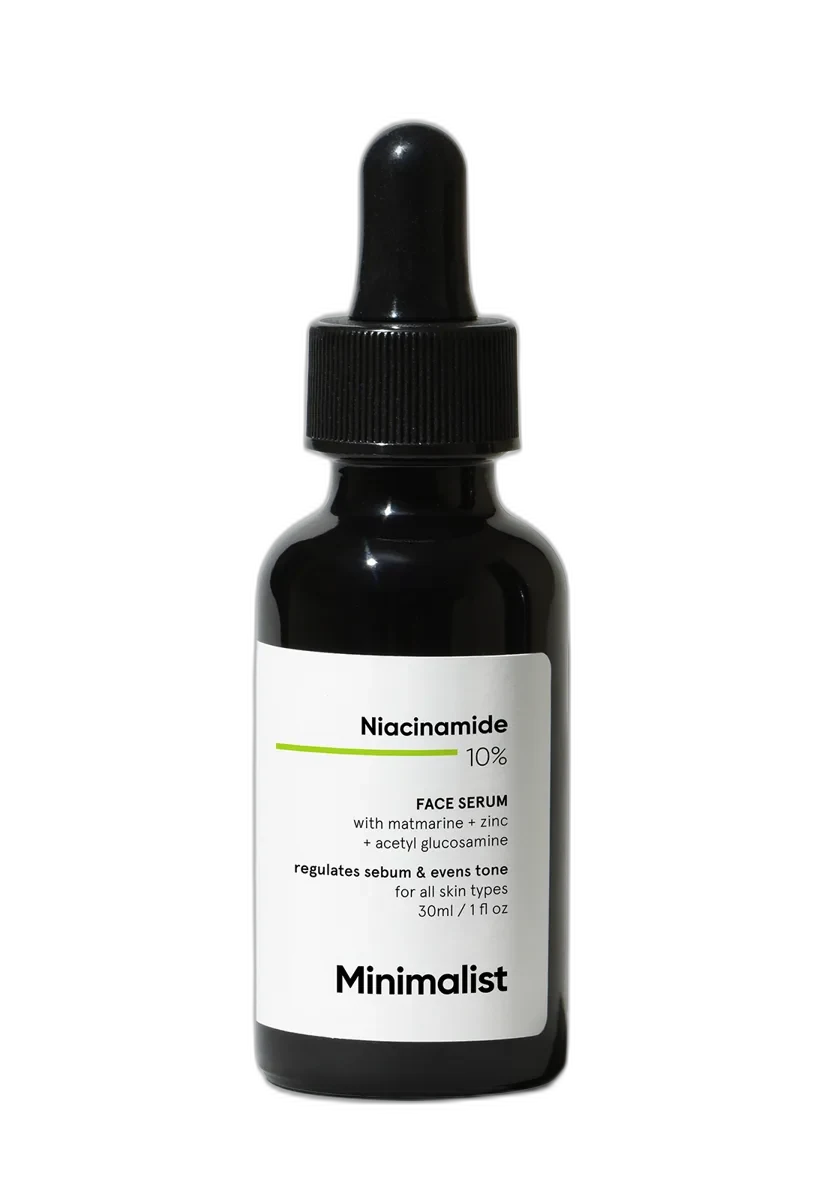
10% Niacinamide Face Serum
Indian Niacinamide Value Champion
 Verified reviewer
Pros & cons.
- +10% niacinamide at clinically studied concentration
- +Matmarine and acetyl glucosamine add mechanistic depth
- +Dual zinc supports anti-bacterial and anti-sebum action
- +Fragrance-free, alcohol-free, pH-balanced at 5.5
- +Brand publishes full INCI, pH, and batch number transparently
- +Exceptional value at roughly ₹599 ($7) for 30ml
- +Pregnancy-compatible with no restricted actives
- +Layers cleanly with retinoids, BHAs, and SPF
- −Small percentage of users experience niacinamide flushing
- −Not hydrating enough as a standalone for very dry skin
- −Slightly tacky finish for some users before moisturizer
- −Dropper packaging can feel cheap at this price point
- −Not a retinoid alternative for deeper wrinkle concerns
The full review.
In 2016, a small Canadian brand called Deciem launched a product under its Ordinary sub-brand called Niacinamide 10% + Zinc 1%. It was a plain, fragrance-free serum in a cheap dropper bottle that cost $6 and listed its two active ingredients directly on the label. That product sold out worldwide within weeks and permanently reshaped how the affordable skincare category thought about packaging, pricing, and active transparency. It also created a vacuum in every regional market that did not have comparable access to Deciem’s pricing or distribution. India was one of those markets. Into that gap stepped Minimalist, founded in 2020 by brothers Mohit and Rahul Yadav in Jaipur, with a premise that translated the Ordinary playbook to Indian cost structures and Indian skin concerns. They published full INCI lists, percentages, and pH values on every box. They refused to add fragrance. They priced the products below the local prestige alternatives but with a better ingredient density than the drugstore ones. And they started with a handful of SKUs, one of which was this 10% niacinamide serum. It is now one of the bestselling skincare products in the country, and the brand was acquired by Hindustan Unilever in 2024 at a valuation of around ₹3000 crore. That context matters because it tells you what kind of product you are actually buying. This is not a marketing-forward niacinamide serum built around a proprietary complex nobody can evaluate. It is an ingredient-transparent serum where you can read the exact INCI, the exact pH (5.5), and the exact actives, and decide for yourself whether the formulation is worth your money. The formula itself is genuinely sophisticated for the price. 10% niacinamide sits as the headline active, and niacinamide at 10% is one of the most clinically studied cosmetic ingredients in existence — published work demonstrates reductions in sebum production, pore appearance, and post-inflammatory hyperpigmentation over 8-12 weeks of consistent daily use. It also supports ceramide synthesis, which means it improves barrier function rather than stressing it. Around the niacinamide, Minimalist built a supporting cast that most budget niacinamide serums do not bother with. Matmarine, a Pseudoalteromonas ferment extract, is a biotechnologically derived marine active that specifically targets sebaceous gland output and has emerging in vitro data for reducing pore appearance through a different mechanism than niacinamide. Acetyl glucosamine is an amino sugar that inhibits melanin production upstream of tyrosinase — a mechanism that is synergistic with niacinamide’s melanosome-transfer blocking, and the combination has published additive brightening effects on dark spots. Dual zinc (Zinc PCA plus Zinc Glycinate) adds anti-bacterial and anti-inflammatory support. Sodium hyaluronate, glycerin, and allantoin form the hydration and soothing layer. The result is a serum that targets three concerns at once — oil control, pore appearance, and pigmentation — rather than just piling niacinamide into a plain base. On application, the experience is exactly what a well-made niacinamide serum should be. Thin, cool, clear, absorbs within 30 seconds, no stickiness for most users, no fragrance. A small percentage of users — maybe one in twenty — will experience mild flushing or tingling in the first week, which is a known and well-documented niacinamide tolerance reaction at 10% that resolves within 7-10 days as the skin adjusts. If you are one of those users, the fix is to start once daily, dilute with your moisturizer for the first week, or step down to a 5% niacinamide product. Over two to four weeks of twice-daily use, the first visible changes are usually midday surface oil and pore appearance. Over 8 to 12 weeks, the pigmentation story starts to show — post-acne marks and mild hyperpigmentation gradually fade, which is where the combination of niacinamide and acetyl glucosamine earns its inclusion. Active breakouts also tend to reduce in frequency, though the serum is not a replacement for a dedicated acne routine if you have moderate-to-severe acne. Honest limitations: this is not a hydration serum, so dry or mature skin will need a dedicated humectant layer on top. It is also not a retinoid, so expectations around deep wrinkle reduction should be moderated. And while the brand’s ingredient transparency is genuinely impressive, the individual actives are not proprietary to Minimalist — any brand could formulate a similar serum, and a few global competitors already do. What Minimalist offers is the specific combination of concentration, formulation, price, and ingredient transparency at a level that is uncommon in the affordable serum category. Pregnancy: safe, with no restricted actives. Sensitivity: generally well-tolerated but the 10% concentration is higher than some skin can handle — a patch test on the inner forearm for three nights is a reasonable first step for anyone who has reacted to niacinamide before. On value, this is one of the best skincare deals in the Indian market and genuinely competitive globally. At around ₹599 ($7) for 30ml, the per-ml cost is lower than The Ordinary’s equivalent in most markets, and the formulation is arguably more complete. If you are building a first serum into your routine, this is an easy starting point. If you are already using a niacinamide serum and wondering whether to switch, the question is whether the Matmarine and acetyl glucosamine additions matter for your specific concerns — if pores and pigmentation are at the top of your list, they do.
Ingredient analysis.
Full INCI list · pH 5.5
Aqua, Niacinamide, Glycerin, Butylene Glycol, Dimethyl Isosorbide, Propanediol, Ethoxydiglycol, Acetyl Glucosamine, Pseudoalteromonas Ferment Extract (Matmarine), Zinc PCA, Zinc Glycinate, Allantoin, Sodium Hyaluronate, Hydroxyethylcellulose, Phenoxyethanol, Xanthan Gum, Lecithin, Sclerotium Gum, Disodium EDTA, Sodium Benzoate, Potassium Sorbate.
Skin match.
The science.
The Science
Niacinamide at 10% is among the most studied cosmetic actives in dermatology literature. Clinical trials, including a landmark study in the British Journal of Dermatology, show reductions in sebum excretion, pore appearance, post-inflammatory hyperpigmentation, and fine line depth after 8-12 weeks of daily use at concentrations as low as 2% — with greater effects at 5% and 10%. The mechanism is multi-modal: niacinamide is a precursor to NAD+ and NADP+, supports ceramide and free fatty acid synthesis in keratinocytes (improving barrier function), and inhibits melanosome transfer from melanocytes to keratinocytes (reducing hyperpigmentation). At 10% concentration, tolerance is generally good, though a small percentage of users experience transient flushing from histamine release, which typically resolves with continued use. Matmarine, the trade name for Pseudoalteromonas ferment extract, is a biotechnologically derived active with published in vitro and panel data showing reduced sebaceous gland output and improved pore appearance. The evidence base is smaller than niacinamide's, but the mechanism is distinct, making it a plausible additive rather than a redundant ingredient. Acetyl glucosamine has published evidence for inhibiting melanin production upstream of tyrosinase; combination studies with niacinamide (including a 2007 paper in Dermatologic Surgery) show additive effects on post-inflammatory hyperpigmentation and facial hyperpigmented spots. The two zinc salts in this formula — Zinc PCA and Zinc Glycinate — support niacinamide's sebum regulation and provide mild anti-bacterial activity against Cutibacterium acnes. The pH of 5.5 disclosed on the product box is optimal for niacinamide stability and skin compatibility, confirming the serum is engineered thoughtfully. Independent third-party clinical testing on the specific Minimalist product has not been published, but the individual actives have strong independent evidence bases and the formulation approach matches published literature.
Dermatologist Perspective
Dermatologists frequently recommend 10% niacinamide serums as a foundational daytime and nighttime active for patients with oily, combination, or acne-prone skin, and for those concerned about post-inflammatory hyperpigmentation — which is common in South Asian, Middle Eastern, and darker skin tones. Board-certified dermatologists note that niacinamide is one of the few cosmetic actives with a strong evidence base across multiple concerns (sebum, pigmentation, barrier, aging) and that a well-formulated 10% serum at a skin-appropriate pH works for most adult skin types. Clinicians in Indian markets increasingly recommend Minimalist because the brand's ingredient transparency allows them to verify the formulation. The main clinical caveat is the small percentage of patients who experience flushing at 10% — for those users, clinicians typically recommend stepping down to a 5% niacinamide product, starting once daily rather than twice, or diluting with moisturizer for the first week.
Where it fits in your routine.
Use twice daily, morning and evening. After cleansing and toning, pat 3-4 drops from your palm or clean fingertips onto your face and neck. Wait 30-60 seconds for absorption, then apply moisturizer. Always finish your morning routine with broad-spectrum SPF 30 or higher. Do not layer this with pure L-ascorbic acid at low pH in one session — use vitamin C in the morning and niacinamide at night, or wait 20-30 minutes between applications. You can layer it with salicylic acid, retinoids, and most other actives on appropriate nights. If you are new to 10% niacinamide, use it once daily for the first week.
At roughly ₹599 (about $7 USD) for 30ml, this offers top skincare value in India and competes globally. The per-ml cost is approximately ₹20, which is lower than most Western budget niacinamide serums and much lower than any prestige equivalent. The formulation is more complete than The Ordinary's niacinamide serum at a similar price; Matmarine and acetyl glucosamine add mechanistic depth most budget options lack. There is no reason to pay more for a niacinamide serum unless you need a treatment-level concentration (25% is available from some brands) or want a luxurious sensorial experience, which are not the goals of this category. For most users, this serum delivers more per rupee than any other niacinamide product on the Indian market.
Oily, combination, or acne-prone readers seeking an affordable first serious serum, Indian-market buyers wanting a transparent, well-formulated 10% niacinamide option, and anyone targeting post-inflammatory hyperpigmentation, enlarged pores, or midday oil. It is also a reasonable pregnancy-compatible option for hormonal breakouts and melasma.
Choose a hyaluronic acid or peptide serum first if your skin is very dry or mature and needs hydration more than oil or pigmentation control. Skip this if 10% niacinamide causes you to flush and lower concentrations do not work.
Product details.
Fragrance-free. The niacinamide raw material has a faint yeasty smell, but most users won't notice it.
30ml amber glass bottle with a glass dropper. Minimalist's signature minimalist label prints the batch number, pH, and full INCI on the box.
First few uses: a cool, thin serum that absorbs into skin in about 30 seconds without residue. A small percentage of users feel mild flushing or tingling during the first week as skin adjusts to 10% niacinamide — this usually stops within 7-10 days. Most users see less midday surface oil within two weeks, then gradual fading of post-acne marks over 8-12 weeks of consistent use. ***
2-3 months with twice-daily face application in the 30ml bottle. ***
12 months ***
All Year ***
The backstory.
Minimalist was founded in 2020 by brothers Mohit and Rahul Yadav in Jaipur, India, explicitly as an answer to the lack of science-forward, transparent skincare in the Indian market. The founders published full ingredient lists, concentrations, and pH values from day one — borrowing the Ordinary's radical transparency approach but applying it to an Indian-cost structure. The 10% niacinamide serum was one of the brand's first three SKUs and became a runaway bestseller within six months. The company was acquired by Hindustan Unilever in 2024 at a valuation of roughly ₹3000 crore, cementing it as one of India's most successful D2C skincare exits.
About Minimalist
Emerging Brand (2–5 years)Mohit and Rahul Yadav founded Minimalist (registered as Be Minimalist), an Indian science-forward skincare brand, in 2020. Uprising Science Private Limited owns the brand. Minimalist publishes full INCI lists, percentages, and pH values for each product, a level of ingredient-transparency rare in the Indian market. HUL (Unilever India) acquired the brand in 2024, making it one of the fastest-growing Indian D2C skincare brands.
Common myths.
10% niacinamide is too strong and damages the skin barrier.
Published tolerance studies show most users tolerate 10% niacinamide well. A small percentage experience flushing during the first week, but this resolves as the skin adjusts. Barrier-damage concerns confuse niacinamide with exfoliating acids; niacinamide actually supports ceramide synthesis and improves barrier function.
Niacinamide and vitamin C neutralize each other, so do not use them together.
This myth relies on 1950s-era data regarding niacinamide and pure ascorbic acid at high temperatures. In modern stabilized formulations at skin-temperature conditions, the interaction is negligible. Most dermatologists consider niacinamide and vitamin C compatible when used together or alternated.
FAQ.
How does Minimalist 10% Niacinamide compare to The Ordinary Niacinamide 10% + Zinc 1%?
Both are pH-balanced 10% niacinamide serums with 1% zinc at similar prices. Minimalist adds two differentiators: Matmarine (a marine ferment that regulates sebum) and acetyl glucosamine (which inhibits melanin). The Ordinary started the 10% niacinamide category and has a longer track record; Minimalist has a more complete formula for users targeting pore appearance and post-acne marks.
Can I use this serum twice a day?
Yes, and most users see best results with twice-daily use. Apply after cleansing and toning, but before moisturizer, in both morning and evening routines. Use it once daily if you are new to niacinamide. Increase to twice daily after the first week if your skin tolerates it well.
Why does my skin flush or tingle when I first use this serum?
Some users experience mild niacinamide flushing at 10% concentrations. This reaction is known, reversible, and usually resolves within 7-10 days as the skin adjusts. If flushing is severe or persistent, dilute the serum by mixing one drop with one drop of moisturizer for the first week, or use a 5% niacinamide product instead.
Is Minimalist 10% Niacinamide good for sensitive skin?
Yes. The serum is fragrance-free, alcohol-free, and pH-balanced at 5.5, making it suitable for sensitive skin. However, the 10% niacinamide concentration is higher than some sensitive skin can tolerate. Patch test on the inner forearm for 3 nights before applying to the face.
Can I use this serum during pregnancy?
Yes. Niacinamide, zinc, acetyl glucosamine, and Pseudoalteromonas ferment extract are pregnancy-compatible. The formula lacks retinoids, salicylic acid, or other restricted actives. It works for pregnancy-related hormonal breakouts and melasma when used with a pregnancy-safe sunscreen.
Will this serum help with large pores?
Yes, but keep expectations realistic. Niacinamide does not shrink pores—pore size is mostly genetic—but it makes pores look smaller by regulating sebum, clearing surface congestion, and supporting barrier function. Most users see visible pore improvement after 8-12 weeks of consistent twice-daily use.
Community
What the community says.
"visible pore reduction"
"controls oil through the day"
"fades acne marks over 8-12 weeks"
"affordable for the formula quality"
"ingredient transparency disclosed by brand"
"mild flushing for some users"
"slightly tacky feel"
"not hydrating enough for dry skin"
"dropper can feel cheap"
People also looked at.