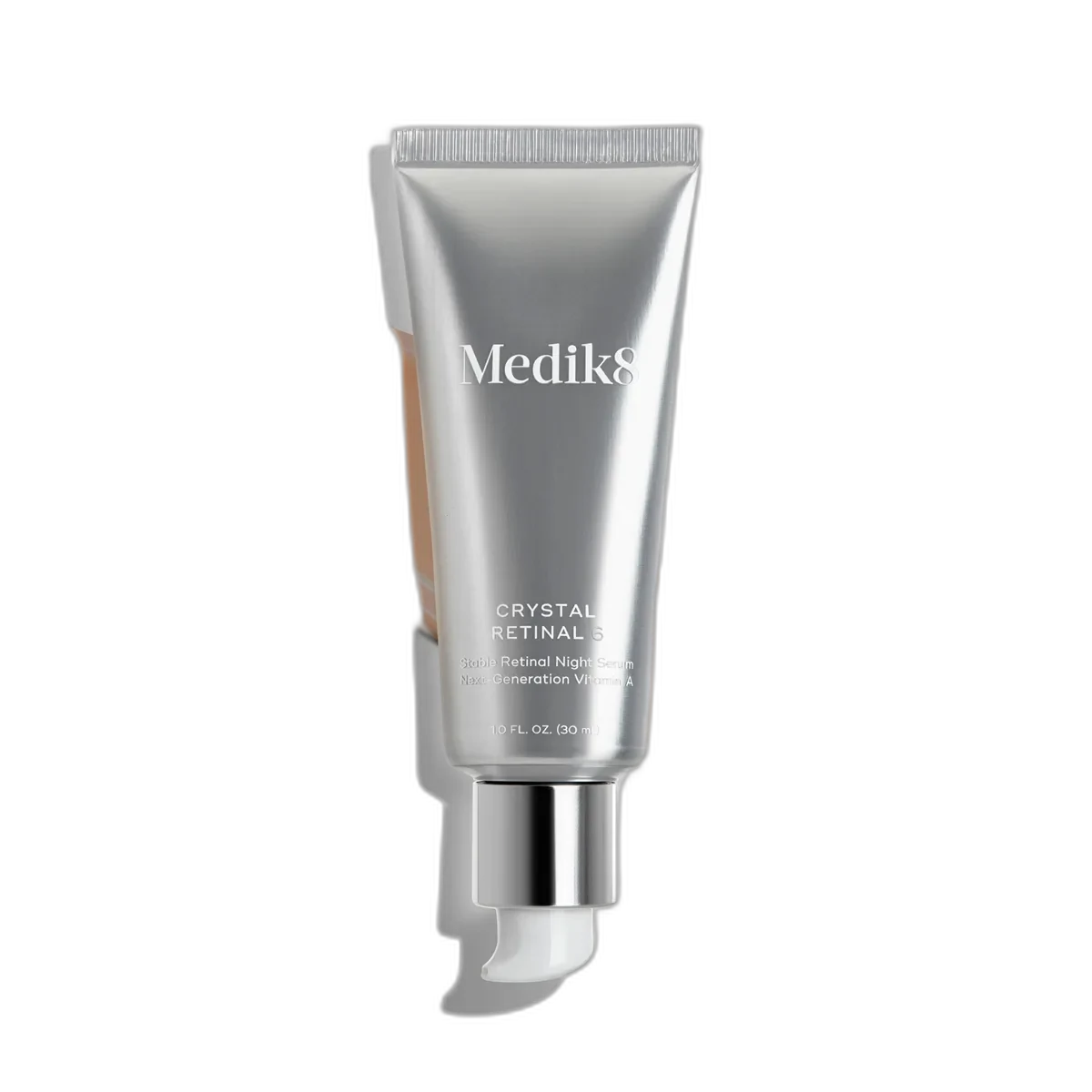
Crystal Retinal 6
Gold Standard Retinal
 Verified reviewer
Pros & cons.
- +Stabilized retinaldehyde via cyclodextrin encapsulation delivers prescription-adjacent efficacy
- +Graduated five-strength system allows precise tolerance building over time
- +Dual vitamin C forms provide comprehensive antioxidant protection across water and oil phases
- +Lightweight, fast-absorbing texture layers beautifully under moisturizer without pilling
- +Airless pump packaging preserves retinaldehyde stability throughout the product's life
- +Silicone-free formula with squalane and hyaluronic acid supports barrier function during retinoid use
- +Visible texture and pore improvements typically appear within the first month
- −Premium $85 price for 30 mL requires commitment, especially across multiple strength levels
- −Contains coumarin and botanical extracts that may concern fragrance-sensitive users
- −Initial adjustment period with flaking and tingling is unavoidable for most new users
- −Not suitable for retinoid beginners — requires prior tolerance from lower strengths
- −Golden tint may be visible on very fair skin tones if not followed by moisturizer
The full review.
Retinaldehyde has long teased the skincare industry. One conversion step from prescription-strength retinoic acid, it offers tretinoin-level efficacy with over-the-counter accessibility. However, retinaldehyde degrades instantly upon contact with light or air, making formulation difficult. Most brands abandoned the ingredient. Medik8 did not.
Elliot and Daniel Isaacs spent years in ‘The Shed’ — the back of their father’s London pharmacy — studying dermatological journals and testing formulations. They developed a cyclodextrin encapsulation system that cages retinaldehyde, releasing it gradually as the product absorbs into skin. When Crystal Retinal launched in 2018, it was among the first consumer-accessible retinaldehyde serums to remain stable on a shelf. This technical achievement makes the product a formulation landmark, not just another retinoid.
Crystal Retinal 6 contains 0.06% retinaldehyde, the middle step in Medik8’s five-strength ladder. It targets users who have built tolerance to weaker retinoids, balancing efficacy with manageable adjustment. The graduated system works well: instead of guessing, Medik8 provides a clear path from 0.01% to 0.2%. Every strength uses the same base formula, changing only the active concentration.
The formula supports the retinal effectively. Two forms of vitamin C — 3-O-Ethyl Ascorbic Acid and Tetrahexyldecyl Ascorbate — provide antioxidant support in both water and oil phases. This counters the myth that vitamin C and retinoids are incompatible. By combining them, Medik8 fulfills its CSA philosophy — vitamin C in the morning, sunscreen by day, and vitamin A at night. Sodium hyaluronate and squalane add hydration and barrier support to aid retinoid tolerance.
Crystal Retinal 6 has a pleasant texture. It is a lightweight cream-serum hybrid with a subtle golden tint that signals the retinal content. It absorbs quickly without leaving a greasy residue or tacky film, allowing for easy layering with a moisturizer. The airless pump packaging is necessary to keep light and air away from the retinaldehyde and preserve stability.
The scent is specific. Crystal Retinal contains vanilla and tonka bean extracts, plus coumarin, a natural fragrant compound. This creates a subtle, warm scent that vanishes within minutes. Most users will find it pleasant and barely noticeable. However, those with fragrance sensitivities or known coumarin sensitivities should take note. It is not a perfumed product, but it is not scentless.
Crystal Retinal 6 performs as expected. During the first two weeks, expect mild tingling or light flaking, which signals active retinoid adjustment. By week three or four, skin texture shifts: pores look tighter, surface roughness smooths, and complexion clarity improves. The main results appear at the two-to-three month mark as fine lines soften and hyperpigmentation fades. Medik8’s clinical testing reported a 20% reduction in wrinkles and visible hyperpigmentation; independent reviews support these timelines.
Limitations exist. At $85 for 30 mL, Crystal Retinal 6 is a premium product priced for cyclodextrin technology and ISO-certified UK manufacturing. One bottle lasts roughly two to three months with nightly use, which lowers the monthly cost, but it remains an investment. Also, the graduated system means building tolerance may require buying multiple bottles at different strengths, all at the same price.
Botanical extracts like honeysuckle, vanilla, and tonka bean introduce minor allergen risks. Coumarin is flagged as an allergen under EU cosmetics regulations. This is inconsequential for most, but matters for those with sensitivities.
The science for retinaldehyde is strong. A 1995 study in the Journal of Investigative Dermatology showed that topical retinaldehyde has biological activity comparable to retinoic acid with better tolerance. A 2018 study in the Journal of Cosmetic Dermatology confirmed that retinaldehyde at 0.05% improves photoaging markers. The advantage lies in the conversion: retinol needs two enzymatic steps to become retinoic acid, while retinaldehyde needs only one. Because the Medik8 cyclodextrin system protects retinal from degradation until it reaches the skin, it delivers the active form more efficiently.
L’Oréal acquired Medik8 in 2024 for reportedly over $1 billion, signaling validation of the brand’s scientific focus. Whether this changes formulations or pricing is unknown, but Crystal Retinal 6 remains the product that brought retinaldehyde to everyday consumers. If you want a retinoid that bridges the gap between cosmetic retinol and prescription tretinoin with stable engineering, this is the benchmark.
Texture
Crystal Retinal 6 has a pleasant texture. It is a lightweight cream-serum hybrid with a subtle golden tint that signals the retinal content. It absorbs quickly without leaving a greasy residue or tacky film, allowing for easy layering with a moisturizer. The airless pump packaging is necessary to keep light and air away from the retinaldehyde and preserve stability.
Scent
The scent is specific. Crystal Retinal contains vanilla and tonka bean extracts, plus coumarin, a natural fragrant compound. This creates a subtle, warm scent that vanishes within minutes. Most users will find it pleasant and barely noticeable. However, those with fragrance sensitivities or known coumarin sensitivities should take note. It is not a perfumed product, but it is not scentless.
Performance
Crystal Retinal 6 performs as expected. During the first two weeks, expect mild tingling or light flaking, which signals active retinoid adjustment. By week three or four, skin texture shifts: pores look tighter, surface roughness smooths, and complexion clarity improves. The main results appear at the two-to-three month mark as fine lines soften and hyperpigmentation fades. Medik8’s clinical testing reported a 20% reduction in wrinkles and visible hyperpigmentation; independent reviews support these timelines.
Common Complaints
Limitations exist. At $85 for 30 mL, Crystal Retinal 6 is a premium product priced for cyclodextrin technology and ISO-certified UK manufacturing. One bottle lasts roughly two to three months with nightly use, which lowers the monthly cost, but it remains an investment. Also, the graduated system means building tolerance may require buying multiple bottles at different strengths, all at the same price.
Conflicts With
Botanical extracts like honeysuckle, vanilla, and tonka bean introduce minor allergen risks. Coumarin is flagged as an allergen under EU cosmetics regulations. This is inconsequential for most, but matters for those with sensitivities.
Ingredient analysis.
Full INCI list
Water, Caprylic/Capric Triglyceride, Glycerin, Isododecane, Cetearyl Olivate, Sodium Acrylate/Sodium Acryloyldimethyl Taurate Copolymer, Cyclodextrin, Cetearyl Alcohol, Sorbitan Olivate, Tocopheryl Acetate, Squalane, Hydroxyethyl Acrylate/Sodium Acryloyldimethyl Taurate Copolymer, Hydroxyacetophenone, 3-O-Ethyl Ascorbic Acid, Phenoxyethanol, Hydroxypropyl Methylcellulose, Sodium Hyaluronate, Tetrahexyldecyl Ascorbate, Rubus Chamaemorus Seed Oil, Pentylene Glycol, Daucus Carota Sativa (Carrot) Seed Oil, Retinal, Alumina, Isostearic Acid, Lecithin, Sodium Polyaspartate, Polyglyceryl-3 Polyricinoleate, Lonicera Japonica (Honeysuckle) Flower Extract, Lonicera Caprifolium (Honeysuckle) Flower Extract, Polyhydroxystearic Acid, Disodium EDTA, Ethylhexylglycerin, Stearic Acid, Polysorbate 60, Sorbitan Isostearate, BHT, Vanilla Planifolia Fruit Extract, Dipteryx Odorata Bean Extract, Coumarin, Red 4, Titanium Dioxide/CI 77891
Skin match.
The science.
The Science
Retinaldehyde sits uniquely in the retinoid hierarchy. Retinol requires two enzymatic conversions (retinol → retinaldehyde → retinoic acid) to become biologically active, but retinaldehyde needs only one. A 1995 study by Saurat et al. in the Journal of Investigative Dermatology shows that topical retinaldehyde mostly converts to retinyl esters for storage. A controlled fraction metabolizes to retinoic acid, which provides sustained biological activity and less irritation than direct retinoic acid application.
Clinical evidence supports retinaldehyde's anti-aging efficacy. Creidi et al. (2018) published a randomized double-blind trial in the Journal of Cosmetic Dermatology comparing 0.1% and 0.05% retinaldehyde creams for photoaging. Both concentrations significantly improved wrinkle depth and skin roughness over 18 weeks. Tolerability remained high throughout the study with minimal adverse events.
Crystal Retinal 6 uses cyclodextrin encapsulation for delivery. Cyclodextrins are cyclic oligosaccharides that form inclusion complexes with lipophilic molecules; they protect molecules from environmental degradation and enable controlled release on the skin. This solves retinaldehyde's main formulation challenge—rapid oxidative degradation—and likely helps the 0.06% concentration maintain a favorable irritation profile.
The dual vitamin C system adds more benefits. 3-O-Ethyl Ascorbic Acid is a stable, water-soluble derivative that brightens skin, while Tetrahexyldecyl Ascorbate penetrates the lipid bilayer more effectively. Together, they provide antioxidant coverage that complements retinaldehyde. The vitamin C addresses oxidative damage while retinal accelerates cell turnover and collagen synthesis.
References
- Topical retinaldehyde on human skin: biologic effects and tolerance — Journal of Investigative Dermatology (1994)
- Efficacy and safety of retinaldehyde 0.1% and 0.05% creams used to treat photoaged skin: A randomized double-blind controlled trial — Journal of Cosmetic Dermatology (2018)
- Topical retinaldehyde increases skin content of retinoic acid and exerts biologic activity in mouse skin — Journal of Investigative Dermatology (1996)
Dermatologist Perspective
Dermatologists often recommend retinaldehyde as a bridge between over-the-counter retinol and prescription tretinoin. It suits patients wanting stronger results without the high irritation of adapalene or tretinoin. Board-certified dermatologists note that Medik8's graduated strength system uses the same dose-titration approach found in clinical settings—starting low and increasing as tolerance allows. Dermatological professionals favor the cyclodextrin delivery system because controlled release reduces peak irritation while maintaining therapeutic exposure. Crystal Retinal 6 is a common recommendation for patients in their 30s and 40s who have adapted to lower-strength retinoids and want more aggressive anti-aging without a prescription.
Where it fits in your routine.
Apply one to two pumps to clean, dry skin every evening. Use it two to three nights per week for the first two weeks. Then use it every other night, and finally nightly as tolerance builds. Follow with a ceramide or peptide moisturizer to support barrier function. Always apply SPF 30 or higher the next morning. Do not use with other retinoids, strong AHAs/BHAs, or benzoyl peroxide on the same night. If upgrading from Crystal Retinal 3, you can typically start every other night instead of the full introductory schedule.
At $85 for 30 mL, Crystal Retinal 6 is a premium product, but context matters. One tube lasts 2-3 months with nightly use. This makes the monthly cost roughly $30-40, similar to mid-range retinol serums with less potent results. The proprietary cyclodextrin stabilization technology is rare at this price; other retinaldehyde alternatives are less stable or much more expensive. However, the graduated strength system means full optimization requires buying multiple bottles at different levels. Medik8's scientific credibility and ISO-certified manufacturing justify the price — this isn't a hype tax.
This serum suits experienced retinoid users aged 30 to 50 who want more potency than retinol or low-strength retinal without using prescription tretinoin. If you use Crystal Retinal 3 comfortably or have used strong retinol products, level 6 is the logical next step.
Skip this if you are new to retinoids—use Crystal Retinal 1 or 3 instead. People with active eczema, severely compromised barrier function, or known coumarin sensitivity should avoid this. Pregnant or breastfeeding individuals must avoid all retinoid products.
Product details.
Lightweight, silky cream-serum hybrid with a slight golden tint. It absorbs fast without grease or residue.
Botanical extracts (Vanilla Planifolia, Dipteryx Odorata) provide a subtle vanilla-like fragrance. It is mild and dissipates quickly.
An opaque airless pump bottle protects the light-sensitive retinaldehyde from degradation. This design allows hygienic dispensing without contamination risk.
Expect mild tingling during the first few applications; this subsides as skin acclimates. Some users see light flaking during weeks 1-2, which is normal retinoid adjustment. Start with 2-3 nights per week. If moving up from Crystal Retinal 3, the transition to level 6 is typically smooth.
2-3 months with nightly use on face
12 months
All Year
The backstory.
Medik8 launched Crystal Retinal in 2018 after years of formulation work to solve retinaldehyde's notorious stability problem. Most brands avoided retinaldehyde because it degrades rapidly on exposure to light and air — Medik8's cyclodextrin delivery system cracked this, making them one of the first brands to bring a stable, consumer-friendly retinaldehyde to market at multiple strengths.
About Medik8
Established Brand (5–20 years)UK scientists Elliot and Daniel Isaacs founded Medik8 in 2009. They formulate products using peer-reviewed dermatological research. ISO-certified UK laboratories manufacture all products. L'Oréal acquired Medik8 in 2024 for its science-backed approach.
Common myths.
Retinaldehyde is just a fancy marketing name for retinol.
Retinaldehyde is a different molecule—it sits one conversion step closer to prescription retinoic acid than retinol. Studies show retinaldehyde has higher bioavailability and works faster than retinol while remaining available over the counter.
Higher retinal strength always means better results.
Crystal Retinal 6 at 0.06% works best for most experienced retinoid users. Using higher concentrations before building tolerance increases irritation risk without proportional efficacy gains. Medik8's graduated system prevents this.
FAQ.
What's the difference between Crystal Retinal 6 and Crystal Retinal 3?
Crystal Retinal 6 has 0.06% retinaldehyde, while level 3 has 0.03%. It targets users who tolerate level 3 or use strong retinol products. The formula base is the same; only the retinaldehyde concentration changes.
Can I use Medik8 Crystal Retinal 6 with vitamin C?
Yes — Medik8 designed it for this. The Crystal Retinal formula includes two forms of vitamin C. For maximum results, Medik8 recommends their CSA philosophy: vitamin C serum in the morning, sunscreen during the day, and Crystal Retinal (vitamin A) at night.
How long does it take to see results from Crystal Retinal 6?
Most users report smoother texture and better glow within 2-4 weeks. Clinical studies show a 20% reduction in wrinkles and visible hyperpigmentation by 8-12 weeks. The initial adjustment period involves mild flaking that resolves within the first 1-2 weeks.
Is Medik8 Crystal Retinal 6 safe during pregnancy?
No. Like all retinoid products, Crystal Retinal 6 is contraindicated during pregnancy and breastfeeding. The retinaldehyde converts to retinoic acid in the skin. All vitamin A derivatives are contraindicated during pregnancy as a precaution.
Why is Crystal Retinal 6 better than regular retinol serums?
Retinaldehyde is one metabolic step closer to retinoic acid than retinol. This means skin uses it more efficiently with fewer conversion steps. Crystal Retinal 6 uses cyclodextrin encapsulation for time-release delivery. This reduces irritation and maintains efficacy, which most retinol serums do not do.
Does Crystal Retinal 6 contain fragrance?
The formula uses vanilla and tonka bean extracts for a subtle scent, plus coumarin (a naturally occurring fragrant compound). It is not technically fragrance-free, though it is not perfumed in the traditional sense. Sensitive or fragrance-averse users should note this.
What strength of Crystal Retinal should I start with?
New retinoid users should start with Crystal Retinal 1. Those with retinol experience can use Crystal Retinal 3 as an entry point. Crystal Retinal 6 works for users who finished one tube of Crystal Retinal 3 or regularly used high-strength retinol serums without irritation.
What the community says.
"Visible wrinkle reduction within weeks"
"Surprisingly gentle for a retinaldehyde"
"Elegant, lightweight texture"
"Smart graduated strength system"
"Premium price for 30 mL size"
"Slight vanilla scent may not appeal to fragrance-averse users"
"Adjustment period with mild flaking for some"
People also looked at.