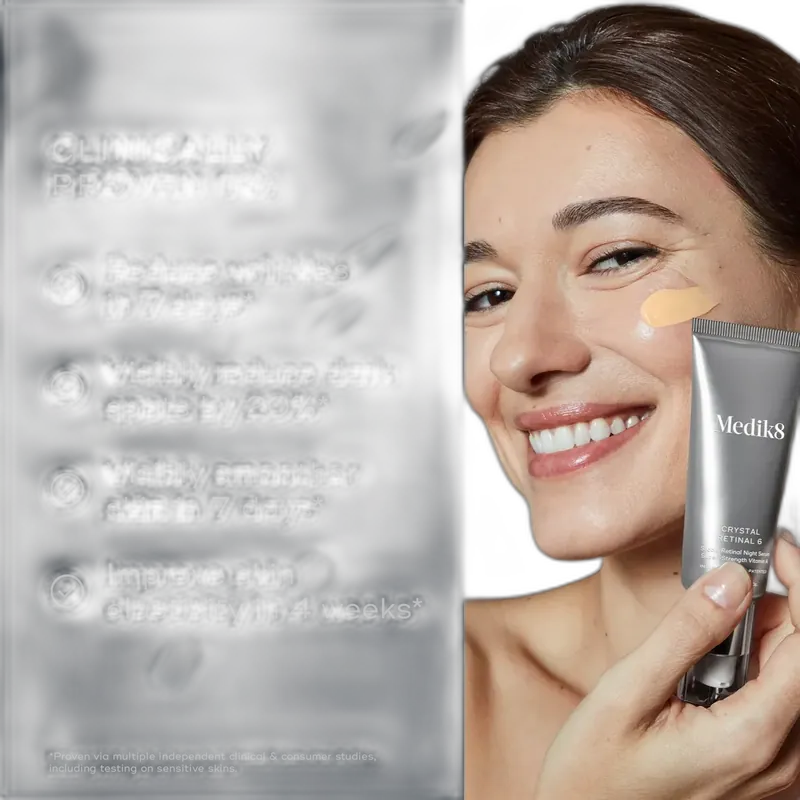
Crystal Retinal 20
Maximum Strength Retinal
 Verified reviewer
Pros & cons.
- +0.2% retinaldehyde delivers near-prescription anti-aging results via OTC
- +Patented cyclodextrin time-release prevents irritation spikes at this high potency
- +Visible wrinkle reduction and texture improvement that retinol cannot match
- +Fragrance-free, vegan, and B Corp certified
- +Elegant cream texture that absorbs without pilling at high retinoid concentration
- +Built-in antioxidant support from vitamin C derivatives and vitamin E
- +Airless pump preserves the stability of light-sensitive retinaldehyde
- −Very expensive at $121 for 30ml — the most premium strength in the range
- −Exclusively for experienced retinoid users — beginners risk significant irritation
- −Pronounced adjustment period with peeling and sensitivity for 2-3 weeks
- −Absolutely requires daily SPF 50 the following morning
- −Contraindicated during pregnancy and breastfeeding
- −Narrow suitability — not for dry, sensitive, or barrier-compromised skin
The full review.
Every retinoid journey has an inflection point — the moment when your skin has adapted to whatever you’ve been using and you find yourself wondering: is this as good as it gets, or can I push further? Crystal Retinal 20 exists for that moment. It’s the product for people who have already climbed through the lower strengths, who have already experienced the peeling and the purging and the adjustment, and who want to know what retinaldehyde can really do when you turn the dial almost as far as it goes.
At 0.2% retinaldehyde, this is among the highest-concentration OTC retinaldehyde products available anywhere. For context: most published clinical studies on retinaldehyde efficacy used concentrations between 0.05% and 0.1%. Crystal Retinal 20 exceeds the studied range, pushing into territory where the published literature runs thin and clinical experience takes over.
The cyclodextrin encapsulation technology becomes even more critical at this concentration. Without it, 0.2% retinaldehyde would deliver an initial burst of activity so intense that even retinoid-adapted skin would rebel — significant redness, widespread peeling, potential barrier compromise. The time-release mechanism distributes that activity over the full night, creating a manageable plateau of retinoid exposure rather than an aggressive spike. This is the engineering that makes the difference between a product that delivers results and one that delivers damage.
The formula surrounding the retinaldehyde is unchanged from the lower strengths — squalane, sodium hyaluronate, tocopheryl acetate, cloudberry seed oil — but these supporting ingredients earn their place even more emphatically at this potency level. Squalane’s barrier reinforcement isn’t a luxury at 0.2% retinaldehyde; it’s structural necessity. Hyaluronic acid isn’t just hydrating; it’s compensating for the accelerated transepidermal water loss that aggressive retinoid therapy induces. The formula understands that potency without protection is just irritation with extra steps.
The adjustment period is real and should be respected. Even users coming from Crystal Retinal 10 — who have already adapted to 0.1% retinaldehyde — will experience a recalibration period of two to three weeks. Peeling concentrates around the nose, chin, and jawline. Skin feels tighter, more reactive, temporarily more sensitive to other products in the routine. This isn’t a sign that something has gone wrong. It’s the expected response as cell turnover shifts into a higher gear.
The payoff arrives around week four, and it arrives emphatically. Skin texture undergoes a transformation that subtler retinoids simply cannot produce — a smoothness and clarity that looks almost filtered in photographs. Fine lines that resisted retinol for months begin to visibly soften. Hyperpigmentation that seemed permanent starts to fade. Pore appearance diminishes as the retinaldehyde normalizes the keratinization process that contributes to congestion.
By the twelve-week mark, the cumulative results are the kind that make colleagues ask whether you’ve had work done. The combination of accelerated cell turnover, stimulated collagen synthesis, and normalized melanin distribution creates a compounding effect where each week builds on the last. This is retinaldehyde doing what decades of dermatological research said it could do — just without the prescription.
The texture remains elegant despite the potency — a smooth cream that glides on without pilling or tugging, with a satin finish that disappears into the skin within a minute. The slight tint from the retinaldehyde itself gives the cream a warm tone that’s actually quite pleasant on application. The vanilla undertone provides a subtle sensory signature without introducing synthetic fragrance.
Honest limitations: this product has the narrowest suitable audience in the Crystal Retinal range. It is explicitly not for beginners, not for sensitive skin, not for compromised barriers, and not for anyone who hasn’t successfully adapted to Crystal Retinal 10 first. It demands rigorous daily SPF — 50 or higher is recommended at this retinoid potency. It cannot be used during pregnancy. And at $121 for a 30ml tube, it’s a significant financial commitment.
The question of whether Crystal Retinal 20 is worth the upgrade from 10 is personal. For users whose skin has fully adapted to 0.1% and who still want more — more texture refinement, more line reduction, more pigmentation correction — the jump to 0.2% delivers measurably. For users who are satisfied with their results at 10 and aren’t chasing diminishing returns, staying there is entirely valid. The law of diminishing returns applies to retinoids just as it applies to everything else.
What Crystal Retinal 20 represents, ultimately, is the outer boundary of what topical vitamin A can achieve without a prescription pad. It’s the last stop before tretinoin. For the experienced retinoid user who knows their skin, respects the adjustment process, and commits to the supporting routine (ceramide moisturizer, daily SPF, no conflicting actives), it delivers results that justify both the price and the effort.
Ingredient analysis.
Full INCI list
Aqua (Water), Caprylic/Capric Triglyceride, Glycerin, Isododecane, Cyclodextrin, Cetearyl Alcohol, Cetearyl Olivate, Sodium Acrylate/Sodium Acryloyldimethyl Taurate Copolymer, Sorbitan Olivate, Tocopheryl Acetate, Squalane, Sodium Hyaluronate, Retinal, Ethyl Ascorbic Acid, Daucus Carota Sativa (Carrot) Seed Oil, Hydroxyethyl Acrylate/Sodium Acryloyldimethyl Taurate Copolymer, Ethylhexylglycerin, Pentylene Glycol, Vanilla Planifolia (Vanilla) Fruit Extract, Hydroxypropyl Methylcellulose, Rubus Chamaemorus (Cloudberry) Seed Oil, Sodium Polyaspartate, Tetrahexyldecyl Ascorbate, Dipteryx Odorata (Tonka) Bean Extract, BHT, Polyhydroxystearic Acid, Disodium EDTA, Titanium Dioxide, Phenoxyethanol, Alumina, Lonicera Caprifolium (Honeysuckle) Flower Extract, Isostearic Acid, Lecithin, Lonicera Japonica (Honeysuckle) Flower Extract, Polyglyceryl-3 Polyricinoleate, Stearic Acid, Coumarin, CI 14700 (Red 4)
Skin match.
The science.
The Science
Retinaldehyde concentrations above 0.1% exceed the range in most published clinical trials, but the foundational science is robust. A 1998 study by Creidi et al. in the British Journal of Dermatology showed that 0.05% retinaldehyde applied for 18 months improved fine and deep wrinkles, skin firmness, and roughness compared to vehicle control. Skin replica analysis and clinical scoring quantified these improvements, proving retinaldehyde's anti-aging effects at concentrations lower than this product.
The mechanism is well-understood: retinal dehydrogenase enzymes in the skin oxidize retinaldehyde to retinoic acid. Research by Duell et al. in the Journal of Investigative Dermatology (1997) showed that retinaldehyde reaches higher intracellular retinoic acid concentrations than equivalent doses of retinol—about 11 times more bioavailable—because it skips one enzymatic conversion step.
At 0.2%, Crystal Retinal 20 likely produces intracellular retinoic acid concentrations near those of low-concentration prescription tretinoin (0.025%). Cyclodextrin encapsulation modulates this delivery. Research by Loftsson and Duchêne in the International Journal of Pharmaceutics (2007) showed that cyclodextrin complexation stabilizes labile actives and creates controlled-release profiles that improve tolerability and sustained efficacy.
The formula's vitamin C derivatives—ethyl ascorbic acid and tetrahexyldecyl ascorbate—work synergistically with retinaldehyde. Research in the Journal of Cosmetic Dermatology (Farris, 2005) established that combining vitamin A and vitamin C adds benefits to collagen synthesis, photoprotection, and hyperpigmentation reduction via complementary cellular pathways.
References
- Profilometric evaluation of photodamage after topical retinaldehyde and retinoic acid treatment — Journal of the American Academy of Dermatology (1998)
- Unoccluded retinol penetrates human skin in vivo more effectively than retinyl palmitate or retinoic acid — Journal of Investigative Dermatology (1997)
Dermatologist Perspective
Board-certified dermatologists view retinaldehyde at this concentration as the bridge between cosmeceutical and pharmaceutical retinoid therapy. Dr. Farah Moustafa, Director of Laser and Cosmetics at Tufts Medical Center, notes that retinals can be more effective than retinol but need proper formulation to manage irritation. At 0.2%, Crystal Retinal 20 exceeds concentrations used in most published studies, entering the territory where dermatologists typically consider prescription retinoids. For patients who cannot access or tolerate tretinoin, this product is the strongest available alternative. Dermatologists emphasize that SPF 50 and ceramide-based moisturizer are non-negotiable companions at this retinoid strength.
Where it fits in your routine.
Apply a pea-sized amount to clean, dry skin every evening. If switching from Crystal Retinal 10, use it every other night for the first 2-3 weeks, then increase to nightly use as tolerance builds. Apply before a ceramide-rich moisturizer. Do not use AHAs, BHAs, benzoyl peroxide, or other retinoids on the same evening. Always apply SPF 50 the next morning. If significant irritation lasts more than 3 weeks, return to Crystal Retinal 10 and retry after 4 more weeks of adaptation.
At $121 for 30ml, Crystal Retinal 20 is the range's most expensive mainline strength. One tube lasts 2-3 months with nightly use, making the nightly cost about $1.30-2.00. Prescription tretinoin is the alternative for comparable results, but it requires dermatologist visits ($100-300+), potential insurance issues, and a more irritating molecule lacking time-release benefits. As a tretinoin alternative, the value is clear. The 24 strength at $135 offers only marginal extra concentration for experienced users.
Retinoid users adapted to Crystal Retinal 10 (or equivalent retinol products used for 6+ months) use this for the strongest OTC retinaldehyde results. It targets moderate wrinkles, stubborn hyperpigmentation, textural irregularities, and photoaging in resilient skin.
People without retinoid tolerance from lower strengths. All beginners. Sensitive, dry, or barrier-compromised skin. Pregnant or breastfeeding individuals. Those who won't use daily SPF 50 and a supporting moisturizer routine.
Product details.
Thick cream with a slightly deeper tint than lower strengths due to the higher retinaldehyde concentration; absorbs smoothly with a satin finish
Subtle vanilla undertone — no synthetic fragrance added
Opaque tube with airless pump protects the high-concentration retinaldehyde from light and oxidation.
Higher strengths cause more warmth and tightness on first application. Peeling and increased sensitivity are common during weeks 1-3; this adjustment phase occurs as cell turnover accelerates. This discomfort is transient and shows the retinaldehyde is working. By week 4, skin adapts and the 'crystal retinal glow' emerges.
2-3 months with nightly use
6 months
fall winter
The backstory.
Crystal Retinal 20 was originally the pinnacle of Medik8's retinal ladder before the brand introduced Crystal Retinal 24 for expert users. It represents the concentration where retinaldehyde's published clinical data becomes most compelling — studies on retinaldehyde efficacy have typically used concentrations in the 0.05-0.1% range, meaning 0.2% exceeds the studied concentrations and pushes into genuinely aggressive territory.
About Medik8
Established Brand (5–20 years)UK scientist Elliot Isaacs founded Medik8 in 2009; his brother Daniel joined as Chief Product Officer in 2011. Medik8 has a global patent for stabilizing retinaldehyde, runs an ISO-certified Innovation Centre outside London, and is B Corp certified.
Common myths.
If Crystal Retinal 10 works, Crystal Retinal 20 works twice as well.
Retinoid benefits do not scale linearly with concentration. Moving from 10 to 20 improves anti-aging results slightly but increases irritation risk disproportionately. Many users find Crystal Retinal 10 offers the best balance of results and tolerance. Only upgrade once you have fully adapted to 10 and your skin can handle more.
High-strength retinal can replace professional treatments
0.2% retinaldehyde improves texture, pigmentation, and fine lines, but it does not match the collagen remodeling depth of professional treatments like laser resurfacing or medical-grade chemical peels. It complements professional care instead of replacing it.
FAQ.
What is the difference between Crystal Retinal 10 and Crystal Retinal 20?
Crystal Retinal 10 has 0.1% retinaldehyde, and Crystal Retinal 20 has 0.2%—twice the concentration. Crystal Retinal 20 gives faster anti-aging results but requires a longer adjustment period. Medik8 recommends using Crystal Retinal 10 nightly for 8-12 weeks without irritation before switching to Crystal Retinal 20.
Is Crystal Retinal 20 comparable to prescription tretinoin?
Crystal Retinal 20 produces visible results near prescription retinoid levels. Retinaldehyde is one conversion step closer to retinoic acid (the active form in tretinoin) than retinol, so it works more directly. However, prescription tretinoin at 0.025-0.1% delivers retinoic acid directly without conversion and remains more potent. Crystal Retinal 20 is the strongest over-the-counter alternative available.
How long does the adjustment period last for Crystal Retinal 20?
Users moving from Crystal Retinal 10 will see 2-3 weeks of more peeling and sensitivity. Use it every other night, then increase to nightly use to manage this. Starting at 20 without prior retinoid experience is not recommended; the adjustment is more intense and lasts longer.
Can I use Crystal Retinal 20 around my eyes?
The delicate eye area reacts more sensitively to retinoids; 0.2% retinaldehyde may be too strong here. Medik8 offers C-Tetra Eye specifically for the eye area. If you apply Crystal Retinal 20 near the eyes, avoid the eyelids and orbital bone area, and buffer with a thick eye cream applied first.
Why is Crystal Retinal 20 more expensive than lower strengths?
The price reflects the higher concentration of retinaldehyde — a costly raw material — and the extra cyclodextrin stabilization technology used. Higher retinaldehyde concentrations are harder to stabilize and need more of the patented encapsulation system. The $121 price also covers Medik8's ISO-certified UK manufacturing and B Corp commitments.
What the community says.
"Visible wrinkle reduction that retinol never achieved"
"The closest thing to prescription tretinoin without a prescription"
"Patented stability system means it actually stays potent"
"Elegant texture that doesn't pill or flake during application"
"Significant adjustment period even for experienced retinoid users"
"Very expensive at $121 for 30ml"
"Too strong for anyone not already using Crystal Retinal 10"
"Requires rigorous sun protection the following day"
People also looked at.