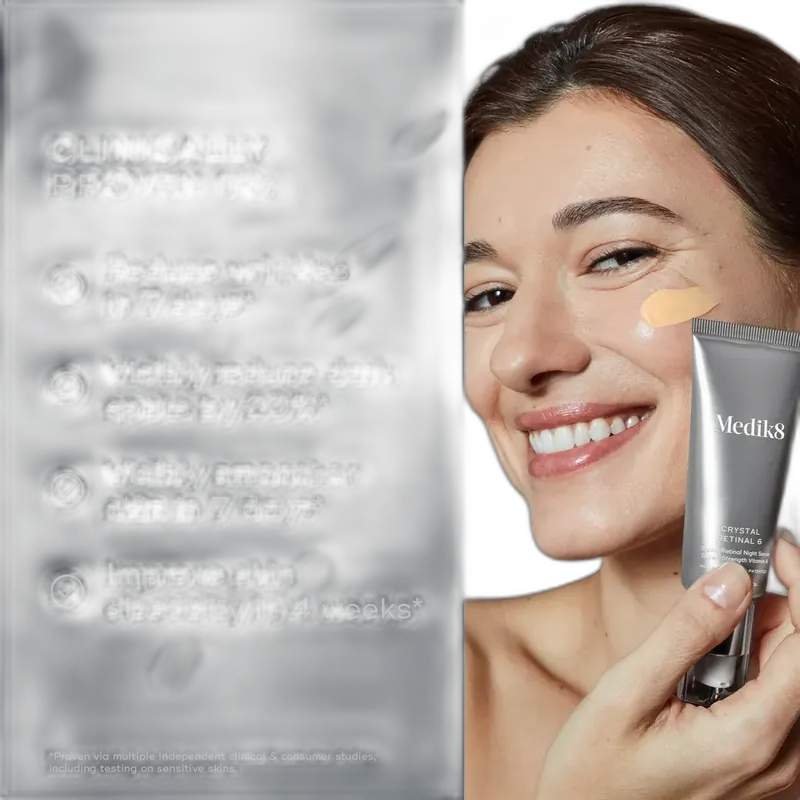
Crystal Retinal 10
Gold Standard Retinal
 Verified reviewer
Pros & cons.
- +Patented cyclodextrin encapsulation solves retinaldehyde's historic stability problem
- +0.1% retinaldehyde delivers results faster than equivalent retinol concentrations
- +Time-release mechanism reduces irritation while maintaining full-night efficacy
- +Elegant cream texture with squalane and hyaluronic acid for built-in barrier support
- +Fragrance-free, vegan, cruelty-free, and B Corp certified
- +Airless pump protects formula from light and air degradation
- +Part of a progressive strength ladder allowing controlled dose escalation
- −Premium price of $109 for 30ml is a significant investment
- −Not suitable for retinoid beginners — requires built tolerance from lower strengths
- −Contraindicated during pregnancy and breastfeeding
- −Adjustment period with mild peeling and sensitivity during first 1-2 weeks
- −Requires committed daily SPF use the following morning
The full review.
The vitamin A hierarchy is simple in theory but complex in practice. Retinoic acid — prescription tretinoin — sits at the top as the gold standard dermatologists have used for decades. Below it is retinaldehyde: one enzymatic step from retinoic acid, faster-acting than retinol, with published evidence showing anti-aging efficacy comparable to tretinoin in some parameters. Below that is retinol: the well-known over-the-counter workhorse, two conversion steps from the end. Dermatological literature established this hierarchy by the 1990s, but retinaldehyde had a commercial flaw: it degrades almost immediately when exposed to light or oxygen. You could put it in a formula, but you couldn’t keep it there.
Elliot and Daniel Isaacs spent years in their London lab solving this. Their solution was cyclodextrin — a ring-shaped sugar molecule that encapsulates the retinaldehyde like a molecular cage, protecting it from degradation in the tube and releasing it gradually on the skin. The technology earned a global patent in 2018, and Crystal Retinal became the first stable, commercially viable retinaldehyde serum. It is the world’s best-selling retinal product.
Crystal Retinal 10 sits in the upper-middle of Medik8’s progressive strength ladder, delivering 0.1% retinaldehyde — a concentration for users who built tolerance through lower strengths (1, 3, or 6). This is not a beginner product. At this level, retinaldehyde delivers results that compete with prescription retinoids on texture, pigmentation, and fine line reduction.
The cyclodextrin encapsulation does more than preserve stability. It creates a time-release mechanism that distributes the retinaldehyde’s activity throughout the night instead of delivering a single peak dose on application. This manages irritation — the initial burst of retinoid activity causes most redness and peeling in stronger formulas. By flattening that peak, Crystal Retinal allows higher concentrations to be tolerable.
The supporting formula is well-constructed. Squalane provides skin-identical emollience, reinforcing the barrier during the cell turnover that retinoids induce. Sodium hyaluronate draws moisture into the epidermis to counteract retinoid-induced dehydration. Tocopheryl acetate (vitamin E) provides antioxidant backup, while ethyl ascorbic acid and tetrahexyldecyl ascorbate act as additional vitamin C-derived antioxidants. Cloudberry seed oil adds linoleic acid supplementation to barrier-stressed skin.
The texture is a cream rather than a serum, which suits a potent retinoid. Cream formats buffer the active from the skin, and the slightly tinted formula (from the retinaldehyde and a touch of added colorant) spreads evenly without the streaking or pilling seen in some retinoid products. A subtle vanilla undertone from vanilla fruit extract provides a pleasant sensory experience without listed synthetic fragrance.
The adjustment period at this strength is real but manageable. During the first one to two weeks, expect mild flaking — typically around the nose, chin, and jawline — as cell turnover accelerates. Some tightness and increased sensitivity to other products is normal. By week three, most users have adapted and the payoff begins: smoother texture and brighter tone.
By the eight-to-twelve week mark, the cumulative effects are clear. Fine lines soften, hyperpigmentation fades, pore appearance diminishes, and overall skin quality reaches levels simpler retinol products typically cannot achieve. This shows the difference retinaldehyde’s proximity to retinoic acid makes in the vitamin A cascade.
The $109 price tag is the primary barrier. For a 30ml tube that lasts two to three months, this costs roughly $1.20-1.80 per night. Against the patented technology, clinical-grade formulation, and results approaching prescription retinoid territory, it is a defensible premium. The airless pump packaging also justifies the cost — it protects the retinaldehyde from the light and air exposure that would degrade it in a jar or dropper bottle.
For anyone who has maxed out what retinol can do, Crystal Retinal 10 is the logical next step before prescription territory. It delivers faster, more visible results through a mechanism retinol cannot match, in a formula that respects the skin barrier.
Formula
Texture
The texture is a cream rather than a serum, which suits a potent retinoid. Cream formats buffer the active from the skin, and the slightly tinted formula (from the retinaldehyde and a touch of added colorant) spreads evenly without the streaking or pilling seen in some retinoid products. A subtle vanilla undertone from vanilla fruit extract provides a pleasant sensory experience without listed synthetic fragrance.
Common Complaints
The adjustment period at this strength is real but manageable. During the first one to two weeks, expect mild flaking — typically around the nose, chin, and jawline — as cell turnover accelerates. Some tightness and increased sensitivity to other products is normal. By week three, most users have adapted and the payoff begins: smoother texture and brighter tone.
Works for
By the eight-to-twelve week mark, the cumulative effects are clear. Fine lines soften, hyperpigmentation fades, pore appearance diminishes, and overall skin quality reaches levels simpler retinol products typically cannot achieve. This shows the difference retinaldehyde’s proximity to retinoic acid makes in the vitamin A cascade.
Packaging
The $109 price tag is the primary barrier. For a 30ml tube that lasts two to three months, this costs roughly $1.20-1.80 per night. Against the patented technology, clinical-grade formulation, and results approaching prescription retinoid territory, it is a defensible premium. The airless pump packaging also justifies the cost — it protects the retinaldehyde from the light and air exposure that would degrade it in a jar or dropper bottle.
Who Should Buy
For anyone who has maxed out what retinol can do, Crystal Retinal 10 is the logical next step before prescription territory. It delivers faster, more visible results through a mechanism retinol cannot match, in a formula that respects the skin barrier.
Ingredient analysis.
Full INCI list
Aqua (Water), Caprylic/Capric Triglyceride, Glycerin, Isododecane, Cyclodextrin, Cetearyl Alcohol, Cetearyl Olivate, Sodium Acrylate/Sodium Acryloyldimethyl Taurate Copolymer, Sorbitan Olivate, Tocopheryl Acetate, Squalane, Sodium Hyaluronate, Retinal, Ethyl Ascorbic Acid, Daucus Carota Sativa (Carrot) Seed Oil, Hydroxyethyl Acrylate/Sodium Acryloyldimethyl Taurate Copolymer, Ethylhexylglycerin, Pentylene Glycol, Vanilla Planifolia (Vanilla) Fruit Extract, Hydroxypropyl Methylcellulose, Rubus Chamaemorus (Cloudberry) Seed Oil, Sodium Polyaspartate, Tetrahexyldecyl Ascorbate, Dipteryx Odorata (Tonka) Bean Extract, BHT, Polyhydroxystearic Acid, Disodium EDTA, Titanium Dioxide, Phenoxyethanol, Alumina, Lonicera Caprifolium (Honeysuckle) Flower Extract, Isostearic Acid, Lecithin, Lonicera Japonica (Honeysuckle) Flower Extract, Polyglyceryl-3 Polyricinoleate, Stearic Acid, Coumarin, CI 14700 (Red 4)
Skin match.
The science.
The Science
Retinaldehyde has a unique place in the vitamin A cascade. A 1999 study by Saurat et al. in the British Journal of Dermatology shows that topical retinaldehyde thickens the epidermis and reduces UV-induced skin damage like retinoic acid, but with significantly less irritation. This study identifies retinaldehyde as the most potent non-prescription retinoid available.
The mechanism uses one enzymatic conversion: retinal dehydrogenase enzymes in the skin oxidize retinaldehyde to retinoic acid. This differs from retinol, which requires two steps: first oxidizing to retinaldehyde (via alcohol dehydrogenase) and then to retinoic acid. Research in the Journal of Investigative Dermatology (Duell et al., 1997) confirms topical retinaldehyde is approximately 11 times more bioavailable than retinol.
Medik8's cyclodextrin encapsulation technology solves retinaldehyde's photolability. Cyclodextrins are cyclic oligosaccharides that form inclusion complexes with hydrophobic molecules to shield them from environmental degradation. Research in the International Journal of Pharmaceutics (Loftsson & Duchêne, 2007) shows cyclodextrin complexation improves the stability and bioavailability of labile active ingredients in topical formulations.
The gradual release of cyclodextrin-encapsulated retinaldehyde improves tolerability. Instead of a bolus dose, the formulation spreads retinoid delivery over hours. This reduces peak retinoid concentrations at the skin surface—the main cause of irritation—while maintaining cumulative overnight efficacy.
References
- Topical retinaldehyde on human skin: biologic effects and tolerance — Journal of Investigative Dermatology (1994)
- Unoccluded retinol penetrates human skin in vivo more effectively than unoccluded retinyl palmitate or retinoic acid — Journal of Investigative Dermatology (1997)
Dermatologist Perspective
Dermatologists see retinaldehyde as the most effective over-the-counter retinoid, sitting between retinol and prescription tretinoin in the vitamin A hierarchy. Board-certified dermatologists like Dr. Anjali Mahto recommend Crystal Retinal for its stability, noting that unstabilized retinaldehyde degrades too fast for consistent results. The progressive strength system (1 through 24) follows the dermatological practice of starting at low concentrations and titrating up. At 0.1%, Crystal Retinal 10 reaches the efficacy level where dermatologists consider it a meaningful alternative to low-concentration prescription retinoids for appropriate patients.
Where it fits in your routine.
Apply a pea-sized amount to clean, dry skin every evening. If you are new to this strength, use it every other night for the first 2 weeks, then use it nightly. Apply before moisturizer. Do not layer with AHAs, BHAs, or other retinoids on the same night. If irritation occurs, buffer by applying moisturizer first, then Crystal Retinal on top. Always apply SPF 30+ the next morning because retinoids increase photosensitivity.
At $109 for 30ml, Crystal Retinal 10 costs more because of its patented encapsulation technology that competitors cannot replicate. Nightly use lasts 2-3 months, making the per-night cost roughly $1.20-1.80. Crystal Retinal provides an over-the-counter alternative to prescription tretinoin (often $50-150+ per tube plus dermatologist visits) and approaches prescription efficacy without a prescription. The airless pump packaging and B Corp manufacturing increase the price but also protect the product integrity.
Retinoid users who built tolerance with retinol or lower Crystal Retinal strengths can use this to escalate to a more potent form. It works for targeting fine lines, uneven texture, hyperpigmentation, and early signs of aging to get near-prescription results without a prescription.
Retinoid beginners without tolerance should start with Crystal Retinal 1 or 3. Avoid use if pregnant or breastfeeding. Do not use during active rosacea flares, severe barrier compromise, or acute eczema. This is also not for budget-conscious users who get adequate results from cheaper retinol products.
Product details.
This thick, slightly tinted cream (from the retinaldehyde and added colorant) absorbs smoothly into the skin.
Subtle vanilla undertone from the vanilla fruit extract — no added fragrance
An opaque tube uses an airless pump mechanism to protect the retinaldehyde from light and air. This preserves potency throughout the product's life.
The cream applies smoothly with slight warmth — not irritation, but the sensation of the retinaldehyde activating. Expect mild flaking and tightness during the first 1-2 weeks as cell turnover accelerates. By week 3, skin adjusts and the 'retinal glow' shows.
2-3 months with nightly use
6 months
All Year
The backstory.
The Isaacs brothers developed Crystal Retinal in their lab outside London after years of frustration with retinaldehyde's instability. Retinaldehyde had been studied since the 1990s and was known to be more effective than retinol, but its extreme sensitivity to light and oxygen made it nearly impossible to formulate commercially. Medik8's cyclodextrin encapsulation breakthrough earned a global patent in 2018, creating a product category that previously couldn't exist at scale.
About Medik8
Established Brand (5–20 years)UK scientist Elliot Isaacs founded Medik8 in 2009; his brother Daniel joined as Chief Product Officer in 2011. Medik8 has a global patent for stabilizing retinaldehyde, runs an ISO-certified Innovation Centre outside London, and is B Corp certified.
Common myths.
Retinal and retinol are the same thing
Retinal (retinaldehyde) is one conversion step closer to retinoic acid than retinol and works approximately 11 times faster. Retinol converts to retinaldehyde before becoming retinoic acid. Retinaldehyde skips the first step, providing results faster at lower concentrations.
Higher strength retinal is always better
Medik8 designed the Crystal Retinal range as a progressive ladder to prevent unnecessary irritation from high strengths. The 10 (0.1%) is for users who adapted to the 6 strength. Skipping to 10 or 20 without building tolerance risks barrier damage that offsets anti-aging benefits.
FAQ.
What percentage of retinaldehyde is in Medik8 Crystal Retinal 10?
Crystal Retinal 10 uses 0.1% retinaldehyde, stabilized by Medik8's patented cyclodextrin encapsulation technology. This advanced-level concentration is one step above the standard Crystal Retinal 6 (0.06%) and targets users who have already built retinoid tolerance.
***
How is retinal different from retinol?
Retinal (retinaldehyde) is one conversion step closer to the active form of vitamin A (retinoic acid) than retinol. Retinol converts to retinaldehyde and then to retinoic acid, but retinal skips the first step. Research shows retinal works approximately 11 times faster than retinol, providing similar anti-aging results at lower concentrations.
***
Can I start with Crystal Retinal 10 or should I begin lower?
Medik8 recommends Crystal Retinal 1 or 3 for retinoid beginners, then increasing strength once skin adjusts (typically 4-8 weeks per strength). Starting at 10 without tolerance causes excessive peeling, redness, and barrier damage. If you use retinol products consistently for 6+ months, you can start at 6 and move to 10 after adjustment.
***
Can I use Crystal Retinal 10 with vitamin C?
Yes, but use them at different times of day. Apply vitamin C (like Medik8's C-Tetra) in the morning for antioxidant protection, and Crystal Retinal at night for cell renewal. This is Medik8's CSA Philosophy: vitamin C in the AM, Sunscreen during the day, vitamin A in the PM.
***
Is Medik8 Crystal Retinal safe during pregnancy?
No — do not use any retinoid products, including retinaldehyde, during pregnancy or breastfeeding. Retinaldehyde converts to retinoic acid in the skin. Systemic retinoid exposure links to birth defects. Stop use before trying to conceive and consult your OB-GYN.
***
Community
What the community says.
"Visible skin texture improvement within weeks"
"Significantly gentler than expected for retinal strength"
"Elegant cream texture that feels luxurious"
"Noticeable reduction in fine lines and dark spots"
"Expensive at $109 for 30ml"
"Initial adjustment period with mild peeling"
"Should not be used during pregnancy"
"Requires sunscreen commitment the following morning"
People also looked at.