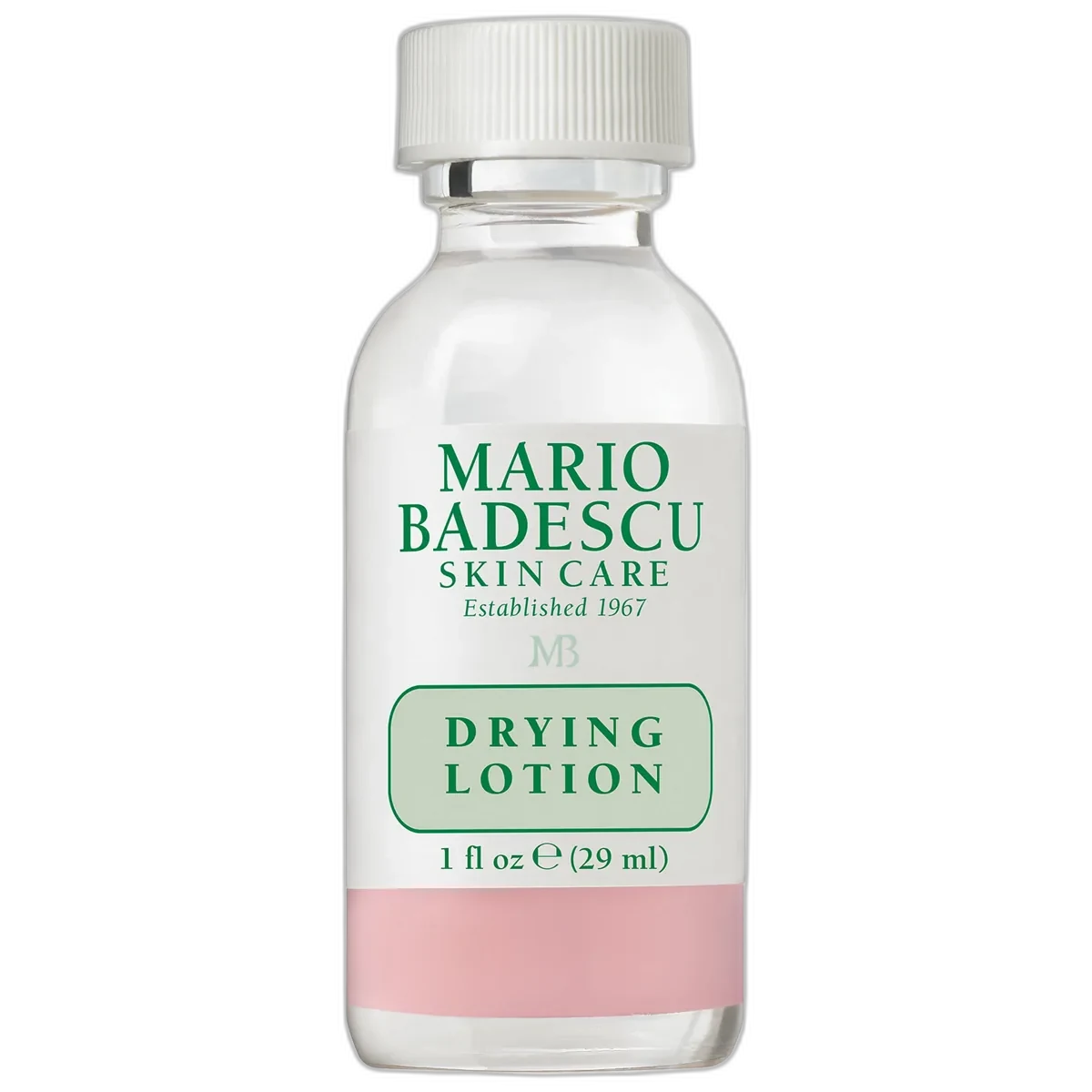
Drying Lotion
The Original Pink Dot
 Verified reviewer
Pros & cons.
- +Visibly flattens surface whiteheads within twelve to twenty-four hours of overnight application
- +Minimalist ten-ingredient formula with no fragrance, parabens, or unnecessary additives
- +Iconic two-phase cotton-swab application ritual ensures precise, concentrated treatment delivery
- +Exceptional value at seventeen dollars per bottle lasting three to six months
- +Backed by over 30,000 reviews, dermatologist endorsements, and multiple beauty awards
- +Cruelty-free, vegan, and manufactured in the USA
- +Nearly sixty years of unchanged formulation provides proven track record
- −Isopropyl alcohol as the dominant ingredient aggressively strips lipids and compromises skin barrier
- −Pink calamine residue transfers to pillowcases and is visible on skin overnight
- −Completely ineffective on deep cystic or nodular acne without a surface head
- −Can cause significant flaking and peeling when used too frequently or on multiple spots
- −No anti-inflammatory agents beyond mild zinc — works through drying rather than pharmacology
The full review.
The story of the Mario Badescu Drying Lotion is really a story about how a product becomes famous. In the late 1960s, a Romanian-born esthetician named Mario Badescu opened a small skincare studio at 320 East 52nd Street in Manhattan. His clients were New York socialites, models, and the kind of women who knew each other’s facialists by first name. Among the products Badescu mixed and dispensed was a small glass bottle containing a clear liquid over a pink sediment — a calamine-and-sulfur spot treatment that his clients would dab onto blemishes before bed and wash off in the morning.
The product itself is almost aggressively simple. Isopropyl alcohol is the first ingredient — the dominant carrier that ensures rapid evaporation and defatting of the skin surface. Below the clear alcohol layer, a pink sediment of calamine, sulfur, zinc oxide, and talc settles at the bottom of the bottle. You never shake it. That is the first rule. The two-phase design is intentional: you dip a clean, dry cotton swab into the sediment, pick up a concentrated dose of the mineral treatment, and dab it directly onto a whitehead. The pink dot dries to a chalky matte finish and goes to work overnight.
The active mechanism is a four-part drying and antimicrobial assault. Salicylic acid penetrates into the clogged pore, dissolving the keratinized sebum plug. Sulfur acts as a keratolytic and antimicrobial, loosening dead cells and suppressing C. acnes bacteria. Calamine absorbs excess oil and delivers zinc ions to the blemish site. Zinc oxide adds bacteriostatic coverage and creates a physical protective barrier. Camphor provides a mild cooling sensation that functions primarily as a counterirritant — the slight tingle that tells you something is happening.
And something does happen. For surface whiteheads and early-stage inflammatory papules, the Drying Lotion is startlingly effective. Most users report visible flattening within twelve to twenty-four hours of the first overnight application. A whitehead that seemed immovable at bedtime is noticeably reduced by morning. Within one to three nights, many blemishes resolve entirely. There is a reason this product has accumulated over thirty thousand reviews across retailers with an average rating above four stars.
But the mechanism behind this effectiveness deserves honest examination. The Drying Lotion works primarily through aggressive physical drying rather than sophisticated pharmacological targeting. The isopropyl alcohol — comprising the majority of the formula — strips lipids from the skin surface and disrupts the intercellular lipid bilayer, increasing transepidermal water loss. This is effective at desiccating a blemish, but it also compromises the surrounding skin’s barrier function. Used too frequently or on too many spots simultaneously, the Drying Lotion can leave skin parched, flaky, and paradoxically more prone to irritation-triggered breakouts.
The formula contains no anti-inflammatory agents beyond the mild zinc contribution. It does not address the inflammatory cascade driving the blemish from below — it simply dries out the surface presentation. For a whitehead that has come to a head, this is sufficient. For deeper inflammation or cystic bumps without a visible surface component, the Drying Lotion will sit on top of the skin accomplishing nothing useful.
The application ritual itself has become the product’s most recognizable feature. The do-not-shake instruction, the careful cotton swab dip, the deliberate dabbing of a pink dot onto each blemish — it is precise, almost meditative, and deeply satisfying in a way that squeezing a tube of benzoyl peroxide is not. The pink dot is both treatment and badge: you go to bed wearing your blemish’s defeat on your face like a tiny flag of surrender.
At seventeen dollars for a one-ounce bottle, the value proposition is exceptional. Used correctly — one swab dip per blemish, a few times per week at most — a single bottle lasts three to six months. The cost per treatment is negligible. For a product that has earned endorsements from dermatologists like Dr. Marisa Garshick, won Allure Readers’ Choice and Prevention Healthy Skin awards, and accumulated celebrity devotees from Gwyneth Paltrow to Bella Hadid, the price feels almost quaint.
The limitations are the trade-offs of its simplicity. This is not a gentle product. It does not soothe, hydrate, or repair. It dries, absorbs, and kills bacteria through mineral brute force and alcohol evaporation. Dry skin types will struggle with it. Sensitive skin may react to the sulfur and camphor. And the pink residue transfers to pillowcases with enthusiastic commitment — invest in a dark pillowcase or accept the consequences.
What makes the Drying Lotion endure is not that it is the most sophisticated spot treatment available. It is not. It is that it delivers exactly what it promises — a visibly smaller blemish by morning — with a formula so minimal and a ritual so specific that it has achieved something rare in skincare: genuine iconography. The pink dot is a universal signal. Everyone who has used it knows what it means.
Ingredient analysis.
Full INCI list
Isopropyl Alcohol, Aqua (Water, Eau), Calamine, Camphor, Sulfur, Zinc Oxide (CI 77947), Talc, Glycerin, Salicylic Acid, Titanium Dioxide (CI 77891)
Skin match.
The science.
The Science
The Drying Lotion uses salicylic acid and sulfur as its active ingredients, with calamine and zinc oxide acting as physical absorbents. A 2020 Cochrane systematic review by Liu and colleagues analyzed 49 randomized controlled trials with 3,880 participants. It found salicylic acid shows comparable effectiveness to tretinoin for participant-assessed acne improvement (RR 1.00, 95% CI 0.92-1.09), though evidence quality was low. That same review found sulfur's effects as monotherapy uncertain, with low-to-very-low quality evidence.
Salicylic acid works through a known mechanism: as a lipophilic beta-hydroxy acid, it enters sebum-filled follicles that water-soluble actives cannot reach. It exfoliates the follicular lining and dissolves the keratinized plug in a whitehead. In the Drying Lotion, the isopropyl alcohol carrier helps this penetration by temporarily disrupting the lipid barrier.
Sulfur works via keratolytic action—breaking disulfide bonds in keratin proteins to loosen cells blocking the pore. Its antimicrobial activity against Cutibacterium acnes adds a pathway to salicylic acid's comedolytic effect.
Zinc oxide provides weak bacteriostatic activity and anti-inflammatory properties via cytokine regulation. Calamine (zinc carbonate plus ferric oxide) acts as a physical absorbent rather than a pharmacological agent. This combination uses multiple mechanisms—comedolytic (salicylic acid), keratolytic (sulfur), antimicrobial (sulfur plus zinc), and physical absorption (calamine plus zinc oxide plus talc)—but no clinical trial has tested this specific combination.
References
- Topical azelaic acid, salicylic acid, nicotinamide, sulphur, zinc and fruit acid (alpha-hydroxy acid) for acne — Cochrane Database of Systematic Reviews (2020)
- Evidence-based topical treatments (azelaic acid, salicylic acid, nicotinamide, sulfur, zinc, and fruit acid) for acne: an abridged version of a Cochrane systematic review — Journal of Evidence-Based Medicine (2020)
Dermatologist Perspective
Board-certified dermatologists view the Drying Lotion as an effective overnight spot treatment for surface blemishes, and several recommend it. Dr. Marisa Garshick, FAAD, says it delivers quick results, while Dr. Leah Ansell confirms its active ingredients target acne through multiple mechanisms. However, dermatologists note limitations: the isopropyl alcohol-dominant vehicle disrupts the barrier with repeated use, and the formula lacks the anti-inflammatory and comedolytic sophistication of prescription retinoids or modern OTC treatments using niacinamide or benzoyl peroxide at validated concentrations. Dermatologists usually use the Drying Lotion as an adjunct for occasional whiteheads instead of a primary acne treatment strategy.
Where it fits in your routine.
Don't shake the bottle — the two-phase separation is intentional. After your full nighttime skincare routine, dip a clean, dry cotton swab into the pink sediment at the bottom of the bottle. Dab the concentrated pink clay onto individual whiteheads or surface blemishes. Use a fresh side of the swab for each spot to avoid contaminating the bottle. Do not rub or blend — let the pink dot sit. Leave it on overnight and rinse it off during your morning cleanse. Use on only a few active spots per session to prevent over-drying the surrounding skin.
At $17 for a one-ounce bottle, the Drying Lotion is a highly cost-effective spot treatment. Since one cotton swab dip treats a single blemish, one bottle lasts three to six months with typical use. This brings the cost to well under a dollar per treatment. The pricing is accessible for a product with nearly sixty years of brand heritage, over thirty thousand reviews, and multiple beauty awards. The only size available is one ounce, so there is no bulk option, but one bottle lasts long enough that this rarely matters for most users.
This is the spot treatment for you if you get occasional surface whiteheads and want something that visibly works by morning. If you appreciate a minimal ingredient list, do not mind the overnight pink dot, and have oily or combination skin, the Drying Lotion has earned its cult status for a reason.
Skip this if your skin is dry, sensitive, or barrier-compromised; the alcohol-dominant formula worsens dehydration. Skip this too if your acne consists of deep cystic bumps without visible heads, as this product treats only surface blemishes. Look elsewhere if you cannot tolerate sulfur or camphor, or if you need a daytime-wearable treatment.
Product details.
This two-phase liquid has a clear alcohol layer above a pink calamine-sulfur sediment. Do not shake the product. Dip a cotton swab directly into the pink clay to collect the concentrated treatment.
It has a faint medicinal smell with a slight camphor note. The fragrance-free formula uses sulfur, which adds a mild mineral scent that fades fast as the product dries.
Small glass bottle (also available in plastic) has an iconic two-tone look — clear liquid over pink sediment. It has no applicator; use a cotton swab to apply.
The pink dot left on your blemish overnight is part of the experience — expect it to be visible. The camphor causes a slight cooling or tingling sensation. The treated spot dries to a chalky, matte finish. The pink residue washes off easily in the morning. Some flaking around the treated area is normal during the first few days as the blemish dries out.
3-6 months with nightly spot application on occasional breakouts
12 months
All Year
The backstory.
Created by Romanian-born esthetician Mario Badescu at his New York City salon in the late 1960s, the Drying Lotion was originally a behind-the-counter secret passed among Manhattan socialites. It spread through word of mouth for decades before the internet era amplified its cult status. Gwyneth Paltrow famously described it as 'the chalky thing from the facialist in New York,' and when Kylie Jenner shared it on Snapchat, a new generation discovered what Upper East Siders had known for forty years. It now has over 107 million views on TikTok.
About Mario Badescu
Legacy Brand (20+ years)Mario Badescu started in 1967 in New York City. It has a nearly six-decade reputation from its professional skincare salon and accessible product line. The Drying Lotion is the brand's most iconic product. Dermatologists and celebrities endorse it, and it has over 30,000 reviews across retailers.
Common myths.
Shake the Drying Lotion before use to mix the ingredients.
Do not shake it. The two-phase design is intentional — the pink sediment at the bottom is the concentrated treatment. Dip a dry cotton swab into the sediment to pick up the active clay and apply it directly. Shaking dilutes the sediment into the alcohol layer and reduces the treatment concentration per application.
The Drying Lotion works on all types of acne.
This product targets surface whiteheads and early-stage inflammatory papules. The formula does not work on deep cystic bumps without a visible head — the brand's Buffering Lotion targets those instead.
FAQ.
Does Mario Badescu Drying Lotion work on cystic acne?
No — this formula targets surface whiteheads and early inflammatory bumps. The calamine-sulfur sediment works on blemishes that have come to a head. For deep, under-the-surface cystic acne, the brand's Buffering Lotion uses a zinc oxide and B-vitamin system designed specifically for that purpose.
Why does the Drying Lotion leave a pink spot on my face?
Calamine (zinc carbonate plus ferric oxide) provides the pink color and acts as the primary treatment active. The visible pink dot sits on the blemish to dry it out overnight. It washes off easily in the morning.
Can I use the Drying Lotion during the day or under makeup?
Use this product only overnight. The pink residue stays visible on the skin and shows through makeup. Apply it as the final step before bed and wash it off during your morning cleanse.
Is Mario Badescu Drying Lotion safe for sensitive skin?
Isopropyl alcohol is the first ingredient, which dries and irritates sensitive skin. Sulfur and camphor add more irritation potential. People with sensitive or dry skin should use this sparingly and watch for excessive dryness or flaking around treated spots.
How long does the Drying Lotion take to work?
Most users see smaller whiteheads within 12-24 hours of the first overnight application. Surface blemishes usually flatten within one to three nights. Results depend on the blemish type — whiteheads respond fastest.
What the community says.
"Shrinks surface whiteheads visibly overnight"
"The cotton-swab application ritual feels precise and satisfying"
"Affordable cult classic at seventeen dollars per bottle"
"Fragrance-free and paraben-free formula"
"Iconic product endorsed by celebrities and dermatologists alike"
"Can over-dry and cause flaking or peeling at the application site"
"Leaves visible pink residue that transfers to pillowcases"
"Ineffective on deep cystic acne without a visible head"
"Isopropyl alcohol as the first ingredient is barrier-disrupting"
"Easy to accidentally shake the bottle and dilute the sediment"
People also looked at.