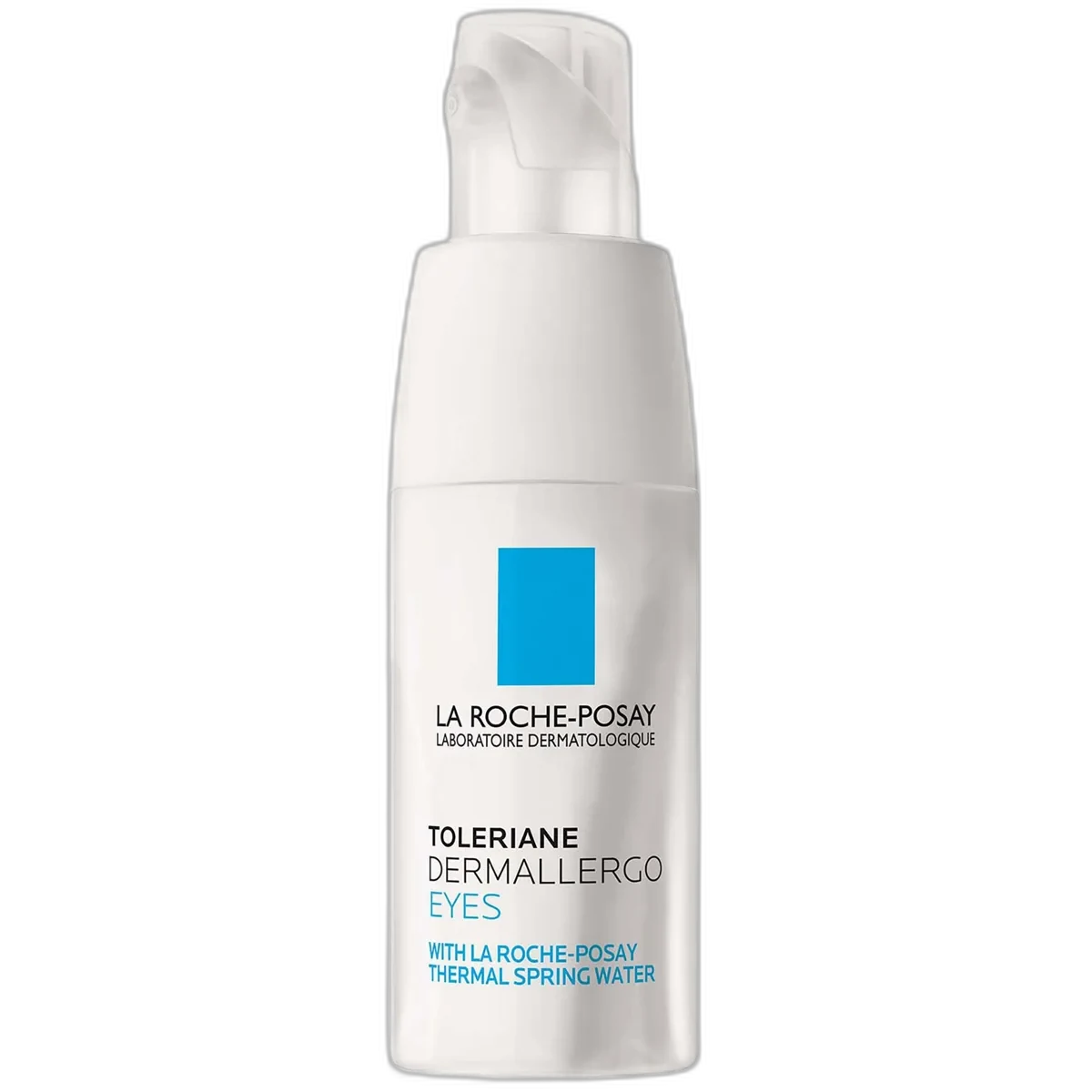
Toleriane Dermallergo Eye Cream
Sensitive Skin MVP
 Verified reviewer
Pros & cons.
- +Neurosensine peptide provides cellular-level calming that goes beyond surface-level soothing
- +Completely fragrance-free and preservative-minimized for ultra-sensitive periorbital skin
- +Ophthalmologist-tested and confirmed safe for contact lens wearers
- +Lightweight texture absorbs quickly without causing milia or interfering with makeup
- +Niacinamide and Neurosensine create a dual-pathway calming system for reactive eye areas
- +Squalane delivers skin-identical hydration without heaviness or pore-clogging risk
- +Immediate comfort on application with no stinging or warming sensation
- −Not designed for anti-aging concerns — no retinol, peptides for wrinkles, or caffeine for puffiness
- −Small tube at 20ml, though it lasts 3-4 months with proper application
- −Standard squeeze tube rather than hygienic airless pump for a preservative-minimized formula
- −Limited availability compared to other La Roche-Posay products at some retailers
- −Will not address dark circles — niacinamide provides only modest brightening over time
The full review.
Finding an eye cream when your periorbital skin reacts to everything is a specific kind of frustrating. You patch test, you wait, you apply hopefully — and then you wake up with puffy, red, stinging eyes that look worse than they did with no product at all. The Toleriane Dermallergo Eye Cream exists for exactly this cycle of disappointment, and understanding that context is essential to evaluating it fairly.
This is not an anti-aging eye cream. It does not promise to erase crow’s feet, banish dark circles, or turn back the clock. What it promises is something more fundamental: to hydrate and soothe the most reactive zone on your face without making it angrier. And on that specific brief, it delivers convincingly.
The star ingredient is Neurosensine — La Roche-Posay’s proprietary Acetyl Dipeptide-1 Cetyl Ester — a calming peptide that functions as a cellular messenger. Rather than masking irritation with a numbing agent or anti-inflammatory drug, Neurosensine signals the skin cells themselves to reduce their inflammatory response. It is a subtle but meaningful distinction: instead of putting out the fire, it convinces the cells to stop lighting matches. Around the eye area, where skin is roughly 40% thinner than the rest of the face and correspondingly more reactive, this approach makes genuine sense.
Niacinamide serves as the supporting act, reinforcing the periorbital barrier and providing its own anti-inflammatory pathway. The combination creates a dual-channel calming system — Neurosensine working at the cellular signaling level while niacinamide strengthens the physical barrier that prevents irritants from reaching those cells in the first place. It is a defense-in-depth strategy that reflects real formulation thought.
The hydration system relies on squalane and shea butter as the primary emollients, with glycerin and propanediol pulling moisture into the skin. Squalane is particularly well-chosen for the eye area — it is skin-identical, lightweight enough to avoid the heaviness that causes milia, and provides surface occlusion without the clogged-pore anxiety that heavier oils provoke. Shea butter adds richness without greasiness, and its natural anti-inflammatory compounds complement the active soothing ingredients.
What is not in this formula matters as much as what is. No fragrance. No parabens. No drying alcohols. The preservative system is minimized to the point where the product carries only a 6-month period-after-opening shelf life — a genuine trade-off that demonstrates the brand’s commitment to stripping out everything that ultra-sensitive eye areas might object to. The ophthalmologist testing and contact-lens-safe designation add another layer of credibility; these are not marketing claims but clinical assessments that require specific testing protocols.
The texture is a pleasant lightweight cream that absorbs into the eye area within about thirty seconds of gentle patting. There is no stinging, no warming sensation, no tacky residue. It simply disappears into the skin, leaving a subtle hydrated feel without any visible film. Under makeup, it provides a smooth base without interfering with concealer application — a practical consideration that many soothing products neglect.
On first use, the immediate experience is one of calm. Where many eye creams produce a slight tingle that brands optimistically describe as the product working, this one produces nothing — and that nothing is exactly the point. Over the first week of twice-daily use, the chronic tightness and dryness that plague reactive eye areas begin to genuinely recede. The skin feels more resilient, less reactive to environmental triggers, more comfortable at baseline.
The limitations are straightforward and should not be held against the product because they reflect deliberate choices. There is no caffeine for depuffing, no vitamin C for brightening, no retinol for wrinkle reduction. If you want an eye cream that addresses dark circles, crow’s feet, or loss of firmness, this is not your product — and La Roche-Posay is not pretending otherwise. The Toleriane Dermallergo Eye Cream occupies a specific niche: soothing, protecting, and hydrating ultra-sensitive eye-area skin. Judging it against anti-aging eye creams is like judging a gentle cleanser against an exfoliating acid — different tools for different jobs.
The price-to-volume ratio is reasonable for the category. Eye creams are inherently expensive per ounce because the application area is small and the formulation requirements are stringent. At $30.99 for 20ml, this falls in the moderate range for a pharmacy-brand eye cream, and the 3-4 month lifespan with twice-daily use makes the per-day cost quite manageable.
For the specific consumer this targets — the person with periorbital eczema, the contact lens wearer who cannot tolerate preservatives, the rosacea patient whose eye area flares at the slightest provocation — the Toleriane Dermallergo Eye Cream is not just good. It is one of a very small number of products that will actually work without making things worse. That narrow but deeply served audience is exactly where La Roche-Posay’s Toleriane line has always excelled.
Ingredient analysis.
Full INCI list
Aqua/Water, Glycerin, Squalane, Propanediol, Butylene Glycol, Butyrospermum Parkii Butter/Shea Butter, Pentylene Glycol, Niacinamide, Dimethicone, Polymethylsilsesquioxane, Polysorbate 20, Acetyl Dipeptide-1 Cetyl Ester, Toluene Sulfonic Acid, Ammonium Polyacryloyldimethyl Taurate, Dimethiconol, Disodium EDTA, Citric Acid, Aluminum Starch Octenylsuccinate, Glyceryl Acrylate/Acrylic Acid Copolymer
Skin match.
The science.
The Science
Neurosensine (Acetyl Dipeptide-1 Cetyl Ester) is La Roche-Posay's solution for neurogenic inflammation — inflammation caused by sensory nerve activation instead of immune system engagement. Research on neuropeptide-mediated skin inflammation shows the periorbital area is vulnerable to this pathway due to its dense sensory nerve network. Neurosensine modulates pro-inflammatory neuropeptide release, calming communication between sensory nerves and inflammatory mediators in the skin.
Niacinamide's barrier-strengthening properties are well-documented. A study in the British Journal of Dermatology (Tanno et al., 2000) shows topical niacinamide increases ceramide and other intercellular lipid levels in the stratum corneum, improving barrier function. This barrier reinforcement matters for the periorbital area, where the stratum corneum is thinner and more prone to transepidermal water loss.
Squalane works as a periorbital emollient because it is a skin-identical lipid. Human sebum contains about 12% squalene, and its hydrogenated form (squalane) integrates into the skin's lipid matrix. Research in the International Journal of Cosmetic Science shows squalane reduces transepidermal water loss without occluding pores — a key trait for the milia-prone eye area.
The preservative-minimized approach follows research into preservative sensitivity in periorbital skin. Studies show the eye area has higher rates of allergic contact dermatitis to preservatives than other facial zones. This supports the decision to minimize preservative load, even if it shortens shelf life.
References
- Nicotinamide increases biosynthesis of ceramides as well as other stratum corneum lipids to improve the epidermal permeability barrier — British Journal of Dermatology (2000)
Dermatologist Perspective
Dermatologists and ophthalmologists often recommend the Toleriane Dermallergo Eye Cream for patients with periorbital contact dermatitis, eyelid eczema, or eye-area sensitivity from seasonal allergies. Board-certified dermatologists note that the Neurosensine technology targets neurogenic inflammation — a mechanism different from the immune-mediated inflammation most anti-inflammatory ingredients target. For patients who find most eye creams too irritating, dermatologists view this as one of the safest options, as the preservative-minimized formula and ophthalmological testing provide clinical reassurance.
Where it fits in your routine.
Apply a rice-grain-sized amount to your ring finger — the weakest finger, which applies the least pressure. Gently pat (do not rub) in a semicircle around the orbital bone from the inner corner outward, both above and below the eye. Use morning and evening after cleansing and serum application, before face moisturizer. Contact lens wearers can insert lenses before or after application. Avoid getting product directly in the eyes.
At $30.99 for 0.66 fl oz, this eye cream costs a moderate amount for pharmacy-brand eye care. The per-ounce price is about $47, but one tube lasts 3-4 months with twice-daily use. This costs roughly $8-10 per month. The price reflects formulation costs for ophthalmological testing, proprietary Neurosensine technology, and a preservative-minimized formula, not luxury-brand markup. Only one size is available, so you cannot trial it without full commitment.
People with reactive, allergy-prone eye-area skin that rejects other eye creams. Contact lens wearers who want a safe periorbital moisturizer. Rosacea and eczema patients needing gentle eye-area care. Users who prioritize soothing and hydration over anti-aging in their eye cream.
This is a soothing cream, not an anti-aging treatment for crow's feet reduction or dark circle correction. It is not for people with oily eyelids who find cream textures too heavy around the eyes. It does not provide visible depuffing or lifting effects.
Product details.
Lightweight cream with a smooth, non-greasy texture. It absorbs quickly into the delicate eye area without dragging the skin.
No detectable scent — completely fragrance-free
Small squeeze tube with a standard cap. It is compact for travel but lacks an airless pump to protect the preservative-minimized formula from contamination.
The cream feels cooling and calming on the periorbital area immediately. It causes no stinging, burning, or irritation, even on freshly washed, potentially sensitized skin. Eye-area dryness and tightness decrease within the first few days of use.
3-4 months with twice-daily application using a rice-grain-sized amount per eye
6 months
All Year
The backstory.
La Roche-Posay developed the Toleriane Dermallergo line specifically for allergy-prone, ultra-sensitive skin — the subset of consumers who react to ingredients that even other sensitive-skin products consider safe. The eye cream addresses a genuine gap: the periorbital area is the most reactive zone on the face, yet many eye creams still include fragrances, preservatives, and potential irritants that aggravate this vulnerability.
About La Roche-Posay
Legacy Brand (20+ years)La Roche-Posay was founded in 1975 near its namesake thermal spring in France and has been a dermatologist-recommended brand for nearly five decades. Its Toleriane line is specifically developed for allergy-prone and ultra-sensitive skin, backed by clinical testing under ophthalmological and dermatological supervision.
Common myths.
Eye creams are just face moisturizers in smaller tubes.
This formula targets the periorbital area. It uses ophthalmologist testing and a Neurosensine concentration calibrated for thinner eye-area skin. The preservative system, emollient balance, and pH are optimized for a zone standard face moisturizers do not address safely.
Avoid all eye creams if you have sensitive skin around the eyes.
This product targets that exact situation. The fragrance-free, preservative-minimized formula uses calming Neurosensine peptide to show eye creams can treat ultra-reactive periorbital skin without causing irritation.
FAQ.
Does La Roche-Posay Toleriane Eye Cream help with dark circles?
This eye cream focuses on soothing, hydrating, and strengthening the delicate periorbital skin barrier rather than correcting dark circles. The niacinamide provides modest brightening over time. If dark circles are your primary concern, use a product formulated with targeted brightening ingredients like vitamin C or caffeine.
Can I use this eye cream if I have eczema around my eyes?
This eye cream targets allergy-prone and ultra-sensitive skin, making it a sensible choice when periorbital eczema is stable. The Neurosensine peptide calms reactive skin, and the preservative-minimized formula lowers flare risks. However, consult your dermatologist before using any new product during active eczema flares.
What is Neurosensine in this eye cream?
Neurosensine (Acetyl Dipeptide-1 Cetyl Ester) is La Roche-Posay's proprietary soothing peptide. It acts as a cellular messenger that signals skin cells to reduce inflammation and irritation. In the delicate eye area where skin is significantly thinner, this peptide calms reactive responses that cause discomfort, redness, and puffiness.
Is this eye cream safe during pregnancy?
Yes. The Toleriane Dermallergo Eye Cream has no retinoids, no salicylic acid, and no other ingredients flagged as pregnancy concerns. This gentle, soothing formula works during pregnancy and breastfeeding, though you should consult your OB-GYN about any skincare product.
How long does a tube of Toleriane Eye Cream last?
Apply a rice-grain-sized amount to each eye twice daily. One tube lasts 3-4 months. The product has a 6-month period-after-opening shelf life, so consistent use finishes a tube before it expires.
Community
What the community says.
"Does not sting or irritate even the most sensitive eye areas"
"Reduces puffiness and dryness noticeably"
"Gentle enough for daily use on reactive skin"
"Absorbs well without causing milia"
"Does not specifically target dark circles or fine lines"
"Small tube for the price"
"Minimal visible anti-aging effect"
"Packaging could be more hygienic with a pump dispenser"
People also looked at.