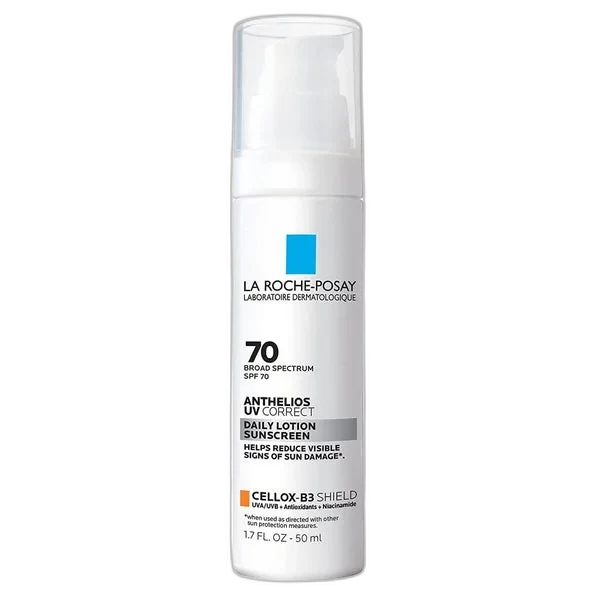
Anthelios UV Correct Daily Anti-Aging Face Sunscreen SPF 70
Anti-Aging SPF Powerhouse
 Verified reviewer
Pros & cons.
- +Niacinamide actively improves skin tone while UV filters prevent new damage
- +SPF 70 provides an exceptionally high safety margin for real-world under-application
- +Alcohol-free formula won't cause cumulative dehydration with daily facial use
- +Sheer, natural finish blends into all skin tones without white cast
- +Panthenol and glycerin provide enough hydration to potentially skip separate moisturizer
- +Photostable avobenzone-octocrylene pairing maintains UVA protection throughout the day
- +Fragrance-free and oil-free with minimal irritation potential
- −Premium price at $44.99 for just 1.7 ounces of product
- −Niacinamide concentration not disclosed — clinical studies use 2-5%
- −Not water-resistant — unsuitable for swimming or intense outdoor activities
- −Four chemical UV filters at high concentrations may concern those preferring mineral options
- −Can pill when layered over certain silicone-heavy moisturizers or serums
The full review.
There was a time when sunscreen was sunscreen and skincare was skincare, and the two met only in the sense that one protected the work of the other. The Anthelios UV Correct represents the moment La Roche-Posay decided those categories should collapse into a single tube. Launched in 2022 with niacinamide as its headline ingredient alongside SPF 70 protection, it’s part of a broader industry shift toward what some have called the skinification of SPF — the idea that your sunscreen should actively improve your skin, not just prevent damage.
The formula’s UV filter system is serious. Four chemical filters — avobenzone at 3%, homosalate at 13%, octisalate at 5%, and octocrylene at 10% — combine to deliver broad-spectrum SPF 70 protection. That’s a higher SPF than most daily facial sunscreens offer, and the filter combination is specifically engineered for photostability. Octocrylene at 10% acts as a stabilizer for avobenzone, which is the only FDA-approved chemical filter with full UVA1 coverage but is notoriously prone to breaking down under UV exposure. By pairing it with a high concentration of octocrylene, La Roche-Posay ensures the UVA protection holds up throughout the day — a critical consideration for a product marketed against photoaging, since UVA1 rays are the primary drivers of collagen degradation and wrinkle formation.
But the real story here is what happens alongside the UV protection. Niacinamide, or vitamin B3, is one of the most thoroughly validated topical actives in dermatology. Multiple randomized controlled trials have demonstrated its ability to reduce hyperpigmentation, improve skin elasticity, strengthen the barrier, and decrease transepidermal water loss. Including it in a sunscreen is clever on multiple levels: you get the corrective benefits of niacinamide applied every morning with the reliability of a daily sunscreen habit, plus the UV protection prevents new pigmentation from forming while the niacinamide fades what’s already there.
Panthenol rounds out the skincare-active portion of the formula, providing provitamin B5’s well-documented soothing and hydrating effects. Combined with glycerin, these ingredients give the UV Correct a moisturizer-like feel that’s noticeably different from basic sunscreens. For normal to combination skin, you could genuinely skip a separate moisturizer in your AM routine — the formula provides enough hydration on its own, and the silicone-based vehicle (dimethicone, polymethylsilsesquioxane) creates a smooth, silky base that makes layering unnecessary for many people.
The texture is where this sunscreen earns its daily-use credentials. It’s a lightweight, slightly creamy fluid that feels more like a quality moisturizer than a sunscreen. There’s no chalkiness, no greasiness, and crucially, no white cast — the chemical filter system absorbs UV rather than reflecting it, so the formula dries completely sheer. La Roche-Posay specifically tested it for compatibility across skin tones, and the results hold up. On the skin, it sets to a natural, satin finish that works well as a makeup base without requiring a separate primer.
The brand’s Cellox-B3 Shield technology adds Cassia Alata leaf extract and tocopherol as antioxidant layers on top of the UV filters and niacinamide. It’s a belt-and-suspenders approach: block UV radiation at the filter level, scavenge free radicals at the antioxidant level, and actively repair skin at the niacinamide level. Whether each individual component is present at clinically meaningful concentrations is debatable — the niacinamide concentration isn’t disclosed, and topical niacinamide studies typically use 2-5% — but the overall formulation strategy is sound.
Now for the less comfortable conversation. This sunscreen costs $44.99 for 1.7 ounces. That’s over $26 per ounce for a product you need to use generously and reapply during extended sun exposure. For a pharmacy brand — even one with La Roche-Posay’s legitimate scientific heritage — this is pushing into territory where the price needs to be justified by exceptional performance. The niacinamide inclusion is meaningful, but niacinamide is an inexpensive ingredient that appears in moisturizers costing a fraction of this price. You’re paying for the elegant formulation, the photostable filter system, and the brand’s clinical validation — all of which have real value — but the per-ounce cost will make budget-conscious consumers reach for alternatives.
The alcohol-free formula is a welcome departure from some other Anthelios products that rely on alcohol denat. for texture. For daily facial use, especially for those with drier or more sensitive skin, the absence of denatured alcohol means less risk of cumulative dehydration over months of use.
The formula is not water-resistant, which positions it clearly as a daily wear sunscreen rather than an active outdoor product. If you need protection for swimming, sports, or heavy sweating, this isn’t the right choice — look to the Anthelios Melt-In Milk or a dedicated sport sunscreen. But for the person who wants their morning SPF to pull double duty as an anti-aging treatment while looking and feeling invisible on the skin, the UV Correct delivers on that specific promise with the scientific backing that makes the Anthelios name worth trusting.
Formula
Ingredient analysis.
Full INCI list
Active Ingredients: Avobenzone 3%, Homosalate 13%, Octisalate 5%, Octocrylene 10%. Inactive Ingredients: Water, Polymethylsilsesquioxane, Dimethicone, Glycerin, Dicaprylyl Ether, Niacinamide, Poly C10-30 Alkyl Acrylate, Styrene/Acrylates Copolymer, Silica, Caprylyl Methicone, Acrylates/Dimethicone Copolymer, Diethylhexyl Syringylidenemalonate, Glyceryl Stearate, PEG-100 Stearate, Phenoxyethanol, Tocopherol, Potassium Cetyl Phosphate, Propylene Glycol, Caprylyl Glycol, Panthenol, Acrylates/C10-30 Alkyl Acrylate Crosspolymer, Triethanolamine, PEG-8 Laurate, Inulin Lauryl Carbamate, Chlorphenesin, Trisodium Ethylenediamine Disuccinate, P-Anisic Acid, Caprylic/Capric Triglyceride, Xanthan Gum, Cassia Alata Leaf Extract, Maltodextrin, Sodium Dodecylbenzenesulfonate, Disodium EDTA
Skin match.
The science.
The Science
The anti-aging efficacy of this sunscreen rests on two pillars: UV prevention through its photostable filter system and active skin correction through niacinamide. A landmark 2003 study published in the International Journal of Cosmetic Science demonstrated that topical niacinamide at 5% significantly reduced hyperpigmentation, fine lines, red blotchiness, and sallowness in a 12-week randomized controlled trial. A subsequent study in the British Journal of Dermatology (2013) confirmed that oral and topical niacinamide reduced actinic keratoses, providing evidence for its photoprotective benefits beyond simple UV blocking.
The UV filter system centers on avobenzone, the only FDA-approved chemical UVA1 absorber. Avobenzone alone is photolabile — it degrades under UV exposure, losing approximately 36% of its filtering capacity within one hour. The 10% octocrylene in this formula addresses this directly: octocrylene's triplet-state energy transfer mechanism stabilizes avobenzone, maintaining its UVA absorption capacity throughout extended wear. This photostabilization has been documented in studies published in Photochemistry and Photobiology.
Panthenol (provitamin B5) has been demonstrated in dermatological literature to improve stratum corneum hydration, reduce transepidermal water loss, and accelerate epidermal regeneration. In this formula, it complements niacinamide's barrier-strengthening effects — both ingredients support barrier function through different mechanisms, creating a more robust hydration and repair profile than either would deliver alone.
The Cassia Alata leaf extract and tocopherol provide antioxidant protection against UV-generated reactive oxygen species (ROS). While the UV filters block the radiation itself, a percentage of UV energy still generates free radicals in the skin. The antioxidant layer addresses this residual oxidative stress, which is particularly relevant for the anti-aging positioning since ROS are directly implicated in collagen degradation and photoaging pathways.
References
- The effect of niacinamide on reducing skin hyperpigmentation and suppression of melanosome transfer — International Journal of Cosmetic Science (2003)
- Nicotinamide and the skin — British Journal of Dermatology (2013)
Dermatologist Perspective
Board-certified dermatologists recognize this product as a meaningful advancement in the daily sunscreen category because it combines genuine anti-aging actives with high-SPF protection. Dermatologists note that niacinamide's evidence base for hyperpigmentation and barrier repair is among the strongest of any topical active, making its inclusion in a daily-use sunscreen clinically logical. For patients using retinoids — which increase photosensitivity — dermatologists appreciate the SPF 70 rating as providing a generous margin of error for the inevitable under-application that occurs in real life. The alcohol-free, fragrance-free formulation makes it broadly recommendable, though dermatologists may steer patients with chemical filter sensitivities toward mineral alternatives.
Where it fits in your routine.
Apply a nickel-sized amount generously to the face and neck as your final morning skincare step. Wait 15 minutes before sun exposure. Use it over serums or alone as a combined moisturizer-sunscreen for normal to combination skin. Reapply every two hours during prolonged outdoor exposure. This formula is not water-resistant; reapply after sweating or getting wet.
At $44.99 for 1.7 ounces, this costs more than most Anthelios products. The niacinamide and panthenol add value beyond a basic sunscreen and can replace a separate brightening serum for some users. Because niacinamide is an inexpensive ingredient in cheaper dedicated serums, the premium price reflects the formulation elegance and photostable filter system rather than just the anti-aging actives. One tube lasts 2-3 months with daily face and neck use, making the daily cost roughly $0.50-$0.75. La Roche-Posay's five decades of clinical credibility justify the price, but this sits at the upper limit for a pharmacy-brand sunscreen.
This daily facial sunscreen provides top-tier UV protection while targeting skin tone and anti-aging. It works well for retinol users needing high SPF and for those managing hyperpigmentation who want corrective ingredients in their sun protection step.
Budget-conscious consumers — $45 for 1.7 ounces is high for a premium facial sunscreen. Users who want mineral-only sunscreens or have sensitivity to chemical UV filters. Anyone needing water-resistant protection for outdoor sports or swimming.
Product details.
Fragrance-free. The UV filter system has a minimal base scent that dissipates quickly after application.
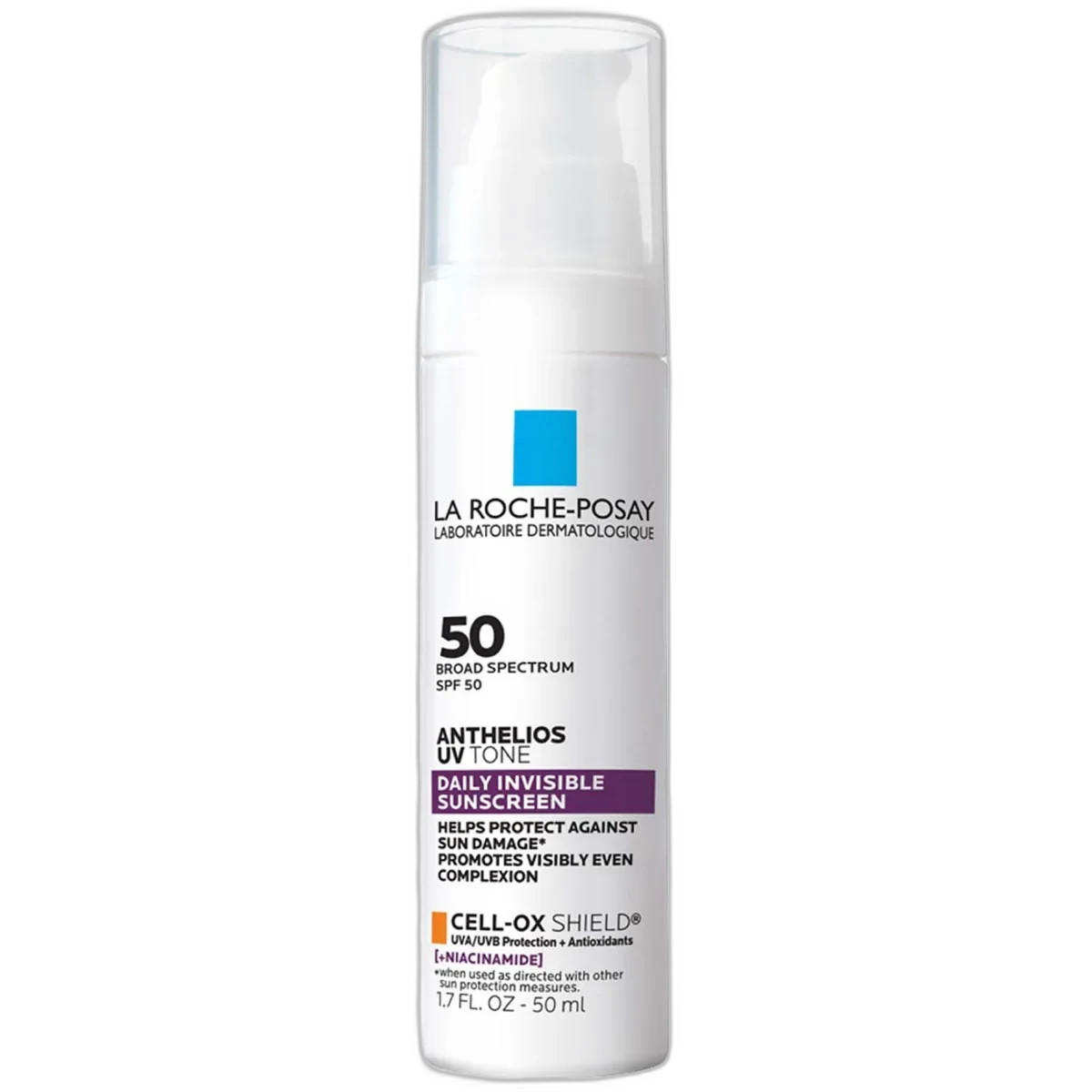
White squeeze tube with a screw-top cap. The 1.7 oz size is standard for a facial sunscreen. Simple, clinical packaging matches the La Roche-Posay brand aesthetic.
It applies smoothly with a slight creamy feel that turns into a lightweight, barely-there finish. Most users feel no stinging or tingling. The niacinamide provides a subtle, immediate brightening effect. Skin feels hydrated instead of dry or tight.
2-3 months with daily face and neck application ***
12 months ***
All Year ***
The backstory.
Launched in 2022, the UV Correct represents La Roche-Posay's recognition that consumers increasingly want their sunscreen to do more than just block UV. By incorporating niacinamide — one of the most well-studied anti-aging ingredients — into a high-SPF formula, the brand created a product that fits the growing 'skinification of SPF' trend while maintaining the clinical rigor the Anthelios line is known for.
About La Roche-Posay
Legacy Brand (20+ years)La Roche-Posay launched in 1975 near central France's thermal springs. Dermatologists have recommended the brand for nearly five decades. Dermatologists develop its formulations, which undergo extensive clinical testing, and the brand has multiple Skin Cancer Foundation seals of recommendation.
Common myths.
Anti-aging sunscreens are marketing — they are regular sunscreens with higher prices.
The niacinamide in this formula is an active ingredient with extensive clinical evidence for improving skin tone, reducing hyperpigmentation, and supporting barrier function. Combined with SPF 70 protection, it provides preventive and corrective anti-aging benefits that a basic sunscreen does not.
SPF 70 is unnecessary; SPF 30 blocks 97% of UVB rays.
The gap between SPF 30 and SPF 70 is larger than the percentages show. Most people apply only 25-50% of the recommended sunscreen amount. At real-world application thickness, SPF 70 delivers what SPF 30 provides at proper application. Higher SPF offers a practical safety margin.
FAQ.
Does this sunscreen help with dark spots?
Yes. The niacinamide in this formula fades hyperpigmentation and evens skin tone over time. With SPF 70 protection that stops new UV-induced dark spots, this sunscreen corrects and prevents discoloration.
Can I use this sunscreen with retinol?
This sunscreen works well for retinol users. Retinol increases photosensitivity, so strong sun protection is essential. The SPF 70 rating provides a large safety margin, and the niacinamide adds to retinol's anti-aging benefits by treating discoloration through a different mechanism. Apply retinol at night and this sunscreen every morning.
Can this replace my moisturizer?
The glycerin, niacinamide, and panthenol provide enough hydration for normal to combination skin. Dry skin types may need a lightweight moisturizer underneath. For oily skin, this formula alone provides sufficient hydration without extra layers.
Does this sunscreen leave a white cast?
No. This chemical (organic filter) sunscreen absorbs UV radiation instead of reflecting it, so it dries transparent. Clinical tests show it blends into all skin tones with a sheer finish.
Is this sunscreen water-resistant?
This formula lacks water-resistant marketing. It works as a daily facial sunscreen for commuting and everyday wear. For swimming, sports, or extended outdoor activities, use a water-resistant body sunscreen or La Roche-Posay's Melt-In Milk SPF 60 instead.
What is Cellox-B3 Shield technology?
Cellox-B3 Shield is La Roche-Posay's proprietary UV protection system. It combines photostable UVA/UVB filters with niacinamide (vitamin B3), Cassia Alata leaf extract, and tocopherol (vitamin E). The system blocks UV radiation and repairs oxidative damage, combining sun protection with antioxidant skincare in one product.
Community
What the community says.
"Lightweight, non-greasy formula that blends into all skin tones"
"Noticeable improvement in skin tone evenness over time"
"High SPF 70 provides peace of mind for retinol users"
"No white cast and sheer finish works well under makeup"
"Alcohol-free formula feels comfortable all day"
"Expensive at $44.99 for only 1.7 ounces"
"Chemical UV filters may irritate very sensitive skin"
"SPF 70 requires multiple chemical filters at high concentrations"
"Can pill if layered over certain silicone-heavy products"
"No water resistance for outdoor activities"
Featured in.
People also looked at.