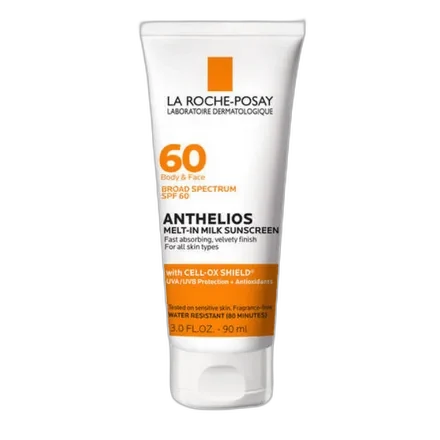
Anthelios Melt-In Milk Sunscreen SPF 60
Consumer Reports Champion
 Verified reviewer
Pros & cons.
- +Perfect Consumer Reports score for five consecutive years of independent testing
- +Photostable UV filter combination that maintains efficacy throughout wear
- +Genuinely comfortable melt-in texture that absorbs in under 90 seconds
- +No white cast on any skin tone thanks to chemical-only filter system
- +80-minute water resistance — the maximum allowed by FDA standards
- +Fragrance-free with no detectable scent after application
- +Oil-free and non-comedogenic, suitable for both face and body use
- +Antioxidant layer with Cassia Alata provides protection beyond UV filtering
- −Alcohol denat. may cause dryness or irritation for compromised skin barriers
- −Chemical-only filters exclude those who prefer or need mineral sunscreens
- −Octocrylene has drawn some environmental and safety scrutiny in recent years
- −Not optimized as a face sunscreen — can feel slippery under makeup
- −Five-ounce bottle depletes quickly with proper full-body application
The full review.
Some products earn reputations through lab testing rather than marketing or influencers. La Roche-Posay’s Anthelios Melt-In Milk Sunscreen SPF 60 is one such product. When Consumer Reports gave it a perfect 100 score for the fifth straight year, it confirmed this sunscreen delivers exactly what it promises every time.
About La Roche-Posay
The formula uses three chemical UV filters: 10% homosalate, 7% octocrylene, and 5% ethylhexyl salicylate. This is a photostable trio. Octocrylene absorbs UVB radiation and stabilizes the other two filters to prevent degradation under UV exposure. This photostability drives its lab testing success. While many sunscreens lose efficacy as filters break down, this one holds.
La Roche-Posay’s Cell-Ox Shield technology layers Cassia Alata leaf extract and tocopherol (vitamin E) over the UV filters. UV filters block radiation, but some radiation still reaches the skin and generates free radicals. This antioxidant layer neutralizes those free radicals before they damage collagen and DNA. This approach uses the brand’s research into UV-induced oxidative stress.
Lab scores do not capture the experience of wearing sunscreen for eight hours at the beach, where the Melt-In Milk excels. The texture is a fluid, milky white that absorbs and vanishes quickly. There is no white cast because this chemical sunscreen uses filters that absorb UV rather than reflecting it with zinc or titanium dioxide. It leaves a lightweight, satin-matte finish that is not greasy or tacky. This comfort is necessary for a body sunscreen requiring reapplication every two hours during active outdoor use.
The oil-free, non-comedogenic formula works for the face, and many people use it that way. However, alcohol denat. is high on the inactive ingredient list. It helps the formula spread, absorb, and dry without stickiness. For users with dry, eczema-prone, or sensitized skin, denatured alcohol can cause irritation or dehydration. If your skin barrier is compromised, this may not be your daily facial sunscreen. Healthy, resilient skin likely won’t notice it.
Texture
The FDA allows a maximum water resistance rating of 80 minutes. This formula holds up during swimming and sweating, but you must still reapply every two hours or after toweling off. It does not sting eyes as much as some chemical sunscreens, but it is not marketed as tear-free.
Scent
The fragrance-free claim is accurate. There is no added parfum or floral/coconut scent. A faint sunscreen-base smell appears during application but disappears within a minute. This is helpful for people sensitive to fragrance.
Value
At roughly $38 for 5 ounces, this is above drugstore pricing but below luxury. Since a proper body application requires about a shot glass worth for exposed arms and legs, one bottle lasts six to eight weeks of daily summer use. The 3-ounce size at around $26 offers better per-ounce value for travel or testing. The price is fair for this level of protection and cosmetic elegance, especially since this formula has independent validation most sunscreens lack.
Conflicts With
The Melt-In Milk has limitations in its filter system. It relies entirely on chemical (organic) UV filters without mineral backup. It is not an option for those who prefer mineral sunscreens due to chemical sensitivities, pregnancy, or concerns about octocrylene. La Roche-Posay makes mineral Anthelios variants for these users.
This is primarily a body sunscreen that works on the face. The texture and finish optimize for larger surface areas. Under makeup, some users find it more slippery than sunscreens formulated as face primers.
These are minor complaints for a sunscreen that passes rigorous independent testing. While many SPF products make ambitious claims, the Melt-In Milk performs through every test and application. It is the sunscreen equivalent of a Honda Civic: not flashy, just reliably good at its job.
Ingredient analysis.
Full INCI list
Active Ingredients: Homosalate 10%, Ethylhexyl Salicylate 5%, Octocrylene 7%. Inactive Ingredients: Water, Dimethicone, Styrene/Acrylates Copolymer, Polymethylsilsesquioxane, Butyloctyl Salicylate, Glycerin, Alcohol Denat., Poly C10-30 Alkyl Acrylate, Caprylyl Methicone, Trisiloxane, Acrylates/Dimethicone Copolymer, Diethylhexyl Syringylidenemalonate, Glyceryl Stearate, PEG-100 Stearate, Phenoxyethanol, Potassium Cetyl Phosphate, Propylene Glycol, Caprylyl Glycol, PEG-8 Laurate, Acrylates/C10-30 Alkyl Acrylate Crosspolymer, Triethanolamine, Tocopherol, Inulin Lauryl Carbamate, Disodium EDTA, P-Anisic Acid, Caprylic/Capric Triglyceride, Xanthan Gum, Cassia Alata Leaf Extract, Maltodextrin, Sodium Dodecylbenzenesulfonate
Skin match.
The science.
The Science
The defining scientific feature is this sunscreen's UV filter system photostability. Octocrylene, at 7%, acts as a UVB absorber and a photostabilizer; it stops the photodegradation of homosalate and ethylhexyl salicylate, the other two active filters. A 2004 study in the Journal of the American Academy of Dermatology shows octocrylene improves the photostability of UVB-absorbing filters in combination. This explains why this sunscreen performs consistently in independent lab testing.
Cell-Ox Shield technology pairs these UV filters with Cassia Alata (Senna Alata) leaf extract, a botanical antioxidant. Research on Cassia Alata in the Journal of Ethnopharmacology documents its antioxidant and anti-inflammatory properties, though most studies focus on traditional medicinal uses instead of topical photoprotection. La Roche-Posay's proprietary research uses this extract as a free radical scavenger to address the oxidative stress UV radiation generates even when UV filters work.
Tocopherol (vitamin E) provides a second antioxidant layer. A 2003 study in the Journal of the American Academy of Dermatology shows topical vitamin E reduces UV-induced erythema and provides modest photoprotective effects when combined with UV filters. In this formula, tocopherol works with the Cassia Alata extract to address immediate and cumulative oxidative damage.
The SPF 60 rating needs scientific context. The difference between SPF 30 (blocking ~97% of UVB) and SPF 60 (blocking ~98.3%) is small in percentage terms, but real-world studies show consumers apply only 25-50% of the recommended amount. Research in the British Journal of Dermatology shows that under-applying SPF 60 still provides protection closer to what SPF 30 delivers at proper thickness, making higher SPF products a practical safety net for typical use.
References
- Photostability of sunscreen products and their UV-absorbing ingredients — Journal of the American Academy of Dermatology (2004)
- Topical vitamin E and UV-induced skin damage — Journal of the American Academy of Dermatology (2003)
Dermatologist Perspective
Dermatologists often rank the Anthelios Melt-In Milk among their top sunscreen recommendations for patients needing reliable broad-spectrum protection with cosmetic elegance. Board-certified dermatologists note the photostable filter combination addresses a clinical concern: many patients apply sunscreen once in the morning and assume they are protected all day. A formula that maintains efficacy over time provides a clinical advantage. Dermatologists also like the fragrance-free, non-comedogenic formulation, which reduces the risk of contact dermatitis and acne mechanica from heavily fragranced or occlusive sunscreens. For patients using photosensitizing treatments like retinoids or AHAs, dermatologists frequently recommend SPF 50+ products like this one to provide protection during increased vulnerability.
Where it fits in your routine.
Apply generously 15 minutes before sun exposure. Use about one ounce (a shot glass full) for exposed body areas and a nickel-sized amount for the face. Spread evenly and wait 60-90 seconds for the formula to absorb. Reapply every two hours, or immediately after swimming, sweating, or towel-drying. One morning application covers areas under clothing for daily use. Apply over moisturizer and serum, but use it as the final step before makeup.
At $37.99 for 5 ounces, the Melt-In Milk is a mid-range sunscreen. It costs less than prestige brands like Supergoop or Shiseido, but more than basic drugstore options. The 3-ounce size at $25.99 is a cheaper way to try it. The price-to-quality ratio is strong when you consider the Consumer Reports validation and the formula's cosmetic elegance. This legacy pharmacy brand has decades of dermatological research behind it; you pay for proven protection, not hype. Because a body sunscreen depletes quickly with proper application, the larger size is the more economical choice.
Choose this sunscreen if you want the most rigorous independent testing available. It works well for active outdoor use, beach days, and sports where water resistance and comfort matter. It suits people who dislike greasy or heavy sunscreens.
People with very dry, eczema-prone, or sensitized skin who react to alcohol denat. Users who need mineral-only sunscreens due to ingredient sensitivity, pregnancy preference, or environmental concerns about chemical UV filters.
Product details.
Virtually unscented. It has no added fragrance, and the sunscreen base scent is minimal and fades fast after application.
White plastic squeeze tube with a flip-top cap. The 5 oz size fits easily in travel bags, and the 3 oz size meets TSA carry-on requirements.
Applies white but absorbs in 60-90 seconds to a nearly invisible finish on most skin tones. Most users feel no tingling or stinging, though those sensitive to alcohol denat. may feel a brief cooling sensation. It feels comfortable and non-sticky immediately.
6-8 weeks with daily face and body use; 3-4 months with face-only daily use
12 months
spring summer
The backstory.
Born from La Roche-Posay's decades-long partnership with dermatologists in France, the Anthelios line was originally developed using Mexoryl technology for the European market before being adapted for US formulations. The Melt-In Milk became the workhorse of the US Anthelios range — a body-and-face sunscreen designed to make high SPF feel effortless rather than burdensome.
About La Roche-Posay
Legacy Brand (20+ years)La Roche-Posay launched in 1975 near central France's thermal springs. Dermatologists have recommended the brand for nearly five decades. Dermatologists develop its formulations, which undergo extensive clinical testing. The brand has multiple Skin Cancer Foundation seals of recommendation.
Common myths.
SPF 60 is overkill — SPF 30 is enough for everyone.
SPF 30 blocks about 97% of UVB rays, but most people apply less sunscreen than the tested amount. SPF 60 provides a safety margin. Even at half the recommended application, you get meaningful protection close to what SPF 30 delivers at full application.
Chemical sunscreens are dangerous and should be avoided.
The FDA requested more safety data on some chemical filters, but this doesn't prove they are unsafe. Homosalate, octocrylene, and ethylhexyl salicylate in this formula have decades of use and remain approved globally. The risk of unprotected sun exposure outweighs these theoretical concerns.
FAQ.
Is La Roche-Posay Anthelios Melt-In Milk SPF 60 good for the face?
This sunscreen works for both face and body. The oil-free, non-comedogenic formula absorbs fast and leaves no greasy residue. But alcohol denat. and chemical UV filters can irritate very sensitive or acne-prone facial skin. For those skin types, La Roche-Posay's mineral face sunscreens work better.
Does this sunscreen leave a white cast?
No. The Melt-In Milk is a chemical sunscreen, not mineral/zinc-based. It absorbs into the skin and dries to a transparent finish in 60-90 seconds. It leaves no white cast on any skin tone.
Is this sunscreen reef-safe?
This formula lacks oxybenzone and octinoxate, the two UV filters most cited in reef-safety legislation. It does contain octocrylene, which some researchers flag as harmful to coral. If strict reef-safety is a priority, a mineral-only sunscreen works better.
How often should I reapply this sunscreen?
Reapply every two hours during continuous sun exposure. This formula is water-resistant for 80 minutes, but reapply immediately after swimming, sweating heavily, or towel-drying. A single morning application works for daily commutes with limited outdoor time.
Can I use this sunscreen with retinol or vitamin C?
This sunscreen works well with morning vitamin C serums because both provide antioxidant protection. This SPF 60 is vital for retinol users. Retinol increases photosensitivity, so the high SPF and Cell-Ox Shield antioxidants provide the protection retinol-treated skin needs.
Is this sunscreen safe during pregnancy?
Yes. This formula uses chemical UV filters generally considered safe during pregnancy. It lacks retinoids or other pregnancy-contraindicated ingredients. Always confirm with your healthcare provider if you have specific concerns.
What the community says.
"Melts into skin without white cast"
"Non-greasy finish despite high SPF"
"Excellent for outdoor activities with 80-minute water resistance"
"Works well under makeup"
"No strong sunscreen smell"
"Contains alcohol denat. which can be drying"
"Some users report mild breakouts on the face"
"Chemical filters may irritate very sensitive skin"
"Bottle design makes it hard to get last product out"
People also looked at.