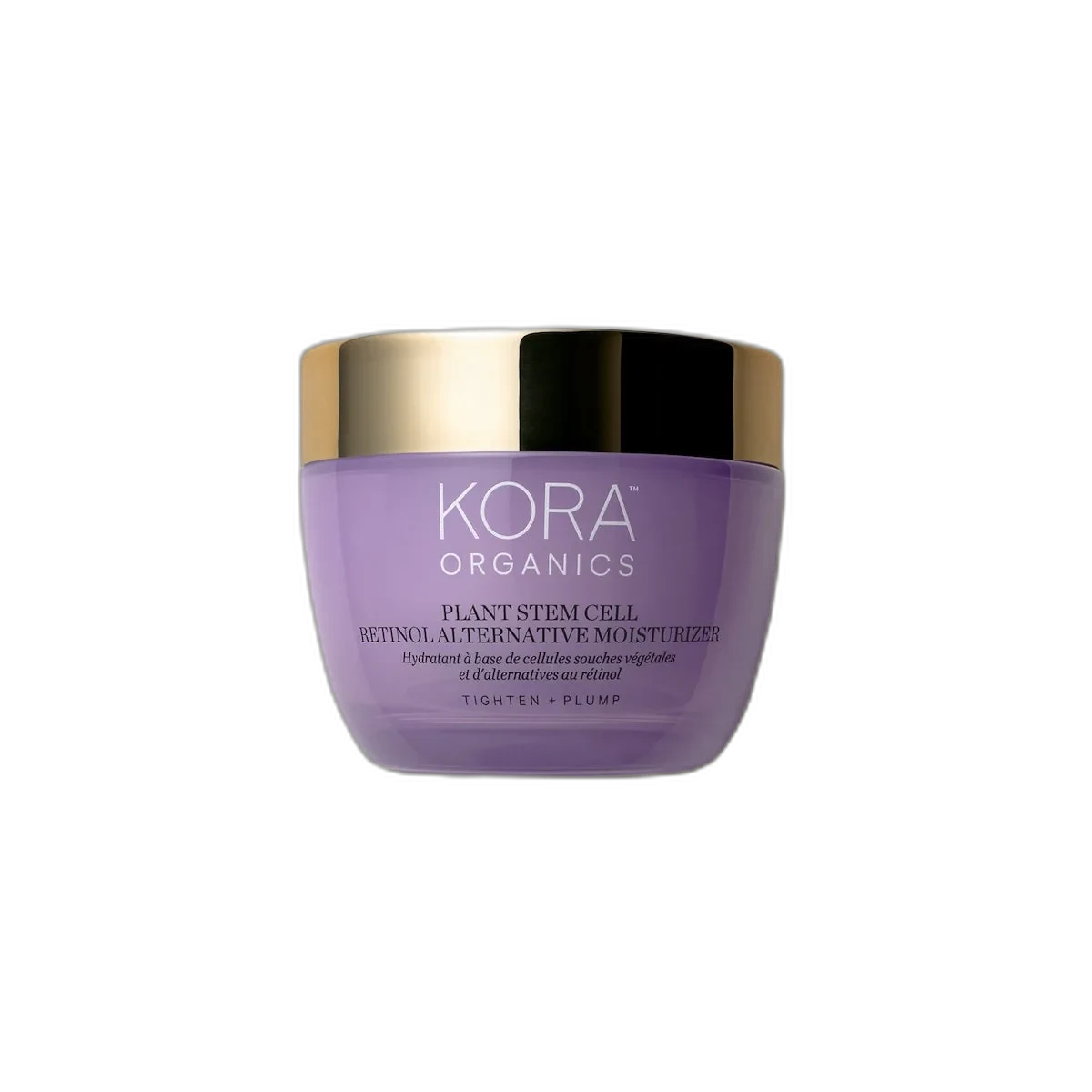
Plant Stem Cell Retinol Alternative Moisturizer
Bakuchiol Starter for Retinol-Averse Skin
 Verified reviewer
Pros & cons.
- +Well-executed bakuchiol stack with rosehip and edelweiss
- +Genuine COSMOS and ECOCERT organic certification
- +Pleasant satin finish that layers under sunscreen
- +Pregnancy-safe alternative to retinoid routines
- +Thoughtful supporting actives including Kakadu plum vitamin C
- +No photosensitization, suitable for AM and PM use
- +Cruelty-free and vegan with verified third-party seals
- −Price is high relative to comparable bakuchiol moisturizers
- −Essential oil fragrance rules out sensitive and rosacea users
- −Jar packaging exposes antioxidants to air and light
- −Not potent enough to replace prescription retinoids
- −Shea butter and marula may congest very oily skin
The full review.
About Kora Organics
Miranda Kerr founded the brand in 2009, and somewhere between the rose quartz facial tools and the Australian superfruit obsession, Kora became one of the few celebrity-founded lines with actual certifications backing its organic claims.
Reality
The star active is bakuchiol, the plant-derived compound extracted from Psoralea corylifolia that has spent the last few years being breathlessly marketed as nature’s retinol. The hype isn’t entirely unearned. A handful of small clinical studies have shown bakuchiol activating some of the same collagen-related gene pathways as retinol, with meaningfully less irritation and no photosensitization. What makes it a genuinely useful ingredient is that gentleness: if your skin has always revolted against tretinoin, if you’re pregnant, if you want an active you can use twice a day without sunscreen anxiety, bakuchiol gives you an actual option rather than a placebo. It is not as potent as 0.5% retinol and it is emphatically not a substitute for a prescription. But it is real.
Kora’s formulation decision here is smart. Rather than relying on bakuchiol alone, the cream stacks it with rosehip seed oil — which contains trace natural trans-retinoic acid and linoleic acid — and an edelweiss meristem cell culture that contributes leontopodic acid, an antioxidant with some interesting early data around collagen protection. The Kakadu plum extract layers in one of the highest natural concentrations of vitamin C on the planet, supporting the brightening side of the equation. It is, in the language of formulation chemists, a stack: multiple gentle actives pointed at the same biological target, each doing a small piece of work so that none has to do too much.
The base is where Kora’s Australian sensibility comes through. Sunflower seed oil and coco-caprylate form a lightweight emollient system, shea butter adds the cushiony afterfeel, and marula and pomegranate seed oils round out the antioxidant profile. The result is a cream that looks richer in the jar than it behaves on skin. It melts in within about ninety seconds, leaving behind a satin finish that reads hydrated rather than greasy. Layered under mineral sunscreen in the morning, it cooperates without pilling. In the evening, it works beautifully after a hydrating toner or a peptide serum.
Texture
The texture is genuinely pleasant, which is worth noting because certified-organic formulations historically came with a texture penalty. Brands that wanted the COSMOS seal used to have to accept slightly tacky finishes or weird emulsion stability. Kora has navigated that well enough that you would not guess the certification from the experience alone.
Scent
There is a fragrance layer here that deserves calling out. The scent is floral and citrus-forward, drawn from rose, neroli, and other essential oils, which means linalool, limonene, citral, and geraniol all appear on the INCI list as naturally occurring fragrance allergens. If your skin is routinely reactive, if you have rosacea, or if you simply prefer unscented skincare, this is not the cream for you. Most users actually love the scent — it is one of the consistent points of praise — but ‘natural fragrance’ and ‘fragrance-free’ are not the same thing, and Kora is firmly in the former camp.
Packaging
The jar packaging is the one real misstep — frosted glass is gorgeous but exposes the antioxidant-heavy formula to oxygen with every use, and for a product this expensive, airless packaging would have been a meaningful upgrade.
Best for
The most honest way to frame this cream is as a bakuchiol starter for the retinol-averse. If your skin hates tretinoin, if you are pregnant or breastfeeding, if you want a gentle anti-aging active you can use morning and night, and if ethical sourcing is part of your buying criteria, this moisturizer does its job with unusual grace.
Not ideal for
If you are already on a serious retinoid routine or you expect $68 to deliver visible wrinkle reversal within a month, you will walk away underwhelmed.
AM routine
Layered under mineral sunscreen in the morning, it cooperates without pilling.
PM routine
In the evening, it works beautifully after a hydrating toner or a peptide serum.
Ingredient analysis.
Full INCI list
Aqua (Water), Glycerin, Propanediol, Coco-Caprylate/Caprate, Glyceryl Stearate Citrate, Squalane, Cetearyl Alcohol, Cetyl Alcohol, Helianthus Annuus (Sunflower) Seed Oil, Cetearyl Glucoside, Butyrospermum Parkii (Shea) Butter, Glyceryl Caprylate, Bakuchiol, Sodium Stearoyl Glutamate, Acacia Senegal Gum, Xanthan Gum, Sclerocarya Birrea (Marula) Seed Oil, Rosa Canina Fruit Oil, Hippophae Rhamnoides Fruit Extract, Daucus Carota Sativa (Carrot) Root Extract, Leontopodium Alpinum Meristem Cell Culture, Terminalia Ferdinandiana (Kakadu Plum) Fruit Extract, Tocopherol, Punica Granatum (Pomegranate) Seed Oil, Rosmarinus Officinalis (Rosemary) Leaf Extract, Citric Acid, Sodium Benzoate, Potassium Sorbate, Dehydroacetic Acid, Benzyl Alcohol, Parfum (Fragrance), Linalool, Limonene, Citral, Geraniol
Skin match.
The science.
The Science
The central evidence for bakuchiol in skincare traces back to a 2014 paper in the International Journal of Cosmetic Science by Chaudhuri and Bojanowski, which demonstrated that bakuchiol upregulated several of the same collagen-related genes as retinol in cultured fibroblasts, including collagen types I, III, and IV. A more widely cited 2019 study in the British Journal of Dermatology by Dhaliwal et al. compared 0.5% bakuchiol against 0.5% retinol in a twelve-week randomized trial of 44 patients, finding that both treatments significantly reduced wrinkle surface area and hyperpigmentation with no statistically significant difference between them — and that bakuchiol users reported substantially less scaling and stinging. These two studies remain the backbone of bakuchiol's clinical credibility, and they are the reason this moisturizer can reasonably claim retinoid-adjacent benefits without overstating its hand. The rosehip seed oil contribution is more modest but notable: rosehip contains small quantities of trans-retinoic acid and significant linoleic acid, and a 2015 study in the Journal of the American Oil Chemists' Society characterized its fatty acid profile in detail, confirming its value as a lipid replenisher. The edelweiss meristem cell culture is the most speculative piece — leontopodic acid has been studied for its antioxidant capacity in plant biology research, but its topical benefits in humans are still largely theoretical. What makes the Kora formulation defensible is that it treats bakuchiol as the workhorse and the supporting actives as additive rather than load-bearing — a structure that matches where the published evidence actually lives.
References
- Bakuchiol: a retinol-like functional compound revealed by gene expression profiling and clinically proven to have anti-aging effects — International Journal of Cosmetic Science (2014)
- Prospective, randomized, double-blind assessment of topical bakuchiol and retinol for facial photoageing — British Journal of Dermatology (2019)
Dermatologist Perspective
Dermatologists generally position bakuchiol as a useful middle rung on the anti-aging ladder — meaningful for patients who cannot tolerate retinoids, who are pregnant or breastfeeding, or who want a daytime-friendly active without photosensitivity concerns. Board-certified dermatologists frequently point to the 2019 Dhaliwal comparative trial when counseling retinol-averse patients, noting that while bakuchiol is not a replacement for prescription tretinoin in more advanced photoaging, it offers a gentler entry point that patients are more likely to actually use consistently. For moisturizers like this one, dermatologists typically recommend them as part of a layered routine rather than as a sole anti-aging product, and they caution patients with rosacea or fragrance sensitivity to review the essential oil content carefully before patch testing.
Guidance
Where it fits in your routine.
Apply a pea-sized amount to clean, damp skin morning and night after water-based serums and before sunscreen. Warm the product between fingertips to spread it evenly over the face and neck. Bakuchiol is not photosensitizing, so use it during the day—but daily broad-spectrum SPF remains essential for any anti-aging routine. Do not layer with prescription retinoids, high-strength acids, or benzoyl peroxide in the same routine; the essential oil fragrance can increase irritation when paired with those actives. Store the jar away from direct light to protect the antioxidants.
At $68 for 50 ml, this cream sits firmly in the luxury tier, and the value conversation becomes a question of what you are actually buying. The bakuchiol concentration is not disclosed, and there are several well-formulated bakuchiol products at $30-45 that likely deliver comparable active exposure. What Kora offers in addition is COSMOS organic certification, ECOCERT sourcing verification, Leaping Bunny cruelty-free seal, and a meaningful track record as a certified-clean brand rather than one that merely markets itself that way. For buyers who weight those factors highly, the premium is reasonable. For buyers focused purely on active delivery per dollar, the math is harder to justify. No larger size is available to improve the per-ounce cost.
This moisturizer suits people seeking retinoid-adjacent anti-aging benefits without irritation, photosensitivity, or pregnancy restrictions, and who value COSMOS-organic certification and ethical sourcing. It works for retinol-averse skin, mature skin needing gentler actives, and anyone building a luxury-tier clean-beauty routine.
Retinoid users seeking prescription-strength results, people with rosacea or high fragrance sensitivity, oily or acne-prone skin prone to congestion, and budget shoppers who can find similar bakuchiol formulations for half the price. If you do not prioritize certifications and provenance, the premium is hard to justify.
Product details.
All Year Certifications COSMOS OrganicECOCERTLeaping BunnyClean at Sephora
The backstory.
Kora Organics was founded by Miranda Kerr in 2009, built around her interest in certified-organic formulation and Australian botanical sourcing. This moisturizer was released in 2021 as the brand's answer to the bakuchiol trend, positioned specifically for customers who wanted the collagen benefits of retinoids without the irritation or sun sensitivity.
About Kora Organics
Miranda Kerr founded Kora Organics in 2009. COSMOS and ECOCERT certify the brand organic. Kora Organics uses Australian botanical actives and third-party certifications instead of clinical trials; its credibility relies on ingredient provenance rather than published dermatological research.
Common myths.
Bakuchiol is just as strong as retinol.
Bakuchiol has retinoid-like effects on collagen pathways in in-vitro and small clinical studies, but it is not a one-to-one replacement for prescription tretinoin. This cream is best thought of as a gentler alternative, not a direct substitute.
Plant stem cells in skincare contain live cells that regenerate skin.
The edelweiss 'stem cell' complex is a meristem cell culture extract of concentrated plant compounds. No live cells touch your skin, and no cells undergo transplantation. Antioxidants like leontopodic acid provide the benefit.
FAQ.
Can I use this moisturizer while pregnant or breastfeeding?
Yes — bakuchiol is the active in this cream, not a retinoid, and the rosehip oil content is too low to matter. Most dermatologists consider bakuchiol pregnancy-friendly, but consult your OB if you have a sensitive pregnancy. The essential oil fragrance is the only other consideration.
Is this strong enough to replace my retinol?
If you cannot tolerate retinol or have persistent irritation, the bakuchiol and rosehip pairing delivers collagen and brightness benefits. For experienced retinol users on 0.5% or higher, this feels gentler and works as a complement, not a replacement.
Why does this cost $68 for only 50ml?
The price reflects COSMOS organic certification, ECOCERT sourcing standards, Australian botanical ingredients, and the brand's position as a certified-clean luxury option. It does not reflect unique clinical proof of superior efficacy — you pay for sourcing and formulation ethics as much as for results.
Does the fragrance come from essential oils or synthetic perfume?
Rose, neroli, and citrus essential oils provide the scent. This puts linalool, limonene, citral, and geraniol on the INCI list as naturally occurring fragrance allergens. People with fragrance sensitivity or rosacea should avoid this.
Can I use this in the morning under sunscreen?
Yes — unlike retinol, bakuchiol is not photosensitizing, so this cream is safe and appropriate under sunscreen. The cushiony satin finish layers well under most mineral and chemical SPFs without pilling.
How does this compare to using a dedicated bakuchiol serum?
A bakuchiol serum delivers a higher concentration of the active. This moisturizer combines bakuchiol with shea butter, marula, and rosehip in an emollient system. If you use a serum layer, a plain moisturizer works better; if you want a one-step finish, this product combines both.
Will this clog pores?
Shea butter and marula oil create a moderate comedogenic profile. This makes it better for normal to dry skin than very oily or acne-prone skin. Users with congestion-prone skin should patch test along the jawline for two weeks before use.
What the community says.
"Pleasant floral-citrus scent"
"Cushiony non-greasy finish"
"Noticeably smoother skin texture"
"Tolerated better than retinol for sensitive users"
"Thoughtful organic formulation"
"Expensive for the size"
"Fragrance too strong for some"
"Slow to show anti-aging results"
"Not potent enough for experienced retinol users"