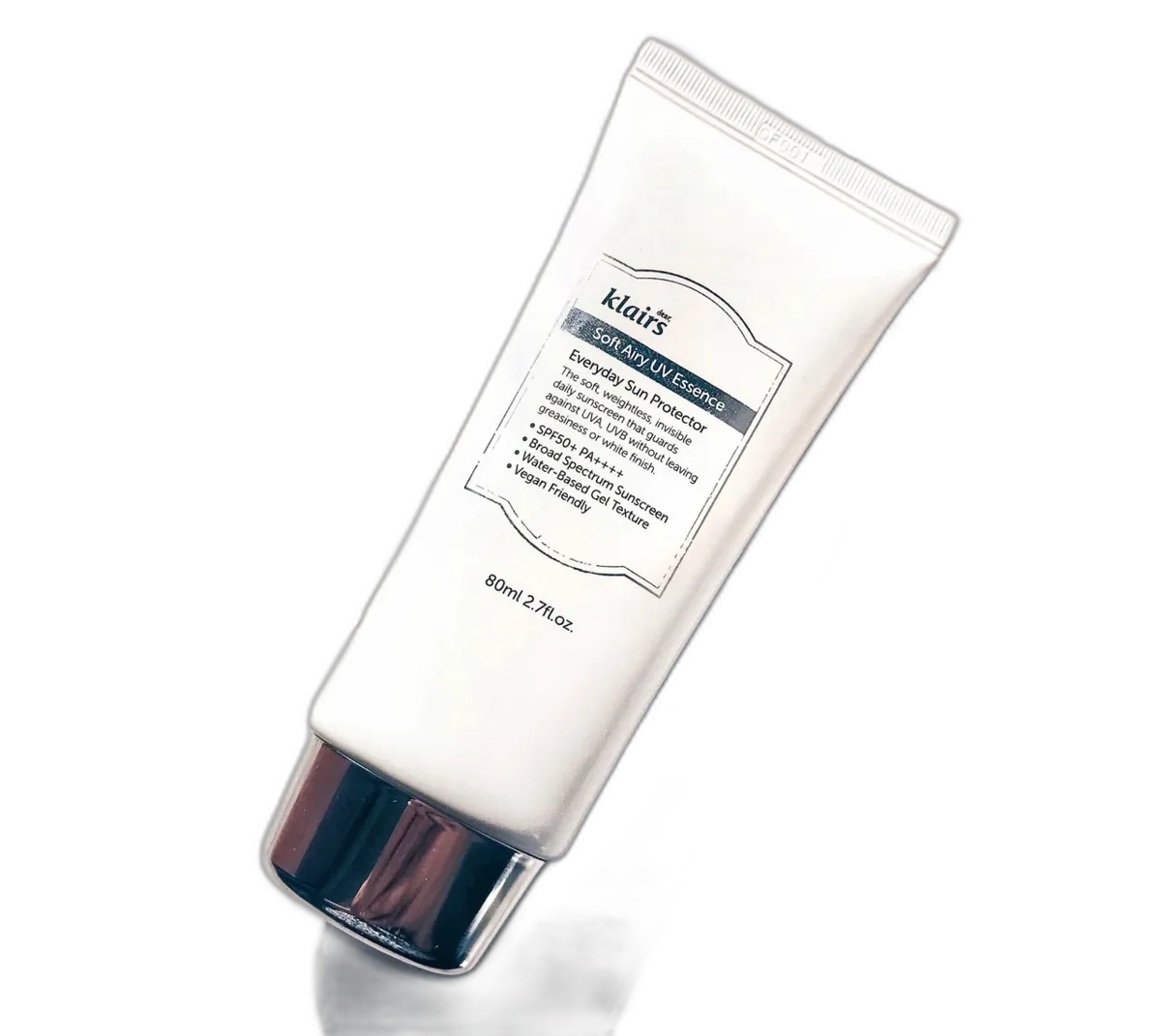
Soft Airy UV Essence SPF 50
Discontinued — SPF Controversy
 Verified reviewer
Pros & cons.
- +Texture was genuinely groundbreaking — lightweight, essence-like, with zero white cast
- +Niacinamide and panthenol provided real skincare benefits beyond UV protection
- +Klairs issued a transparent public statement acknowledging the testing failure
- +The controversy drove industry-wide improvements in sunscreen accountability
- −Independent testing confirmed SPF of 12-28 versus the labeled 50+ — a critical safety failure
- −Product was discontinued due to the SPF discrepancy
- −Years of consumer use under false confidence in UV protection
- −Contains essential oils despite sensitive-skin marketing
- −UV filter concentrations were insufficient for the claimed protection level
- −Damaged brand credibility in the sun protection category
The full review.
It is tempting to write this review as a simple product failure story: brand makes sunscreen, sunscreen doesn’t work as claimed, brand pulls it. But the Klairs Soft Airy UV Essence was something more significant than a single mislabeled product. It was a moment that changed how the global skincare community thinks about sunscreen claims, testing standards, and the implicit trust we place in the numbers on a tube.
Before the controversy, this was one of the most beloved sunscreens in K-beauty. The texture was genuinely remarkable — an essence-like liquid that spread across the skin like a lightweight hydrating serum, absorbing in seconds, leaving zero white cast, and feeling like nothing was there. In a category dominated by heavy, greasy, white-casting products that people tolerate rather than enjoy, the Soft Airy UV Essence offered something radical: a sunscreen that people actually looked forward to applying.
The formula read well on paper. Diethylamino Hydroxybenzoyl Hexyl Benzoate (Uvinul A Plus) provided UVA protection, while Ethylhexyl Triazone (Uvinul T 150) covered UVB. Niacinamide added brightening and barrier support. Panthenol contributed hydration and anti-inflammatory comfort. Beta-glucan, sodium hyaluronate, and allantoin rounded out a formula that blurred the line between sunscreen and skincare treatment.
And then the independent testing happened. In 2021, results revealed that the actual SPF of this product ranged from 12 to 28 — at best, roughly half of the claimed 50+, and at worst, barely a quarter. The UV filter concentrations, when analyzed, were found to be insufficient to deliver the stated protection level. The lightweight texture that made it so pleasant to wear may have been partially a consequence of the same insufficient filter loading that made it inadequate as sun protection.
Klairs, to their credit, did not deny the findings. They issued a public statement acknowledging the testing results and discontinued the product. It was an act of transparency that other brands facing similar scrutiny have not always matched. But transparency after the fact doesn’t undo the years during which consumers applied this sunscreen believing they had SPF 50+ protection while receiving substantially less.
The health implications are worth stating clearly. People who used this as their sole sun protection while taking photosensitizing medications, using retinoids, or recovering from chemical peels were exposed to significantly more UV radiation than they expected. For individuals relying on high SPF for melasma management or post-procedure photoprotection, the gap between claimed and actual protection was not just a cosmetic concern — it was a genuine health risk.
The broader impact extended beyond Klairs. The Soft Airy UV Essence controversy accelerated a wave of independent sunscreen testing across the K-beauty industry. It prompted consumers to demand verification, beauty publications to commission their own testing, and brands to submit to more rigorous third-party evaluation. Whether or not it was the intention, this product’s failure made the sunscreen market more accountable.
The essential oils — chamomile flower oil and orange oil — represent a secondary concern that would be the primary criticism of any other product but seems almost trivial in the context of the SPF failure. For a brand positioning itself as sensitive-skin-friendly, including potential sensitizers in a daily-wear product that sits on the skin all day was an unnecessary risk.
Klairs subsequently released the All-Day Airy Sunscreen as a replacement, reportedly with improved testing protocols. Whether the brand can rebuild trust in their sun protection category is an ongoing question. The formulation expertise to create appealing textures was never in doubt — the Soft Airy UV Essence proved that Klairs could make a sunscreen people genuinely wanted to use. What it failed to prove was that the protection behind the experience was real.
This review exists as documentation and consumer awareness. The product is discontinued and should not be purchased from remaining stock. Any lingering bottles should be replaced with a verified alternative. The lesson it teaches — that the feel of a sunscreen tells you nothing about its actual protective capacity — is one worth remembering every time we reach for a tube of SPF.
Ingredient analysis.
Full INCI list
Water, Dicaprylyl Carbonate, Butylene Glycol, Dibutyl Adipate, Diethylamino Hydroxybenzoyl Hexyl Benzoate, Hydrogenated Polyisobutene, 1,2-Hexanediol, Glycerin, Niacinamide, Ethylhexyl Triazone, Polyglyceryl-3 Methylglucose Distearate, Silica, Cetearyl Olivate, Cetearyl Alcohol, Sorbitan Olivate, Glyceryl Stearate SE, Methyl Glucose Sesquistearate, Sorbitan Stearate, Panthenol, Beta-Glucan, Disodium EDTA, Citrus Junos Fruit Extract, Adenosine, Sodium Hyaluronate, Chamomilla Recutita Flower Oil, Hippophae Rhamnoides Oil, Caprylyl Glycol, Ethylhexylglycerin, Tocopherol, Allantoin, Citrus Aurantium Dulcis Oil
Skin match.
The science.
The Science
This product's SPF testing discrepancy shows a gap between laboratory SPF testing and real-world formulation. The UV filters used — Diethylamino Hydroxybenzoyl Hexyl Benzoate (DHHB/Uvinul A Plus) at 3.3-4.0% and Ethylhexyl Triazone (Uvinul T 150) at 1.5-1.8% — have documented efficacy. But SPF 50+ requires enough filter concentration and a vehicle that keeps filters evenly distributed on the skin surface.
Research in the Journal of the American Academy of Dermatology shows that vehicle formulation impacts SPF performance. The same filter concentrations produce different SPF values based on emulsion type, film-forming agents, and spreading characteristics. A lightweight, fast-absorbing essence vehicle distributes UV filters less uniformly than a thicker cream, which creates gaps in the protective film and reduces effective SPF.
Testing methodology differences may also explain the gap between in-house and independent testing. ISO 24444 (the international SPF testing standard) and different laboratory methods produce variable results based on product application amount, application uniformity, and the UV source's spectral output. However, an SPF drop from 50+ to 12-28 exceeds normal methodological variation and shows a fundamental formulation insufficiency.
This incident shows why products need independent, third-party SPF verification — especially those using lower filter loading to achieve cosmetic elegance. Multiple dermatological publications later called for more rigorous, standardized testing protocols in the cosmetic sunscreen industry.
Dermatologist Perspective
Board-certified dermatologists were vocal critics after the SPF testing revelations. Dermatologists emphasize that sunscreen efficacy is non-negotiable; it is the most important daily skincare product for preventing photoaging, hyperpigmentation, and skin cancer risk. The gap between SPF 28 and SPF 50+ is clinically significant: SPF 50 blocks about 98% of UVB radiation, while SPF 30 blocks 96% and SPF 15 blocks 92%. An SPF of 12-28 when patients expect SPF 50+ protection increases cumulative UV exposure, especially for photosensitive patients or those using retinoids or hydroxy acids. Dermatologists now often advise patients to check sunscreen SPF claims through independent testing databases when possible.
Where it fits in your routine.
DO NOT USE. This product is discontinued because its SPF is insufficient. Use a sunscreen with verified SPF claims instead. Discard any remaining stock and switch to a product with independently verified protection levels.
This product has negative value regardless of price. A sunscreen that fails to meet its claimed SPF level provides negative value; it creates a false sense of protection that leads users to extend sun exposure beyond their actual protection level. A sunscreen must deliver its labeled protection to justify a purchase at any price point. This product did not. Do not purchase remaining stock at any price.
Do not buy this product; it is discontinued. The actual SPF (12-28) is much lower than the labeled claim (50+). For a Klairs sunscreen alternative, use the reformulated All-Day Airy Sunscreen, which the brand made with improved testing protocols.
This product is discontinued and has a confirmed critical safety failure in its primary function. Do not buy remaining stock from resellers.
Product details.
Chamomile and orange essential oils create a light citrus-herbal scent. It is subtle but detectable.
White squeeze tube holds 80ml — a large amount for an Asian sunscreen. This size shows the product's role as an everyday essential. Finish lightweightnaturaldewy
The essence-like texture is impressive and feels unlike a traditional sunscreen. It is light, hydrating, fast-absorbing, and leaves zero white cast. The experience explains why it is a bestseller. The UV protection is not.
N/A — product discontinued
12 months
All Year
The backstory.
The Soft Airy UV Essence launched in 2018 to enthusiastic reception — its featherweight texture and hydrating formula earned devoted fans who recommended it across K-beauty communities worldwide. In 2021, independent testing revealed SPF values of 12-28 versus the labeled 50+. Klairs issued a public statement, acknowledged the testing results, and discontinued the product. The incident damaged the brand's credibility in sun protection and contributed to a broader reckoning about SPF testing standards in the K-beauty industry.
About Klairs
Established Brand (5–20 years)Klairs launched in 2010 in South Korea with KARA cruelty-free certification. CRITICAL NOTE: Independent testing showed the actual SPF is much lower than the labeled SPF 50+ claim, with results between 12 and 28. Klairs issued a public statement and pulled the product from the market. This review exists for historical documentation and consumer awareness.
Common myths.
Lightweight, non-greasy sunscreens have lower SPF.
Modern UV filter technology creates high SPF formulations with elegant textures. The Klairs Soft Airy UV Essence's lightweight feel is not suspicious; many SPF 50+ sunscreens have similar textures. The UV filter concentrations were insufficient, not that elegant texture and high SPF are incompatible.
Asian sunscreens have unreliable SPF claims.
The Klairs controversy caused scrutiny, but Japanese and Korean sunscreen formulations often pass independent testing. The issue affected only this product, not all Asian sunscreens. The incident did raise awareness about the need for independent SPF verification.
FAQ.
Is Klairs Soft Airy UV Essence still available?
No — Klairs discontinued this product after independent testing showed the actual SPF is much lower than the claimed 50+. Old stock may exist on third-party resellers, but do not buy it for sun protection.
What was the actual SPF of Klairs Soft Airy UV Essence?
Independent retesting showed SPF values between 12 and 28, well below the labeled SPF 50+. Klairs acknowledged these results in a public statement and pulled the product from the market.
What replaced Klairs Soft Airy UV Essence?
Klairs released the All-Day Airy Sunscreen to replace previous versions. The brand uses more rigorous testing protocols for its reformulated sun protection products.
Did Klairs address the SPF controversy?
Yes — Klairs issued an official public statement acknowledging the independent testing results and discontinued the product. They committed to improved testing standards for future sun protection products. The incident prompted the brand to reassess their entire sun protection lineup.
Should I use leftover Klairs Soft Airy UV Essence?
No — the confirmed SPF discrepancy means this product provides inadequate sun protection. The actual protection level (SPF 12-28) is below daily sun protection recommendations, especially for photosensitive individuals or those using photosensitizing ingredients like retinoids or AHAs.
What the community says.
"Exceptionally lightweight, essence-like texture (pre-controversy)"
"No white cast on any skin tone"
"Hydrating formula with niacinamide and panthenol"
"Pleasant to wear daily — felt like skincare rather than sunscreen"
"Independent testing revealed SPF was 12-28, not the claimed 50+"
"Product was discontinued by Klairs following the SPF scandal"
"Contains essential oils despite being marketed for sensitive skin"
"Users who relied on this as their sole sun protection were inadequately protected"
"Shook consumer trust in K-beauty sunscreen claims broadly"
People also looked at.