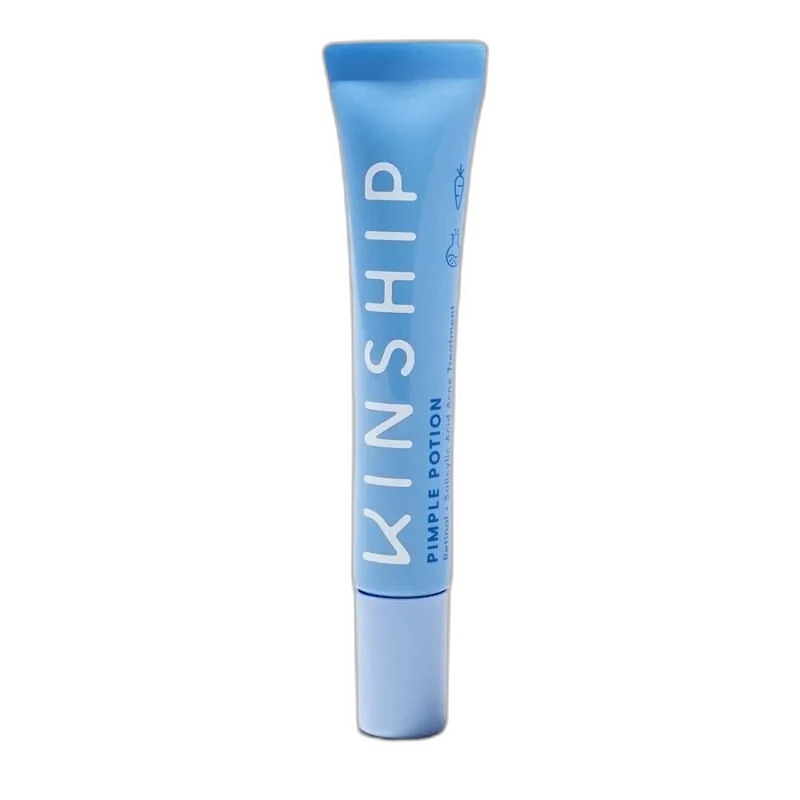
Pimple Potion Retinal + Salicylic Acid Acne Treatment
Clean Beauty Acne Pick
 Verified reviewer
Pros & cons.
- +Real retinaldehyde (not just retinol) paired with maximum-strength 2% SA
- +Centella asiatica and Kinbiome probiotic add soothing and microbiome support
- +Works effectively as both spot and all-over acne treatment
- +FDA-registered OTC drug with proper active ingredient labeling
- +Clean beauty positioning without sacrificing active ingredient chemistry
- +Accessible $22 price compared to clinical retinoid-plus-SA products
- +Vegan and Leaping Bunny cruelty-free certified
- −Contains five essential oils with multiple contact allergen ingredients
- −Avocado oil may clog pores in some acne-prone users
- −Small 0.53 oz tube is limiting for all-over facial use
- −Not safe during pregnancy or breastfeeding
- −Marketing inconsistently calls the retinoid 'retinol' when it's actually retinal
The full review.
Here’s a small scandal you can investigate with any Kinship Pimple Potion listing: the product’s marketing, several retailer pages, and even the master list that shipped this review to my desk all call this a ‘retinol + salicylic acid’ treatment. The INCI list on the tube says retinal. Retinal is retinaldehyde, which is not the same thing as retinol. Retinal sits one conversion step closer to retinoic acid (the active form of tretinoin) in the skin’s metabolic pathway, which means it’s more potent per unit than retinol and works faster. The casual swapping of ‘retinol’ for ‘retinal’ in marketing copy is a common mistake in the industry, but in this specific case it also undersells the product. Pimple Potion isn’t a retinol acne cream — it’s a retinaldehyde acne cream, and that’s a more interesting proposition.
The salicylic acid is the headline active from an FDA perspective. At 2%, this is the maximum OTC concentration for acne treatment, and it’s the reason Pimple Potion is registered as an OTC drug product in the U.S. rather than a cosmetic. Salicylic acid is lipophilic, which means it penetrates into the sebum-rich follicles where comedones form, and it’s been the first-line chemical exfoliant for acne management for decades. A well-formulated 2% SA treatment is a reliable option for mild-to-moderate acne, and this one delivers that core function without cutting corners.
The retinaldehyde is the part that elevates this above a standard SA product. In acne, retinoids do three important things: they normalize follicular keratinization (reducing new comedone formation), they accelerate turnover of existing lesions, and they reduce inflammation in healing skin. Retinol does all of these slowly. Retinal does them faster. Tretinoin does them fastest. By choosing retinaldehyde as their retinoid, Kinship positioned Pimple Potion as a more active product than the retinol-based competitors in the clean-beauty space, without crossing into prescription territory. For Gen Z and younger Millennial users who don’t want to ask a dermatologist for tretinoin but want something more than basic OTC acne care, this is a defensible and genuinely useful middle ground.
The supporting cast adds interesting layers. Bakuchiol has published data on anti-inflammatory and wrinkle-reducing effects that run in parallel with retinoid benefits, which makes it a fitting companion to the retinal here. Centella asiatica extract provides soothing and wound-healing support, which matters because acne treatment inevitably involves some barrier disruption. The Lactobacillus ferment — Kinship’s proprietary Kinbiome — contributes postbiotic metabolites that support surface microbiome balance, which is a more mechanistically plausible use of ‘probiotics’ in skincare than the wishful thinking versions on some competitor labels. Put together, this is a formula with an actual design intent rather than a throw-everything-in marketing deck.
And then there are the essential oils. Lavender, sweet orange peel, litsea cubeba, rosemary, and ylang ylang (Cananga odorata) — five botanical oils, each contributing aromatherapy notes and mild antimicrobial or antioxidant activity, each also contributing multiple contact allergens from the fragrance allergen catalog. In a clean-beauty product this stacking is philosophically consistent — plants over synthetics is the brand’s whole story — but in an acne treatment being applied to already-inflamed, already-sensitized skin, it introduces an irritation vector that undercuts the product’s design intent. If you have a history of fragrance or essential oil sensitivity, these inclusions are a patch-test-before-you-commit situation, and you may find that Pimple Potion is too much for your skin despite having excellent headline actives.
The avocado oil is another consideration. On the classical Draelos comedogenicity scale, avocado oil rates moderate — meaning it can contribute to clogged pores in a subset of acne-prone users. Real-world tolerance varies, and many people use Pimple Potion without issue, but if you start the product and see new clogs in areas you don’t normally break out within 2-3 weeks, the avocado oil is a likely suspect.
Who this product serves well:
resilient combination or normal skin with mild-to-moderate inflammatory and comedonal acne, users who appreciate clean-beauty positioning and tolerate botanical actives, and people who want a single product that combines SA and a stronger retinoid in one step. Used as a spot treatment on active breakouts, it’s particularly effective — most users see individual lesions resolve in 2-4 days rather than the 5-7 days typical with SA-only treatments. As an all-over facial treatment, it’s more of a general management product than a flare-stopper.
Who should skip:
rosacea, eczema, sensitive skin, fragrance-allergic users, pregnant and breastfeeding users, and anyone who knows they react to essential oils. For those users, a simple 2% SA serum from Paula’s Choice or The Ordinary paired with a separate retinaldehyde serum from Avène or Osmosis will give you more control over what your skin is seeing. The $22 price point is generous for the technology on paper, but it’s not a bargain if the essential oils trigger a flare.
Ingredient analysis.
Full INCI list
Active: Salicylic Acid 2%. Inactive: Water (Aqua), Caprylic/Capric Triglyceride, Cetearyl Alcohol, Sorbitan Stearate, Glycerin, Cetyl Ethylhexanoate, Glyceryl Stearate, Lactobacillus Ferment, Retinal, Bakuchiol, Persea Gratissima (Avocado) Oil, Centella Asiatica Extract, Daucus Carota Sativa (Carrot) Root Extract, Citrus Aurantium Dulcis (Orange) Peel Oil, Lavandula Angustifolia (Lavender) Oil, Litsea Cubeba Fruit Oil, Rosmarinus Officinalis (Rosemary) Leaf Oil, Cananga Odorata Flower Oil, Xanthan Gum, Polyacrylate Crosspolymer-6, Phenoxyethanol, Ethylhexylglycerin, Sodium Phytate.
Skin match.
The science.
The Science
The active ingredient case for Pimple Potion rests on two well-established mechanisms. Salicylic acid at 2% is the FDA-recognized OTC standard for acne treatment, with decades of published research supporting its efficacy for mild-to-moderate inflammatory and comedonal acne. Its lipophilic nature allows it to penetrate into sebum-rich follicles where comedones form, and its keratolytic action clears follicular debris. Retinaldehyde has published human clinical data supporting its efficacy for acne and photoaging, with one key study in the Journal of the American Academy of Dermatology reporting that 0.05% retinaldehyde was well-tolerated and effective over 16-24 weeks for mild-to-moderate acne, with comparable results to low-strength tretinoin and fewer irritation issues. The conversion pathway — retinol to retinal to retinoic acid — means retinaldehyde skips one inefficient conversion step compared to retinol, making it more potent per unit. Bakuchiol has been compared to retinol in a 2018 paper in the British Journal of Dermatology, where it showed similar improvements in wrinkle depth and pigmentation over 12 weeks with less irritation, though the acne-specific data for bakuchiol is more limited. Centella asiatica has a robust research base in dermatology for wound healing and anti-inflammatory activity, driven by its content of asiaticoside, madecassic acid, and asiatic acid. The Lactobacillus ferment contributes postbiotic metabolites with some supporting microbiome research, though the specific clinical evidence for ferment-based products in acne is less robust than for the retinoid and SA actives. The principal evidence gap in this formula is not the actives themselves — which are well-supported — but the combination-specific clinical data in the final product, which Kinship has not published in peer-reviewed journals.
Dermatologist Perspective
Dermatologists tend to appreciate the retinaldehyde + salicylic acid combination as a credible OTC acne option, particularly for patients who want to avoid prescription tretinoin or benzoyl peroxide. The choice of retinaldehyde over retinol is a formulation-sophistication signal that indicates the brand took the category seriously. Board-certified dermatologists typically recommend Pimple Potion as a step up from basic SA products for patients with mild-to-moderate acne who can tolerate the essential oil content, and as a clean-beauty-friendly alternative for patients who prefer that positioning. Patients with sensitive skin, rosacea, or known fragrance allergies are routinely steered to alternative products — a plain 2% SA plus a fragrance-free retinaldehyde serum is a common substitute recommendation. As with all retinoids, pregnancy and breastfeeding are contraindications, and daily broad-spectrum SPF is essential with ongoing use.
Where it fits in your routine.
Apply at night as your last active step before moisturizer. For spot treatment, apply a small amount to active breakouts after cleansing and toning, then apply moisturizer to the surrounding skin. For all-over facial treatment, apply a thin layer to acne-prone zones and follow with a hydrating or ceramide moisturizer. Use every other night for the first 1-2 weeks, then use nightly as tolerated. Always apply broad-spectrum SPF 30+ in the morning — retinal and salicylic acid both increase UV sensitivity. Do not pair with benzoyl peroxide, AHAs, or additional retinoids in the same session. Patch test behind the ear for 3 days before facial use if you have a history of fragrance or essential oil sensitivity.
At $22 for 0.53 oz, Pimple Potion has strong value based on its formula. Retinaldehyde often costs more in standalone products. Combining retinaldehyde with 2% SA, bakuchiol, centella, and a probiotic ferment at this price is rare. The 0.53 oz size limits value; the tube lasts 3-4 weeks for all-over facial use, so spot-only use makes more sense. A bare-bones 2% SA serum costs $13, so Pimple Potion costs $9 more for the retinaldehyde and supporting cast. This is a fair premium. Essential oil content is the main variable: if you tolerate them, this is a good buy; if you don't, the value is zero regardless of price.
Gen Z and younger users with mild-to-moderate combination or normal acne-prone skin seeking clean-beauty acne treatments with active chemistry. It works well for spot-treatment users who prefer retinaldehyde over basic SA options and lack essential oil sensitivity.
Avoid this if you have sensitive skin, rosacea, eczema, fungal acne, or essential oil reactivity; use a plain SA treatment instead. Pregnant or breastfeeding users should not use retinoids. Severe or cystic acne requires a dermatologist rather than a spot treatment — Pimple Potion treats mild-to-moderate cases, not severe acne.
Product details.
Lightweight cream-lotion with a soft emollient finish.
Noticeable botanical aromatherapy scent from the lavender, orange, litsea, rosemary, and ylang ylang oils — pleasant if you like that category.
Small squeeze tube has a precise tip for spot application or measured all-over use.
The salicylic acid and the retinal cause a gentle tingle on application. New retinal users may see mild dryness or flaking around lesions during the first 1-2 weeks. Active breakouts often flatten visibly within 2-3 days of spot application.
Apply nightly to spots for 6-8 weeks, or full-face for 3-4 weeks. The small tube works best for targeted use.
12 months
All Year
The backstory.
Kinship launched in 2020 as a Gen Z-targeted clean-beauty brand built around plant-based actives and Kinbiome, their signature probiotic ingredient. Pimple Potion was developed as their clean-beauty answer to the acne category — a product that could claim serious actives (retinal, salicylic acid) while staying true to the brand's vegan, Leaping Bunny-certified positioning. It reflects a specific bet: that a younger customer wants real acne treatment chemistry without feeling like they're using a pharmaceutical.
About Kinship
Emerging Brand (2–5 years)Kinship is a clean-beauty brand founded in 2020. It focuses on probiotics, plant-based actives, and vegan formulations for Gen Z. The brand has a loyal following via Credo Beauty and DTC, but lacks the decades of clinical validation found in legacy acne brands.
Common myths.
Retinol and retinal are the same thing.
They aren't. Retinol requires conversion to retinoic acid via retinaldehyde in the skin, and each step loses efficiency. Retinaldehyde (retinal) skips the first step and has more potency per unit than retinol. Kinship's marketing and some retailer listings use these terms loosely, but the product contains retinal, which is stronger.
Avocado oil is always comedogenic for acne-prone skin.
Avocado oil is moderately comedogenic on older scales, but individual tolerance varies. Some acne-prone users tolerate it well; others do not. If Pimple Potion triggers new clogs within 2-3 weeks of use, the avocado oil may cause it.
FAQ.
Can I use Pimple Potion every day?
Most resilient users tolerate daily use after a short adjustment period. Use it every other night for the first week, then move to nightly. Always follow with moisturizer to minimize dryness, and use daily SPF 30+ in the morning.
Is it safe during pregnancy?
No. Retinal is a retinoid. Dermatology guidance says to avoid all topical retinoids during pregnancy and breastfeeding. Salicylic acid above the rinse-off threshold is also generally avoided during pregnancy. Use a pregnancy-safe acne product instead.
Can I use it with benzoyl peroxide?
Do not use them in the same session. Benzoyl peroxide oxidizes and deactivates retinal. Combining it with 2% salicylic acid in one application also dries skin. Use them on different nights, or use benzoyl peroxide as a morning spot treatment and Pimple Potion at night.
Why are there so many essential oils in an acne product?
Kinship's clean-beauty positioning emphasizes plant-based ingredients, and lavender, orange peel, litsea, rosemary, and ylang ylang oils all have mild antimicrobial or antioxidant activity. The trade-off is that these oils include multiple common contact allergens (linalool, limonene, geraniol) that can sensitize skin, particularly in acne-prone users whose barrier is already challenged. Patch test carefully if you have any history of fragrance sensitivity.
Is this better than a standard 2% SA product from The Ordinary or Paula's Choice?
Better is subjective. Kinship adds retinaldehyde, bakuchiol, centella, and a probiotic ferment to the 2% SA, surpassing basic SA serums. The trade-off is the essential oil content and higher price per ounce. For clean-beauty users wanting real actives, Pimple Potion has more chemistry than a plain SA product. For value shoppers, a $13 SA serum plus a separate retinaldehyde serum has a higher ingredient count.
Does it cause purging?
Some users experience a brief purge during the first 2-4 weeks. The retinal and salicylic acid accelerate cell turnover and bring existing blockages to the surface. This differs from true breakouts: purges resolve in new patterns in existing problem areas, while new breakouts appear in areas where you don't typically break out. A purge that lasts past 6 weeks usually isn't purging.
What the community says.
"Works as both spot and all-over treatment"
"Retinal is a nice upgrade from standard SA products"
"Clean beauty positioning without sacrificing actives"
"Gentler on some users than benzoyl peroxide alternatives"
"Lots of essential oils in an acne product"
"Can sting on sensitive spots"
"Small 0.53 oz tube runs out quickly with all-over use"
"Avocado oil concerns for acne-prone skin"
Featured in.
People also looked at.