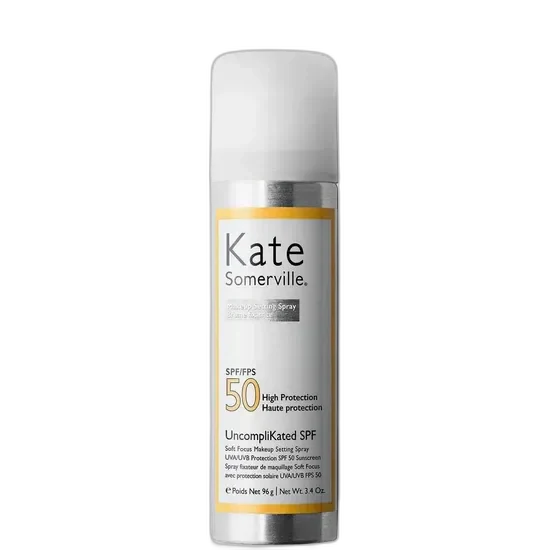
UncompliKated SPF 50 Soft Focus Makeup Setting Spray
On-The-Go SPF Solution
 Verified reviewer
Pros & cons.
- +Genuine SPF 50 broad-spectrum protection in a convenient over-makeup spray format
- +Ultra-fine aerosol mist applies evenly without disturbing foundation or concealer
- +Matte finish with soft-focus pore-blurring effect from silica particles
- +Eliminates the sunscreen-over-makeup dilemma for daily wear
- +Quick-drying formula sets in seconds for efficient morning routines
- +Cost-effective if replacing separate setting spray and facial sunscreen purchases
- −Contains oxybenzone, which many consumers and jurisdictions now prefer to avoid
- −Heavy denatured alcohol base is drying and can irritate sensitive skin
- −Lavender essential oil adds unnecessary fragrance allergens to a daily-wear product
- −Eye stinging commonly reported due to the fine mist carrying alcohol and UV filters
- −Spray format makes it difficult to achieve the application density needed for full SPF 50 protection
The full review.
The sunscreen-under-makeup problem is one of skincare’s most persistent practical headaches. You spend twenty minutes on a careful base routine, blend foundation to a flawless finish, set everything with powder — and then the dermatologist says you need to reapply sunscreen every two hours. The options historically have been grim: smear a thick cream over your finished face, use a powder SPF of questionable efficacy, or simply accept UV damage as the price of looking put-together. Kate Somerville, watching this exact dilemma play out daily among her LA clinic clientele, took the practical route and created a product that attempts to be both things at once.
The UncompliKated SPF 50 is, at its core, a chemical sunscreen in an aerosol setting spray format. The UV filter system is robust on paper: five chemical filters (avobenzone, homosalate, octisalate, octocrylene, and oxybenzone) working together to provide broad-spectrum SPF 50 protection. Avobenzone handles the critical UVA absorption, stabilized by octocrylene to prevent the photodegradation that plagues avobenzone in simpler formulations. Homosalate and octisalate provide the UVB backbone, and oxybenzone fills in remaining spectral gaps.
The delivery mechanism is where the concept really shines. The aerosol produces a genuinely fine, even mist — finer than most facial sprays, closer to the consistency of airbrush makeup than a traditional spray bottle. It lands on the skin without disturbing foundation, concealer, or powder beneath. Within seconds, it dries to a matte, slightly powdery finish thanks to the silica silylate particles that also provide the promised soft-focus effect. Pores look subtly blurred. Shine is controlled. Makeup looks freshly set.
For the person who wears makeup daily and wants convenient sun protection, the experience is genuinely satisfying. One product replaces both a setting spray and a sunscreen reapplication step. The matte finish actually improves how makeup looks throughout the day, controlling the midday oil breakthrough that undoes morning work. And the spray format makes two-hour reapplication feasible — close your eyes, mist, let dry, done.
But the ingredient reality requires honest assessment. The elephant in the aerosol can is oxybenzone. Once a standard chemical UV filter, oxybenzone has faced increasing scrutiny over potential endocrine disruption (though evidence in humans at cosmetic concentrations remains debated) and documented harm to coral reef ecosystems. Hawaii and several other jurisdictions have banned oxybenzone in sunscreens. Many consumers and dermatologists now prefer to avoid it, and its inclusion in a 2017-era product from a prestige brand feels increasingly dated.
The base formula is heavily alcohol-dependent. Alcohol denat. is the first inactive ingredient, serving as the quick-drying solvent that allows the spray to set rapidly without disturbing makeup. It evaporates within seconds, which is why the product dries so fast and so matte. But that evaporation is fundamentally dehydrating, stripping surface moisture from the skin each time you spray. The hydrolyzed hyaluronic acid attempts to offset this, but a single hydrating ingredient against a wall of denatured alcohol is bringing a water gun to a desert.
For dry or sensitive skin, this formula is problematic. The alcohol base combined with chemical UV filters and lavender essential oil creates a triple irritation risk. Eye stinging is a commonly reported issue — the fine mist, while great for coverage, makes it easy for atomized alcohol and UV filters to contact the sensitive periorbital area. Even users who love the product often note having to carefully shield their eyes during application.
The lavender oil is the now-familiar Kate Somerville signature — present in many of her products and always polarizing. In a sunscreen spray, where the product sits on the face all day, having a fragrant essential oil with known allergens (linalool, limonene) feels particularly unnecessary. The scent is noticeable, a distinct lavender herbiness that lingers for several minutes after spraying.
Efficacy as a standalone sunscreen requires a caveat. SPF testing assumes a specific application density (2 mg per square centimeter of skin), which is difficult to achieve and verify with a spray. A light misting provides some protection but likely falls short of the labeled SPF 50. For genuine full-day sun protection, dermatologists recommend using a traditional sunscreen as the primary layer and this spray as a convenient reapplication tool. As a supplementary SPF step that also sets makeup, it is excellent. As your only sun protection for a beach day, it is inadequate.
The value math works reasonably well. At forty-four dollars for 3.4 ounces, you are getting both a makeup setting spray and a facial sunscreen in one product. Purchased separately, a good setting spray runs twenty to thirty dollars and a prestige facial sunscreen another thirty to fifty. If you consistently use both, consolidating into one product makes financial sense.
Ingredient analysis.
Full INCI list
Active Ingredients: Butyl Methoxydibenzoylmethane (Avobenzone) 3%, Homosalate 10%, Ethylhexyl Salicylate (Octisalate) 5%, Octocrylene 10%, Benzophenone-3 (Oxybenzone) 5%. Inactive Ingredients: Alcohol Denat., Isobutane, Propane, Isododecane, Ethylhexyl Methoxycrylene, PVP, Methyl Dihydroabietate, Hydrolyzed Hyaluronic Acid, Rhodiola Rosea Root Extract, Water, Lavandula Angustifolia Oil, Silica Silylate, Pentylene Glycol, Linalool, Limonene
Skin match.
The science.
The Science
The UncompliKated SPF 50 uses a five-filter chemical UV protection system for broad-spectrum coverage. Avobenzone (butyl methoxydibenzoylmethane) at 3% peaks at 360 nm UVA absorption, covering the UVA1 range linked to photoaging and DNA damage. Research in the Journal of the American Academy of Dermatology shows avobenzone photodegrades, losing up to 36% of UVA-absorbing capacity after 1 hour of UV exposure. In this formula, octocrylene at 10% photostabilizes avobenzone by absorbing the triplet-state energy that causes its structural breakdown.
Homosalate (10%) and octisalate (5%) provide UVB absorption at 306 nm and 307 nm. Oxybenzone (5%) adds UVA2 and UVB absorption, making it the system's broadest single UV filter—though in vitro studies suggesting endocrine activity make it controversial. A 2020 FDA study in JAMA found oxybenzone reaches systemic absorption above the proposed safety threshold after one application, though the clinical significance is still under investigation.
The spray format affects SPF consistency. Wang et al. published research in the Journal of the American Academy of Dermatology showing consumers apply spray sunscreens at densities below the 2 mg/cm² SPF testing standard, so real-world protection is lower than the labeled SPF. The fine-mist aerosol in this product improves coverage uniformity over pump sprays, but users must apply it thoroughly to reach SPF 50-level protection.
References
Dermatologist Perspective
Board-certified dermatologists view SPF setting sprays as supplementary tools rather than primary sunscreens. Dermatologists recommend a standard sunscreen (applied at adequate density) as the first UV defense, then using a spray like this for easy mid-day reapplication over makeup. The oxybenzone content concerns dermatologists who now prefer mineral or newer-generation chemical filters. However, dermatologists note that any sunscreen a patient uses consistently is better than a perfect formulation left in the cabinet, and this spray format improves compliance for makeup wearers.
Where it fits in your routine.
Shake the can well before each use. Close your eyes and hold the can 8-10 inches from your face. Spray in even, sweeping motions to cover your forehead, cheeks, nose, and chin. Use 2-3 passes for adequate sun protection coverage. Let it dry for 30-60 seconds; do not touch your face while drying. Reapply every 2 hours during direct sun exposure. Use it over finished makeup or on bare moisturized skin.
At $44 for 3.4 fl oz, this product offers value as a two-in-one replacement for both a setting spray and a facial sunscreen. The aerosol format dispenses product efficiently with minimal waste. However, if you already use a preferred setting spray and only need better sun protection, a traditional facial sunscreen provides better per-dollar UV protection. You pay a convenience premium here — the cost covers the ease of spraying SPF over makeup rather than the ingredients.
Makeup wearers who find sunscreen reapplication difficult can use this matte-finish SPF to set makeup. It works for oily and combination skin types that need a shine-controlling matte finish.
Choose this if you avoid oxybenzone, have sensitive or alcohol-reactive skin, or get eye irritation from spray sunscreens. The alcohol base may dehydrate dry skin types during daily use. Use a traditional sunscreen as your primary defense for heavy-duty protection during prolonged outdoor activity.
Product details.
An ultra-fine, invisible mist disperses evenly from the aerosol nozzle. It dries to a matte, powder-like finish with no visible residue or white cast.
The included essential oil has a noticeable lavender fragrance. It is prominent upon spraying but fades within a few minutes. Users are divided; some find it pleasant, while others find it overpowering.
An aerosol spray can uses a fine-mist nozzle for even, controlled distribution. The travel-friendly size works well. The opaque can makes it hard to see how much product remains.
The ultra-fine mist sprays evenly and dries almost instantly, leaving a matte, soft-focus finish. Makeup looks more set and polished. The lavender scent is immediate. The alcohol base causes brief tingling for some users, especially near the eyes — close your eyes and hold the can at arm's length.
2-3 months with daily single-application use
12 months
spring summer
The backstory.
Kate Somerville created the UncompliKated spray for her clients who struggled with the sunscreen-under-makeup dilemma. In her LA clinic, she saw countless patients whose sun damage worsened because they skipped sunscreen to avoid disturbing their makeup. This product was designed to eliminate that excuse — apply SPF over finished makeup in seconds, with the added benefit of shine control.
About Kate Somerville
Established Brand (5–20 years)Aesthetician Kate Somerville founded Kate Somerville in 2004. She runs a famous skin clinic on Melrose Place in Los Angeles. The UncompliKated SPF spray works as both a sunscreen and a makeup setting spray for the brand's busy clients.
Common myths.
SPF setting sprays offer the same protection as traditional sunscreens.
While this spray offers genuine SPF 50 protection, achieving that rated coverage requires applying a sufficient amount — typically more than a quick spritz. For reliable full protection, apply a traditional sunscreen underneath and use this spray for convenient reapplication and top-up protection throughout the day.
You only need to apply SPF spray once in the morning.
All chemical sunscreens, including this one, degrade under UV exposure. Reapply every 2 hours during direct sun exposure. The spray format makes reapplication convenient, but this is not a set-and-forget product for prolonged outdoor activities.
What the community says.
"Ultra-fine mist applies evenly without disturbing makeup"
"Provides genuine SPF 50 sun protection in a convenient format"
"Effectively controls shine and reduces oily midday breakthrough"
"Convenient all-in-one solution for sunscreen and makeup setting"
"Strong lavender scent that some find overpowering"
"Contains oxybenzone which many consumers prefer to avoid"
"High alcohol content can be drying and irritating for sensitive skin"
"Some users report stinging around the eye area on application"
People also looked at.