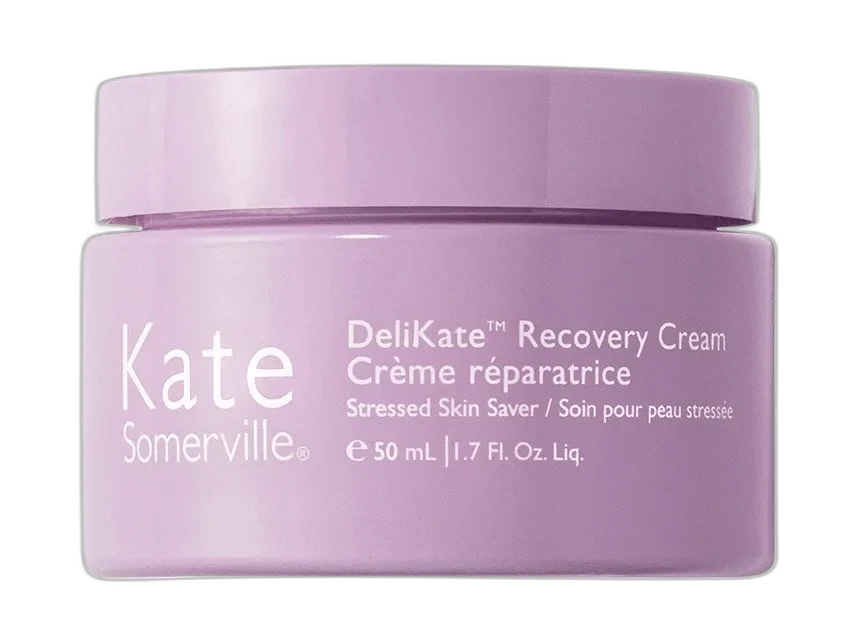
DeliKate Recovery Cream
Sensitive Skin Savior
 Verified reviewer
Pros & cons.
- +Complete ceramide-cholesterol-phytosphingosine complex that mirrors the skin's natural lipid ratio
- +Dual ectoin and hydroxyectoin system provides unique environmental stress protection
- +Fragrance-free and paraben-free — suitable for the most reactive skin types
- +Rich texture melts into skin without feeling heavy or greasy on the face
- +Visibly reduces redness and irritation within the first week of use
- +Genuinely effective for post-procedure recovery, drawing on clinical treatment room origins
- +Thoughtful supporting ingredients including bisabolol, boswellia, and green tea extract
- −Premium price of $76 for just 1.7 fl oz limits accessibility for many consumers
- −Glass jar packaging requires finger contact, which is less hygienic than a pump
- −Too rich for consistently oily or acne-prone skin types to use twice daily
- −Jar runs out in 2-3 months, making the annual cost substantial for a daily moisturizer
- −Emerging peptide (Tetrapeptide-14) has limited independent clinical evidence
The full review.
Skincare trends always leave casualties. The late 2010s obsession with acid-toning, retinol-layering, and twelve-step routines left many with compromised skin barriers and empty bank accounts. Kate Somerville has treated post-laser and post-peel skin in her Melrose Place clinic since 2004. She saw the damage caused by Instagram-fueled routines and created an opportunity. The DeliKate Recovery Cream launched in 2020 as the at-home version of the treatments her aestheticians apply after professional procedures, designed for anyone with similar barrier damage.
The formula centers on a complete ceramide lipid complex: Ceramides NP, EOP, and AP, cholesterol, and phytosphingosine. This is not a marketing gesture. These five components replicate the lipid ratio found in healthy skin. This combination separates effective barrier repair from products that only name-drop ceramides. Cholesterol fills structural gaps between ceramide layers, phytosphingosine acts as a ceramide precursor and antimicrobial agent, and the three ceramide types occupy different positions in the intercellular lipid matrix. The formulation shows a clear understanding of dermatological literature.
The inclusion of ectoin and hydroxyectoin elevates this cream above other ceramide moisturizers. This dual extremolyte system is rare outside of European pharmacy brands. Ectoin is a natural compound from extremophilic bacteria found in deserts and salt lakes. Its mechanism differs from typical soothing agents. Instead of just calming inflammation, ectoin forms a protective water shell around proteins and cell membranes to stabilize them against environmental stress. Hydroxyectoin amplifies this. Together, they add an environmental defense layer that complements the ceramide complex’s structural repair to address sensitized skin from two angles.
The supporting ingredients are equally intentional. Bisabolol provides immediate anti-inflammatory relief, boswellia serrata extract adds calming properties, and green tea extract provides antioxidant protection. Tetrapeptide-14 acts as a signal peptide to help modulate the skin’s inflammatory response, though evidence for this specific peptide is still emerging. Honey extract works as a humectant with antimicrobial properties. None of these ingredients are filler.
The texture explains the product’s loyalty. It is thick in the jar, but transforms into an almost oil-like consistency upon contact with warm skin. It melts instead of spreads, sinks in within about a minute, and leaves a satin finish that feels protective but not occlusive. On freshly irritated skin, the relief is immediate—a cooling sensation that feels like the skin is breathing.
The DeliKate Recovery Cream earns its clinical heritage through long-term performance. Immediate soothing is helpful, but the real value appears after weeks of consistent use. Chronically sensitized skin—skin that flushes with temperature changes, stings from previously tolerated products, or looks perpetually inflamed—becomes more resilient. The barrier strengthens, and skin tolerance for other products improves. For those recovering from over-exfoliation, aggressive treatments, or rosacea flare-ups, this shift from reactive to resilient is the primary benefit.
The price reflects this. At seventy-six dollars for 1.7 ounces, this is luxury-tier pricing. The glass jar looks good but runs out quickly with twice-daily use. The jar format also requires dipping fingers into the product, which is not ideal for preservation. A jar lasts roughly two to three months with judicious use, and less if used generously. A pump tube would be more practical for this formula.
Does the formulation sophistication justify the cost? For the DeliKate Recovery Cream, the answer is a qualified yes. The complete ceramide lipid complex, the dual ectoin system, and the variety of soothing botanicals show genuine formulation investment. You are not paying seventy-six dollars for glycerin in a nice jar. Whether you need this level of intervention or a well-formulated drugstore ceramide cream depends on how compromised your barrier is.
For truly sensitized, post-procedure, or rosacea-prone skin, this cream performs tasks simpler formulations do not. For mild seasonal dryness or occasional sensitivity, it may provide more than you need.
Formula
PM routine
Ingredient analysis.
Full INCI list
Aqua/Water/Eau, Glycerin, Trimethylolpropane Tricaprylate/Tricaprate, Pentaerythrityl Tetraisostearate, Coco-Caprylate/Caprate, Pentaerythrityl Distearate, Cetearyl Alcohol, Caprylic/Capric Triglyceride, Bis-Stearyl Dimethicone, Propanediol, Butyrospermum Parkii (Shea) Butter, Pentylene Glycol, Hexyldecanol, Glyceryl Stearate, Dimethicone, Ceramide NP, Mel (Honey Extract, Extrait De Miel), Tetrapeptide-14, Ceramide EOP, Boswellia Serrata Extract, Phytosphingosine, Ceramide AP, Cholesterol, Camellia Sinensis Leaf Extract, Glycine Soja (Soybean) Seed Extract, Oryza Sativa (Rice) Bran Extract, Ectoin, Cetylhydroxyproline Palmitamide, Bisabolol, Cucumis Sativus (Cucumber) Seed Oil, Hydroxyectoin, Helianthus Annuus (Sunflower) Seed Oil, Adenosine, Tasmannia Lanceolata Fruit/Leaf Extract, Sorbitan Isostearate, Stearic Acid, Brassica Campestris (Rapeseed) Sterols, Tocopherol, Rosmarinus Officinalis (Rosemary) Leaf Extract, Zingiber Officinale (Ginger) Root Extract, Aspalathus Linearis Extract, Aminomethyl Propanol, Hydroxyphenyl Propamidobenzoic Acid, 1,2-Hexanediol, PEG-40 Stearate, Hydroxyethyl Acrylate/Sodium Acryloyldimethyl Taurate Copolymer, Butylene Glycol, 4-T-Butylcyclohexanol, Isohexadecane, Polysilicone-11, Ceteareth-20, Sodium Lauroyl Lactylate, Caprylhydroxamic Acid, Xanthan Gum, Polysorbate 60, Trisodium Ethylenediamine Disuccinate, Carbomer, Citric Acid, Phenoxyethanol, Sodium Benzoate, Potassium Sorbate
Skin match.
The science.
The Science
The DeliKate Recovery Cream's formulation is anchored in the well-established science of stratum corneum lipid biology. The skin's barrier function depends on a specific ratio of ceramides, cholesterol, and free fatty acids organized in lamellar bilayers between corneocytes. Research published in the Journal of Investigative Dermatology has demonstrated that all three lipid classes must be present in approximately equimolar ratios for optimal barrier repair — supplementing with ceramides alone can actually worsen barrier function if cholesterol and fatty acids are not proportionally represented.
This cream includes Ceramides NP, EOP, and AP alongside cholesterol and phytosphingosine (a sphingoid base that serves as a ceramide precursor), reflecting this research. A 2003 study by Chamlin et al. in the Journal of Investigative Dermatology showed that a physiological lipid mixture containing ceramides, cholesterol, and fatty acids in optimal ratios accelerated barrier recovery in atopic dermatitis patients compared to single-lipid supplementation.
The inclusion of ectoin and hydroxyectoin represents a newer but well-supported approach to skin protection. Ectoin is a cyclic amino acid derivative produced by extremophilic bacteria. A 2004 study by Bünger et al. published in Skin Pharmacology and Physiology demonstrated that ectoin protects Langerhans cells from UV-induced damage and suppresses UV-induced inflammatory signaling. More recent research has shown ectoin's ability to form a hydration shell around biomolecules, stabilizing cell membranes against environmental stressors including pollution, temperature extremes, and UV exposure.
Bisabolol, the active component of chamomile, has been studied extensively for its anti-inflammatory properties. Research published in the European Journal of Pharmacology has demonstrated bisabolol's ability to inhibit pro-inflammatory cytokine production and reduce skin irritation. In this formulation, bisabolol provides immediate symptomatic relief while the ceramide complex addresses the underlying barrier dysfunction.
References
- Basis for the barrier abnormality in atopic dermatitis: outside-inside-outside pathogenic mechanisms — Journal of Investigative Dermatology (2003)
- Ectoin: An Effective Natural Substance to Prevent UVA-Induced Premature Photoaging — Skin Pharmacology and Physiology (2004)
Dermatologist Perspective
Board-certified dermatologists frequently recommend ceramide-based moisturizers for patients with compromised barriers, and the DeliKate Recovery Cream's complete lipid complex aligns with evidence-based barrier repair protocols. Dermatologists note that the inclusion of all three essential barrier lipids — ceramides, cholesterol, and a sphingoid base — reflects current understanding of stratum corneum biology more accurately than many competing products. The fragrance-free, paraben-free formulation makes it a safe recommendation for post-procedure care and sensitive skin management. Dermatologists treating rosacea patients often suggest this class of ceramide-rich cream as part of a simplified, barrier-focused routine.
Where it fits in your routine.
Use a gentle, non-foaming cleanser. Apply hydrating serums first and wait one minute for absorption. Use clean fingertips to scoop a pea-sized amount of the Recovery Cream, then press it into the face and neck. Pat the skin instead of rubbing to reduce friction on sensitized skin. Use morning and evening. Apply a mineral sunscreen in the morning. At night, apply retinoids first, then layer the Recovery Cream on top after a few minutes to buffer irritation.
At $76 for 1.7 fl oz ($44.70 per ounce), the price is premium. A 0.5 fl oz travel size lets users trial the product before committing. The formulation complexity—a complete ceramide lipid complex, dual ectoin system, and multiple soothing botanicals—shows investment in ingredient quality. This specialized formulation may justify the cost for the brand's target audience of chronically sensitized or post-procedure skin. However, the small jar size means daily use costs roughly $300-450 annually. The premium reflects Kate Somerville's clinical heritage and the specialty ingredients, but budget-conscious consumers with mild sensitivity can find effective ceramide creams for much less.
People with chronically sensitized, redness-prone, or post-procedure skin who can afford a premium barrier repair cream. It works well for rosacea-prone skin, over-exfoliated skin recovering from aggressive actives, and skin that reacts to most products.
Oily or acne-prone skin types will find this too thick for daily use. Budget-conscious shoppers can buy effective ceramide creams for much less. If sensitivity is mild or seasonal, this level of targeted repair exceeds your needs.
Product details.
This thick, velvety cream feels dense in the jar but melts into a lightweight, oil-like layer on the skin. It is not sticky or heavy.
Unscented. A faint, clean scent exists but dissipates immediately. No added fragrance.
Glass jar with a screw-top lid. Premium feel with the signature Kate Somerville pale pink branding. Jar packaging means fingers contact the product, which is less hygienic than a pump.
The cream provides an immediate cooling, calming sensation on irritated skin upon first application. Redness visibly diminishes within the first few uses. Skin feels more comfortable and resilient during the first week. There is no adjustment period — this works to soothe from the very first use.
Apply to face and neck twice daily for 2-3 months. Many users finish the small jar in closer to 2 months.
12 months
All Year
The backstory.
Kate Somerville developed the DeliKate line after years of treating clients in her LA clinic who came in with compromised, over-treated skin — the inevitable result of aggressive facials, peels, and laser treatments that Hollywood demands. The Recovery Cream was formulated to be the take-home equivalent of what her aestheticians applied in the treatment room after intensive procedures.
About Kate Somerville
Established Brand (5–20 years)Kate Somerville was founded in 2004 by aesthetician Kate Somerville, who operates a renowned skin clinic on Melrose Place in Los Angeles. The brand has over two decades of professional treatment room experience and was acquired by Unilever in 2015 before being sold to Rare Beauty Brands. Products are formulated based on clinical treatment protocols.
Common myths.
Sensitive skin requires minimal, stripped-back formulas with few ingredients.
This 61-ingredient formula shows that sensitive skin often needs a sophisticated approach. The goal is choosing non-irritating, barrier-supportive ingredients, not just using fewer. The ceramide-cholesterol-phytosphingosine trio requires all three components to mimic the skin's natural lipid structure.
Expensive moisturizers are just drugstore formulas in better packaging.
Some premium products follow this trend, but the DeliKate Recovery Cream uses specialty ingredients like ectoin, hydroxyectoin, and a complete ceramide lipid complex. These ingredients cost more to formulate. Whether the price premium is justified is debatable, but the formulation complexity is real.
FAQ.
Is Kate Somerville DeliKate Recovery Cream worth the price?
The formulation uses a complete ceramide-cholesterol-phytosphingosine lipid complex and ectoin. At $76 for 1.7 oz, the cost depends on your skin. The targeted barrier repair justifies the price for chronically sensitized or post-procedure skin. Cheaper alternatives work for mild dryness.
Can I use DeliKate Recovery Cream with retinol?
Yes — this cream works well with retinol. Its ceramide complex and soothing agents buffer retinoid-induced irritation. Apply your retinol first, wait a few minutes, then layer this cream on top to seal in moisture and calm irritation.
Is Kate Somerville DeliKate Recovery Cream good for rosacea?
The fragrance-free formula with ceramides, bisabolol, and ectoin works for rosacea-prone skin. The ceramide complex strengthens the compromised barrier common in rosacea, and the anti-inflammatory botanicals calm visible redness. However, rosacea management requires a dermatologist's guidance.
How long does a jar of DeliKate Recovery Cream last?
The 1.7 fl oz jar lasts 2-3 months if you apply it to your face and neck twice daily. A pea-sized amount works well; add more if needed. A 0.5 fl oz travel size is also available for trial.
Is DeliKate Recovery Cream fragrance-free?
This cream is fragrance-free and contains no synthetic fragrances or essential oils. The faint clean scent comes from the base ingredients and dissipates immediately upon application. This makes it suitable for fragrance-sensitive users.
Can I use DeliKate Recovery Cream after a chemical peel or laser treatment?
Kate Somerville developed this cream for post-procedure recovery, following Kate Somerville's clinic protocols. The ceramide complex and soothing ectoin restore the barrier after professional treatments. Follow your practitioner's specific post-care instructions, but professionals commonly recommend this cream for the recovery phase.
Is Kate Somerville DeliKate Recovery Cream too heavy for oily skin?
The thick texture feels heavy on oily skin, especially in warm or humid climates. If you have oily skin with sensitized patches, use it only on affected areas or as a nighttime-only treatment instead of a twice-daily moisturizer.
What the community says.
"Instantly calms irritated and redness-prone skin"
"Rich but non-greasy texture that absorbs well"
"Noticeable barrier improvement within first week"
"Excellent for post-procedure recovery"
"Very expensive for the amount of product you get"
"1.7 oz jar runs out quickly with daily use"
"Too rich for oily or acne-prone skin types"
"Results may not justify the price for mild sensitivity"