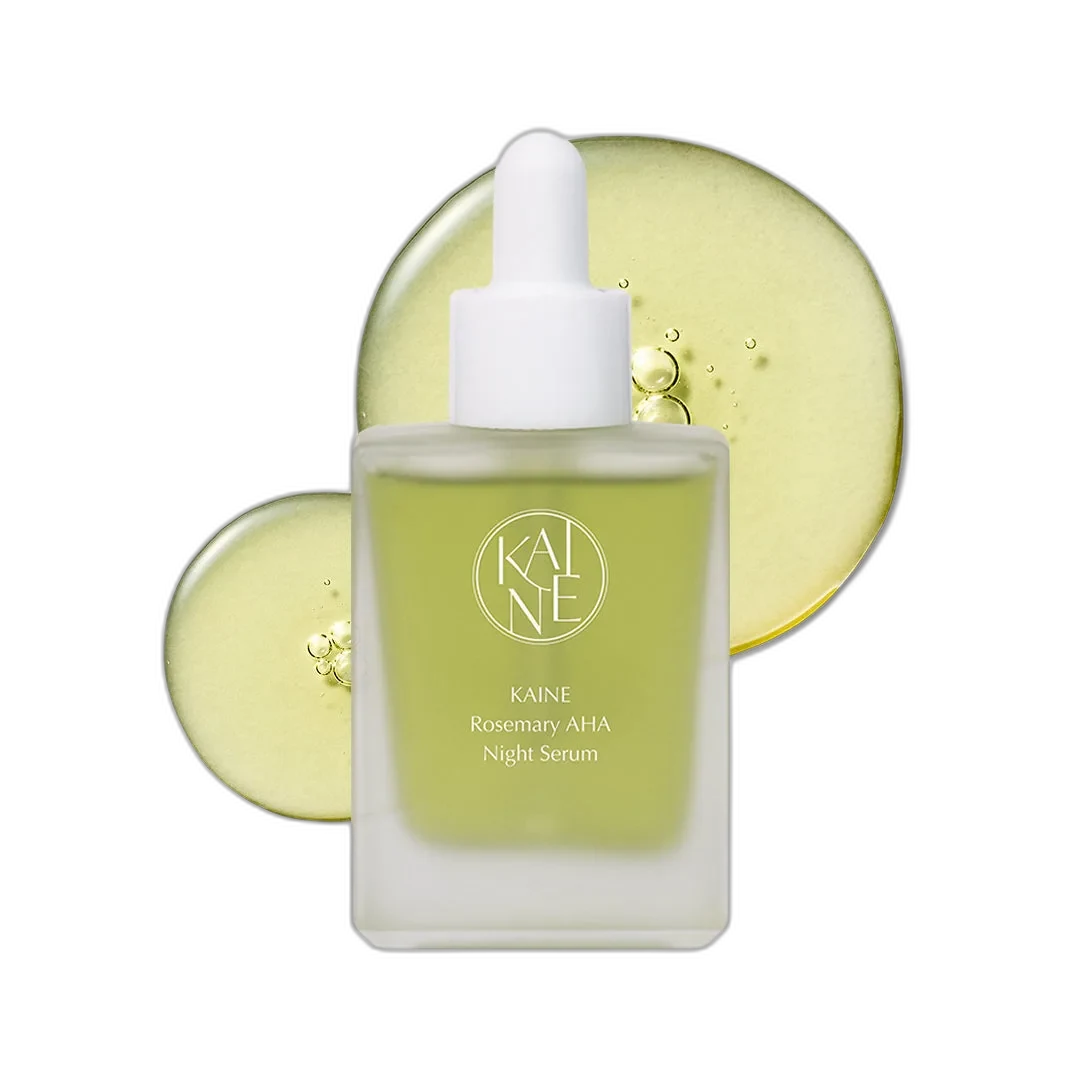
Rosemary AHA Exfoliating Toner (Rosemary AHA Night Serum)
K-Beauty AHA Pick
 Verified reviewer
Pros & cons.
- +Meaningful 9% lactic acid dose at an active pH
- +Watery essence texture absorbs without tackiness
- +Triple hyaluronic acid and panthenol cushion the post-acid finish
- +Fragrance-free, alcohol-free, and fungal-acne safe
- +Fair $30 price for a functional K-beauty AHA
- +Visibly clears texture and closed comedones within 3 weeks
- −Marketed as gentler than a 9% lactic acid realistically is
- −Small 30 ml size runs out in 6 to 8 weeks with nightly use
- −Not appropriate for truly sensitive or rosacea-prone skin
- −No larger pro size for committed users
- −Brand is still young with limited long-term formulation history
The full review.
When KAINE launched in Seoul in 2021, it made an unusual bet for a K-beauty brand. Instead of anchoring its identity around snail mucin or propolis or Centella, the founders decided the hero ingredient would be rosemary extract, a plant most Korean consumers associate with cooking rather than skincare. The gamble only works if the formulations are actually interesting, and this is the product that makes the case. On paper it is a 9% lactic acid treatment at a low pH, which is the kind of number that would normally make you reach for something stabilizing like ceramides or niacinamide. Instead KAINE wraps the acid in a watery essence base with triple hyaluronic acid, panthenol, allantoin, and a list of plant extracts, and the result is a K-beauty product that actually feels like a K-beauty product rather than a Western AHA in prettier packaging.
That texture decision is the first thing you notice. The liquid is clear, watery, and almost weightless, more like a first-essence than a serum. You tap a few drops into the palm, press it onto the face after cleansing, and it is absorbed before you can decide whether to follow with another product. On the first two or three nights there is a polite, unmistakable tingle around the nose and chin that tells you the lactic acid is doing its job. By the first morning, skin looks a shade brighter and feels noticeably softer, and from there the real work begins. Small closed comedones along the forehead and jaw clear over the first couple of weeks. Texture around the nose evens out by week three. The pores in the T-zone visibly look smaller by week six, which is the payoff lactic acid is known for when it is dosed at a genuinely active level.
What makes this formulation worth talking about is not the dose but the design around the dose. Lactic acid at 9% and pH 3.8 is a commitment. A lot of brands that hit those numbers treat the rest of the formula like an afterthought and ship a product that stings and leaves the skin feeling raw. KAINE pads the active with a multi-weight hyaluronic acid blend, pulls water into the upper layers while the acid works, and adds rosemary, panthenol, and allantoin to cushion the post-exfoliation flush. The plant extracts are not there to distract you from the lactic acid. They are there to make nightly use of a strong AHA livable on Asian combination skin, which is the audience this product was built for.
The drawbacks are proportional to the dose rather than to the formulation. This is a 9% lactic acid. The marketing leans toward the word gentle, but anyone who has tried a truly sensitive-skin acid product will recognize that this is not one. Rosacea-prone skin or skin that is actively compromised should not start with a full-face pass. Three or four nights per week is the realistic cadence for most users, not nightly, and pairing it with retinoids or other acids on the same evening is a mistake you only make once. The 30 ml bottle is also a small target for a price-conscious buyer. At 3 or 4 full-face uses a week, you finish it in about six to eight weeks, which makes the per-month cost feel less generous than the $30 sticker suggests. A 50 ml size would be the right move.
There is also the question of the brand itself. KAINE is only a few years old, the clinical validation rests on ingredient-level research rather than proprietary trials, and the rosemary-first identity is still new enough that the long-term story has not fully written itself. That is worth naming honestly. But unlike a lot of new K-beauty brands that ride a single viral moment, KAINE is building from a coherent point of view, and this product is the clearest expression of what that point of view is supposed to mean in practice. It is a strong AHA treatment that most people can use without dreading it, at a price that is not trying to punch above its weight, and that is a specific and useful thing to have in a routine.
Ingredient analysis.
Full INCI list · pH 3.8
Water, Lactic Acid, Dipropylene Glycol, Glycerin, Butylene Glycol, Methylpropanediol, Sodium Hydroxide, 1,2-Hexanediol, Rosmarinus Officinalis (Rosemary) Leaf Extract, Hydroxyethylcellulose, Succinic Acid, Propanediol, Ethylhexylglycerin, Melia Azadirachta Leaf Extract, Hydrolyzed Gardenia Florida Extract, Hydrolyzed Malt Extract, Hydrolyzed Viola Tricolor Extract, Glyceryl Acrylate/Acrylic Acid Copolymer, Melia Azadirachta Flower Extract, Allantoin, Betaine, Panthenol, Hyaluronic Acid, Hydrolyzed Hyaluronic Acid, Sodium Hyaluronate.
Skin match.
The science.
The Science
Lactic acid has a robust evidence base among alpha hydroxy acids, making it highly relevant to this formula. Dermatology journal studies from the last three decades show that lactic acid at 5 to 12 percent concentrations, formulated at a low enough pH for the free acid to dominate, improves corneocyte cohesion, epidermal thickness, and photoaging markers. Lactic acid is a larger molecule than glycolic acid and penetrates more slowly. This results in less acute stinging and a more humectant-like feel, even though total resurfacing power at equivalent strength is broadly similar. This formula uses a 9% dose, which sits at the upper end of the leave-on home-use band where clinical literature shows the most reliable improvement in texture and post-inflammatory pigmentation. The other ingredients are also evidence-based. Panthenol has published data for wound healing and stratum corneum hydration, allantoin has long-standing use in barrier soothing products, and hyaluronic acid at multiple molecular weights shows improved surface hydration in multiple controlled trials. Rosemary extract has more modest evidence: in vitro and some early human studies suggest antioxidant activity from carnosic and rosmarinic acid, but published clinical trial data on rosemary as a cosmetic ingredient is emerging rather than established. The science shows lactic acid is the proven workhorse, while rosemary is a credible supporting actor.
Dermatologist Perspective
Dermatologists view lactic acid at around 9% as a sensible mid-strength home-use AHA, and this KAINE formula fits that category. Board-certified dermatologists often recommend lactic acid over glycolic acid for patients with skin too dry or reactive for glycolic toners who still need a functional at-home exfoliant. A cushioned essence base like this one makes that recommendation easier. Dermatologists also commonly recommend it for texture concerns, hyperpigmentation, and early photoaging in skin of color, where glycolic peels are sometimes avoided to reduce rebound pigmentation risks. Dermatologists generally advise patients to start two to three nights per week, apply to dry skin rather than damp skin, and use consistent broad-spectrum sunscreen because any leave-on AHA increases short-term photosensitivity.
Where it fits in your routine.
Apply at night to dry skin after cleansing and hydrating toner. Press three to five drops from your palm or a cotton pad onto your face. Avoid the eye area and the corners of the nose. Use a hydrating serum and moisturizer after. Use two to three nights per week for the first two weeks to test tolerance, then increase to three or four nights per week. Do not layer with retinoids, benzoyl peroxide, or other AHAs and BHAs on the same night until your skin acclimates. Use daily broad-spectrum SPF 30 or higher during use.
At $30 for 30 ml, the price matches the formula's performance. Using it 3 to 4 times weekly costs fifteen to twenty dollars per month. This price rivals drugstore AHA toners that have less interesting supporting ingredients. The main weakness is the lack of a larger pro size; regular users finish bottles fast, which raises the annual cost. Compared to a $40 Paula's Choice BHA or a $60 K-beauty snail essence, this offers better value for users seeking a functional AHA instead of a broad-spectrum treatment. For a new brand, this price signals the right level of quality.
This works for combination, oily, and normal skin types in their twenties through forties. It suits those wanting a functional lactic acid treatment at a fair price and a watery K-beauty texture instead of a thicker Western serum. It also suits drier skin types who dislike glycolic toners and want a more cushioned AHA option.
Sensitive skin, active rosacea, eczema, or a compromised barrier requires gentler soothing products until the skin stabilizes. Pregnant users can use lactic acid with physician approval for maximum caution, but those wanting zero debate should choose a non-acid exfoliation strategy instead.
Product details.
This clear, watery fluid feels like an essence. It absorbs fast and leaves no sticky residue.
The rosemary extract has a faint green herbal note, plus the mild sour edge of a low-pH lactic acid formula.
Minimalist white bottle has a plain screw cap and a small dropper-style opening. It fits the current K-beauty visual style.
You may feel a brief, mild tingle during the first few nights, especially near the nose. Skin feels softer after the first morning. Some users experience a short surface purge in weeks 1 to 2 as tiny clogs clear, then see smoother texture by week 3.
Use full-face 3 to 4 nights per week for 6 to 8 weeks, or use targeted T-zone only for 10 to 12 weeks.
12 months
All Year
The backstory.
KAINE was founded in Seoul in 2021 by a team that wanted to build a K-beauty brand around rosemary rather than snail or propolis, positioning the ingredient as a dual soothing-and-antioxidant anchor. The Rosemary AHA treatment was one of the first products launched and was quickly embraced by Korean acid enthusiasts as a gentler alternative to the harsher glycolic toners that had dominated the category.
About KAINE
Emerging Brand (2–5 years)KAINE is a Seoul-based K-beauty brand that launched in 2021. It focuses on simple, plant-forward routines using rosemary extract as its hero ingredient. The brand sells in Korea, Stylevana, and Yesstyle, but lacks a long-term track record and independent clinical studies for its formulas.
Common myths.
9% Lactic acid is too weak for results; use glycolic acid instead.
9% Lactic acid at a pH near 3.8 is clinically active. It loosens corneocytes like glycolic acid at similar strengths, but acts as a humectant and penetrates more slowly. This makes it better tolerated on drier skin.
Rosemary and panthenol make this acid product safe for everyone.
The soothing ingredients work, but the formula is still 9% lactic acid at low pH. Treat it as a strong treatment rather than a gentle toner if you have rosacea-prone or actively inflamed skin.
FAQ.
Is this a toner or a serum?
KAINE markets this AHA night product for the treatment step of a routine. The texture is watery like a toner, but the active load is serum-strength. Use it after cleansing and before hydrating layers, instead of an exfoliating toner.
Is 9% lactic acid too strong for daily use?
Yes, for most people. Three to four nights per week works best. Oilier skin can move to nightly use once tolerance builds. Drier and more reactive skin typically stays at two to three nights a week long term.
Can I layer it with retinol or vitamin C?
Don't use both on the same night until you know your tolerance. Alternate nights is the safer strategy. Daytime vitamin C is fine if you reserve this product for evenings.
Is this safe for sensitive skin?
It is gentler than a comparable 9% glycolic formula, but the low pH makes it a strong acid. Sensitive or rosacea-prone skin should start once or twice a week, buffer with a moisturizer first, and scale back if needed.
Does it cause purging?
Some users experience a brief surface purge during weeks 1 to 2 as accelerated turnover brings pre-existing microcomedones to the surface. A true purge resolves by week 4. Anything longer is an adverse reaction, not purging.
Is it safe during pregnancy?
Lactic acid in topical products is generally considered pregnancy-safe by dermatologists. Confirm with your physician if you have specific concerns, but this is one of the less controversial acid options for expectant users.
How long does the 30 ml bottle last?
Most people finish the bottle in 6 to 8 weeks using it 3 to 4 full-face times per week. Targeted T-zone use extends this to 2 to 3 months.
Community
What the community says.
"Noticeably smoother texture after one week"
"Clears small closed comedones without irritation"
"Watery, comfortable finish that does not sting"
"Fair price for a K-beauty acid treatment"
"Too strong for truly sensitive skin despite the marketing"
"Small 30 ml size disappears quickly with full-face use"
"Lactic acid scent is slightly sharp"
People also looked at.