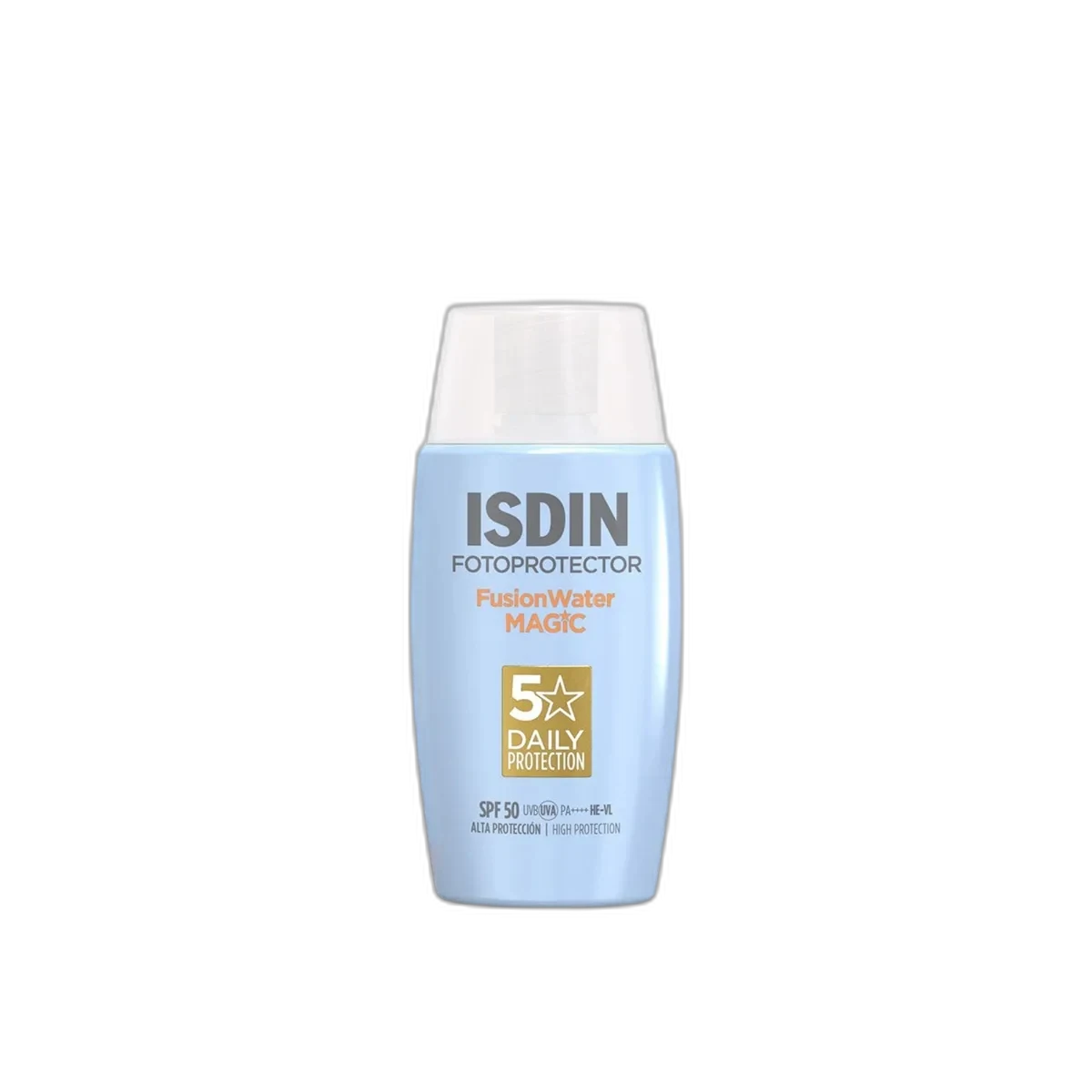
Fotoprotector Fusion Water SPF 50
European Pharmacy Favorite
 Verified reviewer
Pros & cons.
- +Genuinely water-like texture that disappears on skin within seconds of application
- +Matte oil-free finish controls shine without feeling tight or drying
- +SPF 50 broad-spectrum protection from a robust four-filter hybrid system
- +Layers perfectly under makeup with zero pilling or separation issues
- +Antioxidant trio of vitamin E, vitamin C, and ascorbyl palmitate adds free radical defense
- +Trusted formulation from Spain's leading dermatological brand with 50 years of expertise
- +Allantoin and hyaluronic acid provide soothing hydration within the lightweight base
- −Contains fragrance, which fragrance-sensitive users will want to avoid
- −Octinoxate inclusion makes it unsuitable for reef-conscious consumers
- −Small 50ml size runs out quickly with proper daily application and reapplication
- −May leave a subtle white cast on deeper skin tones with generous application
- −Higher per-milliliter cost compared to many domestic sunscreen options
The full review.
Walk into any farmacia in Barcelona, Madrid, or Seville, and you’ll notice something Americans rarely see: entire walls dedicated to sunscreen. Not buried on a bottom shelf between forgotten lip balms and dusty cotton balls, but front and center, curated like wine in a bodega. Spain takes UV protection with a seriousness that borders on religious devotion, and ISDIN — founded in 1975 by two Barcelona entrepreneurs backed by pharmaceutical giant Esteve and beauty powerhouse Puig — sits at the altar. Fusion Water is the product that helped build that congregation.
The pitch is deceptively simple: what if sunscreen felt like water? Not water-light, not water-inspired, not marketing-adjacent to the concept of water — but actual water. The kind that disappears on contact. ISDIN’s formulation team achieved this through a phase-inverted emulsion system that suspends UV filters in a fluid so thin it genuinely startles on first application. You squeeze, you spread, and then you wonder if you actually applied anything. You did. SPF 50 worth of anything.
The UV filter system is a chemical-mineral hybrid. Octinoxate handles the heavy UVB lifting, avobenzone covers the UVA spectrum, ethylhexyl triazone stabilizes the avobenzone so it doesn’t degrade in actual sunlight (a common problem with avobenzone-only formulas), and a judicious amount of titanium dioxide adds physical backup without the chalky penalty. It’s a belt-and-suspenders approach that European sunscreen formulators have refined over decades, and ISDIN executes it cleanly.
Texture
Texture is where Fusion Water earns its cult status. This is not a cream that someone in marketing decided to call a water. It has the viscosity of a light serum — fluid enough to drip if you tip the bottle. On skin, it vanishes in seconds. The silica and polymethyl methacrylate create a soft-focus matte finish that controls oil without the chalky, desiccated feel of mattifying primers. For oily skin types who’ve spent years auditioning sunscreens that all eventually betrayed them with midday grease, this is a genuine revelation.
Under makeup, Fusion Water performs like a primer you didn’t ask for but definitely needed. Foundation glides over it without pilling, balling, or separating. The finish is smooth enough to work bare-faced too — there’s a subtle blurring effect from the polymethyl methacrylate that softens the appearance of pores without looking filtered or artificial.
The supporting cast deserves mention. Sodium hyaluronate provides a whisper of hydration that prevents the matte finish from tipping into uncomfortable tightness. An antioxidant trio — tocopheryl acetate, tocopherol, and ascorbic acid alongside ascorbyl palmitate — offers free radical defense that complements the UV filters. Allantoin adds a gentle soothing note. It’s not a treatment sunscreen loaded with actives, but the base is thoughtfully formulated to do more than just block rays.
Common Complaints
Now for the honest parts. This formula contains fragrance. It’s light and disappears quickly, but it’s there, and for the fragrance-free faithful, that’s a dealbreaker regardless of how faint it is. It also contains octinoxate, which has been restricted in Hawaii and certain marine areas for potential coral reef impact. If you’re reef-conscious, this isn’t your sunscreen. Additionally, on deeper skin tones, some users report a subtle white cast — not the dramatic mime-face of heavy mineral screens, but enough to be noticeable on medium-dark to dark complexions, particularly with generous application.
The 50ml bottle is another consideration. For a sunscreen you’re supposed to apply generously and reapply every two hours during sun exposure, fifty milliliters goes fast. At roughly twenty-eight dollars per bottle, that per-milliliter cost adds up over a summer. Daily facial use will burn through a bottle in six to eight weeks, making this a commitment product rather than a casual purchase.
Value
Value assessment requires geographical context. In European pharmacies, Fusion Water is competitively priced against other premium sunscreens. In the American market, where it’s imported and less widely distributed, the cost feels steeper relative to domestic options. You’re paying for European UV filter technology and ISDIN’s five decades of sun protection expertise, which is real — but whether that premium is worth it depends on how much you value the texture experience.
About ISDIN
ISDIN has been the top dermatological brand in Spain for decades, and Fusion Water is arguably the product that best demonstrates why. It doesn’t try to be a moisturizer-sunscreen hybrid or a tinted skin perfecter or an anti-aging treatment that also blocks UV. It tries to be one thing — a sunscreen that people will actually want to wear every single day — and it succeeds at that more convincingly than almost anything else on the market.
Ingredient analysis.
Full INCI list
Aqua (Water), Ethylhexyl Methoxycinnamate, Butylene Glycol, Propylene Glycol, Polymethyl Methacrylate, Dimethicone, Peg-8, Butyl Methoxydibenzoylmethane, Ethylhexyl Triazone, Silica, Phenoxyethanol, Titanium Dioxide, Acrylates/C10-30 Alkyl Acrylate Crosspolymer, Tocopheryl Acetate, Allantoin, Ethylhexylglycerin, Parfum (Fragrance), Sodium Hyaluronate, Sodium Hydroxide, Carbomer, Disodium EDTA, Tocopherol, BHT, Ascorbyl Palmitate, Ascorbic Acid, Citric Acid
Skin match.
The science.
The Science
Fusion Water's UV protection system combines three chemical filters — octinoxate (ethylhexyl methoxycinnamate), avobenzone (butyl methoxydibenzoylmethane), and ethylhexyl triazone — with the mineral filter titanium dioxide. This hybrid approach is significant because it addresses one of photoprotection's persistent challenges: avobenzone photodegradation. Avobenzone is one of the most effective UVA filters available but is notoriously photolabile, losing up to 50-90% of its protective capacity within an hour of sun exposure when used alone. A study published in the Journal of the American Academy of Dermatology (2006) by Gonzalez et al. demonstrated that combining avobenzone with photostabilizers significantly improves its persistence on skin. Ethylhexyl triazone serves as one such stabilizer in this formula, absorbing the energy that would otherwise break down avobenzone while also contributing UVB protection of its own.
The inclusion of titanium dioxide at a lower concentration than the chemical filters serves a dual purpose: it provides immediate physical UV reflection from the moment of application (unlike chemical filters, which require absorption into the upper skin layers) and broadens the overall UV protection spectrum. Research published in Photodermatology, Photoimmunology & Photomedicine (2011) has shown that hybrid formulations can achieve broader and more uniform UV coverage than either chemical-only or mineral-only approaches.
The antioxidant component — tocopherol, tocopheryl acetate, and ascorbic acid — addresses the oxidative stress that UV radiation produces even beneath a sunscreen layer. No SPF blocks 100% of UV, and the fraction that penetrates generates reactive oxygen species. A study by Lin et al. in the Journal of Investigative Dermatology (2003) demonstrated that topical antioxidants, particularly vitamins C and E in combination, provide photoprotective effects that complement sunscreen filters by neutralizing the free radicals that slip through.
References
- Photostability of avobenzone in combination with UV filters — Journal of the American Academy of Dermatology (2006)
- Hybrid sunscreen formulations and UV spectrum coverage — Photodermatology, Photoimmunology & Photomedicine (2011)
- Topical vitamin C and E combination provides additive photoprotection — Journal of Investigative Dermatology (2003)
Dermatologist Perspective
Dermatologists frequently cite sunscreen compliance — not SPF level — as the most critical factor in UV protection. A high-SPF sunscreen that sits unused because it feels unpleasant offers zero protection. Board-certified dermatologists in Spain and Latin America have widely recommended Fusion Water precisely because its cosmetic elegance solves this compliance problem. The ultra-light texture removes the most common patient objection to daily sunscreen use: that it feels greasy, heavy, or visible. For patients with oily or acne-prone skin, dermatologists note that the oil-free, non-comedogenic formula provides high protection without exacerbating breakouts or sebum production. The hybrid filter system is considered reliable for broad-spectrum coverage, though dermatologists advise that patients with fragrance sensitivities or those seeking reef-safe options should look elsewhere.
Where it fits in your routine.
Shake the bottle gently before use. Apply generously to the face and neck as the last step of your morning skincare routine, at least 15 minutes before sun exposure. Use approximately a nickel-sized amount for the face alone. Reapply every two hours during prolonged outdoor exposure, or immediately after swimming, sweating heavily, or towel-drying. For indoor days with incidental sun exposure, a single morning application with a midday reapplication is generally sufficient. Can be applied over serums and lightweight moisturizers without pilling. ### Value Assessment At approximately $28 for 50ml, ISDIN Fusion Water sits at the premium end of the daily sunscreen market. The per-ounce cost is notably higher than drugstore options, and the small bottle size means frequent repurchasing for committed daily users. However, the price reflects ISDIN's five decades of photoprotection research and a formulation that genuinely solves the texture problem plaguing most high-SPF sunscreens. For oily and combination skin types who've struggled to find an elegant SPF 50, the cost may well be justified by the fact that you'll actually use it. For dry skin types who need more hydration than Fusion Water provides, the value proposition weakens since you'd need an additional moisturizer underneath. ### Who Should Buy Oily and combination skin types who want high-SPF protection without the greasy, heavy feel that makes most sunscreens miserable. Anyone who wears makeup daily and needs a sunscreen that plays well as a base. People who've tried and rejected multiple sunscreens because of texture. ### Who Should Skip Those who prioritize fragrance-free formulas or reef-safe UV filters. Dry skin types who need more hydration than this oil-free formula provides. Anyone with deeper skin tones who's been burned by white cast from mineral-containing sunscreens should patch-test first.
Product details.
The consistency is water-like and feels weightless on the skin. It spreads easily and absorbs in seconds without leaving residue or a greasy film.
Light clean fragrance that dissipates quickly after application.
50ml plastic squeeze bottle with a flip-top cap. The size works for travel, but the small volume requires frequent repurchasing for daily users.
The first application feels like applying water to your face. It requires no adjustment period. The matte finish sets within 30 seconds, and most users report no pilling when layering over serums or under makeup.
6-8 weeks with daily facial application, applying the recommended amount
12 months
spring summer
The backstory.
Born from ISDIN's five decades of suncare expertise in sun-drenched Spain, Fusion Water was developed to solve the main reason people skip sunscreen: they hate the feel. By engineering UV filters into a phase-inverted water-based system, ISDIN created a sunscreen that European beachgoers and Barcelona dermatologists adopted as a daily essential.
About ISDIN
Legacy Brand (20+ years)ISDIN launched in Barcelona in 1975 as a joint venture between Puig and Esteve, two Spanish cosmetics and pharmaceutical groups. The brand is Spain's #1 dermatological skincare company and works closely with dermatologists to develop its photo-protection and skincare lines.
Common myths.
Water-based sunscreens provide less sun protection than thick creams.
The vehicle doesn't set the SPF — the UV filter system does. Fusion Water uses octinoxate, avobenzone, ethylhexyl triazone, and titanium dioxide to reach SPF 50 in independent testing, even with its ultra-fluid texture.
Hybrid sunscreens (chemical + mineral) lack the stability of pure mineral sunscreens.
Hybrid formulations can offer superior photostability. In this formula, ethylhexyl triazone stabilizes the avobenzone, and titanium dioxide provides immediate physical protection. This combination covers more of the UV spectrum more reliably than many single-approach formulas.
FAQ.
Does ISDIN Fusion Water leave a white cast?
No on most skin tones. The titanium dioxide is a secondary filter at a low concentration, not the primary UV protector. Users with deeper skin tones report a faint white cast, especially when applying a generous amount.
Can I wear ISDIN Fusion Water under makeup?
The water-like texture absorbs in seconds and leaves a smooth, matte canvas. Users report zero pilling when they apply foundation or tinted moisturizer over it. This makes it an excellent sunscreen base for makeup.
Is ISDIN Fusion Water reef safe?
This formula contains octinoxate (ethylhexyl methoxycinnamate). Hawaii and some marine-protected areas restrict this UV filter because it impacts coral reefs. Choose a mineral-only alternative if reef safety is a priority.
How often should I reapply ISDIN Fusion Water SPF 50?
Reapply every two hours during continuous sun exposure, or immediately after swimming, sweating, or towel-drying — standard guidance for all sunscreens regardless of SPF level. For office-based indoor days, one morning application and a midday touch-up works.
Community
What the community says.
"Ultra-light water-like texture that absorbs instantly"
"No white cast on most skin tones"
"Works beautifully under makeup"
"Oil-free matte finish without feeling drying"
"Doesn't sting or irritate eyes"
"Contains fragrance, which some sensitive skin users prefer to avoid"
"Can leave a slight white cast on deeper skin tones"
"Small 50ml size for the price"
"Contains octinoxate, which some consumers prefer to avoid for reef safety"
Featured in.
People also looked at.