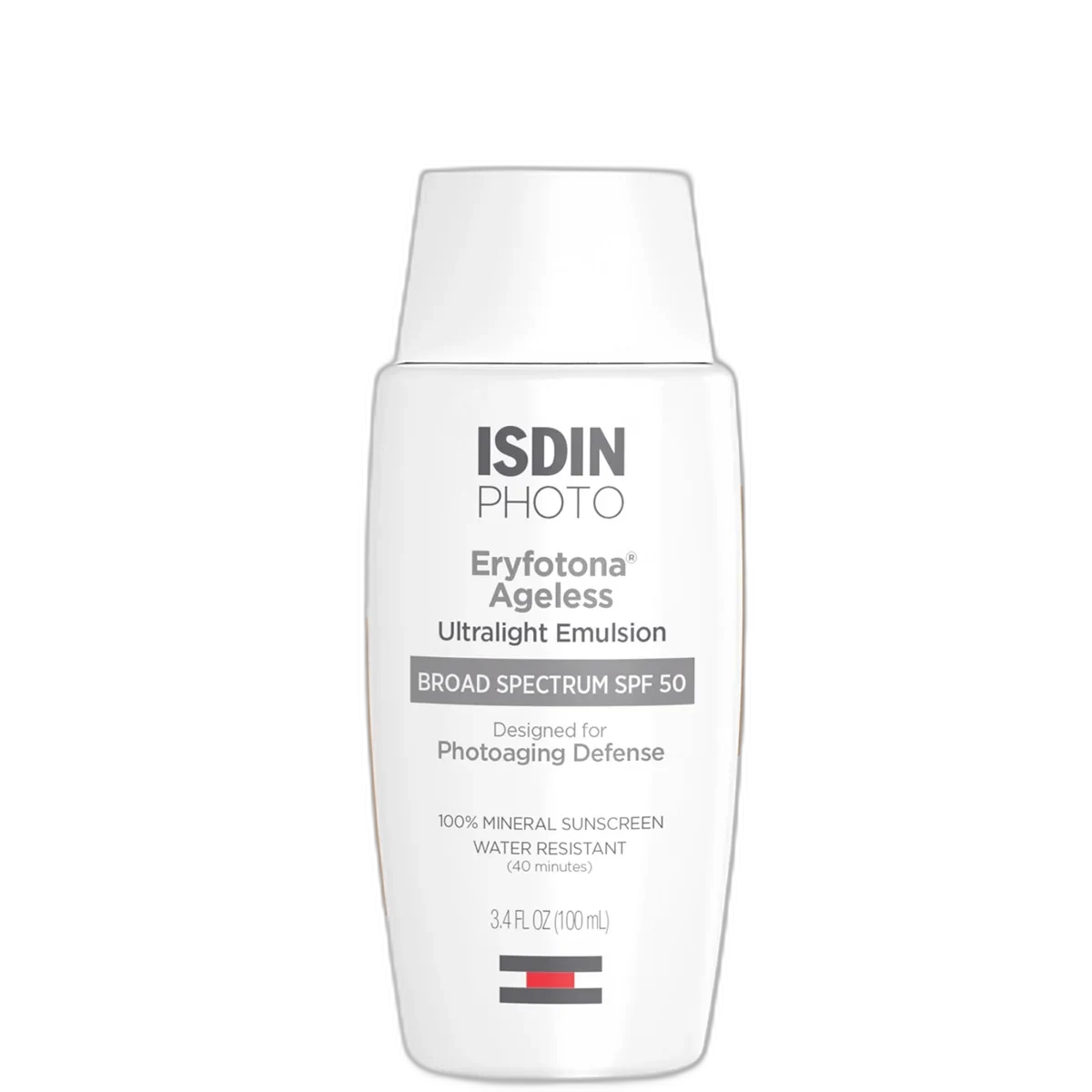
Eryfotona Ageless Ultralight Tinted Sunscreen SPF 50
Derm-Favorite Anti-Aging SPF
 Verified reviewer
Pros & cons.
- +DNA Repairsome technology actively repairs UV-induced DNA damage — unique in the sunscreen market
- +Ultralight fluid texture feels weightless and dries to a matte, powdery finish
- +Tinted formula eliminates white cast and provides natural light coverage
- +Iron oxides add visible light and blue light protection beyond UV filtration
- +Anti-aging peptides (Palmitoyl Tripeptide-38) address fine lines and firmness loss
- +100% mineral UV filter system (zinc oxide only) at SPF 50
- +Nearly 50 years of ISDIN photoprotection research backs the formulation
- −Contains fragrance — surprising for a dermatologist-recommended clinical product
- −Premium price at $78 for 3.4 oz or $50 for 1.7 oz
- −Contains alcohol denat that may concern dry or sensitive skin types
- −Single tint shade limits suitability for very fair or very deep skin tones
- −Some users report eye irritation with close application around the orbital area
The full review.
ISDIN is not a social media brand that launched a sunscreen. ISDIN is a Barcelona-based pharmaceutical company that has researched photoprotection since Gerald Ford was president. Founded in 1975, the company has spent nearly half a century studying UV radiation’s molecular effects on skin and how to stop or reverse it. The Eryfotona Ageless translates that research into a consumer product.
The core innovation is DNA Repairsomes — ISDIN’s proprietary encapsulation of photolyase, an enzyme from marine plankton that recognizes and repairs UV-induced DNA damage. Specifically, photolyase targets cyclobutane pyrimidine dimers (CPDs), the most common DNA lesion from UVB radiation. These dimers drive photoaging, hyperpigmentation, and skin cancer risk. Most sunscreens prevent new CPDs. ISDIN’s formula does that and repairs existing ones.
This is science, not marketing. Photolyase-based DNA repair is the subject of peer-reviewed clinical research in the British Journal of Dermatology and the Journal of the European Academy of Dermatology and Venereology. Evidence shows topical photolyase, activated by visible light, enhances the repair rate of UV-induced DNA damage beyond the skin’s own mechanisms. ISDIN built the Eryfotona line around this technology; the Ageless variant adds anti-aging ingredients to the photoprotection-plus-repair base.
The formulation is an elegant mineral sunscreen. At 10.7% zinc oxide, it reaches SPF 50 through sophisticated dispersion technology rather than high zinc concentrations. The ultralight emulsion has a tinted serum consistency — it pours from the tube and spreads like a water-based product. A silicone and lightweight emollient base (cyclopentasiloxane, diethylhexyl carbonate, dibutyl adipate) carries the zinc oxide without weight. Alcohol denat appears mid-formula, creating a fast-drying, weightless, matte, almost powdery finish within one minute.
Iron oxides provide the tint and serve two purposes. Cosmetically, they offer natural coverage that eliminates white cast and can replace foundation. Scientifically, iron oxides absorb visible light radiation, specifically blue-violet wavelengths that untinted mineral sunscreens miss. This matters for hyperpigmentation and melasma patients, as visible light — not just UV — triggers melanin production.
Beyond DNA repair and UV protection, the formula includes two anti-aging peptides. Palmitoyl Tripeptide-38 is a collagen-stimulating peptide that signals the skin to produce more structural protein to address photoaging-related firmness loss. Pentapeptide-34 Trifluoroacetate provides additional anti-aging support. Together with vitamins C and E (as ascorbic acid, ascorbyl palmitate, and tocopherol), the formula uses a multi-mechanism approach targeting UV filtration, DNA repair, antioxidants, and structural proteins simultaneously.
The product has compromises. It contains fragrance — a controversial choice for a product widely recommended by dermatologists. The fragrance is light, but its presence in a clinical-grade sun protection product favors consumer appeal over dermatological purity. Alcohol denat provides the ultralight texture but can dry already-dry skin. The single tint shade works for light to medium-tan skin tones but is less seamless on very fair or very deep complexions.
The price is $78 for 3.4 ounces, or $50 for a 1.7-ounce travel size. This is premium pricing. If you view zinc oxide as a commodity, the price is unjustifiable. If you view it as a delivery vehicle for DNA repair technology, anti-aging peptides, and unmatched cosmetic elegance, the premium makes sense. The 3.4 oz size has better per-ounce economics and lasts two to three months with daily face application.
ISDIN has earned genuine dermatologist trust through decades of pharmaceutical-grade research. When board-certified dermatologists frequently recommend this sunscreen, they are not paid by ISDIN. They recommend it because the science is legitimate, the protection is robust, and the texture encourages daily use. Compliance is vital for sun protection; ISDIN knows a sunscreen nobody wants to wear protects nobody.
For those investing in advanced consumer-level mineral SPF to prevent photoaging, the Eryfotona Ageless is the benchmark. It is not the only good sunscreen, nor the most affordable. But it is the only mineral sunscreen that repairs DNA damage while preventing new damage, a distinction worth most of its cost.
Ingredient analysis.
Full INCI list
Active: Zinc Oxide 10.7%. Inactive: Water, Diethylhexyl Carbonate, Dibutyl Adipate, Cyclopentasiloxane, Dicaprylyl Carbonate, Alcohol Denat., Cyclohexasiloxane, Butylene Glycol, Silica, PEG-30 Dipolyhydroxystearate, Nylon-12, Glycerin, PEG-10 Dimethicone, Dimethicone, Sodium Chloride, Phenoxyethanol, Iron Oxides, Disteardimonium Hectorite, Triethoxycaprylylsilane, Panthenol, Tocopheryl Acetate, Glyceryl Stearate, Propanediol, Fragrance, Bisabolol, Disodium EDTA, Ethylhexylglycerin, PEG-8, Hydroxypropyl Cyclodextrin, Tocopherol, Lecithin, Plankton Extract, Ascorbyl Palmitate, Sodium Benzoate, Ascorbic Acid, Citric Acid, Palmitoyl Tripeptide-38, Pentapeptide-34 Trifluoroacetate
Skin match.
The science.
The Science
This formula uses photolyase-based DNA repair as its core innovation. Photolyase is an enzyme in many organisms (but not humans) that uses visible light energy to directly reverse UV-induced cyclobutane pyrimidine dimers (CPDs)—the most common and mutagenic DNA damage from UVB radiation. A key study in the British Journal of Dermatology (Puig et al., 2014) shows that applying photolyase-containing sunscreen after UV exposure significantly improves the repair of UV-induced DNA damage in human skin, reducing the CPD burden more than the skin's own nucleotide excision repair.
The Journal of the European Academy of Dermatology and Venereology (Moscarella et al., 2017) published further clinical evidence. Photolyase-containing sunscreen reduced the rate of new actinic keratoses in organ transplant recipients, a high-risk group for UV-induced skin damage. This study proves the molecular DNA repair mechanism leads to meaningful skin health outcomes.
The 10.7% zinc oxide achieves SPF 50 using advanced particle dispersion technology. Research in Photochemistry and Photobiology shows that zinc oxide photoprotective efficacy depends on particle size and dispersion uniformity. Optimized particles provide more efficient UV attenuation per unit concentration, which is how ISDIN achieves high SPF with moderate zinc oxide levels.
Iron oxides in the tint protect against visible light (400-700nm), a known contributor to hyperpigmentation, especially in darker skin phototypes. A study in the Journal of Investigative Dermatology (Mahmoud et al., 2010) shows visible light induces significant, persistent pigmentation in skin types IV-VI. Subsequent research shows iron oxide-containing sunscreens protect better against visible light-induced pigmentation than untinted mineral sunscreens.
References
- Photolyase-containing sunscreen reduces the rate of ultraviolet radiation-induced pyrimidine dimers in human skin — British Journal of Dermatology (2014)
- Visible light-induced pigmentation in human skin — Journal of Investigative Dermatology (2010)
Dermatologist Perspective
Board-certified dermatologists widely recommend the ISDIN Eryfotona Ageless as a top scientifically advanced consumer sunscreen. Dermatologists say the DNA Repairsome technology is a genuine advancement in photoprotection, moving from prevention to active repair of UV-induced DNA damage. Patients with melasma and hyperpigmentation value the 100% mineral formula with iron oxide tinting, as it blocks both UV and visible light. The ultralight texture solves the main compliance barrier for mineral sunscreens—cosmetic inelegance—which dermatologists see as the most critical factor in real-world sun protection. Dermatologists most commonly critique the fragrance, as they generally prefer fragrance-free formulations for daily facial products, especially for sensitive or post-procedure skin.
Where it fits in your routine.
Shake well before use. Apply a large amount to face and neck as your final morning skincare step. The fluid texture pours easily; use about two finger-lengths for the face and neck combined. Let the formula set for 1-2 minutes before applying makeup. The tint gives light, natural coverage that replaces foundation for everyday wear. Reapply every 2 hours during extended sun exposure. For best DNA repair results, apply in the morning when visible light activates the photolyase enzymes.
At $78 for 3.4 oz or $50 for 1.7 oz, this premium sunscreen costs more than most mineral SPFs, even professional-grade ones. Three factors drive its value: the patented DNA Repairsome technology (exclusive to this brand), the anti-aging peptide complex, and a weightless feel that provides 100% mineral protection. For users targeting both photoaging reversal and prevention, the price-per-benefit competes with less effective anti-aging serums. The 3.4 oz size has better per-ounce value and lasts 2-3 months with daily use. ISDIN's 50-year pharmaceutical heritage provides credibility that justifies the premium over brands without clinical research portfolios.
This is for anyone serious about anti-aging sun protection seeking the most scientifically advanced mineral sunscreen. It works for those concerned about photoaging, hyperpigmentation, and existing sun damage. It suits people who skip mineral sunscreens due to white cast and heavy texture. Melasma patients benefit from the iron oxide visible light protection.
Budget-conscious consumers seeking basic sun protection can find mineral SPFs with equal protection for less money, though they lack the DNA repair technology. This product is not fragrance-free, which matters for those with fragrance sensitivities. The alcohol denat may dry very dry skin types. People with very deep skin tones should swatch-test the single tint shade before buying the full size.
Product details.
Light floral/fresh fragrance — noticeable but not overwhelming. Not fragrance-free.
Sleek tube with a twist cap uses ISDIN's clean pharmaceutical branding. It comes in 1.7 oz and 3.4 oz sizes. The 3.4 oz size has better per-ounce value.
The ultralight fluid texture is impressive on first application; it feels unlike a typical mineral sunscreen. The tint provides instant coverage to even skin tone and neutralize redness. It dries to a matte, powdery finish within 1-2 minutes. The alcohol denat makes the formula fast-drying and lightweight. No adjustment period is needed—results show from first use.
2-3 months for 3.4 oz, 5-6 weeks for 1.7 oz with once-daily face application
12 months
All Year
The backstory.
ISDIN has been researching photoprotection from its Barcelona headquarters since 1975, and the Eryfotona line represents the pinnacle of their suncare innovation. The 'Ageless' variant launched in 2019, building on ISDIN's patented DNA Repairsome technology — plankton-derived enzymes that repair UV damage at the DNA level. The concept was born from ISDIN's collaboration with European dermatologists who needed a sunscreen that could do more than prevent damage in patients already showing signs of photoaging. It quickly became one of the most recommended sunscreens in dermatology offices worldwide.
About ISDIN
Legacy Brand (20+ years)ISDIN started in 1975 in Barcelona, Spain, and is a top European dermatological brand. ISDIN uses nearly 50 years of photoprotection research to develop products with dermatologists and leads suncare innovation. The brand has multiple patents and an extensive research portfolio in UV protection and DNA repair technology.
Common myths.
All mineral sunscreens leave a white cast.
This formula uses advanced dispersion technology to reach SPF 50 with only 10.7% zinc oxide — a lower concentration than many SPF 30 products. The iron oxide tint removes white cast and provides natural coverage. This mineral sunscreen is invisible on skin.
Sunscreen prevents future sun damage but does not repair existing damage.
ISDIN's DNA Repairsomes contain photolyase, an enzyme that recognizes and repairs UV-induced cyclobutane pyrimidine dimers in DNA. Published research shows topical photolyase enhances UV-damaged DNA repair. This sunscreen actively reverses photodamage while preventing new damage, which differs from UV filtration alone.
FAQ.
What are DNA Repairsomes in ISDIN Eryfotona Ageless?
DNA Repairsomes is ISDIN's proprietary ingredient from plankton-based photolyase enzymes. These enzymes recognize and repair UV-induced DNA damage (cyclobutane pyrimidine dimers) in skin cells. While standard sunscreens only prevent new damage, DNA Repairsomes reverse existing photodamage at the molecular level—a unique mechanism backed by published clinical research.
Does ISDIN Eryfotona Ageless leave a white cast?
No — the iron oxide tint removes white cast, creating a natural, skin-like finish. The 10.7% zinc oxide concentration and tinting agents make this sunscreen invisible on most skin tones. Very deep complexions may find the single tint shade slightly ashy and should swatch-test before purchasing.
Is ISDIN Eryfotona Ageless worth the price?
At $78 for 3.4 oz (or $50 for 1.7 oz), this sunscreen is premium. DNA Repairsome technology, anti-aging peptides, and cosmetic elegance provide value most mineral SPFs lack. The price is justified for users targeting photoaging with one product that protects and repairs. Cheaper, equally protective, but less sophisticated options exist for basic sun protection alone.
Can I use this instead of foundation?
Many users use the tinted formula as a light foundation for everyday wear. The iron oxides even skin tone, reduce redness, and leave a natural, skin-like finish. Layer foundation over this sunscreen for heavier coverage; it works well as a primer base.
Why does this contain alcohol denat?
Alcohol denat acts as a solvent to create the ultralight, fast-drying texture that makes this mineral sunscreen feel weightless. It evaporates fast upon application and creates a matte, powdery finish. While denatured alcohol can dry some skin types, it provides the cosmetic elegance that distinguishes this product from heavier mineral SPF formulas.
Is ISDIN Eryfotona Ageless safe during pregnancy?
The zinc oxide mineral filter is safe during pregnancy. This formula contains fragrance and alcohol denat, which some pregnant women avoid. Consult your OB-GYN, but the UV filter profile is mineral-only and lacks the chemical filters that raise the most pregnancy-related concerns.
What the community says.
"Ultralight fluid texture feels like wearing nothing — no heaviness or pastiness"
"Natural tint provides light coverage that eliminates the need for foundation"
"DNA Repairsome technology sets it apart from standard sunscreens"
"No white cast — the tint blends seamlessly into most skin tones"
"Dries to a powdery, matte finish that works beautifully under makeup"
"Contains fragrance — a surprising choice for a dermatologist-recommended product"
"Premium pricing at $78 for 3.4 oz or $50 for 1.7 oz"
"Single tint shade may not match all skin tones, especially very deep complexions"
"Contains alcohol denat that may concern dry or sensitive skin users"
"Some report eye irritation with close application"
People also looked at.