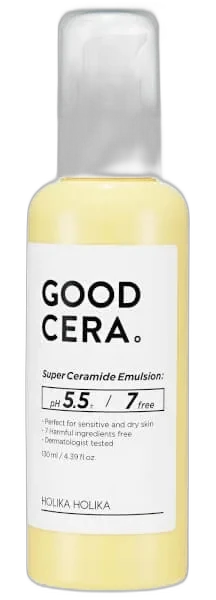
Good Cera Super Ceramide Emulsion
K-Beauty Value Ceramide Emulsion
 Verified reviewer
Pros & cons.
- +Ceramide NP plus pseudo-ceramide booster delivers real barrier repair in a lightweight format
- +Niacinamide and adenosine add brightening and mild anti-aging action
- +130ml size at $22 is outstanding value for a K-beauty ceramide product
- +Lightweight texture appropriate for normal, combination, or oily skin
- +Pump packaging is hygienic and practical
- +Phytosterols and fatty acids complete the barrier lipid story
- −Contains lavender, grapefruit, and lemongrass essential oils — not for sensitive skin
- −Not fungal-acne safe due to camellia oil and fatty alcohol content
- −Less ceramide variety than the cream version (one vs. three ceramide types)
- −Brand sells in mainland China — not cruelty-free by strict definitions
- −May not be rich enough for very dry or compromised skin on its own
The full review.
Classical K-beauty routines include both an emulsion and a cream, layered on top of each other. The logic, traditionally, was that the emulsion provided initial hydration and the cream sealed it in, producing the plumped, cushioned look that defined Korean skincare aesthetics in the 2010s. Most Western skincare users looked at that routine, thought ‘that’s three moisturizer steps,’ and decided they didn’t need to participate. The K-beauty industry, for its part, mostly kept selling emulsions and creams as separate products in the same line, letting buyers make their own calls. Holika Holika’s Good Cera Super Ceramide Emulsion is one of those paired products — the lighter sibling to the Good Cera Cream — and the real question for most readers is whether this emulsion is good enough to stand on its own as the primary moisturizer. The short answer is yes, for most skin types, and at its price it’s genuinely one of the better K-beauty values in the ceramide category.
Formula
Open the INCI list and the ceramide story is leaner than the cream’s but still genuine. You get ceramide NP — the most abundant ceramide type in human skin and the backbone of most barrier-repair products — plus hydroxypropyl bispalmitamide MEA, a pseudo-ceramide that integrates into the same lipid matrix and effectively doubles the ceramide-equivalent content. That’s a different story than the cream’s three-ceramide stack, but it’s still a real barrier-repair formulation rather than a trace inclusion. Phytosterols from soybean sit further down the INCI as the cholesterol analog. Meadowfoam estolide, camellia seed oil, and caprylic/capric triglyceride contribute the fatty acid fraction. Together, the three barrier lipid classes are represented, just at lower total loads than the cream version.
The supporting cast is where the emulsion actually distinguishes itself from the cream rather than just simplifying it. Niacinamide appears at a meaningful-looking position on the INCI — useful both for brightening and barrier support and because niacinamide has been shown to upregulate endogenous ceramide synthesis, reinforcing what the topical ceramides are delivering. Adenosine sits at the Korean regulatory anti-wrinkle concentration, adding a mild anti-aging angle. Alteromonas ferment and Bacillus ferment contribute mild soothing and marine-derived hydration. Sodium hyaluronate and glycerin handle the humectant core. The formula is built around a lightweight emulsion base of hydrogenated polyisobutene and dimethicone, which is why it spreads and absorbs the way it does.
Texture
Texture-wise, this is a fully K-beauty-typical lightweight emulsion — milky, fast-absorbing, and slightly satin in finish. It sits under makeup without pilling and doesn’t leave the heavy cushioned feeling the cream version produces. For normal, combination, or oily skin, it’s weight-appropriate. For genuinely dry skin or compromised barriers, it may not provide enough cushioning on its own — in which case the cream version is the right pick, or you can layer both as the traditional K-beauty routine suggests.
Scent
The honest criticism is the essential oil content. Lavender flower oil, grapefruit peel oil, and lemongrass leaf oil all appear on the INCI. Taken together, they produce a light herbal-citrus scent that most users find pleasant but that rules the product out for truly sensitive, rosacea-prone, or fragrance-averse skin. The cream version in the same line is fragrance-free, which makes it the better pick for sensitive skin that still wants the Good Cera philosophy. If you’re making the emulsion-versus-cream decision based on fragrance alone, the cream wins. If you’re making it based on weight and skin type, the emulsion is the right fit for normal-to-oily skin.
Common Praise
Value is where the emulsion earns its strongest recommendation. At roughly $22 for 130ml, it works out to about $0.17 per milliliter — remarkable for a product containing this much formulation thought. A bottle lasts three to four months at twice-daily face use, meaning the monthly cost is around $5-7. For comparison, a similar lightweight ceramide lotion from a Western clinical brand like CeraVe costs more per ounce, and a K-beauty lotion of similar complexity from Dr. Jart or Laneige runs significantly higher. Holika Holika consistently delivers on value in this category because the parent company has the manufacturing scale to produce thoughtful formulas at accessible prices.
Best for
The practical framing: if you have normal, combination, or oily skin and want a lightweight ceramide moisturizer that actually does meaningful barrier work, this emulsion is one of the easiest recommendations in K-beauty right now. It’s not glamorous, it doesn’t have a viral marketing story, and the packaging is utilitarian rather than beautiful — but the ingredient list is serious, the texture is appropriate for its target audience, and the price is almost embarrassingly reasonable for what’s inside. The only thing to watch for is the essential oil content if your skin is reactive, and in that case the unscented cream version is the better pick. For everyone else, this is a quiet workhorse of a product.
Ingredient analysis.
Full INCI list
Water, Hydrogenated Polyisobutene, Cyclopentasiloxane, Betaine, Glycerin, Butylene Glycol, Neopentyl Glycol Dicaprate, 1,2-Hexanediol, C14-22 Alcohols, Hydrogenated Lecithin, Dimethicone, Cetearyl Alcohol, Caprylic/Capric Triglyceride, C12-20 Alkyl Glucoside, Ammonium Acryloyldimethyltaurate/VP Copolymer, Batyl Alcohol, Stearic Acid, Camellia Oleifera Seed Oil, Lecithin, Tocopheryl Acetate, Ethylhexylglycerin, Xanthan Gum, Disodium EDTA, Glyceryl Stearate, Sodium Hyaluronate, Polyquaternium-51, Niacinamide, Glycerylamidoethyl Methacrylate/Stearyl Methacrylate Copolymer, Ethylhexyl Isononanoate, Dipropylene Glycol, Alteromonas Ferment Extract, Propylene Glycol, Phytosteryl/Isostearyl/Cetyl/Stearyl/Behenyl Dimer Dilinoleate, Bacillus Ferment, Lavandula Angustifolia (Lavender) Oil, Ceramide NP, Hydroxypropyl Bispalmitamide MEA, Glycine Soja (Soybean) Sterols, Yeast Extract, Meadowfoam Estolide, Glycoproteins, Glyceryl Polymethacrylate, Cymbopogon Citratus Leaf Oil, Citrus Grandis (Grapefruit) Peel Oil, Aleuritic Acid, Adenosine
Skin match.
The science.
The Science
Ceramide-based barrier repair has a substantial, well-established evidence base. Research by Peter Elias and colleagues at UCSF established the stratum corneum lipid matrix model — ceramides, cholesterol, and free fatty acids in a roughly 1:1:1 molar ratio — and showed that topical lipid replenishment speeds barrier recovery after disruption. Recent work shows that formulations with multiple ceramide types produce more complete barrier recovery than single-ceramide products.
Ceramide NP (formerly ceramide 3) is the dominant ceramide class in human stratum corneum and the most studied ceramide in cosmetic formulations. Hydroxypropyl bispalmitamide MEA is a well-characterized ceramide mimetic that integrates into the stratum corneum lipid organization at a lower raw material cost than purified native ceramides. Its inclusion in this emulsion supplements the ceramide NP content and produces a more robust barrier-repair profile than ceramide NP alone.
Niacinamide has a strong evidence base among cosmetic actives. Multiple randomized controlled trials support its efficacy for barrier function improvement, erythema reduction, hyperpigmentation, and fine line appearance at topical concentrations of 2-5%. In this emulsion, niacinamide upregulates de novo ceramide synthesis in keratinocytes, complementing the topical ceramides by supporting the skin's own ceramide production.
Adenosine is a Korean Ministry of Food and Drug Safety-notified functional anti-wrinkle ingredient, permitted for wrinkle improvement claims at regulatory concentrations. The evidence base is smaller than niacinamide's but meets Korean regulatory requirements. Phytosterols and camellia seed oil provide the cholesterol analog and fatty acid components of the barrier lipid mix.
Dermatologist Perspective
Dermatologists typically recommend lightweight ceramide moisturizers like this one for normal-to-combination skin patients who want barrier support without the thickness of a dry-skin cream. Board-certified dermatologists note that multi-lipid formulations containing ceramides, cholesterol-analogs, and fatty acids work better than single-lipid products; this emulsion meets that standard in a lighter format. The typical caveat dermatologists raise is the essential oil content — lavender, citrus peel, and lemongrass oils are known contact sensitizers for some patients. Dermatologists steer reactive or rosacea-prone patients toward the unscented cream version of the same line. For non-reactive skin, this emulsion is a sensible primary or layered moisturizer depending on baseline hydration needs.
Where it fits in your routine.
Apply morning and night after cleansing, toning, and any serums. Use one or two pumps. Warm the product between fingertips and press it onto the face and neck. For very dry skin, layer it under the Good Cera Super Ceramide Cream for a two-step barrier approach. Use sunscreen in the morning. This works with all standard actives, including vitamin C, niacinamide, and retinoids.
At roughly $22 for 130ml, this emulsion costs about $0.17 per milliliter — excellent value for a K-beauty ceramide product. A bottle lasts three to four months at twice-daily face application, which works out to around $5-7 per month. For comparison, Western clinical ceramide lotions run two to three times the per-milliliter cost, and most mainstream K-beauty ceramide emulsions from larger brands like Laneige or Sulwhasoo are significantly more expensive. Holika Holika consistently delivers strong value in this category because of manufacturing scale and because the Good Cera line is one of the brand's hero families. For anyone who wants real ceramide content in a lightweight lotion at the lowest credible price point, this is one of the easiest K-beauty recommendations.
People with normal, combination, or oily skin want this lightweight ceramide-based barrier-repair moisturizer for its value. It works as a standalone moisturizer for most skin types or as the lighter half of a traditional K-beauty layered routine.
Skip this if you have sensitive, rosacea-prone, or fragrance-averse skin; the essential oil content risks reactivity. Skip this if you avoid fungal-acne due to the camellia oil and fatty alcohols. Very dry or compromised skin needs the thicker cream version.
Product details.
Lightweight milky lotion spreads easily and absorbs in under a minute. It leaves a smooth, semi-matte finish.
Light herbal-citrus scent from lavender, grapefruit peel, and lemongrass oils.
Tall white bottle with a pump dispenser is hygienic and practical for daily use. This improves on jar packaging.
The first use feels light and hydrates immediately. It does not sting or tingle. It absorbs under makeup without pilling.
Apply to the face twice daily for 3-4 months. The 130ml size lasts a long time for the price.
12 months
All Year
The backstory.
The Good Cera Super Ceramide Emulsion launched alongside the cream version in 2016 as the lighter counterpart in Holika Holika's flagship ceramide line. It was designed for normal and combination skin types who wanted the barrier-repair philosophy of the cream without the richer finish. It has remained one of the brand's most value-positioned skincare products.
About Holika Holika
Holika Holika launched in 2010 as a sub-brand of Korean cosmetics giant Enprani. The Good Cera ceramide line has been a consistent seller for nearly a decade, offering clinically-literate ceramide formulations at mid-range K-beauty prices.
Common myths.
An emulsion is a lighter version with fewer active ingredients.
This emulsion contains ceramide NP, pseudo-ceramide, phytosterols, niacinamide, and adenosine. It is a genuine barrier-repair formula in a lighter vehicle for different skin types.
A complete K-beauty routine uses an emulsion and a cream.
Some K-beauty brands push layering emulsions and creams, but most skin types need only one. Choose the one that matches your skin's hydration needs instead of buying both.
FAQ.
What's the difference between the emulsion and the cream?
The cream uses three ceramide types (NP, AP, EOP) with shea butter and a thick emollient base for dry or compromised skin. The emulsion uses ceramide NP and a pseudo-ceramide in a lightweight lotion base for normal, combination, or oily skin that needs ceramide barrier support.
Can I use both the emulsion and the cream together?
Yes — traditional K-beauty layering uses emulsion before cream for very dry or compromised skin. Most users only need one product that matches their skin type.
Is it suitable for oily skin?
This is the better of the two Good Cera options for oily or combination skin. The formula is lightweight but still has meaningful ceramide content.
Does the lavender scent matter for sensitive skin?
Yes. The formula uses lavender oil, grapefruit peel oil, and lemongrass oil as natural fragrance. These essential oils trigger reactivity in sensitive or rosacea-prone skin. Choose the unscented cream version if you are reactive.
How long does the bottle last?
Applying the 130ml bottle twice daily lasts about three to four months. At around $22, this costs $5-7 per month, offering good value for the ingredient list.
Is it pregnancy safe?
Barrier lipids and niacinamide are generally pregnancy-compatible. Some practitioners recommend caution with essential oils during pregnancy; if that concerns you, check with your OB.
Will it break me out?
Most users do not report breakouts, but camellia oil and fatty alcohol content mean it is not strictly fungal-acne safe. If Malassezia drives your acne, choose a different emulsion.
What the community says.
"Lightweight and absorbs fast"
"Large 130ml size lasts a long time"
"Smooth finish under makeup"
"Balanced hydration without heaviness"
"Light lavender-citrus scent isn't for fragrance-averse users"
"Slightly less barrier-repair power than the cream version"
"Essential oils rule it out for reactive skin"