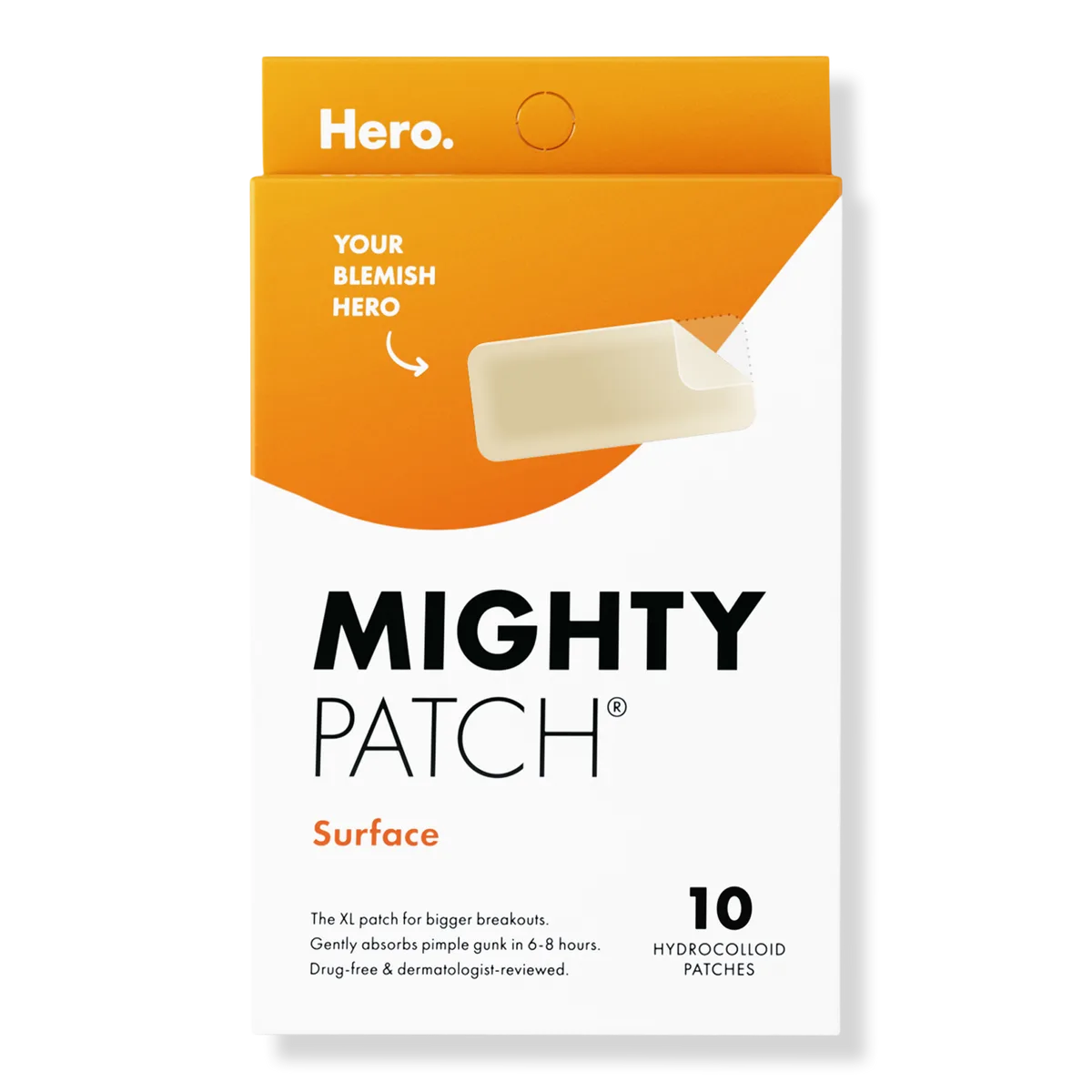
Mighty Patch Surface
Cluster Breakout Specialist
 Verified reviewer
Pros & cons.
- +Covers entire cluster breakout zones that would need 4-5 individual patches
- +Same proven medical-grade hydrocolloid technology as the Original
- +Works on body acne — back, chest, and shoulders — where small patches are impractical
- +Completely drug-free with zero irritation risk across all skin types
- +Satisfying multi-spot absorption visible through the transparent sheet
- +Pregnancy-safe with no active pharmaceutical ingredients
- −$1.80 per patch makes it significantly more expensive per use than the Original
- −Too large for isolated single blemishes — wasteful when the breakout is small
- −Edges can peel on curved or mobile facial areas during overnight wear
- −Not discreet enough for daytime wear on the face for most users
- −Only 10 patches per box limits how long a package lasts during active breakout periods
The full review.
There is a specific frustration that anyone with acne-prone skin knows well: the cluster breakout. Not a single, manageable whitehead, but a constellation of angry spots erupting across the jawline or cheek like they coordinated in a group chat. You could, theoretically, apply six or seven individual Mighty Patch Originals in a neat row, but you would look like you lost a fight with a hole punch. Mighty Patch Surface exists because Hero Cosmetics understood that problem.
The Surface patch measures 91mm by 48mm — roughly the size of a large adhesive bandage — and uses the same medical-grade, plant-based hydrocolloid as the Original. The technology is identical: the hydrocolloid matrix absorbs fluid from surfaced blemishes through osmotic action while the polyurethane film backing creates an occlusive seal. What changes is the coverage area, which gives the patch a meaningfully different use case. Instead of targeting one blemish at a time, the Surface covers an entire breakout zone in a single application.
Applying the Surface patch requires the same preparation as any hydrocolloid patch — clean, dry, product-free skin. The larger format adheres well on flatter facial areas: the cheek, jawline, chin, and forehead all work. It also works on the body — back, chest, and shoulders — where individual patches would be impractical. The adhesion is secure on flat or gently curved surfaces, but the edges can lift on sharply contoured areas or where significant facial movement occurs overnight. If you are a restless sleeper who buries your face in the pillow, expect some corner peeling by morning.
The absorption experience is the same satisfying spectacle as the Original, multiplied. Instead of one white dot forming on a single patch, you get multiple white spots appearing independently over each active blemish under the sheet. It is oddly gratifying to peel off the patch in the morning and see a topographic map of exactly where each blemish was draining. The surrounding healthy skin under the patch remains unaffected — hydrocolloid does not pull moisture from intact skin, so there is no drying or irritation outside the active blemish areas.
Performance matches the Original patch-for-patch. Surfaced whiteheads flatten, popped blemishes heal without scabbing, and the physical barrier prevents the absent-minded touching and picking that makes clusters worse. The difference is purely one of convenience and coverage. For a five-spot jawline breakout, one Surface patch replaces five Originals and provides a more secure, contiguous seal across the area.
The honest limitation is cost. At $17.99 for 10 patches, you are paying $1.80 per application — compared to roughly $0.36 per Original patch. The math only favors the Surface when you genuinely need the larger coverage: if you would use four or more Original patches on a cluster, the Surface is actually the better deal. But if you only have two or three isolated blemishes that happen to be near each other, individual patches are more economical and less wasteful.
The other practical consideration is discretion. The Original patch, at 12mm, can pass as barely noticeable. A 91mm x 48mm sheet on your cheek is not subtle. This is unambiguously a nighttime-at-home product for most people, unless you genuinely do not care about visible adhesive sheets on your face during the day — which, increasingly, some people do not, and more power to them.
Formulation-wise, there are no surprises: drug-free, fragrance-free, vegan, cruelty-free, latex-free, dermatologist-tested, and allergy-tested. The safety profile is identical to the Original, which means it is suitable for sensitive skin, pregnancy, and anyone who cannot tolerate chemical acne treatments.
The Surface patch fills a real gap in the Mighty Patch lineup. Cluster breakouts are common, frustrating, and poorly served by individual spot patches. Having a single sheet that covers the zone and works while you sleep is genuinely useful. The limitation is that you are paying a premium for the format, and the product only makes economic sense when the breakout is large enough to justify the XL size. For anyone who regularly deals with multi-spot flare-ups on the cheeks, jawline, or body, it earns its place in the medicine cabinet alongside — not instead of — the Original.
Ingredient analysis.
Full INCI list
Hydrocolloid (Cellulose Gum, Styrene Isoprene Styrene Block Copolymer, Polyisobutylene, Petroleum Resin, Polyurethane Film)
Skin match.
The science.
The Science
Mighty Patch Surface uses the same hydrocolloid technology as the Original and follows established wound care principles. Clinical wound management has used hydrocolloid dressings since the 1980s; dermatological literature extensively documents their fluid-absorbing and moist-healing properties.
The larger format adds a clinical consideration: covering multi-blemish areas creates a continuous occlusive environment across both affected and unaffected skin. Research on occlusive wound dressings shows the occlusive seal does not harm healthy skin—those areas simply lack exudate to absorb. A 2024 study at the AAD Annual Meeting confirmed hydrocolloid patches showed statistically significant improvements in blemish appearance metrics like erythema, elevation, and diameter. The occlusive barrier function absorbs fluid and protects against external contamination.
The physical barrier of large-format patches helps with cluster breakouts. Research on acne excoriée—where habitual picking worsens acne—shows physical barriers can interrupt the pick-scratch cycle. By covering a breakout zone, the Surface patch removes the tactile accessibility that drives compulsive touching, a known aggravating factor in inflammatory acne.
References
- The Science Behind a Viral Trend: Demonstrating Safety and Efficacy of Hydrocolloid Patch for Facial Acne — Journal of the American Academy of Dermatology (2024)
- Narrative Review of the Use of Hydrocolloids in Dermatology: Applications and Benefits — PMC / Journal of Clinical and Aesthetic Dermatology (2025)
Dermatologist Perspective
Dermatologists know cluster breakouts are hard to manage because individual spot treatments often miss the interconnected inflammatory process. Board-certified dermatologists note the large-format hydrocolloid approach works by creating a continuous protective environment. Clinicians value this drug-free mechanism for patients avoiding topical medications during pregnancy, those with sensitivities to benzoyl peroxide or salicylic acid, or those with compulsive picking behaviors that worsen cluster breakouts. Dermatologists typically recommend Surface patches as a tool alongside a full acne regimen, not as a standalone treatment for persistent or moderate-to-severe acne.
Guidance
Where it fits in your routine.
Cleanse the breakout area and pat dry. Peel one Surface patch from the sheet. Apply it over the entire cluster, pressing from the center outward to seal the edges. Do not apply over serums, moisturizers, or any skincare products; the skin must be bare and dry for adhesion. Leave on for 6-8 hours or overnight. In the morning, peel gently from one edge. White absorption spots will show over each active blemish. Continue your morning skincare routine normally after removal. For persistent clusters, apply a fresh patch the following night.
At $17.99 for 10 patches ($1.80 each), Mighty Patch Surface costs about five times more per unit than the Original ($0.36 each). The value depends on how you cover the same area. If a cluster breakout needs five Original patches, those five cost $1.80 total—matching one Surface patch while providing better contiguous coverage. The Surface is wasteful only on small breakouts a single Original patch covers. For frequent cluster breakouts on the jawline, cheeks, or body, the format is efficient despite the higher price. No other sizes exist, so there is no bulk discount option.
Use this if you regularly get multi-blemish cluster breakouts on the cheeks, jawline, forehead, chin, or body. It works for hormonal breakout patterns that flare in concentrated zones and for people who pick at skin when multiple blemishes are present. It is also a practical choice for body acne on the back and chest where individual patches are too small.
The Original patch costs less and wastes less if you have isolated single pimples. Skip this if your acne is primarily cystic or deep; hydrocolloid patches need surfaced blemishes with accessible fluid. These patches lift during sleep on highly curved or mobile facial areas.
Product details.
Thin, flexible 91mm x 48mm adhesive sheet with a hydrocolloid gel layer. It uses the same material and thickness as the Original but in a larger format.
None — completely unscented
Individual patches on perforated sheets inside a resealable pouch. Each patch peels off cleanly for application.
The XL size covers more area than standard pimple patches, spanning parts of the cheek or jawline. The patch adheres well to clean, dry skin on flatter facial zones. It conforms to gentle curves but lifts at the edges on sharply contoured areas. White absorption spots show over each blemish within the covered area.
One 10-count package lasts 1-3 weeks depending on breakout frequency and cluster size.
36 months
All Year
The backstory.
After the massive success of Mighty Patch Original, Hero Cosmetics heard a consistent request from customers: they needed something bigger for cluster breakouts. The Surface patch was the brand's answer, extending the same medical-grade hydrocolloid technology to an XL format that could cover the cheek, jawline, or forehead breakout zones that individual patches couldn't efficiently address.
About Hero Cosmetics
Established Brand (5–20 years)Ju Rhyu co-founded Hero Cosmetics in 2017, which is now the #1 acne patch brand in the U.S. Church & Dwight acquired the brand in 2022 for $630 million. All Mighty Patch products are dermatologist-tested and made in South Korea.
Common myths.
Larger patches work better because they absorb more fluid from healthy skin too.
Hydrocolloid absorbs fluid only from areas containing fluid; it does not pull moisture from healthy, intact skin. The larger size offers coverage convenience rather than enhanced efficacy. The hydrocolloid treats each blemish under the patch independently.
Cut the Surface patch into smaller pieces to increase uses per patch.
Cutting the patch works, but it exposes the hydrocolloid edge and shrinks the adhesive border that seals the patch. The Original or Invisible+ patches work for single-blemish use and cost less for isolated pimples.
FAQ.
What is the difference between Mighty Patch Original and Surface?
Mighty Patch Original is a 12mm round patch for individual pimples. Mighty Patch Surface is a 91mm x 48mm rectangular patch for cluster breakouts on the cheeks, jawline, or forehead. Both use medical-grade hydrocolloid technology and are drug-free, but Mighty Patch Surface covers over 10x the area.
Can I use Mighty Patch Surface on my body?
Yes — Mighty Patch Surface works on body acne, including the back, chest, and shoulders. The larger format fits body breakouts better than individual patches. Apply to clean, dry skin and leave on for 6-8 hours. The adhesion is stronger on body skin because there is less facial oil.
How many Mighty Patch Surface patches come in a box?
Each box has 10 patches, each 91mm x 48mm (approximately 3.6 x 1.9 inches). At $17.99, the cost is about $1.80 per patch — more expensive per unit than the Original, but each Surface patch covers an area equal to roughly 10 Original patches.
Is Mighty Patch Surface safe for sensitive skin?
Yes. Like all Mighty Patch products, the Surface patch is dermatologist-tested, allergy-tested, and uses medical-grade hydrocolloid. It contains no drugs, fragrances, latex, or common irritants. The formulation is vegan and has no active pharmaceutical ingredients, so it works for even the most reactive skin types.
Can I wear Mighty Patch Surface during the day?
You can, but the large format shows more than the Original patch. The Surface patch is thin and translucent, but its 91mm x 48mm size makes it hard to hide on the face during the day. Most users wear it overnight or while staying home.
What the community says.
"Covers entire breakout clusters that would need multiple small patches"
"Same satisfying white-dot absorption as the Original"
"Stays in place overnight on cheeks and jawline"
"Drug-free and gentle enough for sensitive skin"
"Only 10 patches for $17.99 makes it expensive per use"
"Too large for isolated single pimples — wasteful if you only have one blemish"
"Can peel at edges on curved or highly mobile facial areas"
"Less discreet than the Original due to larger size"
People also looked at.