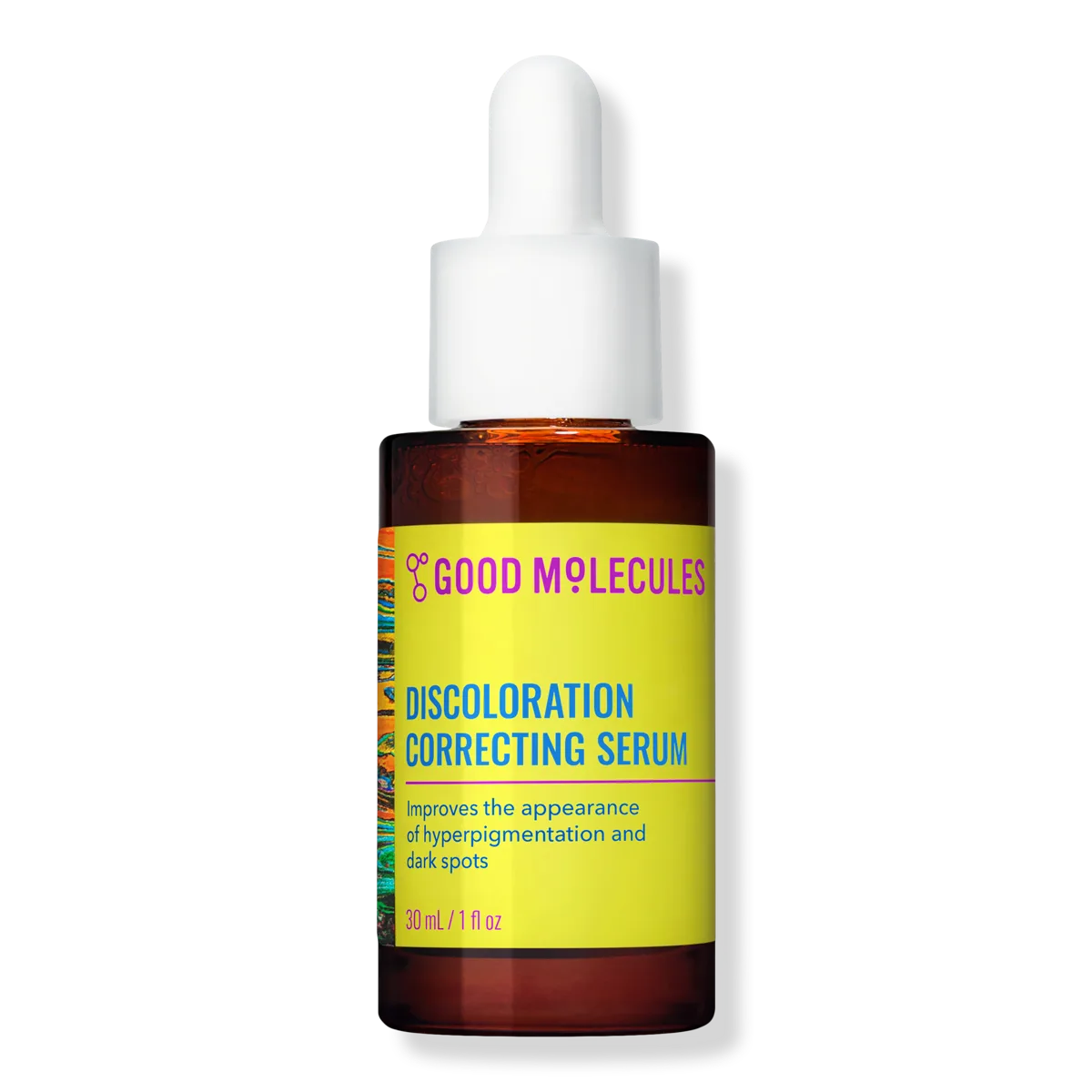
Discoloration Correcting Serum
Budget Brightening Hero
 Verified reviewer
Pros & cons.
- +Exceptional value — $12 for a tranexamic acid and niacinamide serum at effective concentrations
- +Only 12 ingredients with zero irritants — safe for sensitive, reactive, and fungal-acne-prone skin
- +Dual-pathway brightening targets both melanin production and melanin transfer simultaneously
- +Lipophilic tranexamic acid derivative offers enhanced skin penetration over standard forms
- +Fragrance-free, oil-free, silicone-free — layers seamlessly under any routine
- +Available in a 75ml value size for long-term committed users
- −Results require 4-8 weeks of consistent use — no immediate visible effect
- −Slight tackiness during absorption that some users notice under layered products
- −Minimal formula lacks supporting brighteners that could enhance efficacy
- −Less effective on deep, longstanding hyperpigmentation or genetic melasma
- −Pregnancy safety uncertain due to topical tranexamic acid derivative
The full review.
Every skincare enthusiast eventually flips a $60 brightening serum over to find water, butylene glycol, and glycerin as the first three ingredients. They then wonder why they paid $58 extra.
Good Molecules built this serum on the premise that active ingredients rarely justify that cost. Twelve ingredients. Two actives. Twelve dollars. It works.
The formula answers the textbook question: “what would you formulate for hyperpigmentation?” Niacinamide at 4% manages the melanin transfer pathway. It stops pigment granules from moving from melanocytes to keratinocytes. It intercepts the delivery before dark pigment reaches the skin surface. This 4% concentration sits within the clinically effective range shown by the Hakozaki study and subsequent research.
Cetyl Tranexamate Mesylate—a more sophisticated version of standard tranexamic acid—uses a different mechanism. It interrupts the plasminogen activator pathway to reduce inflammatory signals that trigger melanocytes after UV exposure, acne, or inflammation. The “cetyl” modification makes it lipophilic, so it penetrates the oil-rich layers of the stratum corneum better than water-soluble tranexamic acid. This choice matters; enhanced penetration helps the topical reach melanocytes at the dermal-epidermal junction.
Together, these actives use a multi-mechanism approach: one agent prevents new pigmentation by blocking upstream melanocyte stimulation (tranexamic acid), while the other prevents existing pigmentation from reaching the surface by blocking downstream melanosome transfer (niacinamide). This dual-pathway strategy is more comprehensive than either active alone, mirroring the principle behind prescription-level hyperpigmentation treatments.
The formula’s absences are notable. No fragrance. No essential oils. No botanical extracts with unproven brightening efficacy. No dimethicone or silicones. No retinoids. No vitamin C. The formula is stripped down enough to be fungal acne safe—a rare claim for brightening serums. The remaining ingredients provide structure: butylene glycol and propanediol act as solvents, glycerin is a humectant, cetearyl alcohol and plant-derived gums stabilize the formula, and preservatives are included.
This minimalism has two sides. The upside is that there is nothing to react to; sensitive, reactive, and eczema-prone skin types can use this without the fragrance or irritating actives found in most brightening serums. The downside is the lack of supporting ingredients like antioxidants, additional brighteners like alpha arbutin or licorice root, or hydrating complexes to increase nourishment.
The serum is unceremonious on the skin. It is a clear, slightly viscous liquid that absorbs in one to two minutes. It feels briefly tacky before settling, which some users notice under subsequent products. There is no immediate visual effect—no glow or instant blurring. This serum does not flatter you on first use. It flatters you after six weeks of consistent, unsexy application.
Patience is critical. Post-acne marks from the last breakout cycle fade visibly around 4-6 weeks. Older sun spots and deep hyperpigmentation require an 8-12 week commitment. If you test products for only two weeks, this is not for you. If you commit to a daily routine—morning and evening, before moisturizer, with sunscreen during the day—the results are impressive for the price.
The product went viral on skincare TikTok and Reddit’s SkincareAddiction community due to its results-to-price ratio. Users with post-inflammatory hyperpigmentation from acne shared before-and-after photos showing fading over 2-3 months, and the product sold out at Ulta and on Beautylish. Good Molecules responded with a 75ml size for $25, offering better per-ml value for daily users.
Good Molecules launched in 2019 under the Beautylish umbrella. As an emerging brand, its track record is shorter than established brands with decades of formulation history. However, the Discoloration Correcting Serum shows that their formula-first philosophy produces competitive products. Choosing a lipophilic tranexamic acid derivative at this price point—rather than cheaper, easier standard tranexamic acid—shows real formulation intent.
The 4.2 average rating from over 4,500 reviews on Ulta is telling: most people see results, but not all. Lower ratings come from users with deep, longstanding hyperpigmentation or genetic melasma that requires more than a $12 serum. For surface-level post-inflammatory marks and mild to moderate dark spots, satisfaction is higher.
At twelve dollars, the risk is low. If it works for your hyperpigmentation—which it does for most users with post-acne marks and sun spots—you have a daily treatment that requires no justification. If it fails, you only lose the cost of a mediocre lunch.
Formula
PM routine
Ingredient analysis.
Full INCI list
Water, Butylene Glycol, Propanediol, Glycerin, Niacinamide, Cetyl Tranexamate Mesylate, Cetearyl Alcohol, Ceratonia Siliqua (Carob) Gum, Tamarindus Indica Seed Gum, Phenoxyethanol, Ethylhexylglycerin, Caprylyl Glycol
Skin match.
The science.
The Science
This serum uses a dual-active approach to target hyperpigmentation via two established mechanisms. A 2002 study by Hakozaki et al. in the British Journal of Dermatology shows niacinamide at concentrations as low as 2% reduces hyperpigmentation by inhibiting melanosome transfer from melanocytes to keratinocytes. At 4%, this serum uses an effective concentration.
Tranexamic acid's use for hyperpigmentation gained traction after a 2012 review in the Journal of the American Academy of Dermatology showed it treats melasma by inhibiting the plasminogen-plasmin pathway. This formula uses cetyl tranexamate mesylate, a derivative modified with a cetyl chain to increase lipophilicity and skin penetration. Research in the Journal of Cosmetic Dermatology shows lipophilic derivatives of tranexamic acid reach higher concentrations in target skin layers than the standard water-soluble form, which improves topical efficacy.
The combination of niacinamide and tranexamic acid hits the pigmentation cascade at two points: tranexamic acid reduces the initial melanocyte activation signal (upstream), and niacinamide blocks melanin delivery to the skin surface (downstream). This multi-target approach mimics clinical dermatology combination therapies for stubborn hyperpigmentation, where attacking multiple melanin pathway steps works better than targeting one.
References
- The effect of niacinamide on reducing cutaneous pigmentation and suppression of melanosome transfer — British Journal of Dermatology (2002)
- Tranexamic acid in treatment of melasma: A comprehensive review of clinical studies — Journal of the American Academy of Dermatology (2012)
Dermatologist Perspective
Board-certified dermatologists treating hyperpigmentation often recommend niacinamide and tranexamic acid as first-line topical options. Dermatologists note that combining these two actives addresses hyperpigmentation through complementary mechanisms, a multi-pathway approach that follows clinical best practices. Dermatological literature recognizes the lipophilic tranexamic acid derivative in this formula for its enhanced penetration profile. Dermatologists state that users must pair any brightening serum with daily broad-spectrum sunscreen to prevent UV-induced re-darkening of treated areas.
Where it fits in your routine.
Apply a thin layer to clean, dry skin every morning and evening. Use it on the full face or target hyperpigmentation areas. Follow with moisturizer and sunscreen (morning). It layers well under all serums and creams. For more brightening, use a vitamin C serum in the morning (apply vitamin C first). Use it twice daily for best results — the actives work by gradually inhibiting melanin pathways rather than providing instant results.
At $12 for 30ml, this brightening serum offers top value. Other brands sell comparable tranexamic acid serums for $30-80 with similar or lower concentrations. The 75ml size at $25 provides even better per-ml value for long-term use. The minimalist formula keeps manufacturing costs low while keeping the two key actives, passing savings to the consumer. This product has an exceptional value score rather than just an acceptable one.
People with post-inflammatory hyperpigmentation from acne, mild to moderate sun spots, or uneven skin tone seeking affordable daily treatment. It suits those preferring minimal-ingredient formulas and sensitive skin types excluded from most brightening serums by fragrance or irritants. Budget-conscious shoppers want prescription-adjacent ingredients without the high price.
People with deep, longstanding hyperpigmentation or dermatologist-diagnosed melasma likely need prescription-strength treatment or in-office procedures for meaningful improvement. This is a slow-build serum for anyone needing immediate visible results. Pregnant individuals should consult their healthcare provider about the tranexamic acid derivative.
Product details.
This lightweight, slightly viscous water-based serum has a clear, gel-like consistency. It applies smoothly but feels faintly tacky for a few minutes before it absorbs into a non-sticky finish.
Unscented — no added fragrance. Essentially odorless.
A frosted glass dropper bottle features Good Molecules' clean white labeling. A larger 75ml (2.5 oz) pump bottle offers better value. The dropper allows controlled dispensing for the standard size.
The serum is clear and thin, absorbing in 1-2 minutes. It feels slightly tacky for a moment before it fully absorbs. It has no tingling, stinging, or warmth; it feels like applying water with a bit of slip. Results are not immediate. This product rewards consistent daily use over weeks.
6-8 weeks with twice-daily use (30ml); 3-4 months for the 75ml size
12 months
All Year
The backstory.
This serum became Good Molecules' breakout product, going viral on skincare TikTok and Reddit for its remarkable results-to-price ratio. It demonstrated that effective discoloration treatment doesn't require luxury pricing or a 40-ingredient formula. The inclusion of cetyl tranexamate mesylate — a lipophilic tranexamic acid derivative with enhanced penetration — at a $12 price point shocked the skincare community and forced conversations about why similar actives cost $40-80 in other serums.
About Good Molecules
Emerging Brand (2–5 years)Beautylish founded Good Molecules in 2019 as its in-house skincare brand. The brand makes affordable, transparent formulations and sells at Ulta Beauty and Target, earning a loyal following for accessible, no-frills skincare.
Common myths.
Low-cost serums lack effective concentrations of active ingredients.
This serum has 4% niacinamide and 2% tranexamic acid. These concentrations match or exceed many products costing 3-5 times more. The 12-ingredient formula keeps costs low by removing expensive botanical extracts, fragrances, and proprietary complex marketing instead of skimping on actives.
Vitamin C treats dark spots better than any other ingredient.
Tranexamic acid and niacinamide use different mechanisms than vitamin C. They work as well as, or better than, vitamin C for specific hyperpigmentation, especially melasma and post-inflammatory marks. Tranexamic acid and niacinamide are stable in formula and do not need low pH or special storage like vitamin C, which makes them more reliable for consistent results.
FAQ.
How long does the Good Molecules Discoloration Correcting Serum take to work?
This treatment works gradually. Expect skin tone improvements within 2-3 weeks, and visible fading of post-acne marks and mild dark spots at 4-6 weeks. Stubborn hyperpigmentation and sun damage take 8-12 weeks of consistent twice-daily use. The niacinamide and tranexamic acid use different pathways, and their combined effect builds over time.
Can I use this serum with vitamin C?
Yes — niacinamide and tranexamic acid work with vitamin C and complement its brightening effects. Apply the vitamin C serum first (it works best at lower pH), let it absorb, then apply this serum. Using all three brightening pathways together accelerates results for stubborn dark spots.
Is this serum safe for sensitive skin?
Yes. This 12-ingredient formula is fragrance-free, alcohol-free, and oil-free, with no common irritants. Both niacinamide and tranexamic acid tolerate sensitive skin well. The formula is fungal acne safe and non-comedogenic, so it works for almost every skin type.
What size should I buy?
The 30ml ($12) bottle lasts 6-8 weeks when used twice daily. For long-term use, the 75ml ($25) bottle has better per-ml value and lasts 3-4 months. Because brightening results build over time, the larger size is more cost-effective for committed users.
Is this serum pregnancy-safe?
The tranexamic acid derivative (cetyl tranexamate mesylate) in this serum concerns some healthcare providers. This serum uses a low topical concentration, but oral tranexamic acid has pregnancy contraindications. Consult your OB-GYN or dermatologist before using this product during pregnancy.
How does this compare to the Good Molecules Dark Spot Serum?
This Discoloration Correcting Serum uses a two-active approach with tranexamic acid and niacinamide to treat hyperpigmentation. It is a streamlined, targeted option with only 12 ingredients. Both products target dark spots using different active ingredient strategies. Choose based on your preference for a minimalist formula or a complex multi-active approach.
What the community says.
"Visibly fades dark spots and post-acne marks over 4-8 weeks"
"Incredibly affordable for a tranexamic acid serum"
"Minimal ingredient list — no unnecessary additives"
"Layers perfectly under other products without pilling"
"Results are gradual — requires patience and consistent use"
"Texture can feel slightly tacky before fully absorbing"
"Some users see minimal improvement on deep, longstanding hyperpigmentation"
"The 30ml size runs out quickly with twice-daily use"
Featured in.
People also looked at.