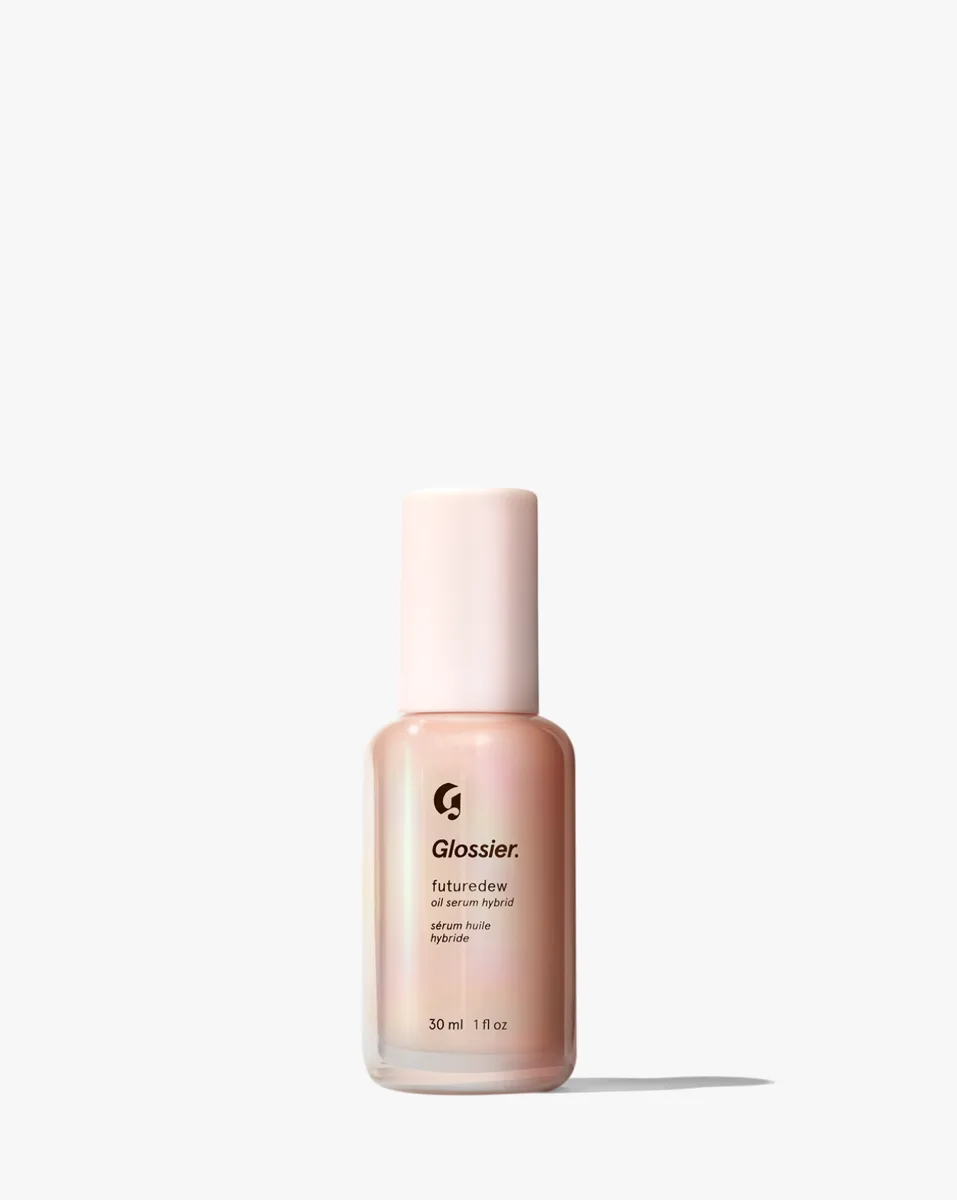
Futuredew Oil Serum Hybrid
Instant Glass Skin Shortcut
 Verified reviewer
Pros & cons.
- +Delivers instant dewy, glass-skin glow from the first application
- +Quality plant oil blend (squalane, jojoba, evening primrose, rosehip) provides genuine hydration
- +Lightweight texture absorbs well without feeling heavy or greasy on dry-to-normal skin
- +Versatile use as a serum, primer, or mix-in with moisturizer or foundation
- +Sodium hyaluronate adds deep humectant hydration alongside the oil layer
- +Silicone-free formula that achieves slip and glow without synthetic polymers
- +Vegan and cruelty-free with Leaping Bunny certification
- −Instant glow relies significantly on reflective mineral particles (mica, titanium dioxide, iron oxides)
- −Too shiny and potentially greasy for oily skin types, especially during daytime
- −Contains rosemary leaf oil — not fragrance-free, may irritate essential oil-sensitive skin
- −Twenty-four dollars for one ounce is a premium for a glycerin-squalane-based formula
- −Isoamyl laurate may be comedogenic for acne-prone individuals
The full review.
Glossier built a billion-dollar brand around a specific look. Since 2014, beauty social media has defined this aesthetic: skin that looks kissed by morning light, slightly wet but not sweaty, and luminous as if from exceptional genetics or an expensive multi-step routine. Futuredew attempts to sell that look in one bottle.
The formula is an oil-serum hybrid. Water and glycerin lead the ingredient list to create a hydrating serum base. Squalane follows, providing a lightweight, non-greasy emollient that mimics skin sebum and absorbs without the heavy residue of traditional facial oils. Supporting plant oils include jojoba, evening primrose, grape seed, and rosehip, each adding different essential fatty acids.
A significant part of the instant glow comes from reflective minerals rather than skincare oils. Mica, titanium dioxide, and iron oxides appear near the end of the ingredient list. These are the same light-reflecting particles used in liquid highlighters and illuminating primers. The immediate glass-skin effect comes from light bouncing off microscopic mineral particles suspended in the oil-serum base.
This is a clarification, not a criticism. Many ‘glow serum’ products use similar methods, but Futuredew is transparent. The supporting ingredients—squalane, evening primrose oil, rosehip oil, and hyaluronic acid—provide real skincare benefits over time. After two to four weeks of consistent use, the glow stems partly from healthier, better-hydrated skin rather than just mica. Rosehip oil contains naturally occurring trans-retinoic acid and high concentrations of linoleic acid, which help smooth and mildly brighten skin with sustained use.
The texture is pleasant. It has the fluid consistency of a lightweight serum with the slip of an oil, and it absorbs faster than expected for this oil content. On dry to normal skin, it leaves a dewy, luminous finish for hours that looks like healthy, hydrated skin instead of highlighter sparkle. On oily skin, this dewiness becomes greasiness, especially in the T-zone, and the reflective particles can make existing shine look ‘sweaty’ rather than ‘glowy.’
Note the rosemary leaf oil. Listed as Rosmarinus Officinalis Leaf Oil, this antioxidant ingredient is an essential oil that can irritate sensitive skin. It gives the formula a faint herbal scent, so Futuredew is not fragrance-free, despite Glossier’s minimal fragrancing approach. This may be a dealbreaker for those with essential oil sensitivities.
As a primer, Futuredew works well. One pump before foundation or skin tint creates a luminous base for light-coverage makeup. As a nighttime treatment, it is a final step that leaves skin softer and more supple by morning. The product is versatile and fits into many routines.
The price-to-quantity ratio is the main concern. At twenty-four dollars for one ounce, Futuredew is a prestige product. Since the formula relies on glycerin, squalane, and plant oils—all available cheaper in products from The Ordinary, The Inkey List, and others—the Glossier premium pays for the specific ratio, the reflective particle blend, and the brand experience. Daily use lasts three to four months, which lowers the per-use cost.
Futuredew is a classic Glossier product: it sells a feeling and a function, looks good on skin, and provides enough skincare benefit to be called a serum. It is well-executed for dry to normal skin types wanting instant glow and cumulative hydration. Without the brand mystique and mica, it is a standard oil-serum blend at a premium price.
Formula
Texture
The texture is pleasant. It has the fluid consistency of a lightweight serum with the slip of an oil, and it absorbs faster than expected for this oil content. On dry to normal skin, it leaves a dewy, luminous finish for hours that looks like healthy, hydrated skin instead of highlighter sparkle. On oily skin, this dewiness becomes greasiness, especially in the T-zone, and the reflective particles can make existing shine look ‘sweaty’ rather than ‘glowy.‘
Scent
Note the rosemary leaf oil. Listed as Rosmarinus Officinalis Leaf Oil, this antioxidant ingredient is an essential oil that can irritate sensitive skin. It gives the formula a faint herbal scent, so Futuredew is not fragrance-free, despite Glossier’s minimal fragrancing approach. This may be a dealbreaker for those with essential oil sensitivities.
Pairs Well With
As a primer, Futuredew works well. One pump before foundation or skin tint creates a luminous base for light-coverage makeup. As a nighttime treatment, it is a final step that leaves skin softer and more supple by morning. The product is versatile and fits into many routines.
Common Complaints
The price-to-quantity ratio is the main concern. At twenty-four dollars for one ounce, Futuredew is a prestige product. Since the formula relies on glycerin, squalane, and plant oils—all available cheaper in products from The Ordinary, The Inkey List, and others—the Glossier premium pays for the specific ratio, the reflective particle blend, and the brand experience. Daily use lasts three to four months, which lowers the per-use cost.
Best for
Futuredew is a classic Glossier product: it sells a feeling and a function, looks good on skin, and provides enough skincare benefit to be called a serum. It is well-executed for dry to normal skin types wanting instant glow and cumulative hydration. Without the brand mystique and mica, it is a standard oil-serum blend at a premium price.
Ingredient analysis.
Full INCI list
Water/Aqua/Eau, Glycerin, Squalane, Isoamyl Laurate, Polyglyceryl-3 Polyricinoleate, Butylene Glycol, Simmondsia Chinensis (Jojoba) Seed Oil, Propanediol, Isohexadecane, 1,2-Hexanediol, Oenothera Biennis (Evening Primrose) Oil, Olive Oil Polyglyceryl-6 Esters, Vitis Vinifera (Grape) Seed Oil, Rosa Canina Fruit Oil, Polyglyceryl-6 Pentaoleate, Sodium Hyaluronate, Tocopheryl Acetate, Evodia Rutaecarpa Fruit Extract, Rosmarinus Officinalis (Rosemary) Leaf Oil, Ricinus Communis (Castor) Seed Oil, Hydrogenated Castor Oil, Hydroxyacetophenone, Sodium Chloride, Disteardimonium Hectorite, Propylene Carbonate, Tin Oxide, Mica, Titanium Dioxide (CI 77891), Iron Oxides (CI 77491)
Skin match.
The science.
The Science
Futuredew works through its blend of oil and humectant. Squalane, the main oil, is a hydrogenated version of squalene—a lipid human sebaceous glands produce naturally. Because it mimics skin chemistry, squalane enters the stratum corneum lipid matrix instead of sitting on the surface, offering emollient benefits without occlusion. A 2020 review in the International Journal of Cosmetic Science shows squalane has both emollient and antioxidant properties, plus higher oxidative stability than its precursor, squalene.
Evening primrose oil (Oenothera biennis) contains gamma-linolenic acid (GLA)—usually 7-10% of its fatty acid profile. GLA converts to dihomo-gamma-linolenic acid (DGLA) and then to anti-inflammatory prostaglandin E1. Topical GLA-rich oils show promise for supporting barrier function in atopic skin, though most clinical evidence stems from dietary supplementation, not topical use.
Rosehip fruit oil (Rosa canina) provides a different fatty acid profile, high in linoleic acid (44-49%) and alpha-linolenic acid (33-36%). It also has low concentrations of natural trans-retinoic acid, which may help mild photo-aging repair with sustained use. A 2015 clinical study in the Journal of Cosmetics, Dermatological Sciences and Applications found that rosehip oil improved skin moisture, elasticity, and roughness after eight weeks of twice-daily application.
The reflective mineral component (mica, titanium dioxide, iron oxides) offers only cosmetic benefits—these inorganic particles scatter and reflect visible light to make skin look smoother and more luminous immediately after application.
Dermatologist Perspective
Dermatologists see oil-serum hybrids as beneficial for dry to normal skin types needing both humectant and emollient hydration. Board-certified dermatologists note squalane is one of the best-tolerated facial oils because it is biomimetic, and the rosehip and evening primrose oils add essential fatty acids that support barrier function. However, clinicians warn that the rosemary leaf oil in this formula is an essential oil and potential sensitizer, and the reflective mineral particles provide no therapeutic benefit despite their cosmetic appeal. Dermatologists typically recommend applying Futuredew after active serums (vitamin C, retinol) and before sunscreen in the morning routine.
Where it fits in your routine.
Apply 1-2 pumps to clean skin after serums but before sunscreen in AM. For a subtle glow, press one pump into skin with palms. For a dewy effect, blend two pumps outward from the face center. Mix it into moisturizer or foundation for a diluted glow. At night, apply as the final step after all treatments. If you have combination skin, avoid oily areas and focus on the cheeks, forehead, and chin for luminosity.
Futuredew costs twenty-four dollars for one ounce. It is a prestige serum, but budget brands sell the core ingredients — glycerin, squalane, plant oils — for much less. The price covers the specific formulation ratio, the reflective particle blend that creates the signature Glossier glow, and the brand experience. Daily use lasts three to four months, lowering the effective cost. Futuredew comes from a brand with six-plus years of track record and Leaping Bunny certification; the price is defensible but not a value play. Budget-conscious consumers can replicate most hydration benefits — though not the exact glow effect — using pure squalane oil for a fraction of the cost.
Dry to normal skin types wanting one product for instant dewy glow and long-term hydration. It suits minimalists who want to combine routine steps, and anyone seeking the glass-skin aesthetic in a format that provides genuine skincare.
Oily skin types with excess shine. People sensitive to essential oils (rosemary leaf oil is present). Acne-prone skin needs a patch test because of isoamyl laurate. Users wanting pure skincare without cosmetic additives should note the reflective particles make this a hybrid product.
Product details.
Rosemary leaf oil gives this a faint herbal scent. It is not fragrance-free; the rosemary is a functional ingredient that also adds a mild botanical aroma.
A glass bottle has a pump dispenser and metallic pink cap. The pump delivers controlled amounts. The glass feels substantial. The transparent bottle shows the golden product inside.
The first application shows an instant glow—skin looks lit from within with a wet, dewy sheen. Mica and reflective minerals provide a cosmetic effect, while other ingredients add genuine hydration. Most skin types experience no tingling or irritation. Oily skin may find the added shine excessive.
3-4 months with daily use of 1-2 pumps
12 months
fall winter
The backstory.
Launched in October 2019, Futuredew was Glossier's attempt to bottle the brand's signature 'dewy skin' aesthetic into a single product. The concept was born from the observation that achieving the Glossier look typically required layering multiple products — serum, oil, highlighter. Futuredew collapsed that routine into one step, blending genuine skincare oils with reflective minerals for instant and long-term luminosity.
About Glossier
Established Brand (5–20 years)Emily Weiss founded Glossier in 2014, stemming from the beauty blog Into The Gloss. The brand is Leaping Bunny certified cruelty-free. Glossier uses direct-to-consumer sales and community-driven product development to build a devoted following, but lacks clinical or dermatologist-developed origins.
Common myths.
Futuredew is just a highlighter marketed as skincare.
The formula uses mica, titanium dioxide, and iron oxides for an instant reflective glow, but relies on squalane, glycerin, jojoba oil, evening primrose oil, rosehip oil, and hyaluronic acid for skincare. These ingredients provide hydration and barrier support over time, separate from the cosmetic glow.
Oil-based products always clog pores and cause breakouts.
Squalane, the primary oil in Futuredew, has a 0-1 comedogenic rating and mimics natural skin sebum. Jojoba oil is also well-tolerated. But isoamyl laurate in this formula can be comedogenic for some, so patch test if you have acne-prone skin.
FAQ.
Does Glossier Futuredew have SPF?
No. Titanium dioxide and iron oxides are in the formula for cosmetic reflection, but at concentrations too low for sun protection. Apply a dedicated sunscreen over or under Futuredew for UV protection.
Scent
No. It contains rosemary leaf oil (Rosmarinus Officinalis Leaf Oil), which has a mild herbal scent and is a fragrant essential oil. Rosemary oil has antioxidant properties but can irritate people with essential oil sensitivities. Patch test if you react to essential oils.
What the community says.
"Gives an instant dewy, glass-skin glow"
"Lightweight and absorbs well for an oil"
"Works beautifully as a primer under makeup"
"Pleasant sensory experience"
"Too greasy for oily skin types"
"Glow is partly cosmetic from mica and reflective particles"
"Rosemary leaf oil scent may bother some users"
"Expensive for the amount of product"
Featured in.
People also looked at.