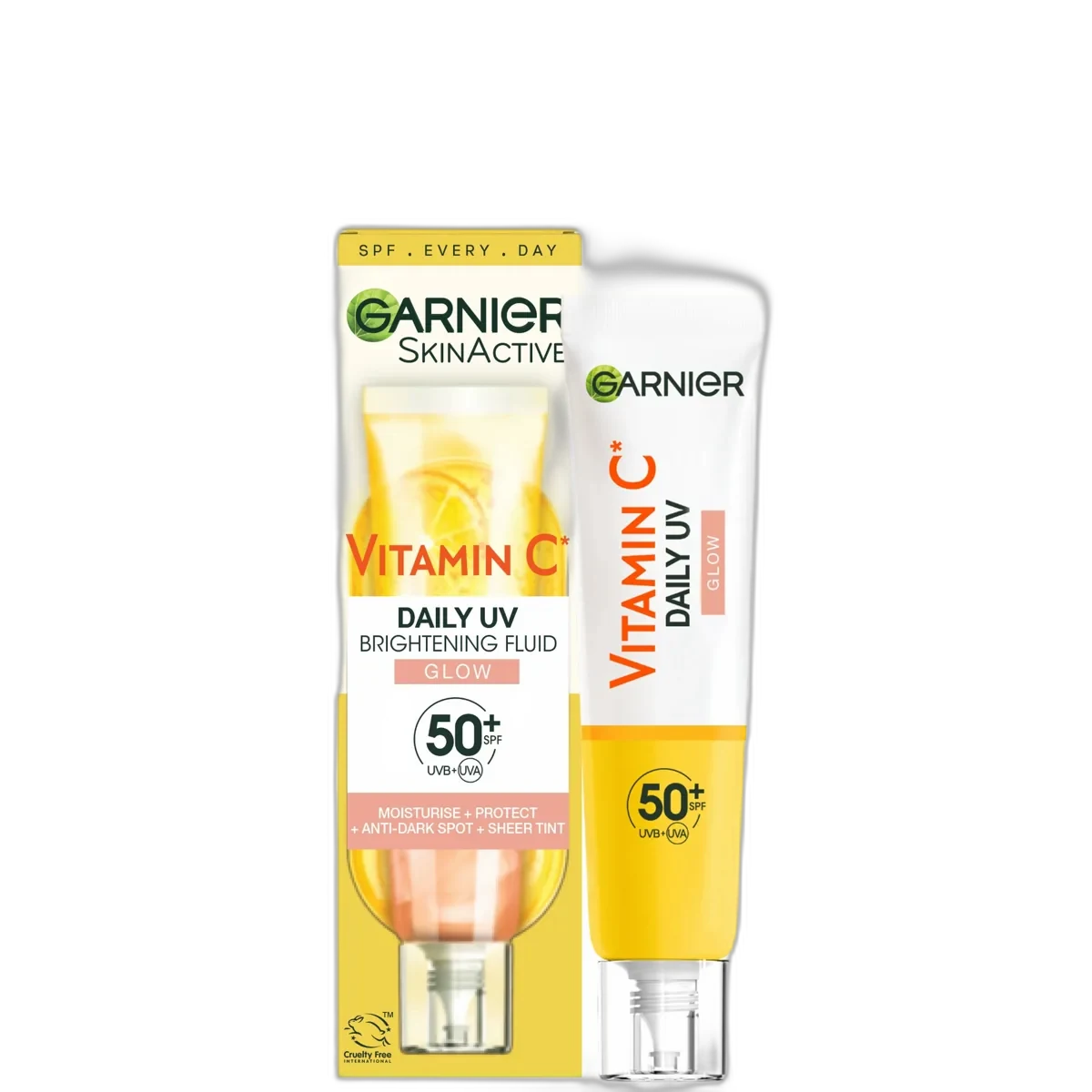
Vitamin C Brightening Daily UV Fluid SPF 50
European Filter Advantage
 Verified reviewer
Pros & cons.
- +Contains modern European filters (Tinosorb S, Uvinul T 150, Uvinul A Plus) unavailable in US drugstores
- +Very lightweight fluid texture with no white cast on any skin tone
- +SPF 50 broad-spectrum protection with strong UVA coverage
- +Works beautifully under makeup and layered with skincare
- +Affordable pricing in European markets for the filter quality
- +Pregnancy-safe filter system without octinoxate or oxybenzone
- +Includes adjunct antioxidants (vitamin C derivative and niacinamide)
- −Contains alcohol denat high in the formula
- −Fragrance limits sensitive-skin suitability
- −Only available in European markets — import premium for US buyers
- −Vitamin C concentration is marketing-positioned, not treatment-level
The full review.
Sunscreen shows the largest gap between European and American drugstores. The FDA hasn’t approved a new sunscreen filter for consumer products since 1999. This means US drugstore SPFs mostly use older chemical filters — avobenzone, octinoxate, octocrylene, homosalate — that require careful formulation to photostabilize and leave gaps in UVA coverage. European regulators approved newer filters years ago, and European drugstore sunscreens routinely include them. This Garnier fluid shows exactly what that regulatory difference means for a product.
The filter system is the story. Ethylhexyl triazone (Uvinul T 150) is the most potent UVB filter in global cosmetics; its absorption efficiency dwarfs older filters like octinoxate. This allows modern formulations to hit SPF 50 without stacking heavy amounts of less efficient actives. Bis-ethylhexyloxyphenol methoxyphenyl triazine (Tinosorb S) is a broad-spectrum filter covering UVA and UVB, and dermatology literature ranks it among the most photostable and effective UV actives. Diethylamino hydroxybenzoyl hexyl benzoate (Uvinul A Plus) provides long-wavelength UVA coverage with excellent photostability. Combined with avobenzone and octisalate, this gives the formula a UVA protection profile competitive with premium derm-recommended European sunscreens costing three or four times as much.
Texture is the second reason this product earns its reputation. It is a lightweight, runny fluid that absorbs into a dry, nearly matte finish without a white cast. The filter system does the work a heavier formulation would need titanium dioxide or zinc oxide for, and modern European sunscreen chemistry is cosmetically elegant. Users with oily and combination skin will like the finish; dry skin will find it doesn’t feel tight or film-forming despite the alcohol content. It layers under makeup without pilling, and the lack of white cast works on all skin tones without the ashy residue found in many mineral-filter alternatives.
Calibrate expectations for the vitamin C. Ascorbyl glucoside is a stable vitamin C derivative that the skin converts slowly to free ascorbic acid. At its position on the ingredient list, the concentration is modest — enough to provide baseline antioxidant support that complements the UV filters, but not the concentration of a dedicated vitamin C serum. Niacinamide appears lower on the list as a supporting active. Together they form the brightening narrative used in marketing, and the mechanism is real: daily SPF use is the most effective intervention for preventing further hyperpigmentation, while low-level antioxidants and niacinamide provide incremental barrier and brightening support. Treat this as an enhanced sunscreen rather than a treatment product. For visible dark-spot reduction, pair it with a dedicated vitamin C serum and be patient.
The formula has limitations in its secondary ingredients. Alcohol denat is high enough on the ingredient list to be noticeable. It helps the fast-absorbing, dry-down feel, but it is a potential irritant for sensitive and reactive skin and can compromise barrier function with sustained use in dry climates. Fragrance is present, which adds to the sensitization concern. Neither ingredient disqualifies the product for tolerant skin, but both mean this sunscreen is not a first-choice recommendation for rosacea, eczema, or chronically reactive users.
Availability is the other frustration. This product is a European-market formulation. Its best differentiator — the modern filter system — cannot legally be sold in US-market sunscreens under current FDA rules. American consumers wanting equivalent filter quality must import from European pharmacies or choose from a few premium brands that manufacture for European markets. At €15 for a tube that lasts one or two months of proper daily use, the price is accessible in its home markets, but import premiums for US buyers erase that value.
For the European drugstore shopper, this is an easy recommendation. You get a sunscreen with filter quality and cosmetic elegance that costs two or three times more in a US drugstore. The fluid texture makes it easy to apply the amount the label expects. The mild brightening from ascorbyl glucoside and niacinamide is a bonus, not a main feature, but it is a sensible choice that complements dedicated treatment products. As an affordable European drugstore SPF 50 with modern filters and an elegant finish, this is one of the better everyday sunscreens on the market.
Formula
PM routine
Ingredient analysis.
Full INCI list
Aqua, Ethylhexyl Salicylate, Butylene Glycol, Diisopropyl Sebacate, Ethylhexyl Triazone, Butyl Methoxydibenzoylmethane, Silica, Bis-Ethylhexyloxyphenol Methoxyphenyl Triazine, Glycerin, Styrene/Acrylates Copolymer, Alcohol Denat., Diethylamino Hydroxybenzoyl Hexyl Benzoate, Ascorbyl Glucoside, Drometrizole Trisiloxane, Polymethyl Methacrylate, Tocopherol, Niacinamide, Acrylates/C10-30 Alkyl Acrylate Crosspolymer, Sodium Hydroxide, Disodium EDTA, Xanthan Gum, Phenoxyethanol, Parfum
Skin match.
The science.
The Science
This sunscreen's filter system reflects current European cosmetic UV-filter science, which exceeds what current FDA regulations allow in US formulations. Ethylhexyl triazone has the highest molar extinction coefficient of any approved UVB filter, so it delivers high SPF per unit concentration. Bis-ethylhexyloxyphenol methoxyphenyl triazine (Tinosorb S) is a broad-spectrum, photostable filter studied extensively in European dermatology literature; research shows it stabilizes avobenzone and extends UVA protection at longer wavelengths. Diethylamino hydroxybenzoyl hexyl benzoate (Uvinul A Plus) covers the 340-400 nm range, the deep UVA zone linked to photoaging and hyperpigmentation. This filter combination produces a UVA protection profile — typically measured as UVA-PF or critical wavelength — that exceeds most FDA-approved filter combinations. Ascorbyl glucoside converts to ascorbic acid in the skin and shows modest antioxidant activity at typical cosmetic concentrations, though clinical brightening studies show visible dark-spot improvement at high concentrations (above 5%). Niacinamide is extensively studied at 2-5% concentrations for barrier support and melanin transfer modulation, but its position on this list suggests a lower concentration. The formulation uses sophisticated cosmetic chemistry for a drugstore tier — a combination more common in European markets than US ones.
Dermatologist Perspective
Dermatologists consistently recommend daily broad-spectrum SPF 30 or higher as the most effective anti-aging and pigmentation-prevention step in a skincare routine. For patients concerned with hyperpigmentation or photoaging, board-certified dermatologists emphasize strong UVA coverage, where older US-market chemical filters often fall short. Dermatologists commonly cite European formulations with Tinosorb S and Uvinul T 150 as the gold standard for chemical sunscreen filter quality, though availability varies by market. For sensitive, rosacea-prone, or eczema-prone patients, dermatologists typically recommend fragrance-free and alcohol-free mineral sunscreens, so this formula suits tolerant skin better than reactive skin. Dermatologists often recommend pairing daily SPF with a dedicated vitamin C serum for users targeting visible hyperpigmentation rather than relying on the low-level vitamin C in the sunscreen itself.
Where it fits in your routine.
Apply each morning as the last daytime step after your moisturizer. Use about a quarter-teaspoon for face and neck (roughly two finger-lengths dispensed on one finger) to get the labeled SPF 50 protection — most users under-apply sunscreen and reduce effective protection. Let it absorb for one minute before makeup. Reapply every two hours if outdoors for long periods. One morning application is typically enough for daily indoor-plus-commute exposure.
At approximately €15 for 40 mL, the filter system offers excellent value in European markets. One tube lasts 4-6 weeks if you use about a quarter-teaspoon per face application. This delivers equivalent filter quality and comparable cosmetic elegance to premium European derm brands like La Roche-Posay or Bioderma at two to three times the price. It outperforms US drugstore sunscreens at similar price points because the filter system advantage is meaningful. For US consumers, import premiums can reduce the value advantage, but it remains competitive with domestic premium options.
European users wanting high-quality filter protection at drugstore prices, anyone preventing hyperpigmentation, oily and combination skin needing a lightweight matte-finish sunscreen, and users building a budget-conscious, formulation-aware daily routine.
Sensitive, rosacea-prone, or eczema-prone skin (alcohol and fragrance are problematic), US-based consumers unless you pay import premiums, and users wanting treatment-level vitamin C instead of a supporting antioxidant dose.
Product details.
This lightweight, runny fluid absorbs quickly. It leaves a dry, almost matte finish without white cast.
Light fresh fragrance typical of European drugstore sunscreens.
Small plastic tube with a flip-cap dispenser, standard European drugstore SPF format.
Absorbs almost instantly into a smooth, nearly invisible finish. It does not tingle. The alcohol content creates the fast-dry sensation common in European SPFs. It leaves no white cast on any skin tone.
About 4-6 weeks with daily face use at proper application amounts.
12 months
All Year
The backstory.
Garnier launched this Vitamin C UV Fluid as part of its broader push into the brightening sunscreen category popular in Europe and Asia. The formula benefits directly from L'Oréal Group's access to proprietary and European-approved UV filters, delivering protection that's genuinely competitive with mid-tier derm-recommended options at a fraction of the price.
About Garnier SkinActive
Legacy Brand (20+ years)Garnier started in France in 1904 and joined L'Oréal in 1965. This sunscreen uses L'Oréal's UV-filter research, including modern European-approved filters like Tinosorb and Uvinul that the FDA has not yet approved in the US.
Common myths.
Drugstore sunscreens lag behind derm brands.
In European markets, drugstore brands like Garnier use the same modern filters (Tinosorb S, Uvinul T 150) as premium derm sunscreens. This specific product shows the formulation gap closing at the drugstore tier.
Vitamin C in a sunscreen lets you skip a dedicated vitamin C serum.
The ascorbyl glucoside concentration is modest. It works as an antioxidant adjunct rather than a treatment-level vitamin C. Use a dedicated serum for active brightening and use this for SPF protection.
FAQ.
What makes this different from US drugstore sunscreens?
The UV filter system is the key difference. This formula uses Tinosorb S, Uvinul T 150, and Uvinul A Plus — European-approved filters not yet FDA-approved in the US. These filters are more photostable and provide broader UVA coverage than older filters used in US formulations. This is why European drugstore sunscreens often outperform US counterparts at similar price points.
Will the vitamin C actually brighten dark spots?
At this low concentration, the vitamin C derivative (ascorbyl glucoside) works as a supportive antioxidant instead of a treatment-level brightener. To reduce visible dark spots, use this sunscreen daily with a dedicated vitamin C serum — the combination delivers brightening results.
Is it safe for sensitive skin?
This is likely not the best choice. The formula contains alcohol denat and fragrance, which can trigger reactive or rosacea-prone skin. A fragrance-free mineral or hybrid sunscreen works better for sensitive users.
Does it leave a white cast?
No — this sunscreen uses only chemical filters. It has no zinc oxide or titanium dioxide and absorbs invisibly on all skin tones.
Can I layer makeup over it?
Yes — the lightweight fluid texture and quick-dry finish make it a strong makeup base. Wait about a minute for the sunscreen to set before you apply primer or foundation.
Is it reef-safe?
The formula excludes octinoxate and oxybenzone, the filters most often restricted by reef-safe regulations, but it uses other chemical filters. Reef safety standards vary — if you need a reef-safe product, choose a mineral alternative.
Is it pregnancy-safe?
Yes — this formula excludes octinoxate, oxybenzone, and retinoids. The European filter system used here is pregnancy-safe, and the ascorbyl glucoside and niacinamide are also pregnancy-safe actives.
What the community says.
"Contains Tinosorb S and Uvinul T 150 — filters typically found in pricier European sunscreens"
"Lightweight fluid texture with no white cast"
"Works well under makeup and layered with skincare"
"Affordable for a modern broad-spectrum SPF 50"
"Contains alcohol denat high in the ingredient list"
"Fragrance makes it unsuitable for sensitive skin"
"Only available in European markets — hard to buy in the US"
Featured in.
People also looked at.