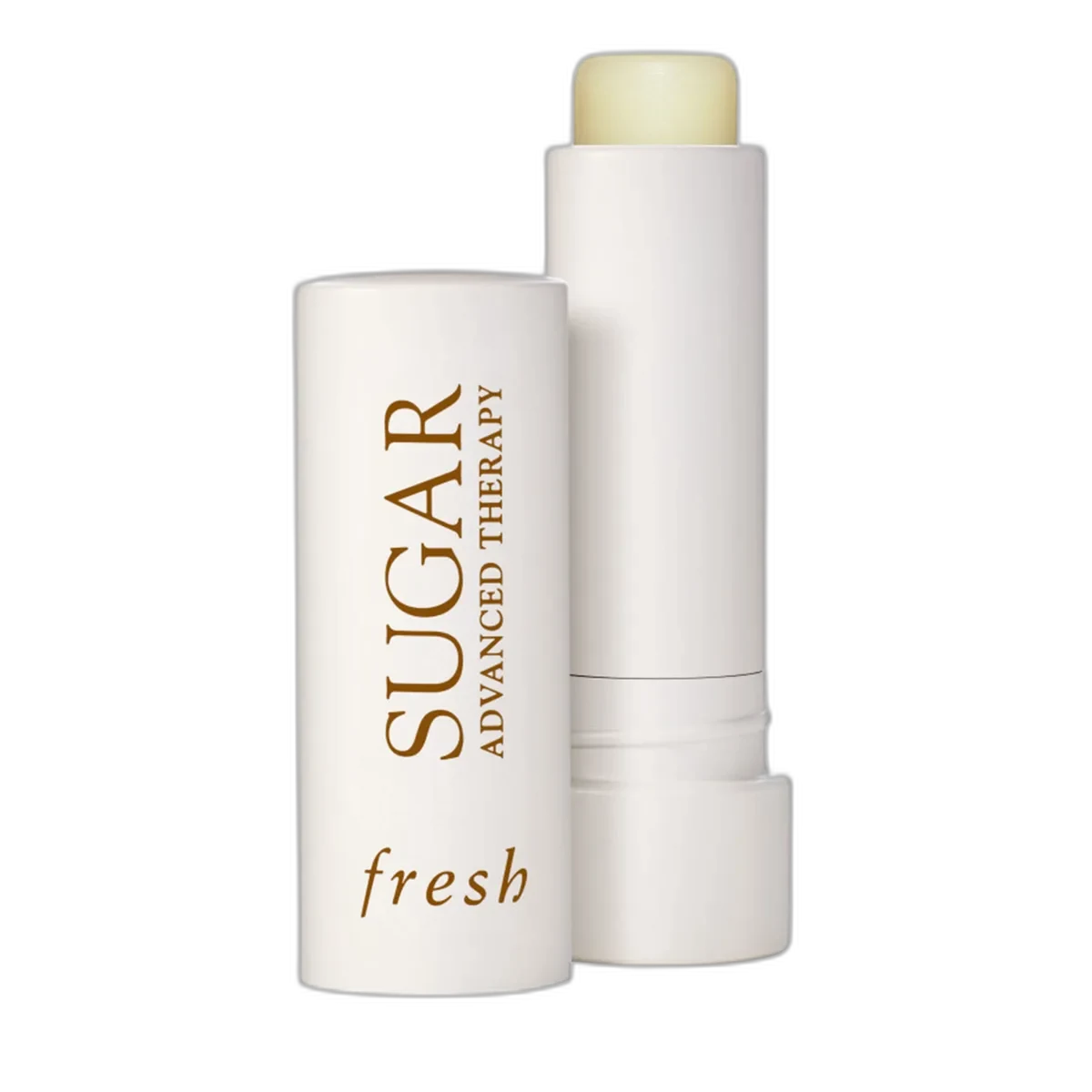
Sugar Advanced Therapy Lip Mask
Luxury Lip Rescue
 Verified reviewer
Pros & cons.
- +Six-oil blend provides a more complex and nuanced fatty acid profile than single-oil lip balms
- +Sea fennel extract is a genuinely uncommon lip care ingredient with antioxidant and regenerative potential
- +Dual oil-soluble vitamin C derivatives remain stable in this anhydrous formula unlike water-soluble alternatives
- +Licorice root derivative provides soothing anti-inflammatory support for irritated lip tissue
- +Visible improvement in cracked and peeling lips within 2-3 days of consistent use
- +Elegant twist-up packaging is sturdy, portable, and protects the product from drying out
- −Contains Parfum plus five EU-listed fragrance allergens on one of the most sensitive facial areas
- −Extreme pricing at approximately $186 per ounce for a beeswax-and-oil lip balm
- −Sodium hyaluronate marketing overpromises relative to its low INCI list position
- −No SPF protection — requires layering a separate SPF lip balm for daytime sun protection
- −Not vegan due to beeswax and carnauba wax base
The full review.
In 2013, Fresh faced a class action lawsuit alleging that their Sugar lip products were falsely advertised because they didn’t actually contain sugar. The case highlighted something the beauty industry rarely discusses openly: the gap between what a product’s name suggests and what its formula delivers. There is no sucrose in the Fresh Sugar Advanced Therapy Lip Mask. There is Sucrose Tetrastearate Triacetate — a sugar ester used as an emollient — but that’s about as close to sugar as a sedan is to a race car. The name references the brand’s Sugar Collection, which itself references the founders’ grandmothers’ use of sugar as a folk remedy. It’s marketing archaeology, not ingredient disclosure.
The actual formula, however, is more interesting than the naming controversy. This is a beeswax-based lip balm at its core, but a remarkably well-built one. Where most lip balms rely on a single emollient — shea butter, petrolatum, or lanolin — Fresh layers six different plant oils, each contributing a distinct fatty acid profile. Jojoba oil (second on the INCI list) mimics the skin’s natural sebum for excellent compatibility. Grape seed oil provides linoleic acid. Meadowfoam seed oil delivers long-chain fatty acids for lasting moisture. Black currant seed oil contributes gamma-linolenic acid with anti-inflammatory properties. Plum seed oil adds oleic acid. Castor oil provides ricinoleic acid for occlusion. The result is a more nuanced moisture delivery system than the typical one-oil-does-everything approach.
The genuinely uncommon ingredient here is Crithmum maritimum — sea fennel extract — a coastal plant that grows on European cliffs and has documented antioxidant properties. Fresh positions it as a lip contour anti-aging ingredient, and while the evidence for lip-specific benefits is limited, the extract does contain compounds with demonstrated epidermal regeneration potential. It’s the kind of ingredient that signals formulation ambition beyond basic hydration.
The dual vitamin C derivatives — ascorbyl tetraisopalmitate and ascorbyl palmitate — are a smart choice for an anhydrous formula. Most vitamin C forms are water-soluble and unstable in oil-heavy products. These lipid-soluble versions were selected specifically because they remain active in the beeswax-and-oil matrix where standard ascorbic acid would degrade immediately. Alongside tocopherol (vitamin E) and the sea fennel, they create a lipid-compatible antioxidant network designed for the thin, vulnerable tissue of the lips.
Ammonium glycyrrhizate, a licorice root derivative, provides soothing anti-inflammatory action — which is particularly welcome given the formula’s fragrance situation. Because this product contains Parfum plus five EU-listed fragrance allergens: Limonene, Citral, Benzyl Alcohol, Linalool, and Geraniol. For a lip product — something you’re putting on one of the most sensitive areas of your face, right next to mucous membranes — that’s a significant fragrance load. The scent itself is a pleasant, subtle vanilla-citrus note from Ethyl Vanillin and the citrus-derived compounds. It’s not aggressive. But the allergens are there, and for anyone with fragrance sensitivity or a history of lip eczema, this is a disqualifying concern.
On the lips, the product performs beautifully. The beeswax-and-carnauba base gives structure to the twist-up stick while the oil blend ensures it glides without dragging. It melts slightly on contact, depositing a smooth, buttery layer that feels genuinely luxurious. The immediate effect is a cushioned softness that lasts several hours. Used overnight as a lip mask — a generous layer before bed — the results by morning are noticeably better: lips are soft, smooth, and any flaking or cracking has improved significantly. Within a few days of consistent use, chronically dry lips show real improvement.
The hyaluronic acid marketing deserves an honest mention. Fresh positions sodium hyaluronate as ‘hyaluronic filling spheres’ that plump the lips. But sodium hyaluronate appears near the very end of the INCI list, indicating a concentration so low that meaningful plumping activity is unlikely. The temporary fullness you feel comes from the occlusive wax barrier trapping moisture in the lip tissue — a simple mechanical effect, not an HA-driven one. It’s not deceptive, exactly, but it’s optimistic labeling.
The price is the final and most significant consideration. At $28 for 0.15 oz, this works out to approximately $186 per ounce. That’s luxury-fragrance pricing for a lip balm. The product lasts two to three months with daily use, which makes the per-day cost roughly $0.30-0.50 — not ruinous, but notable. The multi-oil blend, sea fennel extract, and vitamin C derivatives do represent genuine formulation sophistication beyond drugstore lip balms. But the base mechanism — beeswax and plant oils creating an occlusive moisture barrier — is identical to products costing $5-10. You’re paying for the botanical complexity, the antioxidant system, the elegant packaging, and the LVMH brand experience.
For people who view lip care as a small luxury worth the investment, this delivers. The formula is thoughtful, the texture is beautiful, and the results on dry, damaged lips are real. For the practical-minded, the core healing mechanism has more affordable equivalents — but they won’t have the sea fennel, the dual vitamin C, or the satisfying weight of the twist-up stick in your pocket.
Ingredient analysis.
Full INCI list
Cera Alba (Beeswax), Simmondsia Chinensis (Jojoba) Seed Oil, C10-18 Triglycerides, Ricinus Communis (Castor) Seed Oil, Hydrogenated Olive Oil Decyl Esters, Vitis Vinifera (Grape) Seed Oil, Parfum (Fragrance), Crithmum Maritimum Extract, Prunus Domestica Seed Oil, Limnanthes Alba (Meadowfoam) Seed Oil, Ribes Nigrum (Black Currant) Seed Oil, Cera Carnauba (Copernicia Cerifera (Carnauba) Wax), Hydrogenated Vegetable Oil, Tocopherol, Tocopheryl Acetate, Caprylic/Capric Triglyceride, Sodium Hyaluronate, Triolein, Sucrose Tetrastearate Triacetate, Ammonium Glycyrrhizate, Glyceryl Dioleate, Ascorbyl Tetraisopalmitate, Ascorbyl Palmitate, Ethyl Vanillin, Limonene, Citral, Benzyl Alcohol, Linalool, Geraniol
Skin match.
The science.
The Science
This lip treatment uses a multi-oil formulation based on fatty acid complementarity. Each oil provides a different fatty acid to support lip barrier function. Jojoba oil (Simmondsia chinensis) is a liquid wax ester that mimics human sebum, so it has high skin compatibility. Black currant (Ribes nigrum) seed oil has 15-20% gamma-linolenic acid (GLA), an omega-6 fatty acid with anti-inflammatory properties. A 2010 review in Lipids in Health and Disease links GLA deficiency to impaired skin barrier function and increased transepidermal water loss.
Crithmum maritimum (sea fennel) extract contains falcarinol, phenolic acids, and essential oils. A 2016 review in the Journal of Pharmacy and Pharmacology (PMC5052179) shows its antioxidant and skin regenerative properties. Sea fennel compounds stimulate keratinocyte generation and migration—the primary cells of the epidermis. This matters for lip tissue, which has faster cell turnover than facial skin and a thinner stratum corneum, making it more vulnerable to environmental damage.
The formula uses two vitamin C derivatives. Ascorbyl tetraisopalmitate is a tetra-ester of ascorbic acid and isopalmitic acid; it is oil-soluble and stable in anhydrous systems. A 2009 study in the Journal of Cosmetic Dermatology shows it increases dermal collagen synthesis and reduces melanin production. Ascorbyl palmitate is a simpler ascorbic acid ester that adds antioxidant activity and stabilizes the formula, protecting the polyunsaturated fatty acids in the oil blend from oxidative rancidity.
Beeswax (Cera Alba) and carnauba wax create an occlusive barrier with different melting profiles: beeswax melts at 62-65°C and carnauba at 82-86°C. This graduated melting system softens on contact with lips but stays stable at room temperature. This dual-wax approach offers better adhesion and longer wear than single-wax formulations.
References
- Crithmum maritimum: Phytochemistry and Biological Activities — Journal of Pharmacy and Pharmacology (2016)
- Stability and biological activity of ascorbyl tetraisopalmitate — Journal of Cosmetic Dermatology (2009)
- Gamma-linolenic acid: an anti-inflammatory omega-6 fatty acid — Lipids in Health and Disease (2010)
Dermatologist Perspective
Dermatologists favor emollient lip balms for dry, cracked lips because the occlusive mechanism—trapping moisture under a wax/oil barrier—hydrates lips effectively. Board-certified dermatologists would likely value the multi-oil approach and vitamin C derivatives in this lip balm. However, dermatologists often warn against fragrance in lip products. The lip vermilion border has a thinner stratum corneum and higher permeability than facial skin, increasing contact sensitization risk. The five fragrance allergens in this formula concern patients with lip eczema or contact dermatitis. Dermatologists would also note the lack of SPF; lip tissue is highly susceptible to UV damage and actinic cheilitis, so sun protection is an essential daily lip care component.
Where it fits in your routine.
Apply the twist-up stick directly to clean, dry lips. For daytime, apply a thin layer and follow with an SPF lip balm for sun protection. For an overnight lip mask treatment, apply a thick layer before bed and leave it on overnight — the beeswax barrier prevents moisture loss while you sleep. For extra-dry or cracked lips, exfoliate with a lip scrub first, then apply the treatment to freshly buffed lips to improve absorption. Reapply as needed throughout the day.
At $28 for 0.15 oz, this lip balm costs about $186/oz, one of the highest per-ounce prices available. Daily use lasts 2-3 months, so the daily cost is $0.30-0.50. The six-oil blend, sea fennel extract, dual vitamin C derivatives, and licorice root show more formulation complexity than basic lip balms. However, the core moisturizing mechanism — beeswax and plant oils creating an occlusive barrier — works the same as $5-10 products. Fresh's premium price buys the botanical complexity, the antioxidant system, the elegant packaging, and the brand experience. A mini size (~$15 for 0.07 oz) provides a lower-commitment entry point.
Choose this if you view lip care as a worthwhile luxury investment and want more than basic hydration. It works for chronically dry, cracked, or aging lips needing intensive repair. It suits users who like sophisticated botanical formulations and want an overnight lip mask that softens and conditions. The elegant packaging makes it a satisfying daily-carry item.
People with fragrance sensitivity or lip eczema should avoid this because of the five fragrance allergens. Vegans should note the beeswax. Budget-conscious shoppers can find effective emollient lip balms for much less. Those needing daily SPF lip protection should use the original Sugar Lip Treatment SPF 15 or layer a separate SPF product over this one.
Product details.
This thick balm glides on smoothly and melts into the lips. It feels buttery and comfortable, not heavy or waxy. The beeswax and carnauba wax base provides structure, while the multi-oil blend ensures slip.
Ethyl Vanillin, Limonene, and Citral create a subtle sweet vanilla-citrus fragrance. The scent is light and warm upon application.
A retractable twist-up balm stick in a sturdy, premium-feeling cylindrical casing. The twist mechanism prevents the product from drying out. It is compact, portable, and travel-friendly.
Lips feel soft and coated immediately. The balm melts on contact and leaves a smooth emollient layer. Lips feel smoother and more comfortable within minutes. There is no adjustment period; benefits start right away and improve over days.
2-3 months with once or twice daily application
12 months
All Year
The backstory.
Fresh's Sugar Collection launched in 1998, inspired by the founders' grandmothers who used sugar as a natural healing remedy. The original Sugar Lip Treatment SPF 15 became one of Sephora's all-time bestselling lip products. The Advanced Therapy version launched around 2012 as a more intensive, SPF-free variant focused on lip repair and anti-aging — filling the gap for users who wanted treatment-grade lip care they could layer under separate SPF products.
About Fresh
Established Brand (5–20 years)Fresh launched in 1991 in Boston and joined LVMH as a maison in 2000. The Sugar Lip line has been a signature collection since 1998 and stays among Sephora's bestselling lip treatments for over two decades.
Common myths.
This product contains real sugar that heals your lips
The 'Sugar' branding is misleading; the product lacks sucrose (table sugar). It uses Sucrose Tetrastearate Triacetate, a sugar ester that works as an emollient/emulsifier. A 2013 class action lawsuit challenged this claim. The oil blend, sea fennel extract, and wax base provide the conditioning benefits.
The hyaluronic acid spheres plump your lips like a filler
Sodium hyaluronate is near the end of the INCI list, so the concentration is low. The temporary plumping comes from the occlusive beeswax/carnauba barrier trapping moisture in the lip tissue, not from hyaluronic acid activity.
Premium lip balms work better than drugstore options because they use superior ingredients.
Beeswax and plant oils form this product's base—ingredients in many $5-10 lip balms. Sea fennel extract, dual vitamin C derivatives, and a specific multi-oil blend differentiate it. Whether this complexity justifies a 5-6x price premium depends on your priorities, but the core moisturizing mechanism is similar to simpler products.
FAQ.
Is Fresh Sugar Advanced Therapy Lip Treatment worth $28?
The multi-oil blend uses six plant oils, sea fennel extract, and dual vitamin C derivatives. This formula is more sophisticated than most lip balms. At $28 for 0.15 oz (approximately $186/oz), the price reflects luxury positioning for 2-3 months of daily use. The formula works well, but the core moisturizing mechanism — beeswax and plant oils — costs much less elsewhere.
Does Fresh Sugar Lip Treatment actually contain sugar?
No. This product lacks sucrose (table sugar) despite the 'Sugar' branding. It uses Sucrose Tetrastearate Triacetate, a sugar ester that works as an emollient. The name refers to the brand's Sugar Collection, which draws from the founders' grandmothers using sugar as a natural remedy.
Can I use Fresh Sugar Advanced Therapy as an overnight lip mask?
Yes — apply a thick layer before bed. The beeswax and carnauba wax base creates an occlusive barrier to stop moisture loss overnight. The multi-oil blend and sea fennel extract condition and repair lips during sleep. Many users see the most noticeable results from overnight application.
What's the difference between Fresh Sugar Advanced Therapy and the original Sugar Lip Treatment SPF 15?
The Advanced Therapy version is SPF-free. It uses sea fennel extract, dual vitamin C derivatives, and a thick oil blend for intensive repair and anti-aging. The original Sugar Lip Treatment SPF 15 includes sun protection and multiple tinted shades. They serve different needs: the Advanced Therapy treats skin, while the original provides daily protection and color.
Is Fresh Sugar Advanced Therapy Lip Treatment safe for sensitive lips?
This product contains Parfum and five EU-listed fragrance allergens (Limonene, Citral, Benzyl Alcohol, Linalool, Geraniol). This makes it a risky choice for fragrance-sensitive people or those with lip eczema (cheilitis). The licorice root derivative provides a soothing counterbalance, but the fragrance load is high for a lip product.
What the community says.
"Intensely hydrating — keeps lips moisturized through the night and all day"
"Repairs visibly dry, cracked, and peeling lips within days"
"Smooth, luxurious balm texture that glides on without dragging"
"Pleasant subtle vanilla-citrus scent that isn't overpowering"
"Effective as both a daytime treatment and overnight lip mask"
"Elegant twist-up packaging feels premium and is easy to carry"
"Expensive at $28 for only 0.15 oz — extreme price per ounce"
"Contains Parfum and five EU-listed fragrance allergens"
"No SPF protection unlike the original Sugar Lip Treatment"
"Sodium hyaluronate appears very low on INCI list despite HA marketing"
"Requires frequent reapplication throughout the day for some users"