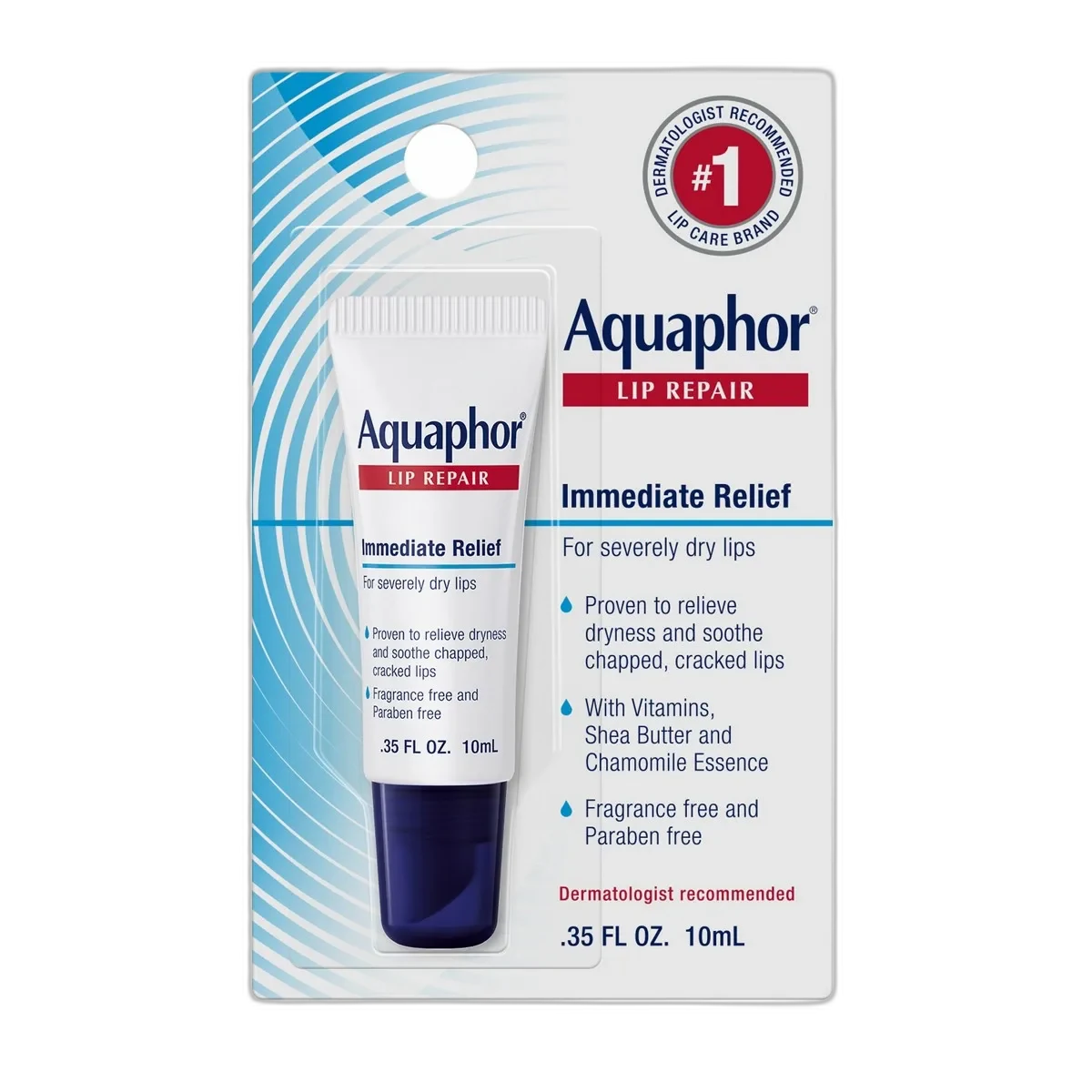
Lip Repair
Derm Office Lip Staple
 Verified reviewer
Pros & cons.
- +Panthenol-bisabolol combination is clinically validated to improve cheilitis symptoms within 2 weeks
- +#1 dermatologist-recommended lip care brand with 15 years of real-world validation
- +Over 50,000 reviews at a 4.7 average rating — one of the most thoroughly vetted lip products available
- +Non-sticky smooth texture that glides on without the waxy heaviness of traditional lip balms
- +Vitamins C and E provide antioxidant protection that most lip products entirely omit
- +Fragrance-free and gentle enough for severely sensitive, eczema-prone, and post-procedure lips
- +Affordable at under and available at virtually every retailer in the country
- −Glossy finish is always visible — not ideal for users who prefer matte or invisible lip balm
- −Some users find moisture does not last long enough, requiring frequent reapplication
- −Formula is entirely different from Aquaphor Healing Ointment — no petrolatum base
- −Small 0.35 oz tube runs out quickly with heavy daily use across multiple applications
- −Not cruelty-free or vegan — contains beeswax and parent company allows animal testing where required
The full review.
In dermatology offices across the country, there is a particular conversation that happens with remarkable frequency. A patient mentions dry, cracking lips. The dermatologist, without hesitation, recommends Aquaphor Lip Repair. Not a prescription treatment, not a compounding pharmacy formulation — a product available at every CVS, Target, and gas station in America. This tells you something about either the product or the state of lip care innovation, and in this case, it tells you about both.
The formula is not what most people assume it is. If you have used Aquaphor Healing Ointment — the thick, petrolatum-heavy ointment that comes in a tub — the Lip Repair is a fundamentally different product. It shares a brand name and a blue color scheme, but the formulation starts from scratch. Where the Healing Ointment is 41% petrolatum with lanolin and mineral oil, the Lip Repair uses octyldodecanol as its base — a lightweight fatty alcohol that provides emollient slip without the heavy greasiness of petrolatum. Castor oil provides the primary occlusive function, while shea butter adds substantive conditioning.
The two ingredients that justify the dermatological endorsement are panthenol and bisabolol, and a 2024 clinical study in the International Journal of Dental Hygiene provided direct evidence for their combination in lip care. In patients with mild-to-moderate cheilitis, panthenol and bisabolol lip care produced significant improvements in all clinical parameters as early as week two, with benefits sustained through week eight. The study concluded this combination could serve as monotherapy, potentially replacing the topical corticosteroids that dermatologists otherwise prescribe for persistent lip inflammation. For a cosmetic lip balm to have clinical evidence suggesting it can substitute for a prescription treatment is genuinely unusual.
Panthenol converts to pantothenic acid in tissue, where it becomes a component of coenzyme A — the enzyme critical for fatty acid and sphingolipid synthesis. On lip tissue, which lacks the sebaceous glands that keep facial skin naturally moisturized, this means panthenol helps the lips build their own moisture barrier from the inside rather than just coating the surface. Bisabolol, derived from chamomile, provides anti-inflammatory activity that calms the redness and irritation of chapped lips while the panthenol handles the structural repair.
The texture lands in a sweet spot between gloss and ointment. It is smoother and less waxy than traditional beeswax-based balms, lighter than petrolatum, and more substantial than a lip oil. It glides on with a silky slip and leaves a noticeable glossy sheen — translucent, not tinted, with the kind of healthy-looking shine that has earned it a quiet cult following among people who like the “glass lips” aesthetic without the commitment of a cosmetic lip product.
The glossy finish is both a strength and a limitation. If you prefer an invisible, matte lip balm that disappears completely, this is not it. The sheen is always present, and for some users — particularly those who wear matte lipstick — the finish can interfere with the desired look. The stick format (0.17 oz) provides slightly less shine than the tube, if that matters to your preference.
Longevity varies significantly by user. Many report hours of lasting moisture, particularly when applied as a thick overnight layer. Others find they need to reapply every couple of hours, especially in dry or windy conditions. This is not a criticism specific to Aquaphor — lip tissue has the highest cell turnover rate of any body surface, and no lip product truly “lasts all day” in the way that marketing suggests. What Aquaphor Lip Repair does well is provide meaningful hydration that improves lip condition over time rather than simply creating temporary comfort that evaporates.
The ingredient list includes a vitamin C and E complex (sodium ascorbyl phosphate, tocopheryl acetate, and tocopherol) that provides antioxidant protection for the lip tissue against environmental oxidative stress. This is a thoughtful inclusion that most lip balms skip — lip tissue is highly exposed to UV, wind, and pollution, and antioxidants support the repair process that the panthenol is driving.
At .79-6.79 for the tube format, the pricing is accessible without being so cheap that you question the quality. The dual packs offer slight savings. The stick format provides a traditional lip balm application experience for those who prefer it, though the tube’s narrow tip allows more precise application to specific cracked areas.
Fifteen years of market presence and over fifty thousand reviews create a data set that is hard to argue with. The 4.7 average rating across retailers with that volume of reviews indicates a product that delivers on its promise for the vast majority of users. The dermatological recommendation is not aspirational branding — it reflects genuine clinical confidence in the panthenol-bisabolol healing mechanism, validated by published research.
It is not the most exciting lip product on the shelf. It is not the most luxurious, the most innovative, or the most Instagram-worthy. It is the one your dermatologist keeps in their coat pocket.
Ingredient analysis.
Full INCI list
Octyldodecanol, C18-38 Alkyl Hydroxystearoyl Stearate, Ricinus Communis (Castor) Seed Oil, Caprylic/Capric Triglyceride, Glycerin, Bis-Diglyceryl Polyacyladipate-2, Panthenol, Water, Polyglyceryl-3 Diisostearate, Butyrospermum Parkii (Shea) Butter, Hydrogenated Castor Oil, Tocopheryl Acetate, Bisabolol, Sodium Ascorbyl Phosphate, Lecithin, Tocopherol, Ascorbyl Palmitate, Beeswax, C20-40 Alkyl Stearate, Magnesium Stearate, Magnesium Sulfate, Glyceryl Stearate, Glyceryl Oleate, Citric Acid
Skin match.
The science.
The Science
The most directly relevant evidence comes from a 2024 study by Varothai et al. published in the International Journal of Dental Hygiene. In 20 patients with mild-to-moderate cheilitis, a lip care product containing panthenol and bisabolol — the same key combination in Aquaphor Lip Repair — produced significant improvements in all clinical parameters as early as week 2, with sustained benefits through week 8. The study found reduced flare-up frequency, no adverse effects, and concluded that this combination could serve as monotherapy, potentially replacing prolonged topical corticosteroid use for lip inflammation.
Panthenol's mechanism is well-characterized. A comprehensive 70th anniversary review by Proksch et al. in the Journal of Dermatological Treatment (2017) confirmed that dexpanthenol (pro-vitamin B5) penetrates tissue and converts to pantothenic acid, a component of coenzyme A essential for fatty acid and sphingolipid synthesis. Applied to lip tissue, this means panthenol supports the biosynthesis of the lipid barrier that keeps lips moisturized — a regenerative mechanism rather than a mere surface-coating effect.
Bisabolol's anti-inflammatory properties complement the panthenol's barrier repair. Research has demonstrated that alpha-bisabolol inhibits pro-inflammatory cytokines through MAPK and NF-kB signaling pathways. In a formulation like this, bisabolol calms the inflammation that perpetuates the chap-crack-dry cycle, while panthenol rebuilds the barrier that prevents recurrence.
The vitamin C and E complex (sodium ascorbyl phosphate, tocopheryl acetate, tocopherol) provides synergistic antioxidant protection. Vitamin C regenerates oxidized vitamin E, extending the functional lifespan of both antioxidants on the lip surface. Given that lip tissue is highly exposed to UV radiation and environmental oxidants, this protection supports the repair process and may slow future damage.
References
- Efficacy of panthenol- and bisabolol-containing lip care as monotherapy for mild-to-moderate cheilitis — International Journal of Dental Hygiene (2024)
- Topical use of dexpanthenol: a 70th anniversary article — Journal of Dermatological Treatment (2017)
- Dexpanthenol in Wound Healing after Medical and Cosmetic Interventions — Pharmaceuticals (2020)
Dermatologist Perspective
Dermatologists recommend Aquaphor Lip Repair more than any other lip care product, and the recommendation is grounded in the formula's panthenol-bisabolol combination, which has clinical evidence supporting its efficacy in treating cheilitis. Board-certified dermatologists note that lip tissue differs fundamentally from facial skin — it is thinner, lacks sebaceous glands, and has higher cell turnover — making targeted lip-specific formulations more appropriate than simply applying facial moisturizer to the lips. The fragrance-free, preservative-free formula further reduces the risk of contact cheilitis, which dermatologists identify as a common cause of chronic lip dryness.
Where it fits in your routine.
Apply directly to lips as often as needed. For best results, apply to clean, dry lips after wiping off food or beverage residue. For intensive overnight repair, apply a thick layer before bed. Use it as a hydrating base before lipstick or over lip liner. Store at room temperature.
Aquaphor Lip Repair costs .79-6.79 for 0.35 fl oz, a mid-range price for lip care. Clinically validated ingredients and the brand's dermatological credibility add value. Dual packs (.99-9.99) save money per unit. The stick format (.49) offers a different application method for a similar price. The price reflects a 15-year track record and overwhelming review consensus for a product that delivers on its promise.
This works for dry, chapped, or cracking lips, including mild seasonal dryness or chronic cheilitis. It suits sensitive skin, eczema sufferers, and people who react to fragranced or medicated lip products. It is an excellent choice for post-procedure lip care after fillers or laser treatments.
The glossy finish is too prominent for those who prefer a matte, invisible lip balm. Users with confirmed sensitivities to castor oil or beeswax should choose alternatives. This product contains beeswax, which vegan consumers should note. Anyone needing SPF protection should use the Lip Repair + Protect SPF 30 variant instead.
Product details.
Smooth, ointment-like texture glides on easily. It is thicker than a typical lip gloss but less heavy than pure petrolatum or beeswax-based balms. It is non-sticky and has a silky slip.
Fragrance-free. No added fragrance is present, though some users detect a faint beeswax/waxy note.
Compact white squeeze tube has a narrow tip for precise application. Blue Aquaphor branding. The 0.35 fl oz size fits in pockets and purses. A stick format (0.17 oz) and multi-packs are also available.
The ointment glides on smoothly at first application and immediately softens chapped lip texture. The translucent formula leaves a noticeable glossy sheen. Tightness and cracking subside within minutes. The ointment causes no stinging or irritation on even severely chapped lips.
4-8 weeks with multiple daily applications
12 months
All Year
The backstory.
Aquaphor's Healing Ointment had long been used informally as a lip balm — dermatologists recommended it, and consumers scooped it from the tub onto their lips. In 2011, Beiersdorf gave the lip application its own dedicated formula, optimized for the unique needs of lip tissue (thinner skin, higher turnover, more environmental exposure) with panthenol, bisabolol, shea butter, and vitamins. Fifteen years later, it is the #1 dermatologist-recommended lip product on the market.
About Aquaphor
Legacy Brand (20+ years)Beiersdorf Inc. introduced Aquaphor in 1925. It is the #1 dermatologist-recommended lip care brand. The Lip Repair line launched in 2011 and has over 50,000 retailer reviews, making it one of the most reviewed lip products on the market.
Common myths.
Lip balm is addictive — your lips depend on it and dry out without it.
Lip balm dependency has no physiological mechanism. Chapped lips feel uncomfortable, and balm provides immediate relief. When balm wears off, the contrast feels like worsening, but the lips are just returning to their baseline state. Consistent use improves lip barrier function over time, as the panthenol-bisabolol cheilitis study shows.
Aquaphor Lip Repair is regular Aquaphor in a smaller tube.
The formulas differ entirely. Regular Aquaphor Healing Ointment has 41% petrolatum, lanolin, mineral oil, and ceresin. The Lip Repair uses octyldodecanol and castor oil as a base. It contains no petrolatum or lanolin, but adds panthenol, bisabolol, shea butter, and vitamins C and E — ingredients absent from the original.
FAQ.
Is Aquaphor Lip Repair the same as regular Aquaphor?
No — the formulas differ entirely. Regular Aquaphor Healing Ointment contains 41% petrolatum, lanolin, and mineral oil. The Lip Repair uses an octyldodecanol and castor oil base with panthenol, bisabolol, shea butter, and vitamins C and E. This formula targets lip tissue, has a lighter texture, and lacks petrolatum or lanolin.
How to Use
Can I use this as an overnight lip treatment?
Yes — applying a thick layer before bed works well. The emollient base seals in moisture overnight, and the panthenol-bisabolol combination repairs the lip barrier while you sleep. Many users report softer, smoother lips by morning.
Safety
Is this safe to ingest?
All ingredients are cosmetic-grade. Normal lip balm use won't cause safety concerns from incidental ingestion, but this product is not intended for ingestion. Small amounts transferred while eating or drinking stay within safe limits for all listed ingredients.
SPF ---
Does this have SPF?
The standard Aquaphor Lip Repair lacks SPF. Aquaphor sells a separate Lip Repair + Protect variant with SPF 30 for daytime UV protection. Use the SPF version for sun exposure or layer a lip-specific sunscreen over this product.
Why is this formula different from the original Aquaphor?
Lip tissue differs structurally from body skin. It is thinner, has higher cell turnover, lacks sebaceous glands, and faces more environmental exposure. The Lip Repair formula meets these needs. It uses lighter emollients for comfort, panthenol for barrier repair, and bisabolol for anti-inflammatory protection instead of the heavy petrolatum base in the original.
Will this make my lips dependent on lip balm?
No — lip balm dependency has no physiological mechanism. Clinical research shows the panthenol-bisabolol combination improves lip barrier function over time. The urge to reapply reflects chapped lips, not dependency from the product.
What the community says.
"Immediate relief for chapped and cracked lips — noticeable improvement after a single application"
"Long-lasting moisture that persists for hours, especially effective as an overnight treatment"
"Non-sticky smooth texture that glides on without clumping or heaviness"
"Fragrance-free and gentle enough for extremely sensitive and eczema-prone skin"
"Compact squeeze tube is easy to carry and allows precise application"
"Affordable and available at virtually every drugstore and retailer"
"Some users find it requires frequent reapplication — moisture doesn't last all day for everyone"
"A small minority report increased dryness or mild irritation, possibly from castor oil sensitivity"
"Different formula than the original Aquaphor Healing Ointment — not a petrolatum-based product"
"Glossy finish may be too shiny for users who prefer a matte or invisible lip balm"
"Small 0.35 oz tube runs out quickly with heavy daily use"