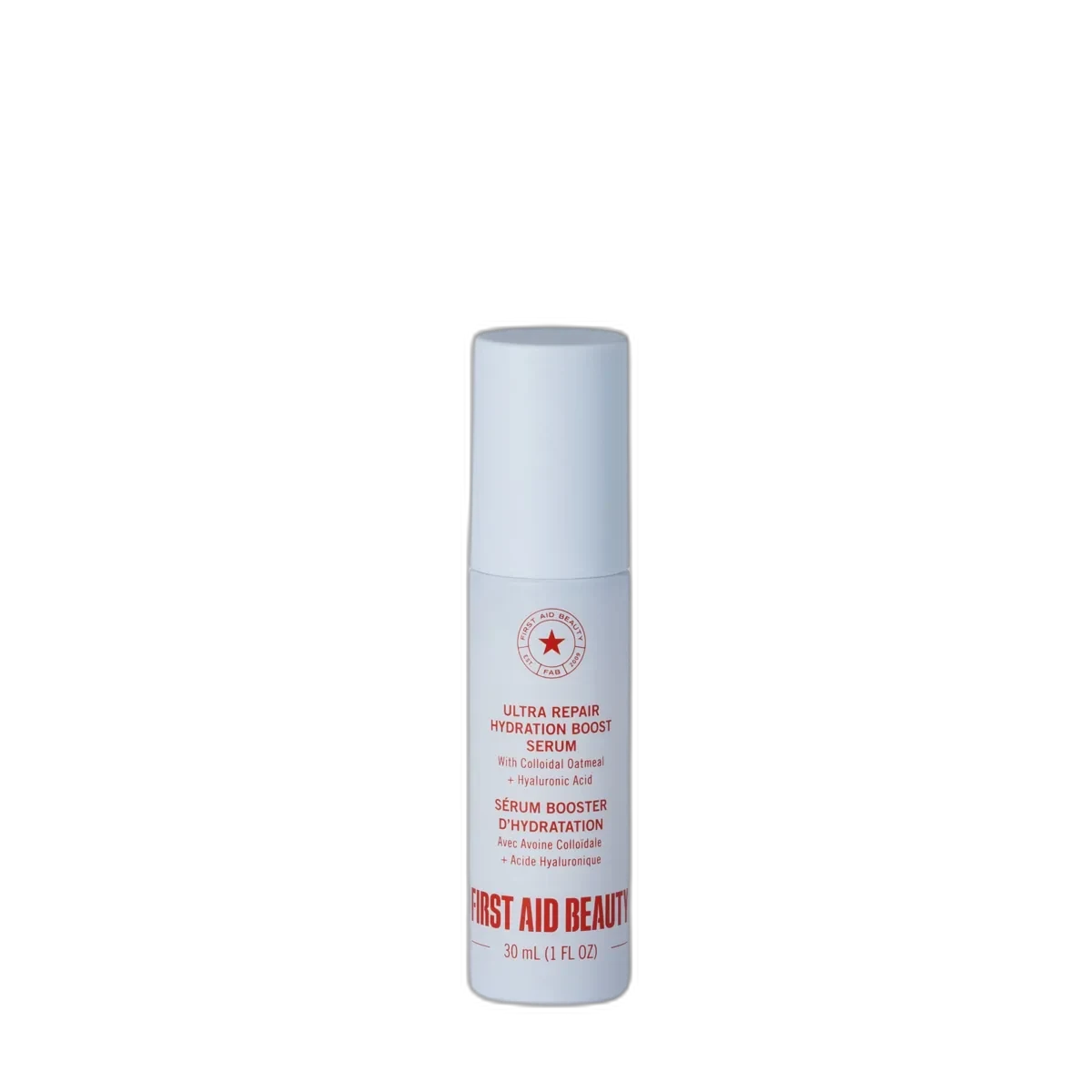
Ultra Repair Hydrating Serum
Sensitive Skin Hydration Booster
 Verified reviewer
Pros & cons.
- +Triple-humectant approach (HA, panthenol, sodium PCA) provides multi-mechanism hydration
- +Squalane prevents HA from backfiring in low-humidity environments
- +Colloidal oatmeal makes this suitable for eczema and rosacea-prone skin
- +Completely fragrance-free and silicone-free with no known irritants
- +Lightweight gel texture layers invisibly under any product without pilling
- +96% of study participants reported instant hydration after use
- −Premium pricing at ~$26 per ounce in a market flooded with affordable HA serums
- −Soluble collagen provides surface hydration only — not the structural benefits the name implies
- −Not vegan due to animal-derived collagen ingredient
- −Reformulated from original version, with some users preferring the earlier formula
- −May not provide enough moisture for very dry skin without a substantial moisturizer on top
The full review.
The hyaluronic acid serum market has a problem. About nine hundred options exist at any time, and most are functionally identical: hyaluronic acid in water with a preservative system and one or two marketing ingredients. Prices range from $7 to $200, but the difference between the cheapest and most expensive is often just the bottle weight and label font.
First Aid Beauty’s Ultra Repair Hydrating Serum enters this saturated category. It tries to distinguish itself not through higher HA concentrations or exotic molecular weights, but through a different formulation philosophy. The question is whether that philosophy justifies the premium price or if it is just clever positioning for a commodity ingredient.
The formula uses a triple-humectant approach. Sodium hyaluronate provides the expected HA moisture-binding capacity. Panthenol — vitamin B5 — adds a second hydration pathway, attracting water and supporting barrier healing. Sodium PCA acts as a third mechanism as a component of the skin’s Natural Moisturizing Factor, providing physiologically native hydration the skin recognizes and uses efficiently. Three humectants and three different mechanisms work simultaneously. This formulation argument explains why this serum should outperform a single-ingredient HA product, and it is persuasive on paper.
Squalane is in the formula as a lightweight emollient, which addresses a limitation of many HA serums. In low-humidity environments, hyaluronic acid can draw moisture from deeper skin layers instead of the atmosphere, which can worsen dehydration. Squalane creates a light occlusive layer that seals in the moisture the humectants attract, preventing this drying effect. This formulation detail shows an understanding of how HA behaves in real-world conditions.
Colloidal oatmeal brings the Ultra Repair line’s signature anti-inflammatory activity to the serum. Its avenanthramides provide soothing that makes this serum appropriate for eczema-prone and rosacea-reactive skin — groups that often struggle to find hydrating products that do not trigger flares. The FAB antioxidant complex of feverfew, green tea, and licorice root adds familiar calming and protective benefits.
The texture is unremarkable in a good way. It is a lightweight, clear water-gel that absorbs in seconds without tackiness, film, or residue. It disappears under moisturizer. It causes no pilling under sunscreen. Under makeup, it creates a smooth, hydrated canvas. The product works invisibly, which is what a hydrating serum should do.
One ingredient invites scrutiny: soluble collagen. Large collagen molecules cannot penetrate the stratum corneum to reach the dermis. Topical collagen works as a surface humectant and film-forming agent — useful for temporary smoothing, but not for the anti-aging collagen replacement the name implies. It is not a harmful inclusion, but it is not the powerhouse its presence on the ingredient list suggests to uninformed consumers.
The reformulation history matters. Long-time users note the current version differs from the original formula, which included palmitoyl tripeptide-5. Some prefer the earlier iteration. Formulas evolve for regulatory, supply chain, or cost reasons, but this means older reviews may not reflect the current product experience.
Value is the toughest challenge for this serum. At approximately $44 for 1.7 ounces, it sits in the upper tier of the HA serum market. The multi-humectant approach and colloidal oatmeal provide formulation advantages over cheaper alternatives, but the price gap is significant. A $10 HA serum and a $44 one both hydrate skin. The question is whether the extra soothing, barrier support, and formulation sophistication are worth the extra $34 for your skin.
For sensitive and condition-prone skin, the answer is likely yes. For healthy skin that only wants hydration, the value is harder to defend. This serum earns its premium through specificity — it is not the best HA serum for everyone, but it may be the best HA serum for people who need gentleness most.
Ingredient analysis.
Full INCI list
Aqua/Water/Eau, Glycerin, Glycereth-26, Squalane, Sodium Hyaluronate, Soluble Collagen, Colloidal Oatmeal, Panthenol, Chrysanthemum Parthenium (Feverfew) Extract, Camellia Sinensis Leaf Extract, Glycyrrhiza Glabra (Licorice) Root Extract, Allantoin, Ethylhexylglycerin, Sorbitan Oleate, Acrylates/C10-30 Alkyl Acrylate Crosspolymer, Sodium PCA, Phenoxyethanol, Sodium Hydroxide, Potassium Sorbate, Sodium Benzoate, Tetrasodium EDTA
Skin match.
The science.
The Science
The Ultra Repair Hydrating Serum employs a multi-humectant strategy grounded in complementary hydration mechanisms. Sodium hyaluronate, the salt form of hyaluronic acid, binds water through its glycosaminoglycan structure, holding up to 1,000 times its weight in water. Its lower molecular weight compared to pure hyaluronic acid allows for better penetration into the stratum corneum.
Panthenol (provitamin B5) converts to pantothenic acid in the skin, where it serves as a precursor to coenzyme A — essential for lipid synthesis and barrier repair. Research published in the Journal of Cosmetic Dermatology has demonstrated that topical panthenol improves stratum corneum hydration, reduces transepidermal water loss, and accelerates epithelial wound healing.
Sodium PCA (sodium salt of pyrrolidone carboxylic acid) is the most abundant amino acid derivative in the skin's Natural Moisturizing Factor (NMF). Supplementing NMF components topically has been shown to improve hydration in skin with depleted natural moisture factors — a common condition in dry, aged, or barrier-compromised skin.
The inclusion of squalane addresses a well-documented limitation of humectant-only formulations. In environments with relative humidity below 70%, hyaluronic acid can draw water from the viable epidermis rather than the atmosphere, potentially increasing transepidermal water loss. Squalane's lightweight occlusive properties create a moisture-retention layer that mitigates this effect.
Colloidal oatmeal provides anti-inflammatory activity through its avenanthramide content, which has been shown to inhibit NF-kB activation and reduce IL-8 and TNF-alpha production. This makes the serum not just a hydrating product but an active soothing treatment for inflamed or condition-prone skin.
Dermatologist Perspective
Dermatologists frequently recommend hyaluronic acid serums as part of sensitive skin routines, and this formula's multi-humectant approach aligns with current dermatological understanding of optimal hydration strategies. Board-certified dermatologists note that combining humectants with different mechanisms of action — HA for water binding, panthenol for barrier support, sodium PCA for NMF supplementation — provides more robust hydration than single-ingredient formulations. The inclusion of squalane as a lightweight occlusive addresses the practical limitation of humectant-only products in low-humidity environments. Dermatologists treating eczema and rosacea patients often seek hydrating serums that avoid common irritants like fragrance and alcohol, making this formula a suitable option for condition-management regimens.
Where it fits in your routine.
Apply 2-3 drops to clean, slightly damp skin morning and evening. Press and pat it into the face, neck, and eye area. Follow immediately with a moisturizer to seal in hydration. Apply to damp skin for best results; the hyaluronic acid needs water to bind. Layer it under retinol, vitamin C, or other treatment products.
At about $44 for 1.7 ounces (~$26/oz), this serum costs much more than basic HA serums under $15. The price pays for a multi-humectant formula with colloidal oatmeal soothing, squalane moisture sealing, and FAB's antioxidant complex — real formulation advantages over bare-bones alternatives. A smaller 1 oz size at $39 exists but has less value per ounce. For sensitive and condition-prone skin types that reacted to cheaper HA serums, the gentle, fragrance-free formulation justifies the price by avoiding the trial-and-error cost of testing less expensive options. For healthy skin seeking basic hydration, more affordable alternatives deliver comparable core hydration.
This serum works for sensitive, dehydrated, eczema-prone, or rosacea-reactive skin that needs hydration without irritation or flares. It suits people using retinol or other active treatments who need extra hydration, and people in dry climates where basic HA serums fail.
Shoppers on a budget get effective HA hydration for less if their skin is not sensitive. Those wanting a vegan product should note the animal-derived collagen. Oily skin types who find serums unnecessary or prefer gel-cream moisturizers may skip this step.
Product details.
This lightweight, water-gel consistency feels weightless on the skin. It is clear to slightly translucent and has a smooth, non-sticky finish that absorbs in seconds.
Fragrance-free with no detectable scent. Completely neutral.
White and red FAB branded glass dropper bottle. The dropper allows precise application and keeps the product hygienic.
Immediate dewy plumping effect on first use. Skin looks hydrated and feels soft minutes after application. No tingling, stinging, or adjustment period. The lightweight texture disappears, leaving skin prepped for the next step.
6-8 weeks with twice-daily facial use using 2-3 drops per application
12 months
All Year
The backstory.
The Ultra Repair Hydrating Serum extended FAB's flagship Ultra Repair line into the serum category, recognizing that many sensitive-skin users wanted a lightweight hydration step to complement the richer Ultra Repair Cream. The product has been reformulated at least once, with the current version emphasizing squalane and sodium hyaluronate for improved texture and efficacy.
About First Aid Beauty
Established Brand (5–20 years)Lilli Gordon founded First Aid Beauty in 2009 to focus on sensitive-skin-safe formulations. Procter & Gamble acquired the brand in 2018. First Aid Beauty is dermatologist tested and sells clean, effective products through Sephora and Ulta.
Common myths.
Hyaluronic acid serums pull moisture from deeper skin layers, which dehydrates skin in dry climates.
This formula uses squalane as an emollient layer to seal in moisture from the HA. This prevents the reverse-osmosis effect that bare HA causes in low-humidity environments. Panthenol and sodium PCA add moisture-binding pathways that depend less on humidity.
Topical collagen replaces collagen lost to aging.
The soluble collagen in this serum is too large to penetrate the skin or integrate into the dermal matrix. It works as a surface humectant and film-forming agent. This provides temporary smoothing and hydration instead of structural collagen replacement.
FAQ.
Is this serum good for sensitive skin?
Yes — the colloidal oatmeal and anti-inflammatory botanical complex make this one of the gentlest HA serums available. It is fragrance-free, silicone-free, and targets sensitive, eczema, and rosacea-prone skin.
Can I use this serum with retinol?
Apply the hydrating serum after your retinol treatment. This buffers moisture to reduce retinol-induced dryness and flaking. The panthenol and colloidal oatmeal soothe retinol irritation, and the HA restores hydration.
Do I still need a moisturizer after this serum?
Yes. This serum provides humectant hydration by attracting and binding water. A moisturizer on top creates an occlusive seal to stop moisture evaporation. For best results, follow with the Ultra Repair Cream or another moisturizer for your skin type.
Is the soluble collagen in this serum effective?
Soluble collagen works as a surface humectant and film-forming agent to provide temporary smoothing and hydration. It lacks the depth to replace structural collagen lost to aging. The sodium hyaluronate, panthenol, and sodium PCA do the real hydrating work in this formula.
Why is this serum not vegan?
The formula's soluble collagen comes from animals, so the product lacks vegan certification. Users wanting a fully vegan hydrating serum should choose formulas without collagen or those using plant-based collagen alternatives.
What the community says.
"Lightweight and non-sticky — absorbs instantly without residue"
"Layers perfectly under any moisturizer or makeup"
"Provides noticeable plumping effect on dehydrated skin"
"Gentle enough for sensitive, eczema, and rosacea-prone skin"
"Fragrance-free with no irritation even on reactive skin"
"High price per ounce compared to competing HA serums"
"Some users found the reformulated version less effective than the original"
"Contains soluble collagen which is too large to penetrate skin meaningfully"
"May not provide enough moisture for very dry skin without a cream on top"
"Small bottle runs out quickly with twice-daily use"
Featured in.
People also looked at.