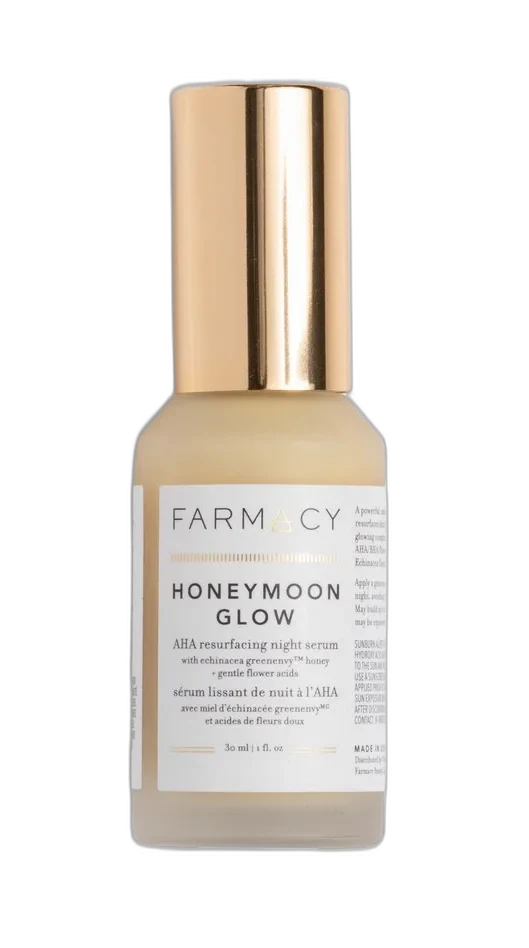
Honeymoon Glow AHA Resurfacing Night Serum
Multi-Acid Powerhouse
 Verified reviewer
Pros & cons.
- +Multi-tiered 14% acid blend provides comprehensive exfoliation without single-acid harshness
- +Honey-propolis-royal jelly complex actively soothes and buffers the acid irritation
- +Dual-weight hyaluronic acid prevents the dehydration common in leave-on acid products
- +Visible overnight glow and improved texture within the first two weeks of use
- +Effective at reducing hyperpigmentation and dark spots with consistent six to eight week use
- +Silicone-free and paraben-free formula with Clean at Sephora certification
- +Elegant opaque glass packaging protects light-sensitive AHA ingredients
- −Premium price of $58 for only one ounce of product with no budget-friendly alternative
- −Divisive earthy scent from the bee-derived and botanical ingredients
- −Can cause purging and stinging during the first two to four weeks of use
- −Not vegan due to honey, propolis, and royal jelly extracts
- −Now discontinued and replaced by the reformulated Honey Glow serum
Ingredient analysis.
Full INCI list · pH 3.5
Water, Lactic Acid, Propanediol, Jojoba Esters, Glycolic Acid, Potassium Hydroxide, Salix Alba (Willow) Bark Extract, Carthamus Tinctorius (Safflower) Oleosomes, Vitis Vinifera (Grape) Seed Oil, Hibiscus Sabdariffa Flower Extract, Citric Acid, Honey Extract, Echinacea Purpurea Root Extract, Propolis Extract, Royal Jelly Extract, Hydrolyzed Sodium Hyaluronate, Hydrolyzed Hyaluronic Acid, Curcuma Longa (Turmeric) Root Extract, Argania Spinosa Kernel Oil, Zingiber Officinale (Ginger) Root Extract, Amaranthus Caudatus Seed Oil, Limnanthes Alba (Meadowfoam) Seed Oil, Vaccinium Myrtillus Fruit/Leaf Extract, Saccharum Officinarum (Sugarcane) Extract, Citrus Aurantium Dulcis (Orange) Fruit Extract, Citrus Limon (Lemon) Fruit Extract, Acer Saccharum (Sugar Maple) Extract, Melia Azadirachta Leaf Extract, Helianthus Annuus (Sunflower) Seed Oil, Melia Azadirachta Flower Extract, Salvia Hispanica Seed Oil, Cetearyl Alcohol, Glycerin, Arachidyl Alcohol, Sclerotium Gum, Coco-Glucoside, Polyacrylate Crosspolymer-6, Behenyl Alcohol, Arachidyl Glucoside, Sodium Benzoate, Tocopherol, Potassium Sorbate, Corallina Officinalis Extract, Polyglyceryl-10 Stearate, Gluconolactone, 1,2-Hexanediol, Ocimum Basilicum (Basil) Flower/Leaf Extract, Ocimum Sanctum Leaf Extract, T-Butyl Alcohol, Glucose, Calcium Gluconate, Citral
Skin match.
The science.
The Science
Honeymoon Glow works using two of the most studied AHAs in dermatology. Lactic acid, the primary exfoliant, increases ceramide production in the stratum corneum and promotes cell turnover in multiple studies. This dual action exfoliates without proportional barrier compromise. A 1996 study in the Journal of the American Academy of Dermatology shows lactic acid at 5-12% concentrations improves skin texture and firmness and reduces fine lines over 22 weeks. Glycolic acid, the smaller-molecule complement, penetrates deeper due to its lower molecular weight and has extensive clinical data for photodamage and hyperpigmentation.
Combining AHA and BHA in one formula is pharmacologically interesting. AHAs are water-soluble and dissolve bonds between corneocytes on the skin surface. BHA (from willow bark's natural salicin, which converts to salicylic acid on skin) is oil-soluble and penetrates the pore lining. This dual-solubility approach addresses surface texture and pore-level congestion simultaneously, providing more comprehensive exfoliation than either acid type alone.
The soothing complex has scientific merit beyond marketing. A 2013 study in Evidence-Based Complementary and Alternative Medicine documented the anti-inflammatory, antimicrobial, and wound-healing properties of propolis in dermatological applications. In this formula, propolis actively counteracts the inflammatory cascade that AHA exfoliation can trigger, reducing the redness and irritation that limit patient compliance with acid products.
The dual-weight hyaluronic acid system addresses a limitation of chemical exfoliants: they can temporarily compromise the barrier's water-retention capacity. By including both hydrolyzed sodium hyaluronate (smaller fragments that penetrate deeper) and hydrolyzed hyaluronic acid (which works at the surface), the formula replenishes hydration at multiple levels of the epidermis and mitigates the transepidermal water loss that exfoliation can exacerbate.
References
- Effect of olive and sunflower seed oil on the adult skin barrier: implications for neonatal skin care — Pediatric Dermatology (2013)
Dermatologist Perspective
Dermatologists often recommend multi-acid formulations for broad-spectrum exfoliation because the AHA and BHA combination addresses surface and pore-level concerns. Board-certified dermatologists note the lactic acid-forward approach in Honeymoon Glow is gentler than glycolic-dominant alternatives, making it a reasonable starting point for patients new to chemical exfoliation. The pH of 3.0-4.0 is within the effective range for AHA activity. Dermatologists advise daily broad-spectrum SPF when using any AHA product because these acids increase photosensitivity. The willow bark BHA content is gentler than synthetic salicylic acid, but dermatologists still recommend against use during pregnancy.
Where it fits in your routine.
Apply 2-3 pumps to clean, dry skin at night, avoiding the eye area. Let the serum absorb for 1-2 minutes before you apply moisturizer. Use 2-3 nights per week for the first two weeks, then increase frequency as tolerated. Do not use on the same evening as retinol, other AHAs/BHAs, or vitamin C serums. Always apply broad-spectrum SPF 30+ the next morning because AHAs increase photosensitivity.
At fifty-eight dollars per ounce, Honeymoon Glow is a premium over-the-counter acid serum. The multi-acid blend, soothing bee-derived complex, and dual-weight hyaluronic acid justify a higher price than single-acid formulations, but the per-ounce cost is high for nightly use. One bottle lasts two to three months, making the monthly cost nineteen to twenty-nine dollars. For a brand with P&G's resources, the price reflects farm-sourced ingredients and clean formulation standards rather than proprietary technology.
This multi-acid treatment works for dullness, uneven texture, mild hyperpigmentation, or clogged pores without stripping skin. It suits normal, combination, and oily skin types comfortable with a moderate adjustment period.
Avoid this acid concentration if you have sensitive, rosacea-prone, or eczema-affected skin. The BHA content makes this unsuitable during pregnancy. Honey, propolis, and royal jelly extracts mean vegans should skip this product. The multiple plant oils in this formula are not Malassezia-safe for those prone to fungal acne.
Product details.
This lightweight gel-serum has a slightly viscous consistency and spreads easily. It feels mildly tacky at first but absorbs within a few minutes to a smooth, non-sticky finish.
It has a faint honey aroma with earthy botanical undertones. The scent is subtle and fades fast. Some users find it polarizing, describing it as either pleasant honey or slightly unusual.
Thick opaque glass bottle has a white pump dispenser and gold cap. The opaque glass protects light-sensitive AHA ingredients. The pump dispenses controlled amounts and feels solid in the hand.
A mild tingling sensation occurs on first use and subsides within minutes; this is normal for a 14% acid blend at pH 3.0-4.0. Some users experience purging (small breakouts in congestion-prone areas) during the first 2-4 weeks as the acids speed up cell turnover. Use 2-3 nights per week to build tolerance.
2-3 months with nightly use, using 2-3 pumps per application
12 months
All Year
The backstory.
Launched in 2018 as Farmacy's answer to premium acid treatments, Honeymoon Glow was designed to deliver overnight radiance — hence the name — by combining lab-formulated acids with farm-sourced botanicals. It became one of the brand's best-selling products and helped propel Farmacy's growth toward its $350 million acquisition by Procter & Gamble in 2021. The product was discontinued in late 2023 and replaced by the Honey Glow 17% AHA + BHA formula.
About Farmacy
Established Brand (5–20 years)Farmacy was founded in 2015 by David Chung with a farm-to-face philosophy and acquired by Procter & Gamble in 2021 for approximately $350 million. The brand holds Clean at Sephora certification and Leaping Bunny cruelty-free status, with its Echinacea GreenEnvy being a proprietary ingredient grown on the brand's own farm.
Common myths.
Higher acid percentages always mean better results.
Honeymoon Glow's 14% blend works best at a pH of 3.0-4.0; pH matters more than raw percentage. The mix of lactic acid's larger molecular size and glycolic acid's deeper penetration provides broad-spectrum exfoliation that beats many single-acid products at higher concentrations.
AHA serums always cause dryness and irritation.
This formula counters that. The dual-weight hyaluronic acid replenishes moisture and the honey-propolis complex soothes inflammation. This makes it tolerable for most non-sensitive skin types even at 14% total acids.
FAQ.
What percentage of AHA is in Farmacy Honeymoon Glow?
Honeymoon Glow has a 14% total acid blend: 10% AHAs (mostly lactic acid and glycolic acid), 1% natural BHA from willow bark extract, and 3% gentle flower-derived acids from hibiscus and fruit extracts. The formula uses a pH of 3.0-4.0 for optimal acid efficacy.
Can I use Farmacy Honeymoon Glow every night?
Use the 14% acid blend 2-3 nights per week, then increase to nightly use as your skin adjusts. This concentration causes irritation if used too fast. Always follow with a moisturizer and wear SPF the next morning because AHAs increase photosensitivity.
Is Farmacy Honeymoon Glow safe during pregnancy?
No — dermatologists generally advise against BHA (willow bark extract provides natural salicylic acid) and high-concentration AHAs during pregnancy. Ask your healthcare provider for pregnancy-safe exfoliation alternatives.
Why was Farmacy Honeymoon Glow discontinued?
Farmacy replaced Honeymoon Glow in late 2023 with the Honey Glow 17% AHA + BHA Resurfacing Acid Serum. This new version raises the acid concentration from 14% to 17% and cuts the ingredient count from 52 to 35. You can find the Honey Glow 17% AHA + BHA Resurfacing Acid Serum on Farmacy's website and at Sephora.
Does Farmacy Honeymoon Glow cause purging?
Yes, some users experience purging during the first 2-4 weeks as the AHAs accelerate cell turnover and bring existing congestion to the surface. This is normal and temporary. If irritation persists beyond 6 weeks or includes severe redness, discontinue use.
Can I use Farmacy Honeymoon Glow with retinol?
Do not use both on the same evening. Combining AHAs and retinol overwhelms the skin barrier and causes irritation. Alternate nights: use Honeymoon Glow on some evenings and retinol on others, using enough moisturizer each night.
Is Farmacy Honeymoon Glow vegan?
No — the formula uses honey extract, propolis extract, and royal jelly extract, which are all bee-derived. The product is cruelty-free (Leaping Bunny certified) but not vegan.
What the community says.
"Delivers visible overnight glow and smoother skin texture by morning"
"Effective at reducing congestion, clogged pores, and blackheads over time"
"More gentle than expected for a 14% acid concentration"
"Honey and hyaluronic acid provide hydration alongside the exfoliation"
"Elegant glass bottle packaging with functional pump dispenser"
"Strong alternative to more expensive acid serums at a lower price point"
"Divisive scent that some describe as unpleasant or earthy"
"Can cause initial purging with breakouts during the first two to four weeks"
"Stinging and redness on sensitive skin especially during first applications"
"Premium price at $58 for only one ounce of product"
"Can cause flaking the next morning if not followed with adequate moisturizer"
People also looked at.