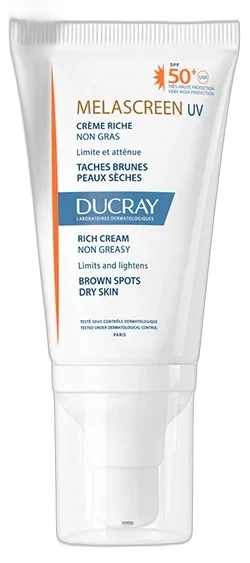
Melascreen UV Rich Cream SPF 50+
Melasma Specialist SPF
 Verified reviewer
Pros & cons.
- +Four-filter European UV system prioritizes deep UVA coverage for melasma
- +Nonapeptide-1 actively supports pigmentation control beyond basic SPF
- +Ferulic acid and vitamin E provide layered antioxidant backup
- +Minimal white cast thanks to filter-based (not mineral) approach
- +Rich cushiony texture works well on dry and mature skin
- +Doesn't pill under makeup if given time to absorb
- +Backed by Pierre Fabre's dermatology research heritage
- +Pregnancy safe and widely tolerated by sensitive skin
- −Small 40ml tube finishes in 6-8 weeks at proper dose
- −Light fragrance may bother the most reactive skin
- −Too rich for oily skin types in warm weather
- −Price per ml is higher than drugstore alternatives
- −Needs 2-3 minutes to settle before makeup application
The full review.
There are a lot of sunscreens marketed for dark spots, and most of them are just a standard SPF 50 with a sticker slapped on the front. Ducray Melascreen UV Rich is one of the few that actually deserves the category name, and the reason comes down to which UV filters are inside the tube. Melasma and post-inflammatory hyperpigmentation aren’t driven by the same wavelengths that cause sunburn — the real culprit is long-wave UVA and, increasingly in the research, visible light. A drugstore SPF 50 can meet the UVB number easily while leaving the UVA side half-protected. Ducray built this formula around Tinosorb S, Tinosorb M, Uvinul A Plus, and Uvinul T 150 — a quartet of modern European filters specifically chosen for deep UVA photostability. That’s the whole reason this product exists, and it’s the reason dermatologists in Europe hand it to melasma patients when the over-the-counter American SPF shelf lets them down.
The filter system alone would make this a strong recommendation, but Ducray layered in two more actives that matter for pigmentation-prone skin. The first is Nonapeptide-1, a peptide that interferes with the alpha-MSH signaling pathway — the molecular conversation that tells melanocytes to make more pigment. The second is ferulic acid, a well-studied antioxidant that neutralizes the free radicals generated by the small percentage of UV and visible light that always slips past even the best sunscreen. Together they create a layered defense: filters block the trigger, ferulic mops up the oxidative byproducts, and the peptide quietly nudges the pigmentation pathway back toward baseline. It’s not a replacement for tranexamic acid or azelaic acid or whatever else you’re using at night, but it’s meaningful sun-adjacent support.
Texture-wise, this is firmly in the ‘Rich’ camp, as the name promises. It comes out of the tube as a cushiony white cream that needs about thirty seconds of massage to absorb and maybe another minute or two to fully settle. Dry and normal skin will love it. Oily skin in July will not. The finish lands somewhere between satin and matte — not glowing, not greasy, just comfortable. There’s a faint pharmacy-style fragrance on application that disappears quickly; sensitive-skin users who are fragrance-phobic should know it’s there, but it’s far from the perfumed white cream you’d find on a department store counter. The white cast is minimal on most skin tones thanks to the filter-based (rather than mineral-based) approach, though like any high-filter-load SPF it can leave a trace of residue on very deep skin tones in harsh light.
Where the formula earns its price is consistency of wear. A lot of ‘prescription-grade’ European sunscreens feel great for an hour and then start to slide under makeup by lunch. Melascreen Rich holds its place reasonably well and doesn’t pill if you give it the 2-3 minutes it wants before foundation. Reapplication over makeup is the usual sunscreen struggle — a powder SPF or mist is your friend here.
The honest limitations: the tube is 40ml, which is on the small side for an SPF in this price bracket. If you’re applying the proper two-finger-length dose every morning (and you should be, because an underapplied SPF 50 is an SPF 20), you’ll finish this in 6-8 weeks. That works out to a non-trivial monthly sunscreen budget, especially if you’re also paying for the rest of a melasma routine. The fragrance, mild as it is, also keeps it off the list for the most reactive skin.
But if you’re actively treating hyperpigmentation — and especially if you’ve been pouring money into serums only to watch your spots flare every summer — this is where a lot of your protection budget should go. The nighttime treatment does less than you think. The morning sunscreen does more than you think. And a sunscreen built around the actual wavelengths driving your pigmentation is worth paying for. Ducray has been doing this since the 1930s, and Melascreen is what that kind of institutional dermatology knowledge looks like when it ends up in a tube.
Ingredient analysis.
Full INCI list
Aqua, Ethylhexyl Salicylate, C12-15 Alkyl Benzoate, Butyl Methoxydibenzoylmethane, Bis-Ethylhexyloxyphenol Methoxyphenyl Triazine, Diethylamino Hydroxybenzoyl Hexyl Benzoate, Ethylhexyl Triazone, Glycerin, Cyclopentasiloxane, Methylene Bis-Benzotriazolyl Tetramethylbutylphenol, Propylene Glycol, Cetearyl Alcohol, Cetyl Alcohol, PEG-100 Stearate, Glyceryl Stearate, Phenoxyethanol, Tocopherol, Nonapeptide-1, Ferulic Acid, Xanthan Gum, Disodium EDTA, Parfum
Skin match.
The science.
The Science
The core evidence behind this product rests on photoprotection research into long-wave UVA and the specific filters in the formula. Tinosorb S (Bis-Ethylhexyloxyphenol Methoxyphenyl Triazine) and Tinosorb M (Methylene Bis-Benzotriazolyl Tetramethylbutylphenol) are photostable broad-spectrum filters with published absorption spectra extending well into the UVA1 range (340-400nm), which is the wavelength band most implicated in melasma pathogenesis. Uvinul A Plus (Diethylamino Hydroxybenzoyl Hexyl Benzoate) is a dedicated UVA filter with peak absorption near 354nm. Ethylhexyl Triazone (Uvinul T 150) contributes strong UVB coverage to the matrix. Published photobiology research consistently identifies UVA1 and visible light as dominant drivers of melanogenesis in melasma patients, and clinical guidelines for melasma management from groups like the Global Melasma Expert Panel specifically recommend sunscreens with high UVA protection factors rather than high SPF numbers alone. On the active side, ferulic acid has well-documented antioxidant activity and has been shown in published work to stabilize vitamin C and vitamin E against oxidative degradation while providing independent free-radical scavenging. Nonapeptide-1 is a synthetic peptide studied for its ability to bind to the melanocortin-1 receptor and modulate alpha-MSH signaling; the evidence base is more limited than for tranexamic acid or azelaic acid, and clinical data is primarily from smaller in-vitro and vendor-led studies, which is why we classify it as 'promising' rather than 'well-established.' The formulation philosophy — heavy UVA load plus antioxidant and pathway support — aligns with current dermatological thinking on melasma management.
Dermatologist Perspective
Dermatologists who specialize in pigmentation disorders frequently recommend European-filter sunscreens for melasma patients because the UVA protection factor is typically higher than American-market SPFs, which matters enormously for a condition driven largely by long-wave UVA and visible light. Products in the Ducray Melascreen range are commonly suggested alongside tranexamic acid, azelaic acid, or hydroquinone treatments in European clinical practice. Board-certified dermatologists note that photoprotection is the single most important component of any melasma protocol — the active treatments do little without aggressive daily sun protection, and the choice of sunscreen is where many patients unknowingly sabotage their progress. The Rich formulation is typically suggested for drier, more mature skin or winter use, with the Light version offered for oilier skin or humid climates. Dermatologists also emphasize that tinted versions provide additional iron oxide protection against visible light, which this untinted formula does not address.
Guidance
Where it fits in your routine.
Apply this as the final step of your morning routine, after serums and moisturizer. Use about two finger-lengths (roughly 1/4 teaspoon) for your face and neck — underapplication is why most people miss the labelled SPF. Let it settle for 2-3 minutes before applying makeup to avoid pilling. Reapply every two hours during prolonged sun exposure, or after swimming or heavy sweating. Use daily year-round to manage melasma, even on cloudy days or indoors near windows, because UVA penetrates glass. For best results, pair with tranexamic acid, azelaic acid, or another pigmentation-targeted treatment in the evening.
At about $32 for 40ml, Melascreen UV Rich is an upper-mid tier pharmacy sunscreen, priced below true luxury SPFs. The per-ml price exceeds drugstore options, but the filter system is more sophisticated than American drugstore versions, and the pigmentation-targeted formulation is rare at any price. For those managing melasma or persistent hyperpigmentation, the premium is worth it — daily sunscreen is the highest-leverage product in a pigmentation routine, and skimping undermines other steps. For general daily sun protection without specific pigmentation concerns, cheaper broad-spectrum options from La Roche-Posay or Bioderma provide comparable base protection for less money. Other sizes are not widely available in this specific formula; the 40ml tube is the standard.
Use this if you manage melasma, post-inflammatory hyperpigmentation, or persistent sun-induced dark spots, especially with dry, normal, or mature skin. It works as a daily SPF for people in high-UV climates who want UVA coverage without a luxury price tag.
Oily or acne-prone skin in warm weather finds the thick texture too heavy — use Melascreen UV Light instead. People with severe fragrance sensitivity should use an unscented alternative, and those on a strict budget can get basic sun protection from cheaper pharmacy options.
Product details.
Thick, cushiony cream that feels like a moisturizing treatment rather than a typical sunscreen
Light, clean pharmacy-style fragrance
White and orange squeeze tube with flip cap
This SPF cream is thicker than average and takes about a minute to settle. First-time users often see a faint residue that disappears after one or two minutes of absorption. Most skin types feel no stinging or tingling; a very mild fragrance is detectable on application but fades quickly.
Use the recommended two-finger dose on your face and neck daily for about 6-8 weeks.
12 months
All Year
The backstory.
Developed by Ducray's dermatological lab as part of the Melascreen range, which began as a targeted depigmenting routine for patients recovering from melasma and post-inflammatory hyperpigmentation. The Rich version was created specifically for drier skin types that needed more emollient support alongside the high filter load.
About Ducray
Legacy Brand (20+ years)Ducray is a French pharmacy brand founded in 1930 and owned by the Pierre Fabre dermatological group. It has been distributed through European pharmacies for decades and its products are frequently recommended by dermatologists for pigmentation disorders, with formulations developed alongside the group's dermatological research laboratories.
Common myths.
Any SPF 50 is enough to prevent melasma flare-ups
UVA and visible light drive melasma, not UVB. This formula uses deep UVA filters like Tinosorb S and Uvinul A Plus. Many drugstore SPF 50s hit the UVB number but offer less UVA coverage.
Peptides in a sunscreen do nothing because SPF products sit on top of skin.
Nonapeptide-1 uses an aqueous-compatible phase to penetrate with other actives during 8+ hours of wear. Its effect compounds with photoprotection instead of replacing it.
FAQ.
Is Ducray Melascreen UV Rich SPF 50 good for melasma?
Yes — it targets pigmentation-prone skin. The four-filter system focuses on UVA coverage (the main melasma driver), while Nonapeptide-1 and ferulic acid help control pigmentation alongside basic sun protection.
Does Melascreen Rich leave a white cast?
The formula uses filters instead of minerals, so most skin tones see minimal white cast. A light residue disappears 1-2 minutes after application.
Can I use this if I have oily skin?
The Rich version is heavy. Oily or combination skin in warm weather may prefer Ducray's Melascreen UV Light Cream. Rich works best on dry, dehydrated, or mature skin that needs extra emollience.
Is Melascreen Rich pregnancy safe?
Yes. Nonapeptide-1 and ferulic acid have no pregnancy contraindications, and the filter system is on the European approved list. Consult your physician if you have a high-risk pregnancy.
How much should I apply?
Apply about two finger-lengths (1/4 teaspoon) to your face and neck for the labelled SPF 50+ protection. Most users underapply, which cuts the real-world SPF dramatically.
Can I use it under makeup?
Yes, but let it absorb for 2-3 minutes before applying foundation. The thick texture pills if you apply makeup too fast.
What the community says.
"Comfortable rich texture"
"No white cast on most skin tones"
"Genuinely helps maintain pigmentation progress"
"Broad-spectrum UVA coverage"
"Small 40ml tube for the price"
"Slight fragrance"
"Too rich for oily skin in humid weather"
Featured in.
People also looked at.