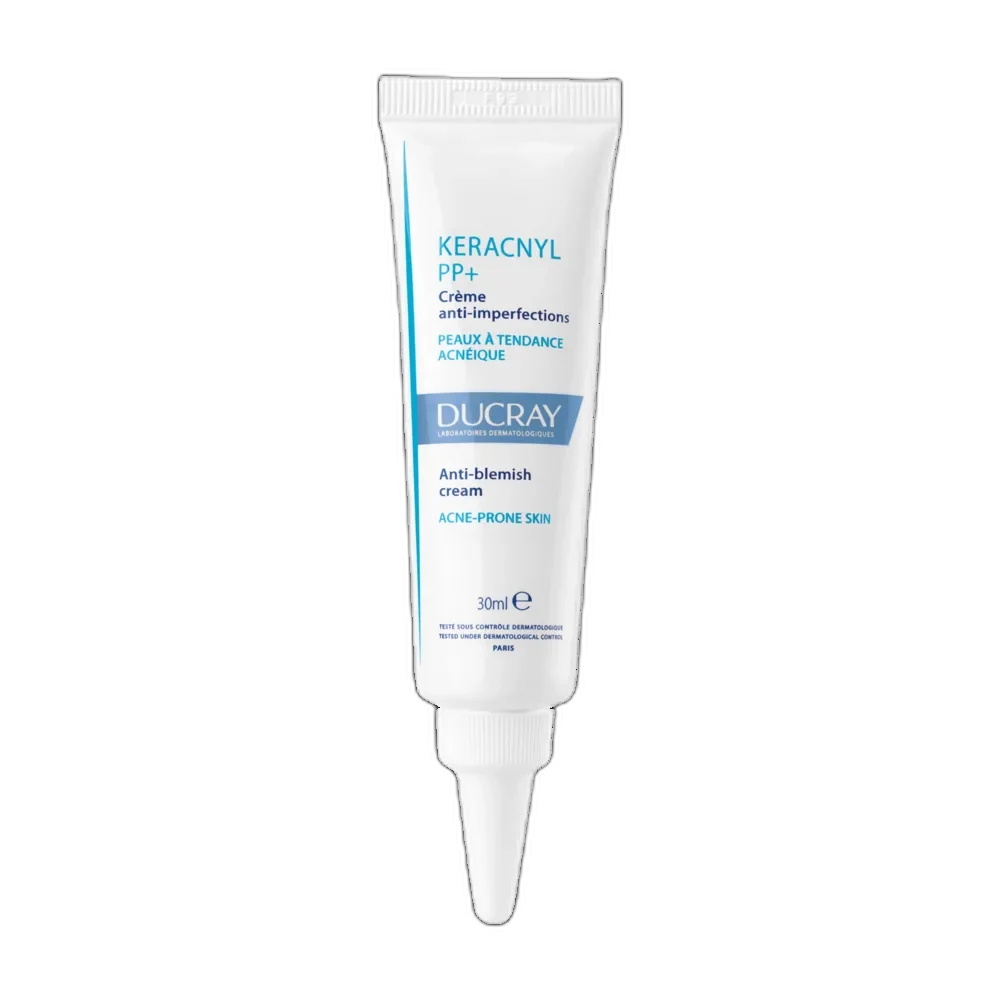
Keracnyl PP Anti-Blemish Soothing Cream
Acne Treatment Companion
 Verified reviewer
Pros & cons.
- +Niacinamide at a meaningful concentration for sebum and inflammation control
- +Patented Myrtacine extract targets C. acnes biofilm without adding irritation
- +Zinc PCA and bisabolol provide secondary anti-inflammatory support
- +Fragrance-free, oil-free, and fungal-acne safe — rare for acne-adjacent creams
- +Excellent retinoid and benzoyl peroxide buffering companion cream
- +Light matte texture that layers under sunscreen and makeup cleanly
- −Small 30 ml tube runs out quickly with twice-daily full-face use
- −Not a standalone acne treatment — needs to be paired with stronger actives
- −Limited US availability through mainstream retail channels
- −Effect is subtle rather than dramatic — wrong product for fast-visible-results seekers
- −Too light on its own for users with genuinely dry skin beyond acne irritation
The full review.
Acne treatments fail most often because patients stop using them, not because they lack efficacy. Dermatologists prescribing tretinoin, adapalene, and benzoyl peroxide see a recurring pattern: patients start well, hit the dryness and irritation typical of effective acne actives, assume the treatment is failing, and quit before the clearing phase begins. Clinical literature confirms this; adherence drops sharply at the three-to-six-week mark. The actives work, but patients do not stay on them.
Pierre Fabre built Keracnyl PP to solve this specific problem. Understanding this explains if this cream fits your routine. This is not a standalone acne treatment. It does not replace adapalene, benzoyl peroxide, or salicylic acid wash. Instead, it calms the barrier damage those treatments cause, reduces the irritation that leads to quitting, and provides mild anti-inflammatory and mild anti-bacterial support using ingredients that do not increase irritation. It is a companion product in the French pharmacy acne protocol, designed for use alongside stronger actives during adjustment and maintenance phases.
The formula uses niacinamide at a meaningful concentration—around 4% according to most published product information. Clinical research shows niacinamide at this level works for acne-prone skin: it reduces sebum production, calms blemish inflammation, supports barrier repair, and mildly brightens post-inflammatory hyperpigmentation. The Keracnyl line also uses its signature botanical: Myrtacine, a patented Myrtus communis (common myrtle) leaf extract. Pierre Fabre research shows Myrtacine has anti-biofilm activity against C. acnes. This matters because most acne research targets killing bacteria directly (like benzoyl peroxide) while leaving the protective biofilm intact. Disrupting that biofilm makes bacteria more vulnerable to other treatments. The formula also includes zinc PCA for sebum regulation and anti-inflammatory effects, bisabolol for chamomile-derived anti-inflammatory support, and allantoin as a gentle skin protectant. It targets the inflammatory and bacterial components of acne without adding to the drying damage from primary treatments.
The texture is a light cream-gel: white, smooth, and absorbs in about forty-five seconds without a film. It has a matte finish that layers under sunscreen and makeup, which helps acne-prone users who use coverage products over blemishes. It is fragrance-free, alcohol-free, oil-free, and fungal-acne safe. This avoids common irritation sources and works for the fungal folliculitis subset.
The calming effect is fast. On skin irritated by adapalene or benzoyl peroxide, this cream visibly reduces redness and softens tightness within the first application. Over the following week, the cumulative effect allows you to tolerate primary acne actives at higher frequency and strength. The real benefit is not that the cream clears acne, but that it helps you use the products that do. Published patient adherence data shows better outcomes when a tolerable buffering agent is part of a combined-treatment regimen.
The limitations are clear. The 30 ml tube is small; twice-daily full-face use lasts six to eight weeks. No larger size exists. If you expect a standalone acne product, the subtle mechanism will disappoint you. It is not fragranced, which some users find boring, but this is a feature for acne-prone skin. US availability is limited to specialty retailers and direct-to-consumer import, though Ductray’s US distribution is improving.
For patients struggling with irritation from primary acne treatments, adolescents or adults starting adapalene, or anyone with acne-prone and sensitive skin, this is an easy recommendation. It does what it was designed for—quiet, reliable, supportive—and lets your harder-working actives work.
Ingredient analysis.
Full INCI list · pH 5.5
Aqua, Glycerin, Caprylic/Capric Triglyceride, Cetearyl Alcohol, Niacinamide, Myrtus Communis Leaf Extract, Zinc PCA, Dimethicone, Glyceryl Stearate, PEG-100 Stearate, Bisabolol, Allantoin, Tocopherol, Carbomer, Sodium Hydroxide, Caprylyl Glycol, Phenoxyethanol, Disodium EDTA
Skin match.
The science.
The Science
Niacinamide has a robust evidence base for acne-prone skin. Research in the Journal of the American Academy of Dermatology and other clinical journals shows that 4-5% topical niacinamide reduces sebum excretion rates, calms inflammatory acne lesions, and supports barrier function over 4-12 week application windows. In comparative studies, niacinamide improves acne similarly to topical clindamycin in some patient populations but has better tolerability.
Myrtacine — Pierre Fabre's patented Myrtus communis leaf extract — has a more recent, interesting evidence base. Published work shows the extract has anti-biofilm activity against C. acnes. Biofilms protect acne-associated bacteria from the host immune response and topical anti-bacterial treatments. Disrupting the biofilm makes bacteria more vulnerable to benzoyl peroxide and antibiotic treatments, which can enable lower effective doses.
Zinc has decades of evidence in acne. Studies on topical and oral zinc for acne vulgaris show the topical form has mild anti-inflammatory and sebum-regulating effects. The PCA ester form used in this cream is a humectant-conjugated version that also aids skin hydration.
This formula targets the inflammatory, bacterial, and barrier-damage components of acne. It avoids mechanisms like keratolysis or comedone loosening that the retinoid or benzoyl peroxide in a patient's primary treatment already handles. This non-overlapping activity makes it an effective companion cream instead of another exfoliating active in an already-irritated routine.
Dermatologist Perspective
Dermatologists treating acne-prone patients often use soothing companion creams in comprehensive regimens, especially for patients showing early signs of intolerance to primary actives. European dermatologists commonly suggest this product as the daily moisturizer layer in adapalene and tretinoin protocols, or as a mid-day calming application for inflammatory flares. Board-certified dermatologists familiar with the Keracnyl line typically use it as the tolerability enabler in a two-to-three-product acne routine — the cream that keeps the patient on the primary treatment long enough for the primary treatment to work. Dermatologists also value that it is fragrance-free and fungal-acne safe, making it appropriate for patients managing the overlap between acne and Malassezia folliculitis.
Where it fits in your routine.
Apply to clean skin twice daily as the moisturizer/treatment layer in an acne routine. In the morning, apply after cleansing and before sunscreen. In the evening, apply to dry skin after your primary acne active (adapalene, tretinoin, benzoyl peroxide) — wait one to two minutes after the active before layering this cream on top. Use it on the full face or spot-apply to inflamed areas. It is safe during pregnancy. This is not a substitute for primary acne treatments; it supports tolerability and calms irritation while the primary actives clear acne.
At about $22 for 30 ml, the per-ounce price exceeds basic niacinamide creams, but the patented Myrtacine and clinical positioning justify it. It offers strong value against $50-80 luxury acne-adjacent products. Compared to $15-20 drugstore niacinamide creams, it carries a moderate premium for a more targeted formulation. The 30 ml tube size causes the main value hesitation; a 50 ml or 75 ml size would lower the per-use cost, but those options do not exist yet.
Patients on prescription retinoids (tretinoin, adapalene) who need barrier support during the adjustment phase, teens and adults starting benzoyl peroxide regimens, users with acne-prone sensitive skin, and anyone managing the overlap between acne and fungal folliculitis. Especially good for adherence-challenged patients who've quit acne treatments before.
This cream is a companion, not a standalone acne treatment. Skip this if you have dry skin needing a thicker moisturizer, or if you want immediate acne-clearing effects instead of subtle soothing support.
Product details.
This lightweight white cream-gel has a smooth slip. It absorbs in about 45 seconds and leaves a matte, non-greasy finish.
None
White squeeze tube with flip cap, 30 ml
Acne-irritated or post-treatment skin calms immediately without stinging. Skin reacts less after the first application and looks calmer within a few days. This is a soothing buffer, not an active exfoliant, so there is no purging or adjustment period.
2-3 months with twice-daily spot or full-face application
6 months
All Year
The backstory.
The Keracnyl PP variant was developed as Pierre Fabre's response to a common clinical problem: patients on aggressive acne treatments (adapalene, benzoyl peroxide, tretinoin) often abandon their regimen because of irritation and barrier damage. Rather than a standalone acne spot treatment, the PP version was built as a companion cream — calming, buffering, and mildly anti-bacterial — to help patients stay on their primary treatments long enough to see results.
About Ducray
Legacy Brand (20+ years)Ducray has formulated dermatological products under Pierre Fabre since 1930. The Keracnyl line has targeted acne-prone skin for over a decade. French dermatologists widely recommend the PP (Post-Procedure / Protective) variant to accompany aggressive acne treatments.
Common myths.
Soothing creams do not treat acne; acne requires actives that dry skin.
Dermatology literature shows barrier damage and irritation are top reasons patients stop using effective acne treatments. A soothing companion cream that keeps the barrier intact improves long-term outcomes by enabling adherence to the actives that clear acne.
FAQ.
How is Keracnyl PP different from Keracnyl PP+?
The PP+ variant is a newer, more active formulation with higher concentrations and extra actives. PP is the gentler original, making it a better daily moisturizer replacement for acne-prone skin. PP+ works for more active intervention. Many users start with PP during retinoid adjustment and switch to PP+ as their skin adapts.
Can I use Keracnyl PP with retinol or adapalene?
Yes — this is one of its main uses. Apply your retinoid to dry skin, wait one to two minutes, then apply Keracnyl PP on top to buffer irritation. Many users report that adding this cream improves their retinoid tolerance.
Will Keracnyl PP clear my acne on its own?
It helps mild occasional blemishes. For moderate-to-severe acne, it lacks sufficient strength alone; use it with an active treatment like adapalene, benzoyl peroxide, or prescription retinoids. It complements rather than replaces those treatments.
Is Keracnyl PP pregnancy safe?
Yes. It has no retinoids, salicylic acid, or essential oils. Standard OB/GYN guidelines consider the main actives — niacinamide, zinc PCA, myrtle extract, and bisabolol — pregnancy-safe.
Is Keracnyl PP fungal-acne safe?
Yes — this formula has no fatty alcohols, esters, or oils that feed Malassezia. It is one of the few pharmacy-brand acne-adjacent creams suitable for patients managing fungal folliculitis and conventional acne.
What the community says.
"calms redness from active acne treatments"
"lightweight on oily skin"
"works well layered under sunscreen"
"reduces barrier damage from retinoids"
"small 30 ml tube"
"not a standalone acne treatment"
"subtle rather than dramatic effect"
"hard to find outside European pharmacies"
People also looked at.