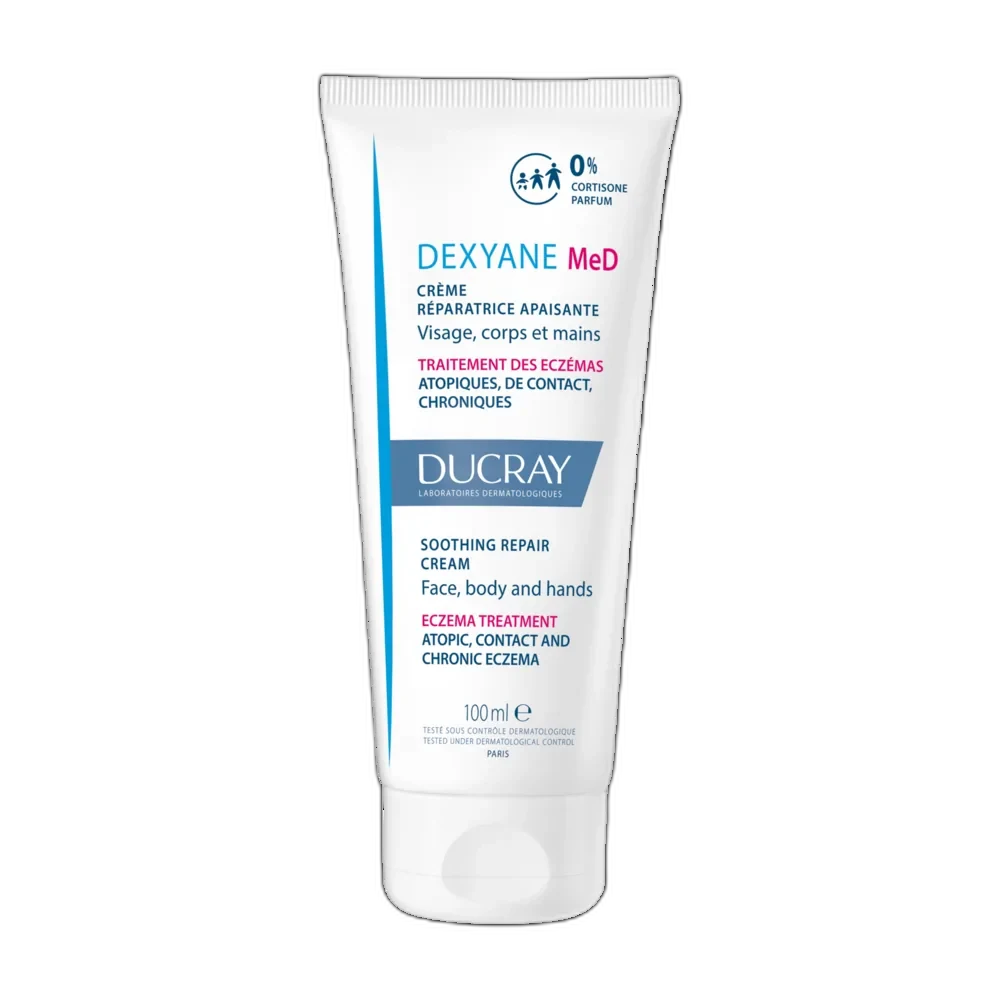
Dexyane MeD Soothing Repair Cream
Clinical Flare Fighter
 Verified reviewer
Pros & cons.
- +Tripterygium wilfordii extract gives it a genuinely unusual anti-inflammatory mechanism
- +Class IIa medical device registration in Europe backs the clinical positioning
- +Faster flare resolution than emollient-only creams in most users
- +Sucralfate and enoxolone target inflammation and physical protection simultaneously
- +Fragrance-free, alcohol-free, and tolerated on broken or weeping skin
- +Useful as a steroid-tapering tool between prescription courses
- −Limited US availability — often requires specialty import or Ducray's own site
- −Not recommended during pregnancy due to the Tripterygium wilfordii extract
- −Small 100 ml tube makes per-use cost high for body-wide flare coverage
- −Too rich for most oily or acne-prone skin as a daily facial moisturizer
- −Not a substitute for prescription treatment in severe eczema flares
The full review.
Most skincare reviews skip regulatory classifications, but Dexyane MeD requires a detour. In the European cosmetics market, Class IIa medical devices occupy a specific tier—products that pass clinical safety and efficacy reviews above cosmetics but below pharmaceuticals. This category exists for topical treatments that perform therapeutic work without being prescription drugs. Few over-the-counter skincare products reach this tier; those that do usually come from brands with the clinical infrastructure and regulatory capacity to complete the CE mark process. Ducray, part of Pierre Fabre’s dermatology umbrella since 1930, is one such brand, and Dexyane MeD is its flagship product.
Tripterygium wilfordii root extract—the thunder god vine—is the anchor ingredient. If you know it from traditional Chinese medicine, you might share a common concern: the safety warnings. Those warnings apply to oral doses of unpurified preparations in traditional medicine. The extract here is a standardized, purified topical fraction with published tolerance data in atopic dermatitis patients, registered under European medical device regulations. The active compound, celastrol, has growing anti-inflammatory research behind it; it modulates inflammatory cascades like NF-kB pathways relevant to eczema. Pierre Fabre’s research team chose it for Dexyane MeD to provide a therapeutic differentiator beyond what a ceramide or niacinamide cream offers.
The rest of the Dexyane architecture surrounds the Tripterygium extract: sucralfate for physical protection over compromised skin, enoxolone (licorice-derived glycyrrhetinic acid) for a secondary anti-inflammatory pathway, niacinamide for barrier signaling and ceramide synthesis, and shea butter as the emollient backbone. The vehicle is fragrance-free and alcohol-free. It works on broken or weeping skin, which matters because many eczema patients find most creams sting on application.
The product is a thick, white emulsion with a cushiony slip. It absorbs in sixty to ninety seconds and leaves a soft, matte-velvety finish instead of a greasy film. On a flare, users often feel a slight cooling sensation followed by less burning in inflamed skin. After two or three days of twice-daily use, redness visibly softens. By day seven to fourteen, a typical moderate flare often improves enough to stop daily application. Ducray’s published tolerance studies track this improvement through about four weeks of continuous use.
Dexyane MeD occupies a specific clinical niche. A generic ceramide cream is cheaper and works just as well for mild intermittent dryness. For severe eczema, no over-the-counter product replaces dermatologist-prescribed care. But for the middle group—patients with moderate flares who want to use fewer topical steroids and need something faster-acting than a pure emollient—this product fits that tier. It works well as a steroid-tapering tool: after a dermatologist stabilizes a flare with a short course of topical corticosteroid, switching to Dexyane MeD during the taper phase can extend remission without more steroid exposure.
The limitations are clear. US availability is poor; you must usually order from specialty pharmacy import sites or Ducray’s own US distribution, which is expanding but not in mainstream retailers. The 100 ml tube is smaller than the 200 ml standard Dexyane tube, and the larger size is harder to find. The price per ounce is higher than the standard Dexyane line, which the Tripterygium extract and medical device registration justify, but it costs more for frequent users. Pregnancy is a notable asterisk: because of the Tripterygium extract, Ducray advises pregnant and breastfeeding users consult a doctor before use. This is not a pregnancy-default option. Also, like the rest of the Dexyane line, it contains shea butter, so it is not fungal-acne safe and may feel heavy on oily facial skin.
For the right patient, this is one of the most differentiated eczema creams available. It is not a steroid, a placebo, or just another ceramide cream in French pharmacy packaging. It is an unusual formulation built around a botanical active with a credible evidence base, developed by a brand with the clinical research infrastructure to support it. If managing the itch-scratch cycle and acute flares is your priority, it earns a place in your routine.
Formula
Ingredient analysis.
Full INCI list · pH 5.5
Aqua, Glycerin, Caprylic/Capric Triglyceride, Butyrospermum Parkii (Shea) Butter, Cetearyl Alcohol, Dimethicone, Glyceryl Stearate, PEG-100 Stearate, Sucralfate, Niacinamide, Tripterygium Wilfordii Root Extract, Enoxolone, Bisabolol, Allantoin, Tocopherol, Ceteareth-20, Carbomer, Sodium Hydroxide, Caprylyl Glycol, Phenoxyethanol, Disodium EDTA
Skin match.
The science.
The Science
The Tripterygium wilfordii research is the most interesting part of this formula's evidence base. Studies in the Journal of Ethnopharmacology and Phytomedicine show celastrol and related Tripterygium compounds act as anti-inflammatory agents that modulate NF-kB signaling and reduce pro-inflammatory cytokine release. Ducray's clinical studies on Dexyane MeD, presented at European dermatology meetings, show measurable SCORAD (Scoring Atopic Dermatitis) index improvements over 28-day use in patients with mild-to-moderate atopic dermatitis, plus lower subjective itch scores.
The sucralfate evidence base is more established. Developed in the 1960s as an oral gastric ulcer protectant, topical sucralfate has been studied for wound healing, radiation-induced dermatitis, and atopic skin. Published work shows it forms a protective coating over compromised skin and supports re-epithelialization. Using it in a leave-on cream is unusual; it gives Dexyane MeD a physical protection layer that purely emollient creams lack.
Enoxolone — glycyrrhetinic acid from licorice root — has a separate anti-inflammatory evidence base. It inhibits 11-beta-hydroxysteroid dehydrogenase to potentiate the skin's own cortisol activity. This formula targets three different parts of the inflammatory cascade using these three actives, layered on a niacinamide-and-shea-butter repair base. This multi-pathway approach justifies the medical device classification and distinguishes it from single-mechanism emollient creams.
Dermatologist Perspective
Dermatologists in Europe, especially in France where Ducray has its strongest distribution, often include Dexyane MeD in atopic dermatitis protocols as a non-steroid adjunct during flare management and tapering. Board-certified dermatologists often recommend it for patients reducing topical steroid use, pediatric patients needing steroid sparing, and adults with chronic moderate atopic dermatitis who need more than a basic emollient. It works as a bridge product between prescription courses to extend remission without extending corticosteroid exposure. Dermatologists also value the medical device registration, which provides higher regulatory vetting than standard cosmetic products and increases confidence in the clinical claims.
Where it fits in your routine.
Apply a thick layer to flare-affected areas twice daily during active flares. Use it on the face, body, and (in European labeling) on children from three months old. It is safe to use alongside or between doses of prescription topical steroids — a common steroid-tapering tool once a flare stabilizes. Do not apply to broken, weeping, or infected skin that requires medical evaluation. Pregnant and breastfeeding users should consult a doctor before use because of the Tripterygium wilfordii extract. Apply until the flare fully resolves, then switch to a standard emollient for maintenance between flares.
At around $35 for 100 ml, this costs more than basic ceramide creams but less than most prescription alternatives. The Tripterygium wilfordii extract and the medical device registration justify the premium over standard Dexyane. For patients with frequent flares who would otherwise cycle through prescription steroid courses, reducing or tapering steroid use provides real clinical value. For patients with mild occasional dryness, a cheaper ceramide cream gives most benefits at a third of the price. A larger 400 ml pump version exists in some European markets and offers better per-unit value if you can source it.
Patients with moderate atopic dermatitis who want faster action than plain emollient creams, users tapering topical steroid use, and anyone with eczema between basic barrier-cream needs and prescription treatment. It works well as a steroid-tapering tool.
Pregnant and breastfeeding users (without medical guidance), people with mild occasional dryness who do not need medical-device-tier actives, those managing fungal folliculitis, and patients whose flares require prescription treatment first.
Product details.
Rich, creamy white emulsion with a cushiony slip — absorbs within 60-90 seconds
None
White squeeze tube with flip cap, 100 ml
Inflamed skin feels a slight cooling sensation upon application. Burning and stinging usually decrease after the first application, and redness typically softens by day 2-3. Most users feel no stinging on broken skin, though a small number report mild warmth initially.
3-5 weeks during an active flare with twice-daily application to affected areas
6 months
All Year
The backstory.
Dexyane MeD launched in 2015 as Ducray's response to a specific clinical gap: patients with moderate eczema who needed more than emollient support but weren't candidates for daily topical steroids. Pierre Fabre's dermatology researchers identified Tripterygium wilfordii as a botanical candidate with enough anti-inflammatory evidence to justify a medical-device-class product, and built the formula around it. The line is now a staple in French pharmacy atopic dermatitis protocols.
About Ducray
Legacy Brand (20+ years)Ducray has developed dermatological products under the Pierre Fabre umbrella since 1930. Dexyane MeD is a registered Class IIa medical device in Europe. This regulatory tier is higher than standard cosmetics and requires clinical safety and efficacy data. European dermatologists widely recommend the line for moderate-to-severe atopic dermatitis flares.
Common myths.
Tripterygium wilfordii is a dangerous traditional Chinese medicine ingredient.
Oral Tripterygium concerns involve systemic dosing in traditional medicine. This topical extract is a standardized, purified fraction registered under European medical device regulations and has published tolerance data in atopic patients.
FAQ.
How is Dexyane MeD different from regular Dexyane cream?
Dexyane MeD is a Class IIa medical device in Europe. This classification requires more rigorous clinical evaluation than standard cosmetics. Dexyane MeD contains Tripterygium wilfordii extract alongside the anti-itch actives in the standard Dexyane line. This makes Dexyane MeD better for acute flare treatment than daily maintenance.
Can Dexyane MeD replace prescription topical steroids?
For mild-to-moderate flares, many users find it reduces or stops daily topical steroid use. For moderate-to-severe flares, it works best alongside prescription treatment instead of replacing it — often used between steroid doses or during tapering.
Is Tripterygium wilfordii safe in a topical product?
Dexyane MeD uses a standardized, purified topical extract registered under European medical device regulations. Safety concerns about Tripterygium involve oral dosing in traditional medicine; the topical extract at cosmetic concentrations has published tolerance data in atopic patients.
Is Dexyane MeD safe during pregnancy?
Ducray advises pregnant and breastfeeding users to consult a doctor before using this product because it contains Tripterygium wilfordii extract. The standard Dexyane (without the MeD formulation) is a common pregnancy-safer alternative.
How long before I see results from Dexyane MeD?
Most users report less burning and stinging after one or two applications, visible redness reduction within 2-3 days, and flare improvement within 7-14 days of twice-daily use. Ducray's tolerance studies show improvement continues through 28 days of application.
Can I use Dexyane MeD on my face?
Yes, it is safe for face application on flare-affected areas. The texture is thicker than a typical facial moisturizer and feels heavy on non-flaring skin. Most users apply it only to active patches instead of as a daily full-face moisturizer.
What the community says.
"faster flare resolution than emollient-only creams"
"reduces burning within days"
"fragrance-free and tolerated on broken skin"
"helps reduce reliance on topical steroids"
"small tube for the price"
"hard to source in the US"
"does not replace prescription treatment for severe flares"