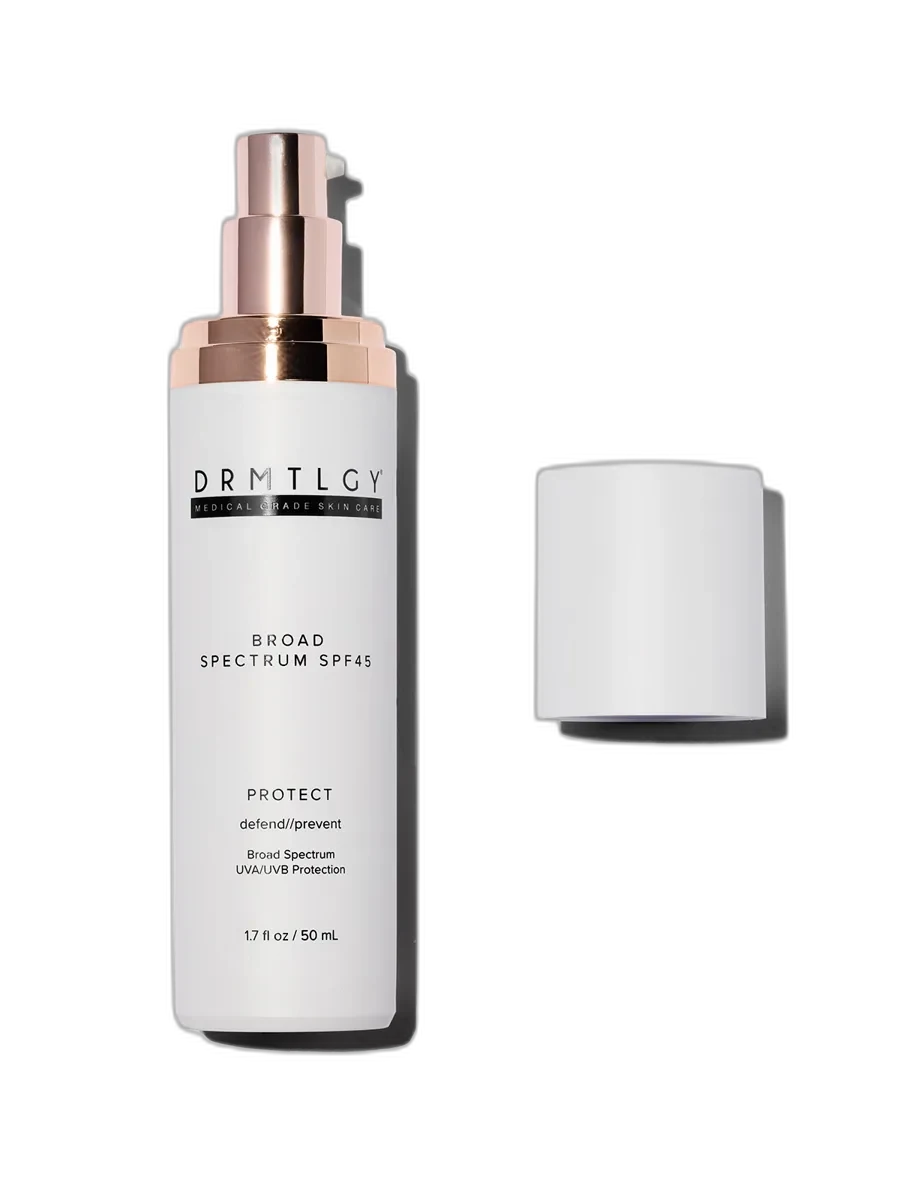
Broad Spectrum SPF 45 Sunscreen
Amazon-Favorite Hybrid
 Verified reviewer
Pros & cons.
- +High 12% zinc oxide content for broad-spectrum coverage
- +Niacinamide at meaningful concentration for redness and pigmentation
- +Hyaluronic acid and glycerin keep the finish hydrated
- +Vitamin E adds antioxidant support to the filter layer
- +Fragrance-free, alcohol-free, and paraben-free
- +90ml airless pump bottle is generous at this price
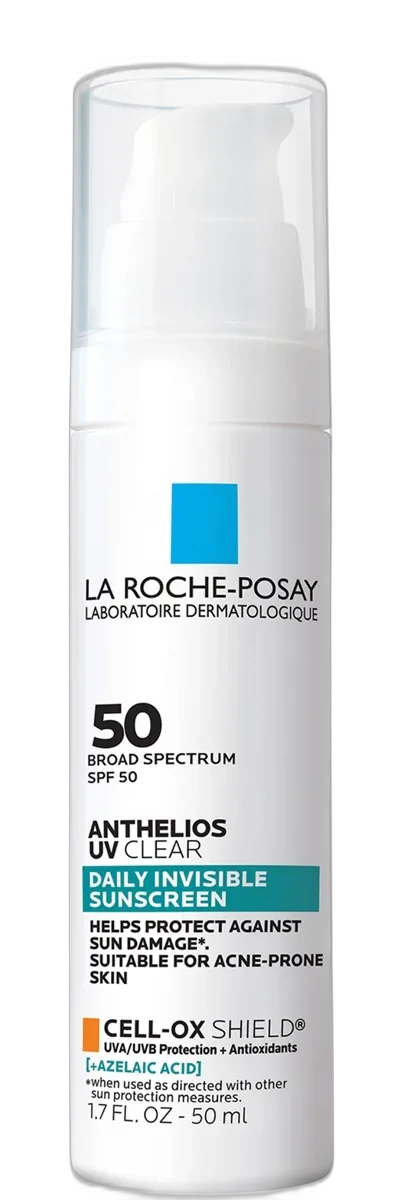
- +Widely positioned as a cheaper EltaMD UV Clear alternative
- −Contains octinoxate — not reef-safe for ocean travel
- −Texture feels heavier than Korean chemical-only sunscreens
- −Brief whitening moment on application from the zinc content
- −Pump bottle can clog with inconsistent storage
- −Brand lacks legacy derm-developed credentials
The full review.
Drmtlgy often serves as a comparison point for other brands. Most shoppers find it while researching EltaMD UV Clear — the expensive gold standard for sensitive-skin facial sunscreen — and seeing Drmtlgy listed on Amazon as “the cheaper one that’s basically the same.” While not identical, the Broad Spectrum SPF 45 earns its reputation through its formula rather than marketing. The filter system is the product’s core, and the proportions matter. Zinc oxide is at 12%, a high amount for a hybrid sunscreen; most hybrids use less mineral load and more chemical filters to reduce weight. Drmtlgy chose a different path: they kept the zinc high and added 7.5% octinoxate to boost UVB efficiency. This makes the sunscreen feel more mineral-leaning than most hybrids, with a texture between pure mineral and chemical-only formulations. The cream feels heavier than a Korean chemical sunscreen, but the SPF 45 broad-spectrum coverage is real. The supporting ingredients justify its “anti-aging” claim. Niacinamide is the third inactive ingredient, suggesting a meaningful 2-4% concentration based on INCI conventions. Like other good sensitive-skin sunscreens, it reduces redness, supports barrier function, and helps post-inflammatory hyperpigmentation over time. Sodium hyaluronate adds surface hydration and prevents the zinc load from drying out the skin. Tocopheryl acetate provides an antioxidant layer for UV-generated free radicals the filters miss. Polygonum aviculare (knotweed) extract adds antioxidant activity and “treatment” benefits without increasing irritation risk. This product is not reef-safe. Octinoxate is banned in Hawaii and several other reef-protected regions, so choose a different sunscreen for ocean travel. It is also not for rosacea sufferers who avoid chemical filters, though the 12% zinc load mitigates that concern more than a pure chemical formulation. The texture lacks the lightness of top Korean chemical-dominant sunscreens; you will feel it on your skin more than a properly engineered K-beauty chemical SPF. As a mid-priced, hybrid, sensitive-skin-friendly daily facial sunscreen, it hits major anti-aging actives (niacinamide, HA, vitamin E) and provides reliable broad-spectrum protection without fragrance or alcohol. The 90ml pump bottle lasts two or three months with proper application, and the per-ounce cost is lower than the EltaMD UV Clear that drives most traffic to Drmtlgy. The airless pump bottle is convenient, though some Amazon reviews mention occasional clogging. Overall, this hybrid facial sunscreen earns its comparisons for the right reasons.
Ingredient analysis.
Full INCI list
Active Ingredients: Zinc Oxide 12.0%, Octinoxate 7.5%. Inactive Ingredients: Water, Cyclopentasiloxane, Niacinamide, Oleth-3 Phosphate, Octyldodecyl Neopentanoate, Hydroxyethyl Acrylate/Sodium Acryloyldimethyl Taurate Copolymer, Polyisobutene, PEG-7 Trimethylolpropane Coconut Ether, Glycerin, Tocopheryl Acetate, Polygonum Aviculare Extract, Sodium Hyaluronate, Disodium EDTA, Sodium Hydroxide, Citric Acid, Phenoxyethanol, Ethylhexylglycerin, Polyglyceryl-3 Polydimethylsiloxyethyl Dimethicone, Triethoxysilylethyl Polydimethylsiloxyethyl Hexyl Dimethicone, Triethoxycaprylylsilane
Skin match.
The science.
The Science
The hybrid filter architecture in this sunscreen reflects current photoprotection research showing that combining mineral and chemical filters typically yields better cosmetic elegance and broader spectral coverage than either category alone at equivalent SPF ratings. Zinc oxide at 12% provides continuous protection across the UVA-UVB range with particular strength in UVA1 (340-400nm), the wavelength range associated with deep dermal damage and photoaging that most chemical filters struggle to cover efficiently. Octinoxate (ethylhexyl methoxycinnamate) is a UVB-dominant chemical filter with peak absorption around 311nm, which boosts the SPF number efficiently when added to a zinc-heavy formula. This is the mechanistic reason hybrid sunscreens feel lighter than pure mineral at equivalent SPF ratings. Niacinamide's documented effects at topical concentrations of 2-5% include reduction in transepidermal water loss, inhibition of melanosome transfer from melanocytes to keratinocytes for pigmentation improvement, and anti-inflammatory effects through NF-kB pathway modulation — research published in the British Journal of Dermatology and similar outlets supports clinical benefit over 8-12 weeks of consistent use. Tocopheryl acetate is a stable vitamin E ester that converts in skin to the active antioxidant form, with decades of research supporting its role in protecting membrane lipids from UV-generated oxidation. Hyaluronic acid (as sodium hyaluronate) is a well-studied humectant that draws water into the stratum corneum, contributing to the surface hydration story without interfering with the UV filters. Polygonum aviculare extract contains flavonoids and phenolic compounds with antioxidant activity, though its evidence base is smaller than the primary actives.
Dermatologist Perspective
Dermatologists routinely recommend daily broad-spectrum SPF 30 or higher as the single highest-impact intervention for preventing photoaging, managing hyperpigmentation, and reducing skin cancer risk. Clinicians frequently suggest hybrid sunscreens for patients who want broader spectral coverage than pure chemical formulas can provide but find pure mineral sunscreens too heavy or prone to white cast. Dermatologists often note that the EltaMD UV Clear product has become a benchmark in this category because of its combination of sensitive-skin tolerability, niacinamide content, and elegant texture, and comparable mid-priced alternatives like this Drmtlgy product serve patients looking for similar benefits at lower cost. For patients specifically avoiding chemical filters due to rosacea or pregnancy considerations, dermatologists typically steer toward pure mineral alternatives rather than hybrid formulations like this one.
Where it fits in your routine.
Apply this as the final step of your morning skincare routine once moisturizer absorbs. Use about two finger-lengths (roughly 1/4 teaspoon) for the face and neck to reach the labeled SPF 45 protection. Warm the product between fingertips, then press and blend it into skin using upward strokes. Wait 60-90 seconds for the zinc to blend and the surface to dry before applying foundation or powder. Reapply every two hours of direct sun exposure, or after sweating or swimming. For office use, one morning application and one midday touch-up is typical.
At about $30 for 90ml, Drmtlgy costs less than EltaMD UV Clear's typical $40 for 48ml — the per-ounce savings are large. A 90ml pump bottle lasts 2-3 months with daily facial application at proper SPF dose, making the monthly cost $10-12. This hybrid sunscreen has niacinamide, hyaluronic acid, and vitamin E in a sensitive-skin-friendly base, offering strong value. The trade-off is brand heritage — you pay for the formula instead of a legacy dermatology name. For budget-conscious buyers who prioritize ingredients over brand names, Drmtlgy wins the calculation.
Normal, combination, dry, or sensitive skin types want a mid-priced hybrid facial sunscreen with anti-aging actives. It works as an EltaMD alternative, a zinc-anchored hybrid with niacinamide, or a daily, non-irritating, fragrance-free SPF with hydrating ingredients.
Reef-conscious travelers should skip this formula because it contains octinoxate. Very oily skin types may prefer a lighter Korean chemical-dominant sunscreen. Pregnant users typically avoid chemical filters as a precaution and should choose a pure mineral alternative. Rosacea patients who avoid chemical filters should also look elsewhere.
Product details.
Medium-weight cream has a slight silicone slip and dries to a semi-matte finish
Neutral, essentially odorless
Airless pump bottle
The cream feels thicker than a chemical-only sunscreen but lighter than pure mineral alternatives. The 12% zinc causes brief whitening that disappears within about a minute of rubbing in. It has no stinging, no fragrance, and no tingling.
About 2-3 months with daily facial application at proper SPF dose
12 months
All Year
The backstory.
Drmtlgy built its early following on Amazon as a value-focused alternative to premium sensitive-skin sunscreens like EltaMD, and the Broad Spectrum SPF 45 became its signature product largely through word-of-mouth review volume rather than traditional retail placement. It's often cited as the 'EltaMD alternative' in skincare forums.
About Drmtlgy
Emerging Brand (2–5 years)Drmtlgy is an American indie skincare brand that launched around 2016. It markets itself as dermatologist-adjacent, though it lacks the formal derm-development of legacy brands like CeraVe. Amazon reviews and influencer placements for sunscreen and retinol built the brand's following.
Common myths.
Octinoxate is unsafe and banned everywhere.
Hawaii and some reef-protected zones ban Octinoxate, though the FDA still approves Octinoxate for sunscreen use in the US and EU. Environmental concerns drive the debate rather than human safety; avoid Octinoxate to ensure reef-safe travel.
Hybrid sunscreens work less effectively than pure mineral or pure chemical sunscreens.
Hybrid sunscreens like this one often provide better broad-spectrum coverage at wearable textures than single-category formulas, because combining filters lets each type cover its strongest wavelengths.
FAQ.
Is Drmtlgy Broad Spectrum SPF 45 the same as the tinted version?
No — Drmtlgy makes an untinted Broad Spectrum SPF 45 (this product) and a Universal Tinted Moisturizer SPF 46. This product is the untinted version and lacks iron oxides, so it does not provide blue light protection like the Universal Tinted Moisturizer SPF 46.
Is this sunscreen reef-safe?
No. It has 7.5% octinoxate, which Hawaii and several other reef-protected regions ban. Use a mineral-only sunscreen if you travel to those areas.
Does it leave a white cast?
Minimally. The 12% zinc oxide causes brief whitening when applied, but rubbing blends it out within a minute. Medium-to-deep skin tones may still see a slight cast despite the chemical filter.
Is it good for oily skin?
The finish is satin, not matte, so oily skin may find it too dewy. It works, but combination and dry skin types enjoy the texture more than very oily skin.
Can I wear makeup over it?
Yes. Wait 60-90 seconds for it to dry before applying foundation. The silicone-containing base creates a smooth canvas that most makeup layers over cleanly.
Is it an EltaMD dupe?
Not exactly — EltaMD UV Clear uses different filters and a different texture. But Drmtlgy is a lower-cost alternative for people seeking a similar use case: a sensitive-skin daily facial sunscreen with niacinamide. Performance is broadly comparable for most users.
How often should I reapply?
Reapply every two hours of direct sun exposure, or after sweating or swimming. For indoor office use with intermittent window exposure, apply once in the morning and reapply over makeup at midday.
What the community says.
"No white cast"
"Layers well under makeup"
"Doesn't break out acne-prone skin"
"Doesn't sting eyes"
"Contains octinoxate (not reef-safe)"
"Less elegant than some Korean competitors"
"Pump bottle can clog"
Featured in.
People also looked at.