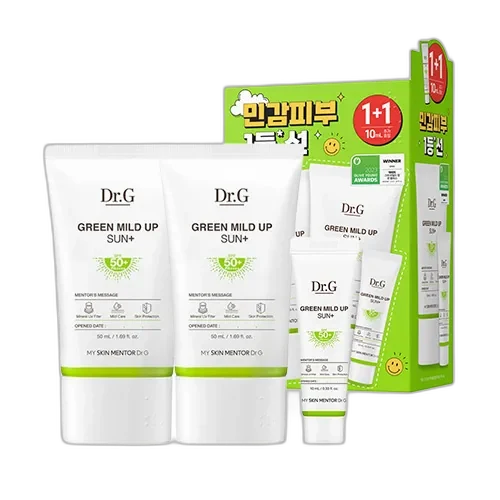
Green Mild Up Sun SPF 50+
Sensitive Skin MVP
 Verified reviewer
Pros & cons.
- +100% mineral zinc oxide formula with no chemical filters
- +Fragrance-free and alcohol-free — suitable for reactive skin
- +Green tint neutralizes mild facial redness on application
- +Houttuynia cordata and centella provide real soothing action
- +Pine bark and vitamin E add antioxidant layer to photoprotection
- +Lower white cast than most 100% mineral sunscreens
- +Reef-safe for ocean-side travel
- −Heavier texture than hybrid or chemical sunscreens
- −Can pill when layered over silicone-heavy products
- −Not ideal as a makeup primer — foundation sits rather than blends
- −50ml tube empties quickly at proper application dose
- −Still shows cast on very deep skin tones
The full review.
About Dr.G
If you sought a Dr.G sunscreen that won’t irritate sensitive skin, you likely tried the Brightening Up Sun first — the famous product in every K-beauty roundup. You probably regretted it, because despite the brand’s sensitive-skin positioning, the Brightening Up Sun contains fragrance and alcohol denat., the two ingredients reactive skin should avoid. The Green Mild Up Sun is the correction. Dr.G built this because they knew part of their audience needs a sunscreen without cosmetic bells and whistles. The active is zinc oxide, full stop — this is a true 100% mineral sunscreen, not a hybrid. The base is silicone-dispersed, the engineering trick that keeps modern mineral sunscreens from feeling like spackle. Cyclomethicone and caprylyl methicone take the second and fourth positions in the INCI list, providing the slip and spreadability traditional mineral formulas lack. The zinc oxide sits in that silicone matrix instead of clumping in a thick emulsion, so the white cast is lower than expected from a truly active mineral sunscreen. The green tint is the smart part. On first application, the product has a visible green undertone — enough that people notice it in the tube — but the green fades into the skin without a visible cast, because the color neutralizes mild facial redness. This uses color theory: green sits opposite red on the color wheel, so a green tint cancels the rosy undertone sensitive and rosacea-prone skin typically shows. It is not full color-correction like makeup, but it settles into a more even, natural finish than a pure white mineral sunscreen. The supporting cast separates Dr.G from the generic mineral-sunscreen pack. Houttuynia cordata extract is a traditional Korean dermatological ingredient for post-acne inflammation, and it sits earlier in the ingredient list than expected for a decorative botanical. Centella asiatica handles the broader soothing. Pine bark extract and tocopherol build a two-layer antioxidant system that catches UV-generated free radicals that even the best sunscreen cannot entirely block. This is thoughtful formulation for this price point. You trade some cosmetic ease for this. The texture is heavier than the Brightening Up Sun — mineral physics require that — and it takes about a minute of careful massage to disappear fully. It can pill when layered over a silicone-heavy moisturizer, so the order of operations matters: water-based hydrator, cream moisturizer if needed, then this. Do not stack it over a silicone primer. It is also not a makeup-friendly primer like some chemical sunscreens; foundation sits on top rather than blending in, which is fine if you prefer it but a shift from silicone-based formulas. For rosacea, post-procedure skin, active eczema, fragrance sensitivity, or anyone whose dermatologist says “stick to mineral” — this is one of the better K-beauty options, and the green tint and soothing botanical story put it ahead of plain zinc oxide tubes at a drugstore.
Formula
Ingredient analysis.
Full INCI list
Purified Water, Cyclomethicone, Zinc Oxide, Caprylyl Methicone, Polyglyceryl-3 Polydimethylsiloxyethyl Dimethicone, Propanediol, Disteardimonium Hectorite, Pentylene Glycol, Caprylic/Capric/Succinic Triglyceride, Magnesium Sulfate, 1,2-Hexanediol, Sorbitan Caprylate, Polyglyceryl-2 Dipolyhydroxystearate, Lauryl Polyglyceryl-3 Polydimethylsiloxyethyl Dimethicone, C30-45 Alkyl Cetearyl Dimethicone Crosspolymer, Triethoxycaprylylsilane, Glyceryl Caprylate, Dimethicone/Vinyl Dimethicone Crosspolymer, Caprylyl Glycol, Ethylhexylglycerin, Caesalpinia Spinosa Fruit Extract, Houttuynia Cordata Extract, Butylene Glycol, Kappaphycus Alvarezii Extract, Tocopherol, Buddleja Officinalis Flower Extract, Pinus Pinaster Bark Extract, Centella Asiatica Extract
Skin match.
The science.
The Science
Zinc oxide remains the most broad-spectrum single UV filter available, covering roughly 290-380nm continuously and extending further into UVA1 than any chemical filter other than avobenzone or Tinosorb S. At cosmetically viable concentrations (typically 12-25% in mineral sunscreens) it provides reliable SPF 30-50+ protection, and its safety record in sensitive populations is better established than any organic filter, which is why dermatologists routinely direct rosacea, eczema, and post-procedure patients to zinc-only formulas. The delivery system in this product is a silicone-in-water dispersion, which uses cyclomethicone and dimethicone crosspolymers to keep zinc particles evenly suspended and reduce visible whitening compared to traditional aqueous mineral formulas. Houttuynia cordata has been studied for its anti-inflammatory effects — quercitrin and other flavonoids in the plant show activity against inflammatory markers in in-vitro skin models, supporting its traditional use in Korean medicine for inflamed skin. Centella asiatica's triterpenoid compounds, particularly madecassoside and asiaticoside, have demonstrated wound-healing and barrier-repair effects in published dermatology literature. Pine bark extract (Pycnogenol) contains proanthocyanidins with documented antioxidant activity, and small studies have suggested it may complement sunscreen protection by reducing UV-induced free radical damage in skin, though the evidence base is smaller than for tocopherol. Tocopherol (vitamin E) is a well-established lipid-soluble antioxidant that protects membrane lipids from UV-induced oxidation and is a standard inclusion in modern photoprotective formulas.
Dermatologist Perspective
Dermatologists routinely recommend 100% mineral sunscreens for patients with rosacea, active eczema, post-procedure skin, and chemical filter sensitivity — zinc oxide remains the gold standard for these populations. Clinicians note that fragrance is one of the most common contact allergens in skincare, and alcohol denat. can disrupt barrier function in already-compromised skin, so sunscreens that eliminate both are disproportionately useful in sensitive-skin protocols. Dermatologists managing patients who've had recent laser treatments, chemical peels, or microneedling commonly direct them to fragrance-free mineral formulas like this one for the first weeks of recovery. The inclusion of centella asiatica and houttuynia cordata aligns with the soothing-ingredient recommendations frequently made for post-inflammatory skin, and the addition of antioxidants reflects current photoprotection guidance that pairs UV filters with free-radical scavengers for more comprehensive protection.
Guidance
Where it fits in your routine.
Apply this as your final morning skincare step once your moisturizer absorbs. Use about two finger-lengths (roughly 1/4 teaspoon) for your face and neck. Warm the product between your fingertips, then press and pat it into skin in sections. Do not rub aggressively; hard massage causes mineral sunscreen to streak or pill. Wait at least one minute before applying foundation. Reapply every two hours of direct sun exposure. A mineral sunscreen stick works best for touch-ups over makeup.
At about $24 for 50ml, this sunscreen's price is competitive for an imported mineral K-beauty SPF with this level of formulation thoughtfulness. Western mineral sunscreens at this price often use only zinc oxide and a basic emollient base. The Dr.G formula adds soothing botanicals and an antioxidant layer. The brand offers no larger refill, a drawback for daily users who empty a tube every two months at the correct application dose. For sensitive skin that's struggled to find a tolerable daily SPF, the cost-per-outcome calculation favors the brand.
This works for rosacea, eczema, sensitive skin, fragrance intolerance, or post-procedure recovery. It also suits acne-prone skin seeking a fungal-acne-friendly mineral SPF with active soothing benefits. The Korean tint calibration fits fair-to-medium skin tones.
This product has more texture than chemical alternatives, so skip it if you want a weightless silicone-slip finish or use sunscreen as a makeup primer. Also skip if you have very deep skin tones; some white cast remains visible despite the formulation's efforts to minimize it.
Product details.
Medium-weight silicone-dispersed mineral cream with a faint green tint on first application
Neutral, nearly odorless
Squeeze tube with narrow nozzle
The first pump is green and slightly thick. This shows it is a legitimate mineral formula, not a chemical one cosplaying as one. It rubs in to a neutral finish within a minute. The green undertone neutralizes mild redness without leaving a visible cast.
About 2 months with daily facial application at correct SPF dose
12 months
All Year
The backstory.
Dr.G developed this sunscreen as a companion to its popular Red Blemish Clear line, targeting Korean consumers with acne-prone and rosacea-adjacent skin who needed a mineral SPF that wouldn't break out, sting, or leave a heavy cast. The 'Green' in the name references both the tint and the plant-extract orientation of the formula.
About Dr.G
Established Brand (5–20 years)Dr.G launched in 2003, founded by Korean dermatologist Dr. Ahn Gun-Young to focus on sensitive skin. The brand is a staple in Korean dermatology clinics and passes repeated in-vivo hypoallergenic testing across its product range.
Common myths.
Mineral sunscreens always leave a heavy white cast.
Modern silicone-dispersed mineral formulas like this one reduce the cast. This product's green undertone works with mild redness instead of against it.
'Green' in the product name indicates it contains chlorophyll or greens extract.
The green color signals the botanical soothing theme. The color fades when applied. houttuynia cordata and centella are the active soothing agents, not any green juice ingredient.
FAQ.
Is Dr.G Green Mild Up Sun a 100% mineral sunscreen?
Yes — zinc oxide is the only UV filter in this formula. This mineral sunscreen works for sensitive, post-procedure, and rosacea-prone skin that reacts to chemical filters.
Does it leave a white cast?
The silicone-dispersed formulation keeps the cast lower than traditional mineral sunscreens. A faint green tint neutralizes residual whiteness by pairing with underlying skin redness. Some cast remains visible on very deep skin tones.
Is it safe for rosacea?
Yes — it is fragrance-free, alcohol-free, uses only zinc oxide as the active, and includes houttuynia cordata and centella as soothing agents. This combination makes it a top daily SPF option for rosacea-prone skin.
Can I wear it under makeup?
Yes, but it has more grip than a silicone-heavy chemical sunscreen, so foundation sits on top instead of gliding. Use a hydrating primer or skip primer for best results.
Is it reef-safe?
Yes, because it uses only zinc oxide as an active filter and lacks octinoxate or oxybenzone. It works for ocean-facing travel and meets reef-protection legislation in places like Hawaii.
Is it fungal acne safe?
The formula lacks most esters and fatty alcohols that feed malassezia. It is generally fungal-acne-friendly, but individual tolerance varies; patch test on a small area first.
How does it compare to the Dr.G Brightening Up Sun?
The Brightening version is a hybrid tone-up sunscreen with a peach tint, fragrance, and alcohol. The Green Mild is 100% mineral, fragrance-free, and targets sensitive and reactive skin. Choose based on your priority: brightening or soothing.
What the community says.
"Genuinely non-irritating"
"Lower white cast than expected for mineral"
"Calms redness over time"
"Slight green tint on initial application"
"Can pill if layered over heavy silicone products"
"Small tube size"
Featured in.
People also looked at.