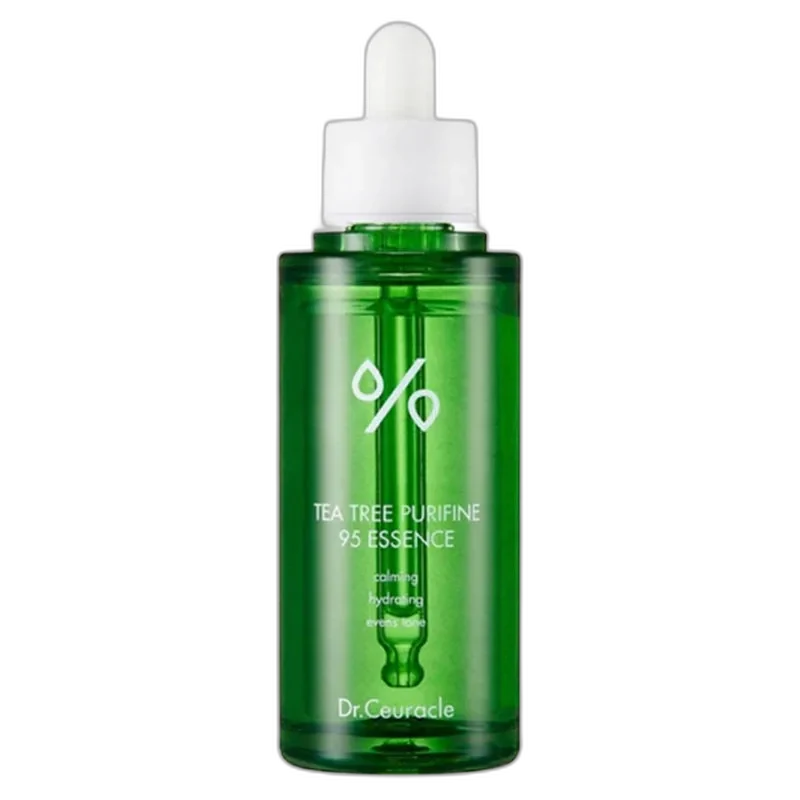
Tea Tree Purifine 95 Essence
Tea Tree Essence Benchmark
 Verified reviewer
Pros & cons.
- +Tea tree leaf water delivers antibacterial benefit without essential oil irritation
- +Functional salicylic acid addresses blackheads and clogged pores
- +Niacinamide fades post-blemish marks and regulates sebum
- +Absorbs instantly with no tacky residue
- +Fragrance-free, alcohol-free, vegan
- +Good value at around $28 for 50ml
- +Layers well with other treatments and under makeup
- −Not hydrating enough to serve as a standalone essence for dry skin
- −Faint herbal scent bothers fragrance-sensitive users
- −Can be drying if used twice daily on reactive skin
- −Not fungal-acne safe for malassezia folliculitis management
The full review.
About Dr. Ceuracle
Tea tree is one of those ingredients everyone agrees works and almost no one formulates well. The essential oil is a potent antimicrobial, and it’s also one of the most-documented contact allergens in cosmetic chemistry. If you’ve ever tried a tea tree spot treatment and watched a single dab turn into a halo of red, peeling skin the next morning, you’ve already met the problem. Dr. Ceuracle’s Tea Tree Purifine 95 Essence exists because the brand looked at that problem and chose a different input: tea tree leaf water, at 95% of the formula, instead of the concentrated essential oil that dominates the category.
Reality
The swap matters more than it might first sound. Tea tree leaf water is produced by steam-distilling the leaves and capturing the water-soluble fraction, which carries a portion of the plant’s antibacterial terpenes — enough to meaningfully suppress the bacteria involved in acne — without the lipid-disrupting potency of the undiluted oil. In an essence format, that means you can cover your whole face twice a day without wondering whether your cheeks are about to revolt. That alone would make the product worth a look. What pushes it from interesting to actually useful is the supporting cast.
Formula
The formula includes a functional dose of salicylic acid, which is the real workhorse on blackheads and clogged pores. It’s not strong enough to use as a standalone exfoliant, but it’s present at a level that makes a difference over weeks of use, slipping into the oily environment of congested pores and loosening the plugs that cause blackheads in the first place. Niacinamide, as usual, does multiple jobs: it regulates sebum, it fades the dark marks left behind by old breakouts, and it strengthens the barrier so the tea tree and salicylic acid can work without creating fresh irritation. Madecassoside and asiaticoside, the purified centella fractions, are there purely to calm, and zinc PCA adds further sebum control for oily skin. Panthenol, hyaluronic acid, beta-glucan, and glycerin round out the hydration layer. There is no fragrance, no alcohol, no essential oils, and no unnecessary botanical decoration.
Texture
On the skin, the essence behaves exactly the way a watery treatment step should. It absorbs within seconds, leaves no residue, and delivers a brief herbal cooling sensation that fades almost immediately. Within a few hours you’ll notice your T-zone feels less oily — that’s partly the zinc PCA, partly the tea tree. Within one to two weeks of consistent use, active blemishes start losing their inflammation faster than usual, and new ones show up less often. The texture smoothing and pore appearance improvements come a bit later, usually around the four-to-eight-week mark, and that’s mostly the cumulative work of the salicylic acid and niacinamide.
Best for
The essence is clearly tuned for oily and combination skin. Dry and very sensitive users can still get away with it, but they’ll probably want to limit it to once-daily application and make sure the rest of the routine leans hydrating. The formula is gentle enough to use through a flare, but not so rich that dry skin will want to live in it year-round. It’s also not fungal-acne safe, which is worth noting for anyone specifically managing malassezia folliculitis — the essence won’t make that condition worse in any dramatic way, but it isn’t designed to help either.
Pricing
At around $28 for 50ml, the pricing is fair for what the formula actually does. Cheaper tea tree products exist, and most of them either use essential oil at levels that cause problems or lean entirely on tea tree without the supporting actives that make this essence functional. More expensive tea tree products usually just have prettier packaging. Dr. Ceuracle sits in that narrow middle where the spending goes into ingredients rather than aesthetics, which is where K-beauty tends to earn its reputation. A bottle lasts two to three months with twice-daily use, and the fact that it doubles as both a blemish treatment and a pore refiner means it can replace multiple other products in a stripped-down routine.
Summary
The larger story here is about formulation restraint. It would have been easy — cheaper, even — to throw tea tree essential oil into a vehicle, call it a treatment, and market it on the strength of a single ingredient. Dr. Ceuracle went a different direction, and the result is a product that actually delivers tea tree’s benefits without the irritation penalty the ingredient usually carries. For anyone with oily or combination skin who’s been looking at tea tree products and bracing for the sting, this is the ampoule-adjacent essence worth trying first.
Ingredient analysis.
Full INCI list · pH 5.5
Melaleuca Alternifolia (Tea Tree) Leaf Water (95%), Butylene Glycol, 1,2-Hexanediol, Niacinamide, Panthenol, Glycerin, Sodium Hyaluronate, Allantoin, Madecassoside, Asiaticoside, Asiatic Acid, Madecassic Acid, Salicylic Acid, Zinc PCA, Beta-Glucan, Adenosine, Tocopherol, Carbomer, Arginine, Disodium EDTA, Ethylhexylglycerin
Skin match.
The science.
The Science
Dermatology has thoroughly studied how Melaleuca alternifolia kills acne-associated bacteria. Research in the Medical Journal of Australia and the Journal of Dermatological Treatment shows 5% tea tree oil reduces inflammatory acne lesions similarly to 5% benzoyl peroxide, though it works slower and causes less irritation in most clinical trials. Most tea tree products fail because the high essential oil concentrations needed to match benzoyl peroxide also cause high contact sensitization. Tea tree leaf water — the hydrosol — contains those same antibacterial terpenes in a water-soluble form, trading some potency for better tolerability. This essence offsets lower antibacterial levels with salicylic acid, a proven comedolytic and antibacterial BHA, and niacinamide, which studies show reduces sebum excretion and post-inflammatory hyperpigmentation at 2-5% concentrations over 8-12 weeks. The formulation uses a layered logic: tea tree water targets surface bacteria, salicylic acid targets pore-level comedones, niacinamide targets sebum and pigmentation, and madecassoside from the centella fractions acts as an irritation buffer. This layered design makes the essence perform better in real routines than single-active tea tree products.
Dermatologist Perspective
Dermatologists often prefer water-based tea tree formulations over essential oil spot treatments for patients seeking natural-leaning acne products without the high contact sensitization risk of undiluted tea tree oil. Board-certified dermatologists view tea tree as a supportive antimicrobial rather than a primary treatment; products combining it with low-dose salicylic acid and niacinamide yield more reliable results than single-ingredient tea tree formulations. Dermatologists commonly suggest this type of essence as a daily maintenance layer for mild-to-moderate inflammatory acne, especially for patients with barriers already compromised by harsher actives.
Where it fits in your routine.
Cleanse and tone first. Press 2-3 pumps into damp skin, targeting the T-zone and blemish-prone areas. Wait 30-60 seconds for absorption, then apply moisturizer. Use once or twice daily based on skin tolerance. Always apply sunscreen in the morning. If skin is dry, use once daily in the evening with a thick moisturizer. If you have redness, do not layer with strong retinoids or high-strength acids in the same routine.
At around $28 for 50ml, the essence sits at the fair end of the mid-range K-beauty tea tree category. A bottle typically lasts two to three months with twice-daily use, which works out to roughly $0.30 to $0.47 per day, and because the formula covers both blemish control and pore refinement, it often replaces a separate spot treatment and a separate BHA toner in a streamlined routine. That functional overlap is where the real value comes from — you're paying for a genuinely multi-purpose treatment rather than a single-ingredient gimmick.
This works for oily or combination skin with active blemishes, blackheads, and enlarged pores that needs tea tree benefits without essential oil irritation. It also suits normal skin that breaks out occasionally and needs a multi-tasking treatment step.
Dry, very sensitive, or barrier-compromised skin works best with a hydrating essence and a targeted spot treatment. People managing fungal acne need a formula designed for malassezia, as this one is not built for that use case.
Product details.
Watery essence with slight viscosity, absorbs almost immediately
Faint natural tea tree aroma, no added fragrance
Frosted bottle with pump dispenser
The first use gives a light herbal cooling sensation that fades in seconds. Oily areas feel mildly astringent. Most users do not experience purging, but reactive skin can start with once-daily application.
2-3 months with twice-daily use
12 months
All Year
The backstory.
Dr. Ceuracle launched the essence in 2018 as a response to growing Korean consumer concern about tea tree oil irritation and barrier damage. The brand's pharmacy-skincare roots gave it the formulation chops to substitute leaf water for essential oil without losing efficacy.
About Dr. Ceuracle
Emerging Brand (2–5 years)Dr. Ceuracle launched in 2017. Its Korean dermatology-adjacent parent company also makes the Leegeehaam line, giving the brand a pharmacy-skincare reputation within the K-beauty category.
Common myths.
Tea tree water is too weak to actually help acne
The leaf water contains many of the same antibacterial terpenes as the essential oil. In this essence, salicylic acid and niacinamide work together to show measurable results on blemish-prone skin within a few weeks.
Tea tree oil products require a high percentage to work.
High-concentration tea tree oil often damages the barrier more than it treats the blemish. A well-formulated essence with leaf water and supporting actives typically works better than raw oil in real routines.
FAQ.
Can I use this with retinol?
You can, but not simultaneously if your skin is sensitive. Alternate nights or use the essence in the morning and retinol at night to prevent overlapping irritation.
Is this suitable for dry skin?
Not primarily. The formula has enough humectants for comfort, but dry skin types get more value from a hydrating essence and a separate spot treatment for blemishes.
Does it help with blackheads?
Yes. The low-dose salicylic acid works inside the pore to loosen sebum plugs, while the tea tree water targets the bacteria that often accompany blackhead formation.
Is it vegan?
Yes. Unlike Dr. Ceuracle's propolis line, this essence contains no bee-derived ingredients and is suitable for vegan routines.
Can I layer this under makeup?
Yes. The essence absorbs almost immediately and leaves no residue, so it sits well under sunscreen and makeup.
Community
What the community says.
"Controls oil without tight feeling"
"Noticeable on blemishes in a few days"
"Clean minimal formulation"
"Light texture layers well"
"Faint herbal scent bothers some"
"Not hydrating enough on its own"
"Can be drying if used twice daily on dry skin"
People also looked at.