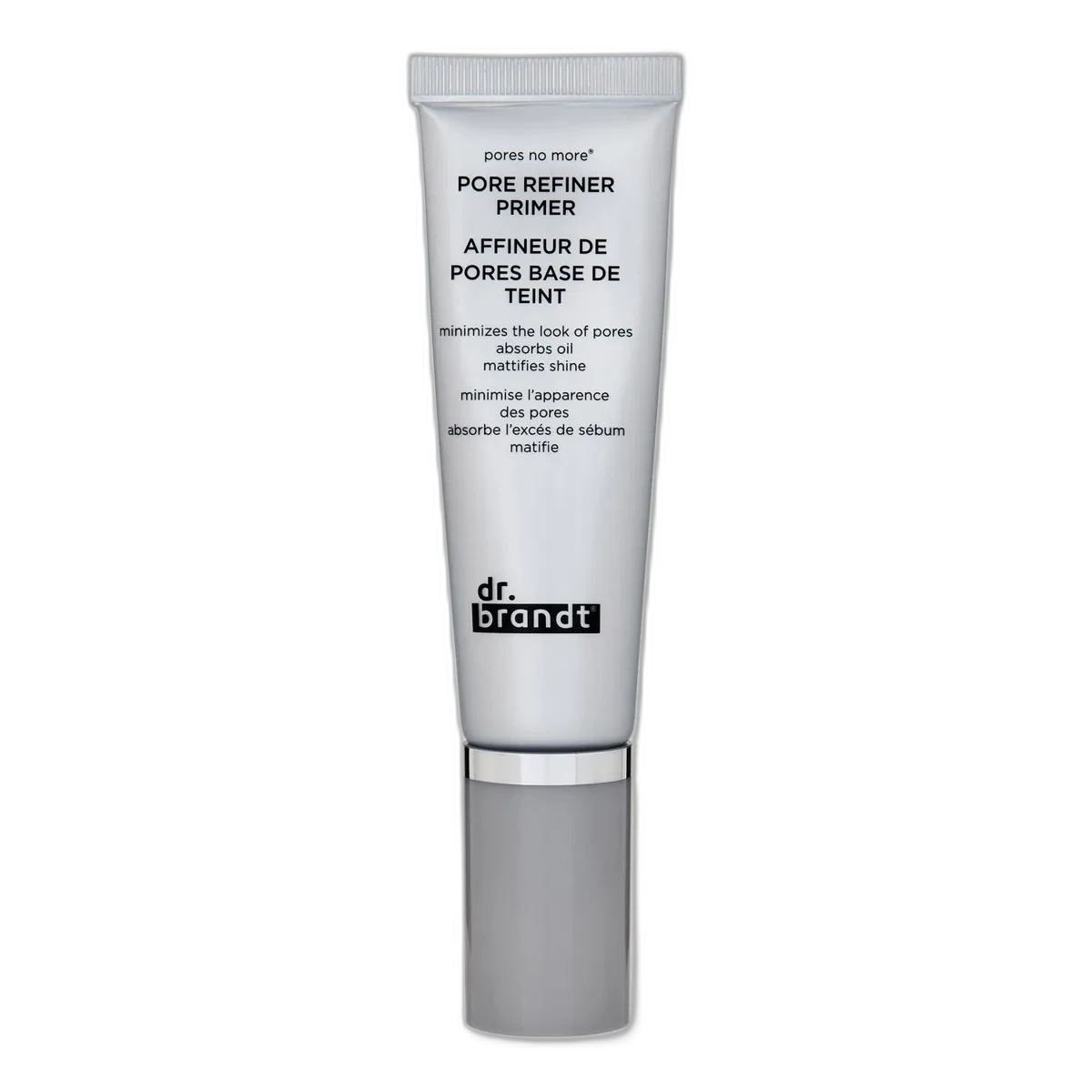
Pores No More Pore Refiner Primer
Pore-Blurring Cult Classic
 Verified reviewer
Pros & cons.
- +Genuinely effective pore blurring via silicone elastomer blend
- +Sneaky-good salicylic acid and red clover extract for long-term refinement
- +Velvet finish that foundation glides over smoothly
- +Mattifying effect lasts through a full day on oily skin
- +Small daily dose makes the tube last four to six months
- +Over 15 years of consistent category leadership and refinement
- −Lavender and tea tree oils make it a poor sensitive-skin pick
- −Contains retinyl palmitate — not pregnancy-safe
- −Can pill under water-based foundations
- −Silicone-heavy texture isn't for everyone
- −Premium price for a primer in its category
The full review.
Dr. Brandt launched Pores No More in 2009 when the primer category mostly consisted of silicone gels for foundation smoothing. Primers sat firmly on the makeup side, separate from skincare. Pores No More was among the first mainstream products to intentionally blur that line, and it remains on Sephora shelves because the approach works. You feel the cosmetic side first. A pea-sized amount squeezes out as a soft white cream that turns into a powdery-velvet finish seconds after pressing it into the skin. A blend of silicone elastomers—dimethicone crosspolymer, polymethylsilsesquioxane, and dimethicone/vinyl dimethicone crosspolymer—drives this effect by filling pore topography and smoothing skin light-diffusion. This creates the instant pore-blurring effect that sells this category. Above the silicone, methyl methacrylate crosspolymer spheres absorb sebum all day, keeping oily skin matte for hours instead of breaking through in minutes like many primers. Titanium dioxide adds a subtle light-bouncing effect to brighten without adding coverage. This is well-executed cosmetic chemistry, but the interesting part lies further down the INCI: salicylic acid, Trifolium pratense — red clover — extract, retinyl palmitate, and sodium hyaluronate. None have high enough doses to act as a primary treatment, but together they add a cumulative skincare layer beneath the cosmetic one. The salicylic acid provides mild keratolytic action to keep pore openings clearer. Red clover isoflavones have data supporting sebum regulation and pore refinement. Retinyl palmitate is a mild vitamin A. Sodium hyaluronate adds humectant support so the silicone-heavy base does not dehydrate the skin. Daily use over weeks and months provides small, real long-term benefits alongside the immediate effect, exceeding most primers in the category. The experience is consistently good. It pairs well with silicone-based foundations, creating a smooth, long-wearing finish where foundation glides over pore shadows instead of catching. Oily T-zones stay controlled, and combination skin gets a uniform matte without dry areas looking flat. With fifteen years of market history—including Allure Best of Beauty, Glamour picks, and thousands of reviews—this is near best-in-class. The longevity is earned. However, the product is harder to recommend for sensitive or reactive skin. Lavender oil and tea tree oil are on the INCI; while tea tree is often tolerated at low doses, the combination with lavender makes this one of the more fragrance-loaded primers in its category. This is a problem for users with rosacea, eczema, or essential-oil sensitivity, especially since the primer stays on the skin under foundation all day. Retinyl palmitate is also a complication for those pregnant or trying to conceive—it is a vitamin A derivative typically avoided during pregnancy, and a daily primer is easily overlooked when checking for retinoid content. Water-based foundations occasionally pill over the silicone base, which is a compatibility issue rather than a defect. At $48 for 30ml, the price is in the mid-premium range—above drugstore primers but below most luxury brands. A pea-sized daily dose makes the tube last four to six months, making the math better than the sticker price suggests. For combination to oily skin without sensitivity concerns, this is one of the smarter primers on the market—a cosmetic product that effectively moonlights as a mild skincare treatment.
Ingredient analysis.
Full INCI list
Cyclopentasiloxane, Water/Aqua/Eau, Dimethicone Crosspolymer, Lauryl PEG/PPG-18/18 Methicone, Methyl Methacrylate Crosspolymer, Polymethylsilsesquioxane, Dimethicone/Vinyl Dimethicone Crosspolymer, Polysilicone-11, Titanium Dioxide, Linum Usitatissimum (Linseed) Seed Extract, Dimethyl Oxobenzo Dioxasilane, Ethylhexyl Palmitate, Phenoxyethanol, Lavandula Angustifolia (Lavender) Oil, Silica Dimethyl Silylate, Melaleuca Alternifolia (Tea Tree) Leaf Oil, Silica, Triethoxycaprylylsilane, Trifolium Pratense (Clover) Flower Extract, Retinyl Palmitate, Sodium Hyaluronate, Tocopheryl Acetate, Salicylic Acid
Skin match.
The science.
The Science
The pore-blurring mechanism uses well-understood silicone elastomer chemistry. Dimethicone crosspolymer, polymethylsilsesquioxane, and related silicone elastomers form a thin, flexible layer on the skin. This layer physically fills surface topography — pore openings, fine lines, and micro-textural irregularities — to create a smoother surface that diffuses light uniformly. This chemistry powers most category leaders and is legitimate cosmetic science with a solid safety and efficacy record. Methyl methacrylate crosspolymer oil-absorbing spheres also have robust data showing they absorb sebum without compromising the skin barrier. The functional actives make the science more interesting. Salicylic acid at low concentrations has keratolytic activity on the pore lining; consistent topical use at low doses associates with clearer pore openings and reduced comedones visibility. The dose is modest — a small percentage based on its INCI position — but supports the long-term refinement claim. Red clover extract has a smaller but meaningful research body: its isoflavones, specifically biochanin A and formononetin, show sebum-regulating effects in some studies, and some cosmetic research suggests topical application may reduce pore size appearance over time. Retinyl palmitate is the weakest vitamin A ester and has minimal evidence for skin benefit at typical primer concentrations. Sodium hyaluronate provides baseline humectant support. The overall formula is more scientifically substantive than most primers, though it is not a genuine treatment.
Dermatologist Perspective
Dermatologists generally view silicone-based pore-blurring primers as safe, effective cosmetic tools for patients with visible pore concerns, and Pores No More is often a category reference product. The low-dose salicylic acid is typically a welcomed, gentle functional addition, and the red clover component is a reasonable supporting active. Board-certified dermatologists caution patients with sensitive, rosacea-prone, or reactive skin about the lavender and tea tree oil content, and they routinely flag the retinyl palmitate for pregnant or breastfeeding patients. For patients with true structural pore concerns — ice-pick scarring or deeply pitted pores from long-term acne — dermatologists typically recommend in-office treatments like laser resurfacing or microneedling instead of relying on topical blurring.
Where it fits in your routine.
Apply this as your final skincare step, after moisturizer and sunscreen but before foundation. Use a pea-sized amount for your whole face. Pat it onto the skin, focusing on pore-prone areas like the T-zone, cheeks, and chin. Do not rub. Wait 30-60 seconds for the primer to set into its velvet finish before you apply foundation. It works best with silicone-based foundations; water-based formulas may occasionally pill. Cleanse thoroughly at the end of the day to fully remove the silicone base.
At $48 for 30ml, this primer costs mid-premium for its category. The 0.5 oz size has a lower entry price but worse per-milliliter value. The price reflects 15+ years of formulation refinement, functional actives beyond cosmetic blurring, and reliable effects. A daily pea-sized dose lasts four to six months, keeping the per-use cost reasonable. For a functional pore-blurring primer for combination or oily skin that does more than just blur, this is competitive; cheaper silicone primers exist if you only need cosmetic effects.
This works for combination or oily skin with visible pores needing a primer that acts as a makeup base and a mild long-term treatment. It also fits anyone who found cheaper silicone primers lack staying power or a mattifying effect.
Use this if you are sensitive to essential oils, pregnant, or trying to conceive (due to retinyl palmitate). It works for very dry or tight skin that does not need mattifying. For pore blurring without functional actives, cheaper silicone primers give the same cosmetic effect for less money.
Product details.
Velvety cream-to-powder that glides on and sets quickly
Faint herbal aroma from lavender and tea tree
White and silver squeeze tube with flip cap — practical and easy to dispense
Apply a small amount. It turns from cream to powder on your skin within seconds. Pores look softer and the surface feels velvet-like, so foundation glides on easily. Most users see results immediately.
4-6 months with once-daily use
12 months
All Year
The backstory.
Launched in 2009 as one of the first mainstream 'skincare primers' to combine cosmetic blurring with functional actives, this product became a Sephora bestseller and helped define the category. It remains one of Dr. Brandt's most-purchased products.
About Dr. Brandt
Legacy Brand (20+ years)Dr. Brandt Skincare launched the Pores No More line in the late 2000s. It was among the first skincare-meets-makeup hybrid products in mainstream retail. The line remains one of the brand's longest-running bestsellers.
Common myths.
Silicone primers clog pores.
Silicone elastomers like dimethicone crosspolymer are non-comedogenic and stay on the skin's surface. Other formula ingredients or poor cleansing at night cause breakouts from silicone primers.
This will permanently shrink your pores.
Pore size is mostly genetic and topical products cannot permanently reduce it. This primer blurs their appearance cosmetically and uses salicylic acid for gradual refinement — both are real effects, but they do not permanently change pore diameter.
FAQ.
Does this actually shrink pores?
Topical products cannot physically shrink pores. This product uses silicone elastomers to visually blur them and salicylic acid and red clover to support gradual long-term refinement. The immediate effect is cosmetic, while the long-term effect is modest.
Myth
Topical products cannot physically shrink pores.
Reality
This product uses silicone elastomers to visually blur them and salicylic acid and red clover to support gradual long-term refinement. The immediate effect is cosmetic, while the long-term effect is modest.
Is it safe during pregnancy?
Not recommended. The formula has retinyl palmitate and salicylic acid, which people typically avoid during pregnancy. Use a retinoid-free primer if you're expecting.
How much should I apply?
Use a pea-sized amount for the full face. Too much product causes pilling under foundation. Apply to areas with visible pores — typically the T-zone — and blend.
Will it work under any foundation?
It works best with silicone-based foundations. Water-based foundations sometimes pill or separate on top. If pilling occurs, let the primer set longer before applying foundation.
Is it safe for sensitive skin?
Not ideal. The formula has lavender oil and tea tree oil, which can irritate reactive skin. Patch-test before full-face use. Skip it if you have rosacea or a history of essential oil sensitivity.
Can I use it without makeup?
Yes. Some users wear it alone as a mattifying treatment. The velvet finish works on bare skin, and the salicylic acid and red clover components work whether foundation follows.
What the community says.
"Instantly blurs pores"
"Keeps makeup looking smooth all day"
"Velvety soft texture"
"Long-lasting mattifying effect"
"Works well on combination and oily skin"
"Silicone feel not for everyone"
"Can pill under certain foundations"
"Fragrance from lavender and tea tree"
"Contains retinyl palmitate (pregnancy caution)"
People also looked at.