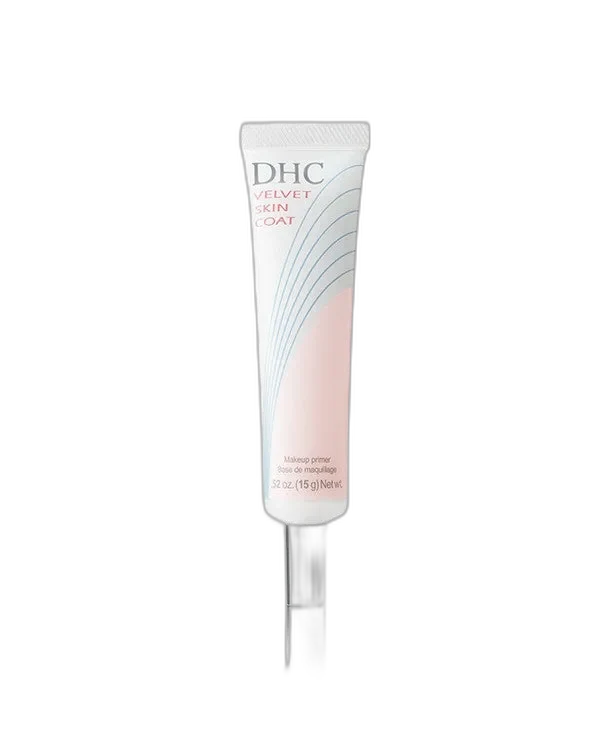
Velvet Skin Coat
J-Beauty Primer Staple
 Verified reviewer
Pros & cons.
- +Dense silicone elastomer network delivers real pore-blurring effect on contact
- +Velvety finish that isn't matte or slick — sits between satin and blurred
- +Fungal-acne safe and fragrance free, rare in the primer category
- +A pea-sized amount covers the full face, making the small jar last
- +Foundation and powder both sit more evenly on top throughout the day
- +Neutral scent and non-reactive formula suitable for most skin types
- +Stable shelf life — formula stays consistent for the full jar
- −Small 16g glass jar that isn't travel-friendly or hygienic for on-the-go use
- −Can pill if layered too quickly over wet sunscreen or tacky serums
- −Contains BHT, which some readers prefer to avoid on principle
- −Offers no real skincare treatment benefits — purely a cosmetic finisher
- −Jar packaging requires fingers or a spatula rather than a pump
The full review.
For years, DHC Velvet Skin Coat lived almost entirely inside Japanese department stores and the carry-on luggage of makeup artists returning from Tokyo. It wasn’t marketed with a celebrity face or a TikTok launch campaign. It just quietly sat on shelves in Isetan and Tokyu Hands while Japanese women swore by it and international beauty editors smuggled jars home. The product eventually made its way to Western audiences through J-beauty subscription boxes and Reddit threads, and today it has built a cult international following without DHC ever raising its voice about it. That backstory matters because it tells you what kind of product this is — a functional, no-drama finisher that earned its reputation through results, not theater.
What you’re actually buying is a dense silicone-elastomer balm housed in a small frosted glass jar. Scoop out a pea-sized amount with a clean fingertip and it feels firm and waxy at first, almost like a solid. The moment it hits warm skin, though, the cyclopentasiloxane flashes off and the entire blob transforms into a slippery, near-weightless fluid that slides across your cheekbones and forehead. Press it in rather than rubbing, and within about fifteen seconds it has settled into a soft, velvety layer that sits on top of your skincare and waits patiently for foundation.
The reason it works so well comes down to a single design choice. Most primers you’ll find on drugstore shelves are water-based gels or lotions with a modest amount of dimethicone crosspolymer suspended in them. Velvet Skin Coat skips the water entirely and delivers a much higher concentration of that elastomer network in a dense, silicone-only vehicle. Those tiny spherical particles of dimethicone crosspolymer physically sit inside the visual texture of your pores and fine lines, creating an optical blur that your eye reads as smoother skin. The silica that rounds out the formula adds a soft-focus mattifying effect on top, absorbing surface oil so the finish stays velvety rather than shiny. You see the result immediately, and because the silicone network is so concentrated, the effect holds up for hours longer than a typical watery primer.
On the skin, the feel is exactly what the name promises. ‘Velvet’ is actually the right word — not matte, not dewy, but something halfway between a satin finish and a blurred canvas. Foundation glides over it like butter, liquid formulas don’t cling to dry patches, and powder products sit down more evenly. If you’re used to primers that feel slippery or silicone-slick, this one feels drier and more skin-like, probably because the silica and elastomer together absorb just enough to eliminate that glossy primer sheen.
It isn’t flawless, though. The biggest real-world complaint is pilling, and it’s almost always a layering problem. If you apply Velvet Skin Coat before your sunscreen has fully set, or on top of a very hyaluronic-acid-heavy serum that’s still tacky, the silicone balm will roll up into little grey flakes as soon as you try to apply foundation. The fix is boring but reliable — wait a full two or three minutes after your last skincare step, press (don’t rub) the primer in, and then give it another thirty seconds before you reach for foundation. Do that and the pilling disappears almost entirely. The glass jar is also small and not travel-friendly, and the BHT preservative at the end of the INCI will turn off readers who are avoiding it on principle, even though it’s present in a stabilizing trace amount.
The ingredient list is honest about what this is. Cyclopentasiloxane, dimethicone crosspolymer, trimethylsiloxysilicate, silica, dimethicone, and polymethylsilsesquioxane do all the cosmetic heavy lifting. The olive oil and tocopherol are a small nod to DHC’s olive-oil heritage and a token antioxidant gesture, but this isn’t a skincare-treatment primer. Don’t buy it expecting barrier repair or long-term texture improvement. Buy it because you want your pores to visually vanish under makeup this morning.
Value-wise, the sticker shock of a small glass jar goes away once you realize how little product you use per application. A pea-sized amount covers the entire face, and a 16-gram jar will last most users somewhere between six and ten months. That works out to well under a dollar per use, which is a much better deal than a $38 liquid silicone primer from a luxury brand that you burn through in three months. The formula also stays stable in the jar thanks to the BHT and tocopherol, so you’re not racing the clock on shelf life.
Who’s this for? Oily, combination, and normal skin types with visible pores around the nose, cheeks, or forehead will get the most out of it. Dry skin can absolutely wear it, but may prefer to apply it only to the center of the face where pore texture is most visible, rather than all over. Sensitive skin should patch-test only because of the BHT — the silicones themselves are among the most inert ingredients in cosmetics. If you’re looking for a treatment primer with niacinamide or peptides built in, keep moving. If you just want your skin to look like it’s been airbrushed under foundation for the next eight hours, this small, quiet jar from DHC is one of the best purchases you can make.
Ingredient analysis.
Full INCI list
Cyclopentasiloxane, Dimethicone Crosspolymer, Trimethylsiloxysilicate, Silica, Dimethicone, Polymethylsilsesquioxane, Olea Europaea (Olive) Fruit Oil, Tocopherol, BHT
Skin match.
The science.
The Science
Silicone-based primers work through a documented optical and physical effect called soft-focus blurring. Dimethicone crosspolymer forms a three-dimensional silicone network of spherical particles, usually 5-20 microns. These particles physically fill the visual depression of an enlarged pore and diffuse incoming light across the surface instead of letting it fall into the cavity. Combined with silica microspheres that scatter light, the result is an optical effect that looks like smoother skin without changing pore size. Cosmetic-science literature has characterized this soft-focus mechanism for decades; it is the basis for almost every blurring primer on the market. The vehicle differentiates Velvet Skin Coat from the average liquid primer. By dispersing the elastomer and silica in a water-free silicone balm, the formula has a higher effective concentration of blurring particles per application than a water-based gel of the same weight. Dermatological reviews of silicone polymers, including a 2016 review in the Journal of Cosmetic Science on the safety of cyclic and linear silicones in skincare, consistently show they are non-comedogenic, non-irritating to healthy skin, and compatible with virtually all skin types. The olive oil and tocopherol in this product are at concentrations too low to provide a measurable antioxidant or emollient benefit — they act as stabilizers and brand-signature ingredients rather than actives. This is a cosmetic product doing cosmetic work well.
Dermatologist Perspective
Dermatologists generally view silicone-based primers as a low-risk cosmetic category for acne-prone and sensitive skin. Board-certified dermatologists note that silicones like dimethicone and dimethicone crosspolymer are chemically inert, sit on the skin's surface, and rinse away with any gentle cleanser, so they do not clog pores like some oils. DHC Velvet Skin Coat is frequently suggested as a suitable pre-makeup step for patients wanting a smooth canvas without adding active ingredients that could interact with prescribed treatments. Dermatologists note the main caution is mechanical, not chemical — pilling when layered too quickly over other products can cause patients to rub sensitive areas. Proper technique (press, don't rub) resolves this almost entirely.
Where it fits in your routine.
Apply Velvet Skin Coat after your full skincare routine and sunscreen. Wait two to three minutes for your SPF to set. Use a clean fingertip or small spatula to scoop a pea-sized amount. Warm the product between your fingers, then press it into areas needing pore blurring, like the nose, cheeks, and forehead. Press and pat the balm instead of rubbing in circles. Wait thirty seconds before you apply foundation, concealer, or powder. Apply Velvet Skin Coat only to the center of the face if you have dry skin. Store the jar at room temperature with the lid sealed.
At $26 for a 16-gram jar, Velvet Skin Coat sits between drugstore primers and luxury silicone balms from brands like Hourglass or Chanel. The price seems high for the jar size, but the water-free formulation means a pea-sized amount covers the whole face. One jar lasts six to ten months with daily use. This costs well under a dollar per application, and the velvety finish competes with primers costing three times as much. No larger size exists, which limits heavy users who want a bulk option. Overall, the value is strong if you recognize you are buying a mature, well-formulated Japanese cosmetic product rather than a skincare active.
Oily, combination, and normal skin types with visible pore texture seeking a soft-focus, velvety finish under foundation. Readers tired of pilling liquid primers who want a water-free silicone balm that lasts all day. Anyone wanting a J-beauty staple with decades of word-of-mouth credibility.
Skin reactive to BHT or avoiding silicones on principle. Readers seeking a treatment primer with niacinamide, peptides, or barrier-repair ingredients will find this product purely cosmetic. Very dry skin types need a more emollient primer with real humectants.
Product details.
A firm, balm-like silicone softens on contact and melts into a silky fluid.
Virtually odorless — a neutral, slightly waxy silicone note.
Small frosted glass jar with a screw-top lid. It looks elegant but is not travel-friendly; use clean fingers or a spatula.
The balm is firm and waxy in the jar, but turns into a slippery silicone fluid on warm skin. Use less than expected — one pea-sized scoop covers your entire face. It has no tingling or adjustment period; this is a cosmetic product, not an active treatment.
6-10 months with daily use over oily zones and makeup-wearing days only.
12 months
All Year
The backstory.
DHC built its global reputation on the Deep Cleansing Oil, but Velvet Skin Coat quietly became a Japanese department-store favorite among makeup artists looking for an elastomer primer without the Hollywood markup. It has travelled internationally through J-beauty subscription boxes and word-of-mouth recommendations rather than major marketing campaigns.
About DHC
Legacy Brand (20+ years)DHC started in Japan in 1972 as Daigaku Honyaku Center, a translation company. It pivoted to skincare in 1980 with the Deep Cleansing Oil. The brand uses decades of experience in olive-derived skincare and Japanese clean-beauty staples, with a history rooted in the Japanese market.
Common myths.
Silicone primers suffocate skin and cause breakouts.
Silicones like the dimethicone crosspolymer in this formula are chemically inert, stay on the surface, and rinse off cleanly. They do not block pores like occlusive oils, and this product is fungal-acne safe.
FAQ.
Does DHC Velvet Skin Coat actually fill in pores?
Yes — the dimethicone crosspolymer and silica in this formula sit inside the pore texture to create an optical blur. This effect shows immediately on application and lasts until you wash your face.
How to Use ---
Can I wear Velvet Skin Coat without foundation?
Absolutely. Many users wear it alone for a soft-focus, lightly mattified finish on no-makeup days. Applied over sunscreen, it gives a velvety finish without any color payoff.
Conflicts With
Will this primer pill under my sunscreen?
It pills if you apply it before sunscreen or while sunscreen is wet. For best results, let your SPF set for 2-3 minutes, then press the Velvet Skin Coat in instead of rubbing.
Works for ---
Is DHC Velvet Skin Coat non-comedogenic?
The silicones and silica in this formula are non-comedogenic and fungal-acne safe. The olive oil is low-risk but not inert for extremely breakout-prone skin; patch test if you are very acne-reactive.
How long does a jar last?
A 16g jar lasts 6-10 months with daily use. A pea-sized amount covers the full face. Heavy users applying it to the entire face use it closer to 6 months.
Does Velvet Skin Coat have any skincare benefits?
Minimal — this is a cosmetic finishing product, not a treatment. Olive oil adds light conditioning and tocopherol provides a small amount of antioxidant. This jar does not provide barrier repair or hydration benefits.
What the community says.
"Blurs pores effectively"
"Lightweight silicone feel"
"Makeup glides on smoothly after"
"A little goes a long way"
"Small jar for the price"
"Can pill if layered with certain sunscreens"
"Contains BHT which some users avoid"
People also looked at.