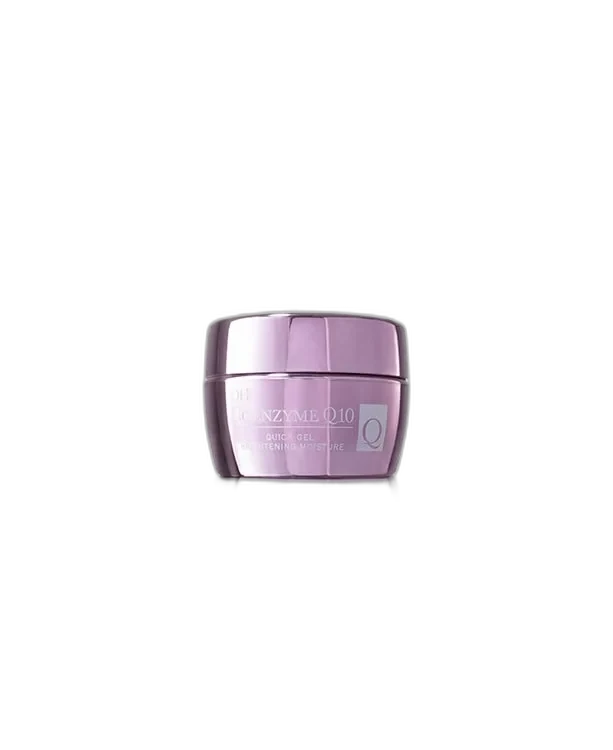
CoQ10 Quick Gel Brightening Moisture
J-Beauty Brightening Gel
 Verified reviewer
Pros & cons.
- +Four complementary brightening mechanisms in a single product
- +Ascorbyl glucoside is gentler and more stable than L-ascorbic acid
- +Fragrance-free in a category dominated by scented options
- +Tocopherol directly above CoQ10 for antioxidant regeneration
- +Olive oil and licorice derivative support anti-aging and soothing
- +Silky, lightweight finish that replaces multiple routine steps
- +Gentle enough for daily use on most skin types
- +Pregnancy-safe with no retinoids or salicylic acid
- −Expensive at $69 for 3.5 oz
- −Contains placental protein and soluble collagen — not vegan
- −Brightening effects are subtle compared to prescription options
- −Jar packaging exposes light-sensitive actives to air and UV
- −Not cruelty-free certified in all markets
- −Daisy flower extract has more limited evidence than other actives
The full review.
About DHC CoQ10 Quick Gel Brightening Moisture
Most brightening moisturizers use a standard formula: one vitamin C derivative, a few botanicals, heavy marketing, and a jar. Products in Sephora or Ulta often look identical aside from the label font. DHC CoQ10 Quick Gel Brightening Moisture differs. It combines four pigment-targeting actives with four different mechanisms into one gel-cream, uses the olive-oil-and-CoQ10 base from DHC’s core anti-aging line, and is fragrance-free. This shows more formulation ambition than most category competitors. Evaluate the $69 price tag against these facts. The brightening starts with ascorbyl glucoside, a stable vitamin C glycoside derivative at the fourth position on the INCI. Unlike L-ascorbic acid, it works at a higher, gentler pH and does not oxidize uselessly within weeks. It converts to active ascorbic acid in the skin, providing the same brightening mechanism as prestige vitamin C serums but at a slower, gentler pace. CoQ10 provides the lipid-phase antioxidant complement, with tocopherol placed directly above the ubiquinone on the INCI to regenerate oxidized CoQ10 and extend the antioxidant activity of both. Mulberry root extract — Morus alba — follows; this traditional Asian brightening botanical inhibits tyrosinase to slow the first step in melanin production. Finally, daisy flower extract, Bellis perennis, is a j-beauty brightening active whose polyphenols reduce melanin output in laboratory studies. One product uses four different routes to one outcome. Whether results match the effort is harder to prove. None of these actives, alone or together, match the efficacy of prescription hydroquinone or professional tyrosinase inhibitors. No gel-cream solves significant melasma or major pigmentation. This formula provides a gentle, daily, multi-mechanism brightening approach that shows modest, real improvement over 8-12 weeks with consistent use and daily SPF. It is a reasonable addition for general dullness, early sun damage, or subtle uneven tone. It will not provide dramatic fade. The base formulation also merits credit. Olive fruit oil, a DHC signature, sits high on the INCI and provides squalane-adjacent emollience and phenolic antioxidants. Glycerin, butylene glycol, and pentylene glycol form a multi-tier humectant system. Sodium hyaluronate reinforces the hydration layer. Stearyl glycyrrhetinate, a licorice-derived anti-inflammatory, sits in the soothing layer with phytosterols. The formula adds sodium riboflavin phosphate (vitamin B2) and cyanocobalamin (vitamin B12) at the end — small contributors that reflect the j-beauty habit of including well-studied water-soluble vitamins.
Texture
The ‘Quick Gel’ name is accurate. It is a silky pale-yellow gel-cream that spreads thinly, absorbs in about 45 seconds, and leaves a subtle dewy finish. It is fragrance-free, non-sticky, layers well under sunscreen, and replaces toner, essence, serum, and moisturizer for most users. The first use is clean: no tingling, no stickiness, and no scent. The application feels polished, which j-beauty at this price point should deliver.
Common Complaints
The limitations are standard for j-beauty. The formula contains placental protein and soluble collagen; both are animal-derived, so it is not for vegan users or those avoiding placental ingredients. The jar packaging exposes the light-sensitive vitamin C and CoQ10 to air and light; an airless pump would be better practice at this price. The price is the main hurdle. Sixty-nine dollars for 3.5 ounces competes with prestige peptide and retinol creams. While the formulation is cohesive, it does not outperform those options on brightening. You pay for the specific j-beauty philosophy — fragrance-free, multi-active, layered, and restrained — which is hard to find in Western brands. This is a good product for users who value that philosophy. For others, the math is harder to justify.
Ingredient analysis.
Full INCI list
Water/Aqua/Eau, Butylene Glycol, Glycerin, Ascorbyl Glucoside, Olea Europaea (Organic Olive) Fruit Oil, Pentylene Glycol, Squalane, Hydrogenated Lecithin, Potassium Hydroxide, Carbomer, Betaine, Acrylates/C10-30 Alkyl Acrylate Crosspolymer, Cetearyl Alcohol, Tocopherol, Ubiquinone, Glycosyl Trehalose, Hydrogenated Starch Hydrolysate, Glyceryl Stearate, PEG-100 Stearate, Polyglyceryl-10 Myristate, Stearyl Glycyrrhetinate, Cetearyl Glucoside, Phytosterols, Bellis Perennis (Daisy) Flower Extract, Sodium Hyaluronate, Placental Protein, Soluble Collagen, Olea Europaea (Olive) Leaf Extract, Morus Alba Root Extract, Sodium Riboflavin Phosphate, Cyanocobalamin, Phenoxyethanol
Skin match.
The science.
The Science
The brightening active with the most robust evidence in this formula is ascorbyl glucoside (AA2G), a stable glycoside derivative of vitamin C developed by Hayashibara in Japan. Published studies have shown that ascorbyl glucoside is enzymatically cleaved in skin to yield free ascorbic acid, which then enters the standard vitamin C pathway — neutralizing free radicals, inhibiting tyrosinase, and serving as a cofactor for collagen synthesis. Clinical trials on topical ascorbyl glucoside at concentrations of 1-2% have shown improvements in hyperpigmentation and overall skin brightness over 8-12 weeks, with notably better tolerability than L-ascorbic acid at comparable concentrations. Ubiquinone (coenzyme Q10) provides the complementary lipid-phase antioxidant activity, and its efficacy in topical formulations is supported by studies documenting improvements in fine line appearance and oxidative stress markers at concentrations around 0.3%. The tocopherol directly above ubiquinone on the INCI is not accidental — published research on antioxidant recycling has shown that vitamin E regenerates oxidized CoQ10 back to its active reduced form, extending the effective antioxidant life of both compounds in the skin. Mulberry root (Morus alba) extract is one of the most studied botanical tyrosinase inhibitors, with compounds including mulberroside F and oxyresveratrol demonstrating significant inhibition in in vitro assays and modest effects on melanin output in clinical studies. Daisy flower (Bellis perennis) extract is a more recent addition to the brightening category, with published evidence primarily from cell culture and small clinical studies rather than large controlled trials. The supporting cast — olive oil phenolics, stearyl glycyrrhetinate, phytosterols, sodium hyaluronate — builds out the antioxidant, soothing, and hydration layers. The formula's multi-mechanism approach is supported by the broader dermatological principle that brightening is best achieved through combination therapy targeting multiple steps in melanin production and oxidative stress, rather than relying on a single high-concentration active.
Dermatologist Perspective
Dermatologists consider ascorbyl glucoside a reasonable alternative to L-ascorbic acid for patients with sensitive skin who can't tolerate the sting of prestige vitamin C serums. Board-certified dermatologists note that multi-mechanism brightening approaches tend to deliver more consistent results than single-active approaches, particularly for users with mild dullness or early photoaging rather than significant pigmentation disorders. This gel is commonly suggested for patients in their thirties and forties who want a gentle daily brightening option they can use consistently without irritation. Dermatologists emphasize that no topical brightening product, including this one, replaces the importance of daily broad-spectrum SPF — sun exposure is the single largest driver of hyperpigmentation, and even the most sophisticated brightening actives can't keep up with unprotected UV exposure. Patients with significant melasma, post-inflammatory hyperpigmentation, or established dark spots are typically steered toward prescription hydroquinone, tranexamic acid, or professional treatments for faster and more meaningful results.
Where it fits in your routine.
Apply to damp or dry skin after cleansing. Use it alone or layer it over a hydrating toner if skin is very dry. Dispense a pearl-sized amount, warm it in your hands, and press it into the face and neck with light upward motions. Wait 45-60 seconds for absorption. In the morning, follow with broad-spectrum SPF 30 or higher; SPF is required to maintain brightening results. At night, apply it as the final step after treatment serums or retinoids. Keep the jar away from direct sunlight to protect the light-sensitive ascorbyl glucoside and CoQ10, and close the lid firmly after each use.
At $69 for 3.5 oz, this gel costs as much as SK-II or high-end Shiseido moisturizers. The value comes from the multi-active brightening stack—finding four complementary brightening mechanisms in one product is rare at any price—and the fragrance-free formulation. The 3.5 oz size lasts 2-3 months with twice-daily use, costing about 80 cents to a dollar per day. The math works for users wanting a j-beauty approach to replace multiple serum-plus-moisturizer steps with one product. Prescription or professional options outperform this for users seeking peak brightening efficacy regardless of cost. Budget-conscious users can find adequate ascorbyl glucoside products for much less, though these typically include fragrance and lack the CoQ10, olive oil, and mulberry extract layer.
Users with normal, combination, or mildly dry skin want this layered j-beauty brightening moisturizer with multiple complementary actives. It works best for people in their thirties and forties concerned with early photoaging and general dullness, who want fragrance-free formulations and fewer routine steps.
Vegan users and those avoiding placental protein need different products. People with significant pigmentation concerns or established melasma get better results from prescription or professional options. Budget-conscious shoppers, users with very oily or acne-prone skin sensitive to olive oil, and those who dislike jar packaging should choose other options.
Product details.
Pale-yellow gel-cream with a silky texture that spreads thinly and absorbs in about 45 seconds.
It is nearly fragrance-free, with a faint neutral undertone from the plant extracts.
Glass jar with twist-off lid. It looks like the rest of DHC's premium line, but the lack of an airless design affects the light-sensitive vitamin C and CoQ10.
The first application feels silky and cool, absorbs fast, and leaves a soft dewy glow. It does not sting or tingle — the ascorbyl glucoside is gentler than L-ascorbic acid and works for sensitive users. Subtle brightness shows within 1-2 weeks, while pigmentation improves more significantly over 8-12 weeks.
Approximately 2-3 months with twice-daily full-face application.
6 months
All Year
The backstory.
The CoQ10 Quick Gel line was developed as DHC's lightweight, multi-step-replacing alternative to the brand's richer Q10 Cream. The Brightening Moisture variant adds ascorbyl glucoside, mulberry, and daisy flower extract to the base formula, targeting users who want both anti-aging antioxidant protection and gradual improvement in dullness and pigmentation.
About DHC
Legacy Brand (20+ years)DHC became a leading Japanese beauty brand after its 1990s skincare pivot. The CoQ10 line is one of the company's longest-running anti-aging pillars. This gel focuses on brightening and combines CoQ10 with ascorbyl glucoside, mulberry root, and daisy flower extract. This j-beauty brightening stack lacks significant Western market competitors at this price point.
Common myths.
Brightening products work fast
Consistent use and daily SPF show meaningful improvement in dark spots and sun-related pigmentation in 8-12 weeks minimum. Brightening products promising faster results use hydroquinone or overpromise.
Vitamin C and CoQ10 don't work together
These ingredients complement each other. ascorbyl glucoside is a water-soluble vitamin C derivative, CoQ10 is a lipid-soluble antioxidant, and tocopherol regenerates oxidized CoQ10. Combining water-phase and lipid-phase antioxidants is a standard formulation strategy.
FAQ.
Is this the same as DHC's original CoQ10 Quick Gel?
No — this is the Brightening Moisture variant. It adds ascorbyl glucoside, mulberry root extract, and daisy flower extract to the base formula. These ingredients target dullness and pigmentation alongside the standard CoQ10 antioxidant story.
Can this replace my serum and moisturizer?
Most users can use this one-step gel to replace toner, essence, brightening serum, and moisturizer. Very dry or mature skin may still want a hydrating toner underneath. It does not replace sunscreen or dedicated treatment products like retinol.
How does ascorbyl glucoside compare to L-ascorbic acid?
Ascorbyl glucoside is more stable and gentler than L-ascorbic acid, though its peak clinical effect is lower. It converts to active vitamin C in skin over time. This causes brightening results to develop more slowly than with high-strength L-ascorbic acid serums.
Is this product vegan or cruelty-free?
No. The formula uses placental protein and soluble collagen, both animal-derived. DHC lacks cruelty-free certification in all markets.
Does it contain fragrance?
No — the formula is fragrance-free. This is unusual for brightening gel-creams and benefits sensitive skin.
Is it safe during pregnancy?
Yes. The formula has no retinoids, salicylic acid, or hormone-active botanicals.
How does it compare to the non-brightening DHC Astaxanthin Collagen All-in-One Gel?
The Astaxanthin version targets antioxidant protection and immediate plumping. This formula adds a multi-active brightening layer for dullness and pigmentation. Users focused on early photoaging prefer the Astaxanthin version; those with pigmentation concerns choose this one.
What the community says.
"simplifies routine to one step"
"noticeable glow"
"gentle enough for daily use"
"fragrance-free"
"silky non-greasy finish"
"expensive"
"contains animal-derived ingredients"
"results are subtle compared to prescription brightening"
"jar packaging not ideal for the actives"