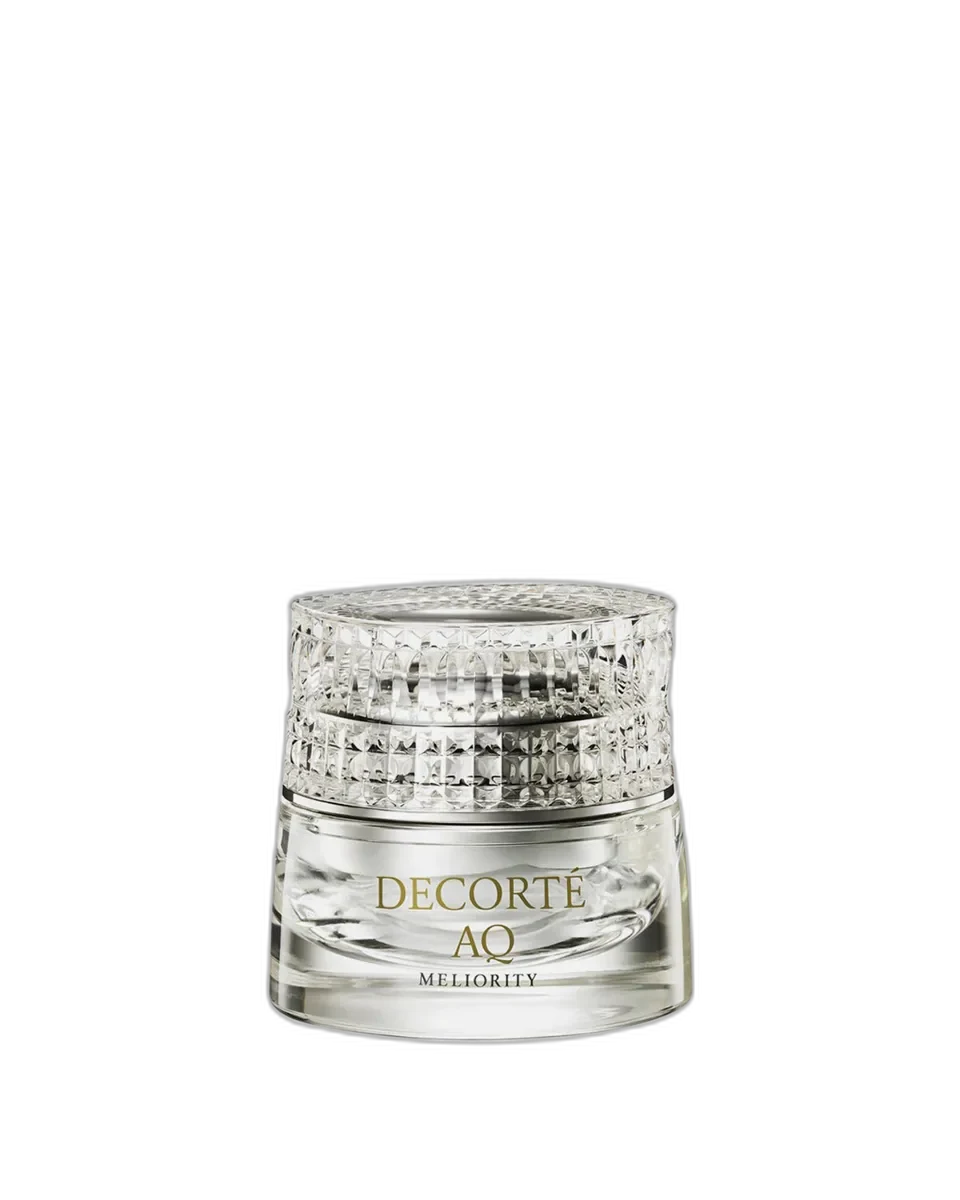
AQ Meliority Intensive Revitalizing Cream
J-Beauty Luxury Flagship
 Verified reviewer
Pros & cons.
- +Silky liposome-based texture that integrates actives into a rich lipid base
- +Contains legitimately useful Matrixyl, adenosine, and ascorbyl tetraisopalmitate
- +Distinctive Japanese botanical extract profile unavailable in Western brands
- +Weighty glass packaging and sensory ritual feel like a luxury object
- +Five decades of Decorté liposome delivery technology lineage
- +Immediate plumped, glowy finish visible after first application
- −Price is extremely difficult to justify on per-dose efficacy basis
- −Contains alcohol and synthetic fragrance, unsuitable for sensitive skin
- −Most botanical extracts sit at cosmetic concentrations without efficacy data
- −Not cruelty-free and contains animal-derived hydrolyzed collagen
- −A 45ml jar burns through fast if you over-apply
The full review.
About Decorté
Decorté launched in 1970.
Texture
The cream has a sandalwood-and-clove scent that feels like Japanese prestige. It is controlled and intentional, like a tea ceremony. The thick cream melts on contact into a velvety layer, absorbs in about forty-five seconds, and leaves a subtle sheen. This texture is remarkable; cheaper creams cannot replicate this feel. Decorté spent decades refining liposome delivery technology to integrate actives into a lipid base.
Scent
The cream has a sandalwood-and-clove scent that feels like Japanese prestige. It is controlled and intentional, like a tea ceremony.
Common Praise
The texture is remarkable. Cheaper creams cannot easily replicate this specific feel.
Common Complaints
Alcohol sits moderately high on the ingredient list, alongside synthetic fragrance, peppermint leaf extract, and clove flower extract. These ingredients make the formula a poor choice for sensitive skin, rosacea, or fragrance allergies. The product is not cruelty-free and contains hydrolyzed collagen, so it is not for vegan routines. A 45ml jar lasts three to four months using pea-sized amounts, making the monthly cost higher than many grocery budgets.
Best for
This is a well-made product with craft and clinically meaningful actives. It suits those seeking a Japanese luxury cream who value the sensory experience and have the disposable income.
Not ideal for
Alcohol, synthetic fragrance, peppermint leaf extract, and clove flower extract make this a poor choice for sensitive skin, rosacea, or fragrance allergies. The product is not cruelty-free and contains hydrolyzed collagen, so it is not for vegan routines.
If you prioritize pure efficacy—maximum fine line reduction or barrier repair per dollar—this cream does not win. A well-formulated $80 ceramide moisturizer with Matrixyl and niacinamide provides most measurable benefits.
If you are in the mid-market, do not stretch your budget for this. Other options use the price difference better.
Ingredient analysis.
Full INCI list
Water, Butylene Glycol, Glycerin, Squalane, Hydrogenated Lecithin, Betula Platyphylla Japonica Juice, Oleyl Oleate, Cetearyl Alcohol, Trimethylolpropane Triisostearate, Alcohol, Phytosteryl Oleate, Limnanthes Alba (Meadowfoam) Seed Oil, Behenyl Alcohol, Theanine, Acanthopanax Senticosus (Eleuthero) Root Extract, Acorus Calamus Root Extract, Adenosine, Alnus Firmifolia Fruit Extract, Ascorbyl Tetraisopalmitate, Betula Platyphylla Japonica Bark Extract, Camellia Sinensis Leaf Extract, Chrysanthellum Indicum Extract, Eugenia Caryophyllus (Clove) Flower Extract, Hydrolyzed Collagen, Hydrolyzed Soybean Extract, Isodonis Japonicus Leaf/Stalk Extract, Jania Rubens Extract, Lactobacillus/Soymilk Ferment Filtrate, Lonicera Caerulea Fruit Juice, Lonicera Japonica (Honeysuckle) Flower Extract, Maltose, Mentha Piperita (Peppermint) Leaf Extract, Mucuna Birdwoodiana Stem Extract, Oenothera Biennis (Evening Primrose) Seed Extract, Palmitoyl Pentapeptide-4, Poria Cocos Sclerotium Extract, Santalum Album (Sandalwood) Wood Extract, Sesamum Indicum (Sesame) Sprout Extract, Sodium Hyaluronate, Theobroma Cacao (Cocoa) Seed Extract, Tocopherol, Tocotrienols, Zizyphus Jujuba Fruit Extract, Algin, Carbomer, Cholesterol, Cholesteryl/Behenyl/Octyldodecyl Lauroyl Glutamate, Dimethicone, Diphenylsiloxy Phenyl Trimethicone, Disodium Succinate, Ethyl Oleate, Hydrogenated Coconut Oil, Hydrogenated Palm Oil, Hydrogenated Polyisobutene, Isohexadecane, Lecithin, Oleyl Alcohol, Oryza Sativa (Rice) Bran Oil, Phytosteryl Macadamiate, Phytosteryl/Octyldodecyl Lauroyl Glutamate, Polysorbate 20, Polysorbate 80, Sodium Acrylate/Sodium Acryloyldimethyl Taurate Copolymer, Sodium Hydroxide, Sodium Lactate, Sodium Methyl Stearoyl Taurate, Sorbitan Oleate, Succinic Acid, Phenoxyethanol, Fragrance, Caramel
Skin match.
The science.
The Science
This cream's clinical profile relies on three evidence-backed ingredients: palmitoyl pentapeptide-4 (Matrixyl), adenosine, and ascorbyl tetraisopalmitate. Published data shows palmitoyl pentapeptide-4 acts as a matrix-metalloproteinase-regulating signal peptide. A 2005 study in the International Journal of Cosmetic Science—one of the first to introduce palmitoyl pentapeptide-4—showed improved wrinkle depth and skin roughness after 12 weeks of topical application at 3 ppm. Subsequent formulation studies expanded this evidence, and Matrixyl remains a credible peptide in cosmetic chemistry.
Adenosine is notable in Japanese formulations as an approved quasi-drug wrinkle ingredient. This means the Japanese Ministry of Health reviewed the evidence and permitted specific anti-wrinkle claims at standardized concentrations. Most Western markets lack this regulatory pathway, making adenosine one of the few ingredients in Japanese skincare with government-level efficacy validation.
Ascorbyl tetraisopalmitate works differently than L-ascorbic acid in this formulation. Cosmetic chemistry journal research shows it penetrates lipid-rich bases effectively, converts to active ascorbic acid intracellularly, and avoids the stability issues of pure vitamin C. It is a sensible choice for a cream built around squalane and phytosterols.
The botanical extract complex is more complex. While centella, licorice, and camellia sinensis have strong evidence bases, the specific Japanese plants used here—Japanese white birch sap, acorus calamus, and mucuna birdwoodiana—lack independent cosmetic research. They may be active, but the supporting evidence is mostly in-house and lacks independent lab reproduction. While the liposome delivery system is real and the peptide-plus-adenosine profile is substantive, the rest of the claims require brand trust.
Dermatologist Perspective
Dermatologists view luxury moisturizers like this through a standard lens: the vehicle and texture can be excellent, but the actives providing measurable clinical work usually exist in cheaper products. Board-certified dermatologists note that Matrixyl and adenosine have credible evidence, making this cream more defensible than luxury products relying only on proprietary botanical blends. The alcohol content and fragrance blend disqualify this product for sensitive or reactive skin. For dry, mature skin without sensitivity, it is a reasonable choice if the patient values the sensory ritual and knows they pay for experience rather than incremental clinical benefit over a well-formulated mid-priced moisturizer.
Where it fits in your routine.
Apply a pea-sized amount to clean skin after your serum, morning and evening. Warm it between fingertips and press it into the face and neck using upward, outward motions. The sensory ritual adds value, so do not rush. Always follow with a broad-spectrum sunscreen in the morning; this cream contains no SPF. At night, use it as the final step or layer it under a light occlusive if your skin is very dry. Avoid the immediate eye area; AQ Meliority has dedicated eye products. If you use more than a pea-sized amount, you are applying too vigorously or need a heavier base product under this one.
At roughly $620 for 45ml, this is among the most expensive moisturizers at department stores. A jar lasts three to four months for disciplined users, making the monthly cost $155 to $200. Based on ingredients, a peptide moisturizer from mid-priced brands like Paula's Choice or Medik8 provides the same Matrixyl-and-vitamin-C benefit for a tenth of the monthly cost. The extra money buys the signature Decorté texture, the liposome delivery lineage, the specific Japanese botanical narrative, and the packaging ritual. Whether the premium is worth it depends on the individual — for some, the sensory and emotional experience of using this cream every day is a legitimate reason to pay. But it does not deliver results a $60 product cannot reach.
Target luxury skincare buyers with dry or normal mature skin who value Japanese craft, sensory ritual, and the specific texture from decades of Decorté liposome technology. This works for those who own AQ or other J-beauty prestige products and want to explore the top of the Decorté range.
Skip this if you have sensitive skin, rosacea, fragrance allergies, oily or acne-prone skin, or if you prioritize clinical efficacy per dollar. Also skip if the cost requires budget cuts—better $80-120 peptide moisturizers deliver most of the measurable benefit.
Product details.
Rich, silky cream that melts on contact without feeling heavy
Signature Decorté aromatic floral-woody fragrance (sandalwood, clove)
Weighted glass jar with metallic lid — unmistakably luxury counter-style
This cream provides an immediate plump, cushioned feel and a subtle glow on first use. The fragrance is present and smells like Japanese prestige sandalwood and florals. It does not cause tingling or purging. You will notice both fragrance and alcohol if you are sensitive to them.
3-4 months with twice-daily face application using a pea-sized amount
12 months
fall winter
The backstory.
Decorté launched in 1970 as Kosé's luxury counterpart, pioneering liposome delivery in cosmetics in the 1980s. The AQ Meliority line is the current top of the range, positioned above AQ and reserved for the brand's most complex botanical-and-peptide combinations. The Revitalizing Cream exists to sit at the top of department store skincare shelves next to La Mer and Sisleya, competing on ritual and provenance more than on peer-reviewed actives.
About Decorté
Legacy Brand (20+ years)Decorté is Kosé's luxury J-beauty line. Launched in 1970, it uses liposome delivery technology developed over five decades. The brand occupies a unique spot in Japanese prestige skincare, using rare botanical extracts from Japan's Hokkaido region. However, its price points require strong justification.
Common myths.
Rare Japanese botanical extracts work where Western ingredients fail
Most exotic plant extracts in this formula exist at narrative concentrations. The ingredients in this cream with real efficacy — Matrixyl, adenosine, squalane, ascorbyl tetraisopalmitate — appear in much cheaper products.
A $600 cream must be six times better than a $100 cream
Luxury skincare prices reflect packaging, brand positioning, and the application ritual. Clinical benefits over a well-formulated $80 cream are marginal.
FAQ.
Is the Decorté AQ Meliority cream worth the price?
The ingredient list is fine but lacks value for the price. The efficacious actives (adenosine, Matrixyl, ascorbyl tetraisopalmitate) exist at the same dose in creams that cost much less. You pay for the Decorté liposome technology lineage, the sensory ritual, and the brand provenance. The price makes sense if those factors matter. It does not if you care only about clinical outcomes.
How does it compare to La Mer Crème de la Mer?
Both sit in the same luxury tier. La Mer uses its Miracle Broth narrative and a thick occlusive texture; AQ Meliority uses Japanese botanicals, a peptide story, and a lighter, silkier finish. Decorté's formulation has more modern peptide inclusion, while La Mer has stronger brand recognition in the US market.
Does it contain alcohol and fragrance?
Yes — the ingredient list has moderately high alcohol and synthetic fragrance. If you have sensitive skin, rosacea, or fragrance allergies, this is not the right cream for you regardless of the price.
Is it a day cream or a night cream?
The brand markets it for twice-daily use. The texture works for both, but many users prefer using it at night for the sensory ritual. Use sunscreen in the morning, as nothing in this formula provides SPF.
What's the peptide actually doing in this formula?
Palmitoyl Pentapeptide-4 (Matrixyl) is a signaling peptide. Published evidence shows it stimulates collagen production and reduces fine line depth after 12+ weeks of consistent use. It is one of the better-studied peptides in skincare and is the most clinically grounded ingredient in this cream.
Is this cruelty-free or vegan?
No on both counts — Decorté sells in markets that require animal testing and the formula contains hydrolyzed collagen, which is typically animal-derived.
How long does a jar last?
A 45ml jar lasts three to four months using a pea-sized amount twice daily. Using more burns through it fast, making this an expensive habit at this price.
What the community says.
"exquisite texture"
"luxurious application experience"
"noticeable immediate glow"
"elegant packaging"
"extremely expensive"
"contains alcohol and fragrance"
"hard to justify vs similar-performing mid-range creams"