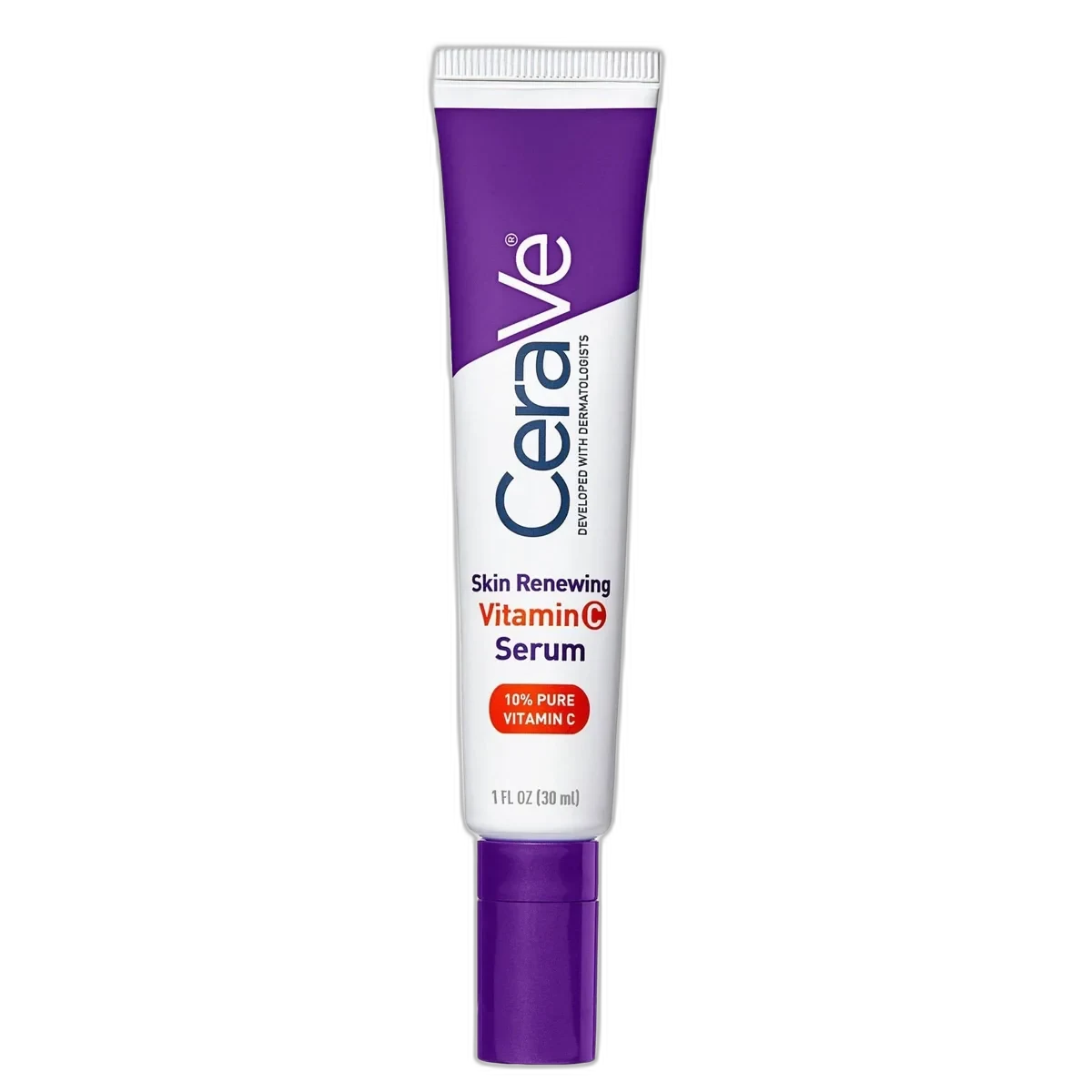
Vitamin C Serum with Hyaluronic Acid
America's Bestselling Vitamin C
 Verified reviewer
Pros & cons.
- +Pure L-ascorbic acid at 10% — the gold-standard form with the deepest clinical evidence base
- +CeraVe's three-ceramide complex protects the moisture barrier during vitamin C treatment
- +Airless pump packaging significantly outperforms dropper bottles for vitamin C stability
- +America's #1 vitamin C serum by unit volume — validated by market success
- +Excellent value at ~$20 for a pure L-ascorbic acid serum with ceramide support
- +Vitamin E derivative (tocopheryl acetate) extends the antioxidant network
- +Fragrance-free formulation suitable for most skin types
- −Contains denatured alcohol, which may dry or irritate sensitive and compromised skin
- −Thick, silicone-heavy texture can pill under certain moisturizers and sunscreens
- −Isopropyl myristate carries moderate comedogenic potential for breakout-prone skin
- −10% concentration may be insufficient for severe or stubborn hyperpigmentation
- −The silicone-based vehicle gives a less elegant feel compared to water-based prestige serums
The full review.
About CeraVe
The vitamin C serum market has a pricing problem. At the top, you have SkinCeuticals C E Ferulic at a hundred and eighty dollars, setting a gold standard that most dermatologists reference but few patients can sustain. At the bottom, you have dozens of serums using vitamin C derivatives — forms that are cheaper to formulate and more stable to bottle but have a fraction of the clinical evidence supporting their efficacy. In between, there was a gap: where was the pure L-ascorbic acid serum that a normal person could afford to use every day without wincing at the price?
CeraVe filled that gap so effectively that this became the number-one selling vitamin C serum in the United States by unit volume. And the formula itself explains why.
Reality
The active is L-ascorbic acid at 10% — the same form of vitamin C that has the deepest bench of clinical research behind it. L-ascorbic acid is the form your skin actually uses. It does not need to be converted enzymatically the way vitamin C derivatives do, which means it gets to work immediately upon contact with skin cells. At 10%, you are in the effective range established by multiple clinical studies: high enough for meaningful antioxidant protection, collagen stimulation, and brightening effects, but low enough that the irritation and instability issues that plague 15-20% formulations are largely avoided.
The ceramide complex is what makes this a CeraVe product rather than just another vitamin C serum. Pure L-ascorbic acid is harsh. It is acidic, it is oxidatively active, and at functional concentrations it can compromise the moisture barrier in sensitive or dry skin. CeraVe’s three ceramides (NP, AP, and EOP), plus cholesterol and phytosphingosine, create a lipid support system around the vitamin C that actively protects the barrier during treatment. This is not a trivial addition — it is the difference between a vitamin C serum that some skin types cannot tolerate and one that most can.
Packaging
The packaging deserves specific mention because it addresses the single biggest problem with L-ascorbic acid formulations: oxidation. Pure vitamin C is notoriously unstable — it degrades when exposed to air, light, and heat, turning from an effective antioxidant into a brown, inactive liquid. Most vitamin C serums use dropper bottles, which expose the entire formula to air with every use. CeraVe chose an opaque, airless pump that dispenses product without introducing air into the reservoir. It is a packaging decision that directly affects how long the product remains potent, and it represents a real advantage over more expensive competitors that charge three to ten times more while using inferior packaging.
Texture
On the skin, the texture is divisive. This is not the thin, water-like serum that vitamin C devotees may be accustomed to. The dimethicone base gives it a thicker, cream-serum hybrid consistency with a distinctly silicone-y slip. Some users find this luxurious and easy to spread; others find it heavy and prone to pilling under their moisturizer or sunscreen. The pilling issue is manageable — applying to slightly damp skin and using patting rather than rubbing motions helps significantly — but it is a real complaint that CeraVe could address in a reformulation.
Common Complaints
The inclusion of denatured alcohol is the formula’s most debated ingredient. It serves a functional purpose — helping the ascorbic acid dissolve into the silicone-based vehicle — but it carries the potential for drying and irritation, particularly in sensitive or compromised skin. For most users, the ceramide buffer and the relatively modest alcohol concentration prevent any noticeable effect. For those with very dry or reactive skin, it is a legitimate reason for caution.
Works for
Results follow the typical vitamin C timeline. Within the first week of daily morning use, skin often looks subtly brighter — not dramatically different, but as if someone turned up a very faint dimmer switch. By week three or four, the brightening is more obvious and skin tone begins to look more even. The real payoff for hyperpigmentation and dark spots comes at the eight-to-twelve-week mark, when cumulative oxidative protection and melanin inhibition produce visible lightening of post-inflammatory marks and sun spots. These results are well-documented in clinical literature for L-ascorbic acid at this concentration.
Best for
The antioxidant protection is the benefit users feel least but matters most. Every morning you apply this serum, you are adding a layer of free radical defense that amplifies your sunscreen’s protection. UV radiation and urban pollution generate reactive oxygen species that damage DNA, degrade collagen, and accelerate photoaging. Vitamin C neutralizes these before they can do their work. You will never see this benefit in a mirror — but your future skin will reflect the difference.
Not ideal for
Isopropyl myristate in the formula carries a moderate comedogenic rating. Most users will not experience breakouts from it, but genuinely acne-prone skin types should be aware and patch test accordingly. It is a formulation compromise — the ingredient helps the ascorbic acid penetrate effectively through the silicone base — but it narrows the audience slightly.
Best Season
At approximately twenty dollars for a month to three months of daily use (depending on how many drops you apply), the value is exceptional. You are getting pure L-ascorbic acid — the same active that costs $180 in the most prestigious vitamin C serum on the market — wrapped in ceramide barrier support and protected by superior packaging, for roughly the cost of a decent lunch. CeraVe’s scale (backed by L’Oreal) makes this pricing possible, and the bestselling status confirms that consumers recognized the value proposition.
Formula
This is not the most refined vitamin C serum you will ever use. The texture is thick, the silicone base is not for everyone, and the denatured alcohol is a concession to formulation chemistry. But measured by what actually matters — the active ingredient, its concentration, its stability, and the supporting ingredients — CeraVe delivered something the market needed: a serious vitamin C serum at an unserious price.
Ingredient analysis.
Full INCI list
Water, Ascorbic Acid, Glycerin, Dimethicone, Cetearyl Ethylhexanoate, Alcohol Denat., Sodium Hydroxide, Ammonium Polyacryloyldimethyl Taurate, Panthenol, Ceramide NP, Ceramide AP, Ceramide EOP, Carbomer, Cetearyl Alcohol, Behentrimonium Methosulfate, Sodium Hyaluronate, Sodium Lauroyl Lactylate, Cholesterol, Phenoxyethanol, Tocopheryl Acetate, Disodium EDTA, Isopropyl Myristate, Caprylyl Glycol, Xanthan Gum, Phytosphingosine, Ethylhexylglycerin
Skin match.
The science.
The Science
L-ascorbic acid is the most studied topical antioxidant in dermatology. A Pinnell et al. (2001) study in Dermatologic Surgery established that topical vitamin C at 10-20% concentrations provides photoprotection by neutralizing UV-generated reactive oxygen species. The study shows L-ascorbic acid at 15% concentration increases tissue concentration 20-fold over baseline, protecting against UV-induced erythema and thymine dimer formation.
The 10% concentration in this formula is within the effective range. Research in the Journal of Clinical and Aesthetic Dermatology shows L-ascorbic acid concentrations as low as 5% provide measurable antioxidant benefits, with efficacy increasing up to approximately 20%, where irritation rises without proportional efficacy gains. At 10%, this formula balances efficacy and tolerability—crucial for broad consumer use rather than clinical application.
Combining vitamin C (ascorbic acid) and vitamin E (tocopheryl acetate) in this formula uses a documented synergy. A Journal of the American Academy of Dermatology study (Lin et al., 2005) shows that combining vitamins C and E provides superior photoprotection compared to either antioxidant alone, because vitamin C regenerates oxidized vitamin E, extending the antioxidant cycling capacity of both ingredients.
The ceramide system addresses a common L-ascorbic acid issue: barrier compromise. Ascorbic acid at functional concentrations (pH 2.5-3.5 for stability and penetration) can disrupt the stratum corneum lipid matrix. CeraVe's three-ceramide complex (NP, AP, EOP) with cholesterol and phytosphingosine replenishes the lipid species that acid exposure depletes, mitigating the barrier damage that causes many users to stop using vitamin C serums.
Dermatologist Perspective
Dermatologists recommend vitamin C serums as a morning staple for antioxidant protection and photoaging prevention. Board-certified dermatologists note that CeraVe uses pure L-ascorbic acid—not less-studied derivatives—which aligns with clinical evidence. The 10% concentration is a good starting point for patients new to vitamin C serums, with the option to increase if tolerated. Dermatologists value the ceramide complex because it helps patients who abandon effective vitamin C serums due to irritation and dryness; the barrier support addresses this compliance issue. Dermatologists emphasize using vitamin C consistently every morning before sunscreen.
Where it fits in your routine.
Apply 4-6 drops to clean, dry skin every morning. Press and pat the serum into your face and neck. Do not rub, as the silicone base causes pilling. Wait 1-2 minutes for full absorption before you apply moisturizer and sunscreen. Always use broad-spectrum SPF 30+, because vitamin C complements but does not replace sun protection. Store in a cool, dark place. Replace the serum if it turns dark orange or brown, which shows significant oxidation.
At about $20 for 1 fl oz, this is one of the most affordable pure L-ascorbic acid serums available. For comparison, SkinCeuticals C E Ferulic (the clinical benchmark) costs $182 for 1 oz, Drunk Elephant C-Firma Day Serum is $78, and Paula's Choice C15 Super Booster is $52. The CeraVe formula uses the same gold-standard active ingredient at an effective concentration, adds ceramide barrier support that competitors lack, and uses superior airless packaging. The value is clear — you get 80% of the prestige vitamin C serum experience for 10-15% of the prestige price.
This serum works for anyone needing an affordable daily antioxidant to brighten skin, fade dark spots, and provide environmental protection. It suits people in their mid-20s and older starting a vitamin C routine without a premium price. It also fits those who value CeraVe's ceramide barrier support.
People with very sensitive or compromised skin who react to denatured alcohol. Acne-prone individuals who reacted to isopropyl myristate before. Anyone wanting a lightweight, water-based vitamin C serum texture — this silicone-heavy formula lacks that feel. People with severe hyperpigmentation who need a higher concentration (15-20%) for results.
Product details.
No added fragrance. Faint metallic note common to L-ascorbic acid formulations — barely detectable and dissipates immediately.
Opaque airless pump packaging protects the light-sensitive and oxidation-prone ascorbic acid. This airless pump reduces air exposure per use, extending the serum's active life longer than dropper bottles. CeraVe chose this packaging for a reason. Finish satinnon-greasylightweight
Most users feel no tingling or stinging at 10% concentration. It absorbs in 1-2 minutes, leaving a smooth, slightly silicone-y finish. Some users feel slight warmth upon first application. If the serum turns dark orange or brown, it has oxidized and needs replacement.
2-3 months with daily morning use (4-6 drops)
6 months
All Year
The backstory.
CeraVe entered the vitamin C serum market recognizing that most affordable options used vitamin C derivatives with weaker evidence, while pure L-ascorbic acid serums were concentrated in the $40-$150 price range. By applying their ceramide technology and investing in proper packaging, they brought a genuinely effective vitamin C serum to the drugstore at a price that disrupted the category — ultimately becoming the #1 vitamin C serum in the U.S. by volume.
About CeraVe
Legacy Brand (20+ years)Dermatologists helped develop CeraVe in 2005, and clinicians have recommended it for over two decades. The brand's formulations use its patented MVE delivery technology and three essential ceramides. This vitamin C serum is the #1 selling vitamin C serum in the United States by unit volume.
Common myths.
Vitamin C serums need 15-20% L-ascorbic acid to work.
Research shows L-ascorbic acid at 5% concentrations provides antioxidant protection. The 10% in this formula is in the effective range and causes less irritation than 15-20% formulations. Higher concentrations are not always better; they often just cause more irritation.
You cannot use vitamin C and niacinamide together.
This myth comes from a decades-old study using temperatures irrelevant to skincare. Modern vitamin C and niacinamide formulations coexist well. CeraVe's own moisturizers contain niacinamide and work well over this serum.
FAQ.
How does CeraVe Vitamin C Serum compare to more expensive vitamin C serums?
CeraVe uses pure L-ascorbic acid, the same gold-standard ingredient prestige brands sell for $50-$150. The 10% concentration works without causing irritation. The ceramide complex adds barrier support most competitors lack. The airless pump packaging protects the vitamin C better than the dropper bottles used by SkinCeuticals and Drunk Elephant. The main trade-off is the thick, silicone-heavy texture, which lacks the elegance of premium formulations.
Should I apply CeraVe Vitamin C Serum in the morning or at night?
Use it in the morning. Vitamin C works best as an antioxidant during the day when UV radiation and environmental pollutants hit your skin. Apply it after cleansing but before moisturizer and sunscreen. Use retinol at night. This AM vitamin C / PM retinol split provides the benefits of both without interference.
Why does my CeraVe Vitamin C Serum pill under moisturizer?
The dimethicone (silicone) base interacts with some moisturizers and sunscreens, which causes pilling. To avoid this: apply the serum to bare, slightly damp skin, use 4-6 drops, wait 1-2 minutes for full absorption before applying moisturizer, and pat your next product over it instead of rubbing. Water-based moisturizers layer more smoothly over this serum than silicone-heavy ones.
How do I know if my CeraVe Vitamin C Serum has oxidized?
Fresh L-ascorbic acid serum ranges from colorless to pale yellow. If the serum turns dark orange or brown, it has oxidized and lost potency — replace it. The airless pump packaging slows this process, but heat and light accelerate oxidation. Store in a cool, dark place and use within 3-4 months of opening.
Is 10% vitamin C strong enough for dark spots?
10% L-ascorbic acid improves mild to moderate hyperpigmentation after 8-12 weeks of daily use. The ceramides and hyaluronic acid in this formula maintain skin health while the skin brightens. 10% may not work for severe or stubborn dark spots; these cases need a higher concentration (15-20%) or a combination of niacinamide and AHA products.
Community
What the community says.
"Noticeably brighter, more even skin tone within weeks"
"Ceramides prevent the drying irritation typical of vitamin C serums"
"Excellent value compared to prestige vitamin C serums"
"Works well under moisturizer and sunscreen"
"Protective packaging helps maintain vitamin C stability"
"Contains denatured alcohol which can be drying for some"
"Thick, silicone-heavy texture may not suit everyone"
"Can pill under certain moisturizers or sunscreens"
"Vitamin C at 10% may not be potent enough for stubborn hyperpigmentation"
"Isopropyl myristate may cause breakouts in acne-prone skin"